
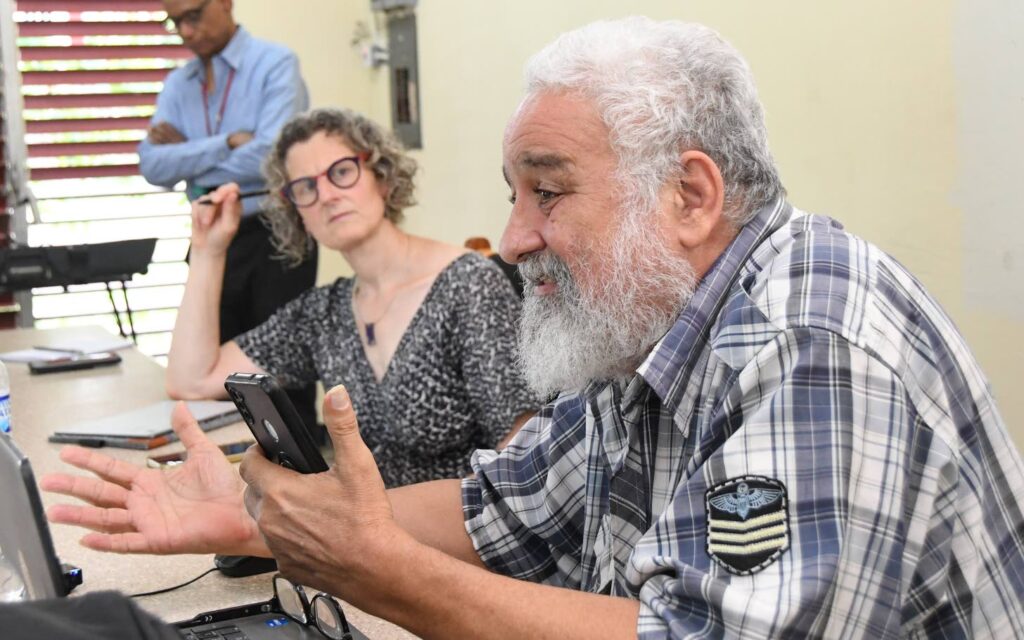
TWO scholars examining Jamaica’s Obeah Law from different perspectives have agreed that the legislation is fundamentally flawed and lacks a clear definition of the practice it seeks to criminalise.
Speaking at a public forum on The Jamaican Obeah Law in Practice last Friday, Professor Diana Paton argued that the legislation has never truly been about combating spiritual evil but has historically been used as a tool of colonial control and cultural suppression.
Meanwhile, Catholic priest and sociologist Reverend Peter Espeut maintained that while the law is defective and outdated, some form of legislation is still needed to address practices intended to cause harm, and the law should be amended.
The forum came against the background of a constitutional challenge of the 19th-century Obeah Act, which criminalises some spiritual practices. The challenge was filed in the Supreme Court and argues that multiple sections of the law violate fundamental constitutional rights, including freedom of religion, privacy, conscience, expression, and the right to seek and distribute information.
Paton, a William Robertson Professor at the University of Edinburgh, opened the discussion by stating that while many Jamaicans support the law because they view Obeah as immoral or demonic, historical evidence suggests the legislation has little to do with preventing spiritual wrongdoing.
Tracing the origins of anti-Obeah legislation, she noted that Obeah was not illegal in Jamaica until after Tacky’s Revolt in 1760.
Paton argued that the first law against Obeah formed part of a broader effort to suppress rebellion among enslaved Africans and was used primarily to prevent collective resistance, punish suspected attacks on enslavers, and curb conflicts among enslaved people.
PATON…If, for the sake of argument, we accept that ‘Obeah’ is the use of spiritual power to hurt others, or for evil purposes, the Obeah Law is not about Obeah (Photo: Naphtali Junior)
“Before 1760, Obeah was not illegal anywhere in the Caribbean. There were some efforts to use legislation to control aspects of enslaved Africans’ religious lives. For instance, there were prohibitions on drumming. But mainly, enslavers were not very interested in Africans’ culture, as long as they could force them to work and replace them when they died. That was the brutality of the system,” said Paton.
She continued: “The first law against Obeah was passed in 1760. It was part of a wider counter-insurgency law, An Act to Remedy the Evils arising from Irregular Assemblies of Slaves. It was passed after the huge rebellion we know as Tacky’s Revolt, which started in St Mary and spread across most of Jamaica. Tacky was advised by an Obeah man, who was said to have administered protective oaths to the rebel forces.
“These oaths gave the rebels courage and solidarity, and so the Assembly made Obeah illegal. It was punishable with either death or transportation. The 1760s provisions were then incorporated into subsequent laws that regulated slavery over the next 80 years,” she added.
Paton noted that the earlier law only applied to enslaved people, and free people could not be prosecuted for Obeah. She shared that following Emancipation, lawmakers quickly moved to keep Obeah criminalised through vagrancy legislation before eventually enacting the standalone Obeah Act in 1856 and the current Obeah Law in 1898.
“If, for the sake of argument, we accept that ‘Obeah’ is the use of spiritual power to hurt others, or for evil purposes, the Obeah Law is not about Obeah, and never has been. Not in the way it’s written. Not in the history of the intentions of those who passed it, and not in the way it was enforced,” she declared.
Paton further argued that the law is vague and equates Obeah and myalism, stating that the two words shall be “of one and the same meaning”.
“It does not define Obeah. Rather, it defines a person practising Obeah, and makes practising Obeah and consulting any person practising Obeah an offence. The law states that there are two ways to prove that a person was practising Obeah. The first is that the person ‘presents to possess any supernatural power or knowledge’ and that they do so ‘for any fraudulent or unlawful purpose, or for gain, or for the purposes of frightening any person’,” she recited.
ESPEUT…What we’ve got to do is say those aspects of religion that are positive, we keep, and those that are negative, we do away with (Photo: Naphtali Junior)
“The second way of proving that a person was practising Obeah is that they are in possession of what is called an ‘instrument of Obeah’, which is defined as ‘anything used, or intended to be used by a person, and pretended by such person to be possessed of any occult or supernatural power’. This is all very abstract legalese, hard to follow, especially when read aloud,” said Paton.
According to Paton, the evidence suggests the law was most often used against spiritual healers, religious practitioners, and working-class Jamaicans rather than individuals accused of using supernatural powers to injure others.
“In court, the evidence of instruments of Obeah encompassed a huge range of things, many of them very ordinary objects: playing cards, mirrors, scissors, candles, oils…so this definition means that Obeah cases revolved around a triad of things: money, ritual, and objects. This definition also meant that there was a huge amount of discretion in what kind of actions could lead to arrest. Inevitably, the application of the law was very arbitrary. It gave individual police officers a great deal of latitude in deciding whether to prosecute someone for Obeah,” said Paton.
In response, Espeut agreed that the legislation is deeply problematic, describing it as “stupid” because it fails to define Obeah while simultaneously criminalising it.
According to Espeut, the absence of a definition has resulted in a wide range of religious and cultural practices being labelled as Obeah, creating confusion about what the law actually prohibits. However, he argued that the act should remain, with amendments made to address the gaps and not repealed.
“The practises of different denominations are different. Many people call the Catholic Church an Obeah church. Why? Because we use holy water and we use incense and so on, but we know we’re not an Obeah church. Maybe the argument is that what we are calling Obeah, they don’t call it Obeah.
“As far as they are concerned, it’s just an ordinary something. I am saying we don’t have a definition for Obeah, and that is the problem, so we are calling things Obeah that may not be, strictly speaking, evil, and I said that in my introduction, that not having a definition is a big problem, and that is the problem with the Act,” said Reverend Espeut.
Mystical objects laid out which some people claim are used Items by those involved in Obeah
“You know that every Jamaican Act, if you ever read an Act, the first part of it has definitions, this word and that’s what it means, this word and that. Can you have an Obeah Act and don’t define what Obeah is? It’s really silly. That’s why I say the Act is stupid. However, we need an Act like that, so what is important is to fix it, not demolish it, and that’s my view,” he stated.
Espeut argued that the absence of a definition has resulted in a wide range of religious and cultural practices being labelled as Obeah, creating confusion about what the law actually prohibits. He noted that many objects cited as instruments of Obeah, such as oils and water, are also used in mainstream religious traditions, including Christianity.
While the objects are similar, he said the intent is different, and spiritual practices that intend to harm others should remain criminal offences.
The sociologist further argued that the law wrongly treats Obeah and myal as the same thing, despite long-standing distinctions within Jamaican tradition. He said myal historically functioned as a counterforce to harmful spiritual practices and should not be criminalised alongside Obeah.
“What we’ve got to do is say those aspects of religion that are positive, we keep, and those that are negative, we do away with. I believe that Obeah is a negative thing and that it should remain a criminal offence,” he declared.
Espeut also pointed to surveys suggesting that many Jamaicans also view Obeah as harmful or evil and said lawmakers should not ignore those concerns. However, he acknowledged that legislation alone cannot eliminate such practices.
“One of her [Paton’s] points is that having it as a criminal offence is not going to stop it, that’s true. However, having a law against murder is not going to stop it either. Having a law against having sex with children is not going to stop it, but nobody says we should go away with those laws, so I think we need laws, all we have to make it better,” said Espeut.
Syndicated from Jamaica Observer · originally published .
Legal context · powered by Jurifi
Get the legal angle on this story. Pick a prompt and Jurifi's AI will explain it using Jamaican law.
AI replies are based on Jamaican law via Jurifi. Not legal advice.
Other coverage
The Brown Paper Bag Rule: The Segregation We Don’t Talk About
Jamaica Inquirer
Arrests of critics in Ghana provokes alarm over free speech under Mahama
Jamaica Inquirer
I slept with two brothers
Jamaica Star
Former lecturers seek millions over alleged wrongful dismissal
Jamaica Gleaner
Pastor rebukes stigma around mental health
Jamaica Star