
After Afghanistan fires drones into Pakistan, what’s next?
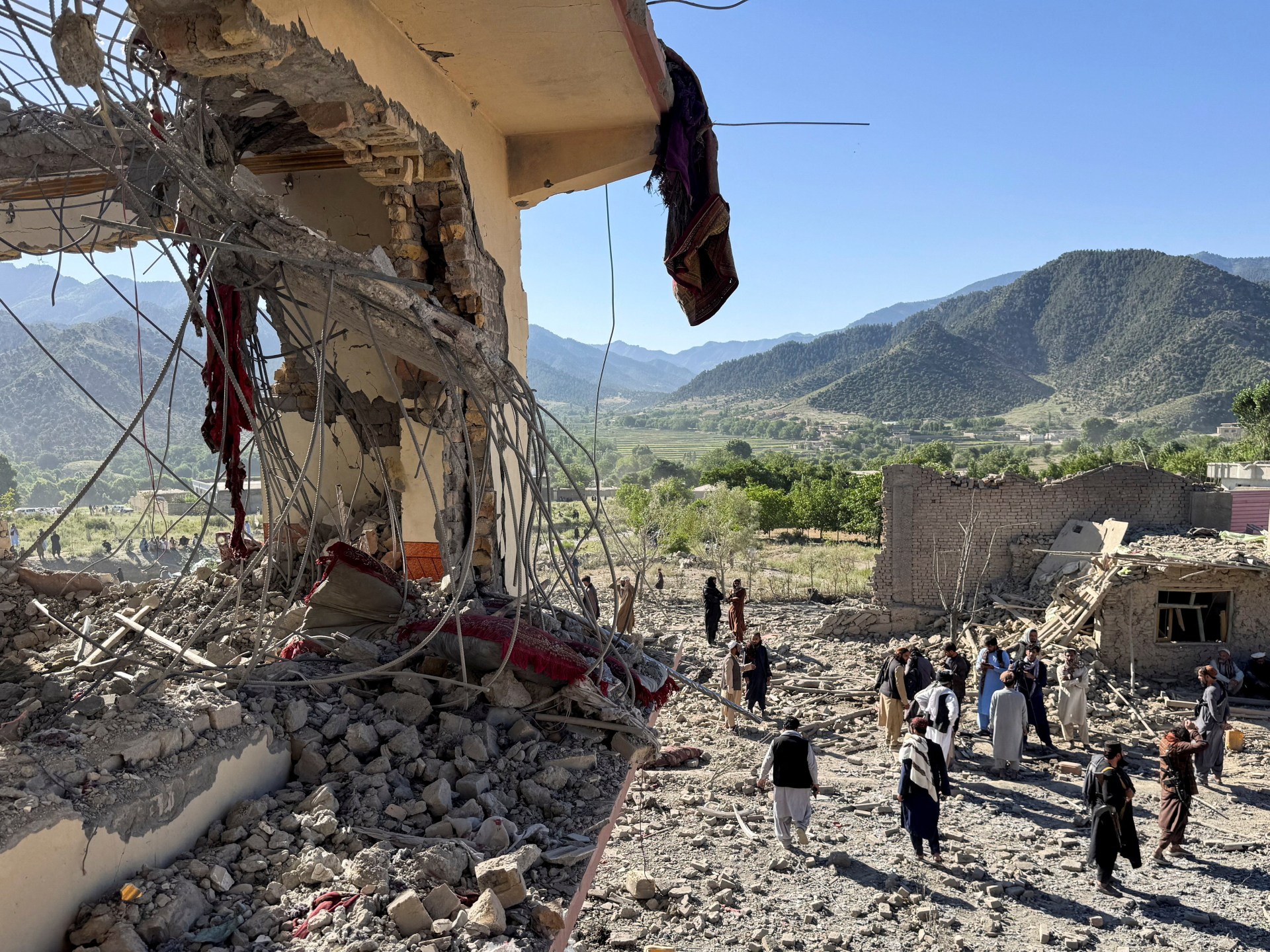
Islamabad, Pakistan – Pakistan’s military said on Wednesday it shot down four drones launched by the Afghan Taliban into Balochistan, hours after Afghanistan’s defence ministry claimed its air force had struck what it called ISIL (ISIS) “centres” in Balochistan’s Pishin district and parts of Khyber Pakhtunkhwa.
Pakistan’s Inter-Services Public Relations (ISPR) said the drones were detected immediately after crossing the border and were neutralised through “sophisticated countermeasures”, describing the launch as part of the Afghan Taliban’s “patronisation and support of terrorist outfits”.
list of 4 items- list 1 of 4Why Pakistan’s Afghan air strikes aren’t stopping armed attacks
- list 2 of 4Pakistan says its security forces killed 29 fighters along Afghan border
- list 3 of 4Do Taliban’s drone attacks expose a chink in Pakistan’s armour?
- list 4 of 4Pakistan says it intercepted four drones fired from Afghanistan
end of list
Kabul’s defence ministry said separately that its strikes targeted a centre in Pishin district, allegedly used to plan “subversive activities and attacks in Afghanistan”, adding that no civilians were harmed.
Neither side’s claims could be independently verified.
Earlier, on June 27, gunmen attacked a paramilitary compound in Karachi, killing three personnel. Jamaat-ul-Ahrar, a splinter faction of the Pakistan Taliban (TTP), claimed responsibility, and the suspect captured alive was identified as an Afghan national. Pakistan responded on June 29 with strikes in Paktia, Paktika and Kunar provinces, claiming 25 fighters were killed. The Taliban government said 36 civilians died.
The drone strikes mark the latest in an escalating back-and-forth of military strikes between Afghan and Pakistani territory since October 2025.
The question is, will the drone strikes lead to a new escalation from Pakistan, or will the neighbours find a way to return to diplomacy to resolve their deepening tensions?
Advertisement
Escalation cycle
Behind those tensions are numbers that Pakistani officials say they cannot ignore. The Pakistan Institute for Peace Studies (PIPS) recorded 699 “terrorist” attacks across the country in 2025, a 34 percent increase from the previous year, with at least 1,034 people killed.
Meanwhile, the United States-based Armed Conflict Location & Event Data (ACLED) project has documented at least a dozen drone launches into Pakistani territory since February.
Still, Pakistani officials told Al Jazeera on condition of anonymity that for now, they plan to pursue what they described as a strategy of controlled escalation: responding forcefully to armed attacks from non-state groups while being more selective about how to retaliate against the Afghan Taliban government strikes.
Pakistan declared “open war” on February 27 and launched Operation Ghazab-lil-Haq (Wrath for Justice) after Taliban forces attacked Pakistani border posts, themselves a response to earlier Pakistani strikes on armed rebel camps in eastern Afghanistan.
By March, a Pakistani strike on a rehabilitation centre near Kabul had killed more than 100 people, according to independent estimates. Taliban authorities called it a “crime against humanity”.
Last year, Qatari and Turkish mediation produced an October ceasefire that briefly held before follow-up talks in Istanbul collapsed twice.
Chinese-mediated talks in Urumqi in April this year led to a measurable drop in Pakistani air strikes, with Taliban officials reportedly prepared to offer written guarantees against the TTP. However, the lull lasted only about two months before tensions resurfaced in June.
“The latest escalation is a continuation of skirmishes that have been regularly observed over the past two years,” said Fahad Nabeel, head of the Islamabad-based consultancy Geopolitical Insights.
“Pakistani aerial strikes in Afghanistan have become reactionary in nature, without any notable change in the frequency of militant attacks. Afghan Taliban officials, for their part, have failed to take any notable action to ensure Afghanistan does not serve as a launching pad for attacks in Pakistan,” the analyst told Al Jazeera.
Ricardo Alvarez, a research analyst tracking armed rebellions across South and Central Asia, said the pattern has solidified over several years.
“What had started in 2022 as occasional incidents and retaliations has, since 2025, become a consolidated pattern,” Alvarez said. “That does not mean escalation might not still occur. We have already seen an escalation between October 2025 and March 2026 rounds of conflict. Tit-for-tat has become the norm, but there might still be a gradual escalation ahead, with more decisive attacks from each side.”

‘Mutual blackmail’
Other analysts dispute where responsibility lies. Rahim Nasari, a Quetta-based security analyst, argued that Islamabad’s domestic security failures are being obscured by the cross-border framing.
Advertisement
“Pakistan has turned this into a kind of new normal, blaming its own security failures on Afghanistan,” Nasari said. “Attackers travel more than 1,200km (750 miles) from the Afghan border to reach Karachi, planning and organising with facilitators inside Pakistan itself. That raises a basic question: whose intelligence failure is this, really?”
Nasari described the relationship between the two governments as one based on leverage rather than a dispute likely to be resolved soon.
“By striking inside Afghanistan, Pakistan manages several things at once: a controlled level of conflict, pressure on Kabul, and a way to divert attention from its own domestic security failures,” he told Al Jazeera. “At its core, this is a case of mutual blackmail. Kabul accuses Pakistan of sheltering anti-Taliban figures, and Islamabad accuses Kabul of harbouring the TTP.”
Alvarez argued that any durable shift would require steps neither government has shown willingness to take.
“Both sides have to address their internal issues without outsourcing the conflict to each other,” he said.
The Venice-based analyst said Pakistan must pair its military response with a long-term strategy addressing the conditions driving armed rebellion in its own provinces.
Without that, he warned, the current approach risks deepening the conflict rather than resolving it.
At the same time, he said, the Afghan Taliban must confront the reality that the “Pakistani Taliban maintain leadership, propaganda centres and hideouts for themselves and their families inside Afghanistan”.
“For both countries, addressing these issues carries strong internal repercussions,” Alvarez said. “And for now, neither side is willing to face those consequences.”
Syndicated from Jamaica Inquirer · originally published .
Legal context · powered by Jurifi
Get the legal angle on this story. Pick a prompt and Jurifi's AI will explain it using Jamaican law.
AI replies are based on Jamaican law via Jurifi. Not legal advice.
Other coverage

JMDA Praises MOH's Response to Interns' Concerns | Midday News
Television Jamaica (Video)Watch
CVM News At 7PM: June 25, 2026 | @CVMTVNews
CVM TV News (Video)Watch
Chang: No criminal will find safe haven in Jamaica
Jamaica Gleaner
CVM News At Noon: June 23, 2026 | @CVMTVNews
CVM TV News (Video)Watch
Jamaica News Today June 30, 2026 /Real News Media TV
Realnews YtWatch