
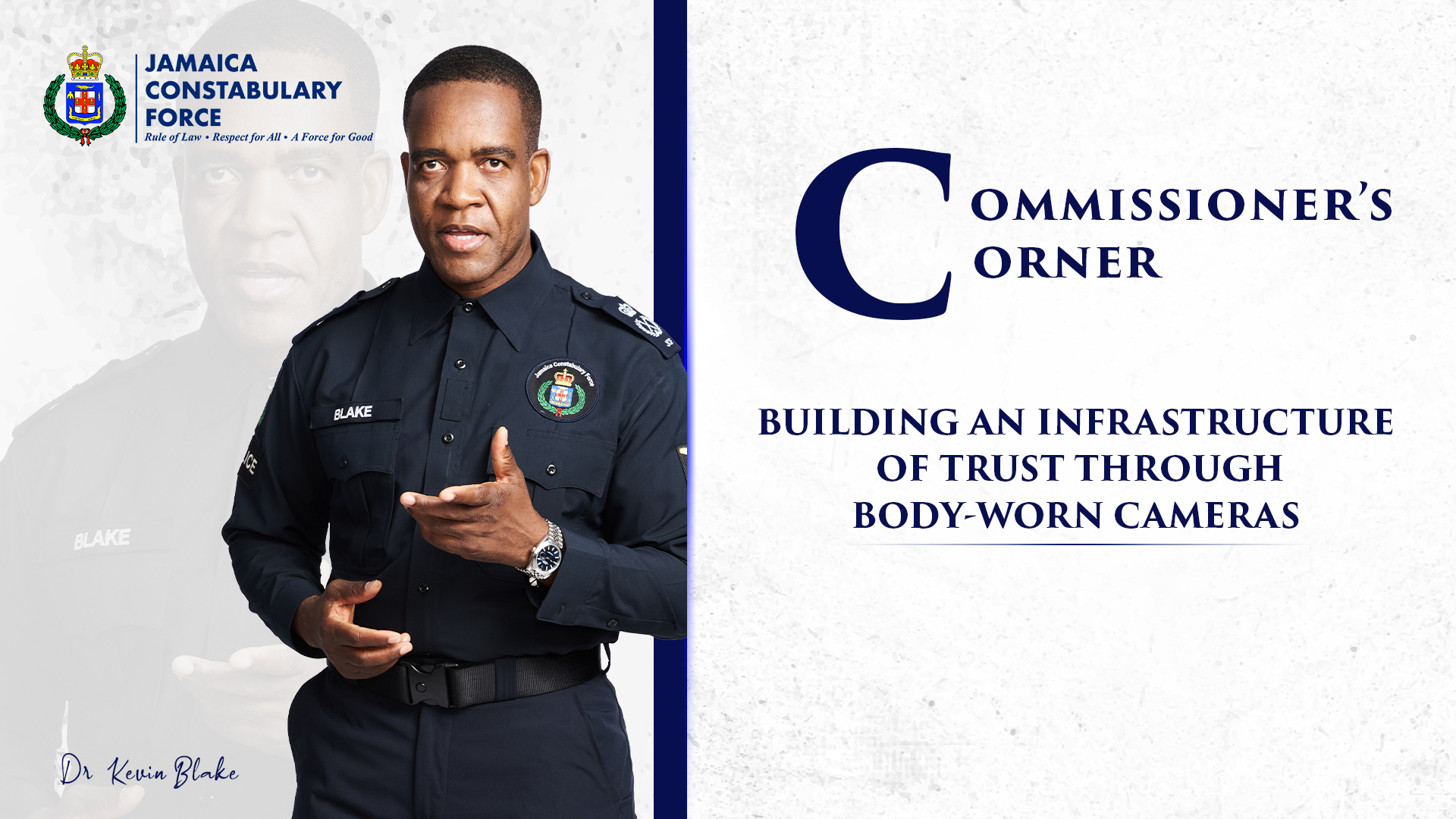
Building an Infrastructure of Trust through Body-Worn Cameras
Building An Infrastructure Of Trust Through Body-Worn Cameras
There is a tendency in modern public discourse to mistake visibility for readiness. The camera becomes the symbol. The announcement becomes the achievement. Yet serious institutional transformation has never been sustained by symbolism alone. It rests on systems, preparation, technical competence and disciplined execution.
That is precisely the point Police Commissioner Dr Kevin Blake sought to make in his latest Commissioner’s Corner, where he returned to the hotly debated issue of Body Worn Cameras (BWCs) within the Jamaica Constabulary Force.
Of note is the fact that the Commissioner did not enter the public discourse with hostility or defensiveness. He instead adopted the posture that has increasingly defined his leadership communication style: measured transparency anchored in verifiable facts. “As I thought about what to include in this week’s discourse, the idea of going back to the controversial topic of Body Worn Cameras (BWC) has been quite tempting, even while I am advised against it,” Dr Blake wrote.
That opening immediately establishes the context surrounding the national discussion. The Commissioner openly acknowledges the controversy while deliberately refusing to become consumed by it. Instead, he identifies what he sees as the real challenge before the Force: “balancing the need to enlighten those who are interested in understanding the technology of BWC and video management, with the risk of feeding detractors with material for use as ammunition to distract and misinform their audiences.”
This framing is important because it shifts the discussion away from accusation and toward understanding. The Commissioner’s argument throughout the column is not that BWCs are unnecessary, nor that the JCF lacks commitment. His argument is that institutional credibility depends on implementing BWCs correctly.
“Very often I attempt to explain the project of BWCs implementation on which we have embarked since 2019,” he explained. “I spoke about the need to ensure that the infrastructure to support the implementation and use of BWC precedes the procurement of the actual cameras.”
That may well be the most important point in the entire column because it captures the philosophy driving the JCF’s approach. The Force refused to pursue cameras without first building the digital ecosystem required to sustain them. “This part of the project has been completed since fiscal year 2023/2024, and now we are in the procurement of BWC phase,” the Commissioner clarified.
He then laid out the details with unusual specificity for a policing communication. “Since fiscal year 2024/2025 we have as a budget line item the procurement of 1,000 BWCs for each of 4 fiscal years. In 2025/2026 we procured 1,000, and are now in the process of procuring another 1,000 for this fiscal year (2026/2027).”
This is not the language of institutional reluctance. It is the language of phased implementation. The Commissioner further disclosed that “we have over 1,500 BWCs deployed each day,” while explaining that “these cameras are distributed to a plan which prioritize areas of frequent public engagement, where the risks for contention and accusations for impropriety are high.”
Again, there is deliberate operational logic behind the deployment strategy. The Force is prioritising the environments where BWCs have the greatest evidentiary and accountability value.
The most striking aspect of the Commissioner’s column, however, was his extensive explanation of the technological realities behind video storage and management. Public conversations on BWCs often focus almost exclusively on the devices themselves. Dr Blake instead directed attention to the invisible infrastructure that determines whether the system can function credibly.
“One of the most resource demanding data type is video,” he explained before attempting to simplify the issue for readers by referencing ordinary mobile data consumption habits.
He then methodically outlined the extraordinary scale of the storage requirements. “If we take the storage of video captured by a single camera for a period of 2 hours on a given day, the storage used is 1 Gigabyte,” he noted. “It means that 1,000 cameras recording for 2 hours each will consume 1 Terabyte (1,000 Gigabyte) of storage each day.”
The figures escalate rapidly. “With the 4,000 cameras that we are procuring over the 4 years period of the project, there will be a need for 4 Terabytes of data storage capacity per day,” the
Commissioner stated. “If we are to retain the footage for 4 months or 120 days, it means we retain 960,000 hours of video.”
He further explained that this “would require 480,000 Gigabytes of storage,” and that the footage retained would equal “109.6 years of playback.”
These are not abstract numbers. They represent the operational reality of accountable digital policing.
“This is not an attempt to exaggerate or to confuse,” Dr Blake emphasised. “It is simply an attempt to demonstrate the reality of which many commenters on BWCs are unaware.”
The Commissioner’s core point becomes unmistakable at this stage of the column. “The investment in such storage capacity was no simple thing. It was huge and very expensive, but had to be done.” Why? Because, as he explained, “a single incident that last just a few seconds may become the subject of investigation or judicial proceeding several months after.”
That reality places enormous responsibility on the institution. Video evidence must remain secure, retrievable, authentic and properly managed. “The storage and management of the video data is not optional,” the Commissioner stated directly.
Ultimately, this latest Commissioner’s Corner was never merely about cameras. It was about institutional seriousness. It was about demonstrating that policing reform cannot operate through improvisation or spectacle.
“So having shared how much we invested and continue invest in data management,” Dr Blake concluded, “I want to make the point that, once again, this is a reflection of our commitment to getting it right on BWCs.”
This should now become central to the national conversation. The JCF has made its position clear. It is building a BWC programme designed not for headlines, but for endurance. Not for symbolism, but for operational legitimacy. Not for appearances, but for accountability that can survive scrutiny long after the public noise subsides.
Syndicated from JCF — Jamaica Constabulary Force · originally published .
Legal context · powered by Jurifi
Get the legal angle on this story. Pick a prompt and Jurifi's AI will explain it using Jamaican law.
AI replies are based on Jamaican law via Jurifi. Not legal advice.
Other coverage
Letter of the Day | Precise speech: the lifeblood of parliamentary democracy
Jamaica Gleaner
Sunday Sips with HG Helps | A wa Burchell did a chat bout?, give US ambassador-designate Lake a chance, Dennis Lalor – a king who did not need a crown, and Shericka looking good
Our Today
Orville Taylor | Appropriate language and symbols
Jamaica Gleaner
THE WHITE-COLLAR RECESSION IS HERE-AI-accelerated, corporate strategy-entrenched
Jamaica Gleaner
JCF High Command interdicts cop who shot civilian in Granville on Sunday
Radio Jamaica News Online