


Dr Kevin Brown of UTECH recently voiced concern about a growing crisis confronting Jamaica’s universities: too few incoming students possess the scientific and mathematical literacy necessary to thrive in Science, Technology, Engineering, and Mathematics (STEM) disciplines.
His concern deserves far more public attention than it has received.
The issue extends beyond UTECH. It affects the University of the West Indies (UWI), the College of Agriculture, Science and Education (CASE), the wider Caribbean tertiary system, and ultimately the economic future of Jamaica itself.
The question, however, is not simply why universities are struggling to recruit STEM-ready students.
The more important question is this: How did we get here?
I ask that question not merely as a physicist/energist, educator, and long-time observer of Jamaican education, but as someone whose life has been deeply intertwined with one particular educational ecosystem.

I was raised in Port Antonio.
For decades, residents of Portland took quiet pride in a remarkable statistical reality. Titchfield School consistently enjoyed a reputation for supplying more recruits to UWI’s medical programmes than any other school in the Caribbean. It was also one of Jamaica’s most dependable sources of science and engineering students.
This achievement was not accidental.
Generations of dedicated educators helped build that culture. Among them were the legendary chemistry teacher Mr Fulton from the United Kingdom, the highly respected physics teacher Mr Ketwaroo from Guyana, the mathematics and timetabling master Mr Ram also of Guyana, Principal Lloyd O. “Butty” Chin of Port Antonio, and the outstanding biology teacher Mrs Thomas from South India who succeeded him and helped sustain the school’s once prestigious scientific tradition.
Together, they cultivated something increasingly rare: a school culture that regarded science, medicine, engineering, agriculture, and technical excellence as worthy aspirations for ordinary children.
The significance of this achievement became even clearer when viewed through the lens of evidence.
For many years I led the A-QuEST Think Tank’s pioneering longitudinal studies of Jamaican secondary schools. These studies employed value-added methodologies that sought to measure not simply examination outcomes, but educational transformation.
The findings were striking.
Although Titchfield School frequently admitted students whose Common Entrance, GSAT, and later PEP scores ranked among the lowest entering cohorts of Jamaica’s so-called traditional high schools, the institution consistently emerged as the country’s most efficient producer of tertiary-ready graduates in that era up to Principal (now Custos) Lincoln Thaxter’s time.

In simple language, Titchfield repeatedly did more with less.
Its success was not explained by elite intake. It was explained by educational effectiveness.
The school transformed students.
That kind of reality should have profoundly influenced educational policy discussions.
Instead, another trend was quietly gathering momentum.
Across Portland and beyond, a growing proportion of students began identifying themselves not as science students but as “business students”.
The shift was not subtle.
At Titchfield School, Happy Grove High School, Fair Prospect High School, Buff Bay High, and Port Antonio High School, increasing numbers of young people openly described their educational ambitions through the language of business studies rather than scientific inquiry.
Simultaneously, financial institutions and corporate interests began supporting examination fees in subjects such as Principles of Accounts, Principles of Business, Economics, EDPM, and related commercial disciplines.
Those interventions were often well-intentioned.
Yet they also sent powerful signals.
Students notice what society rewards.
Parents notice.
Principals notice.
Guidance counsellors’ notice.
When visible support flows disproportionately toward certain disciplines, students inevitably draw conclusions about which pathways are valued and which are not.
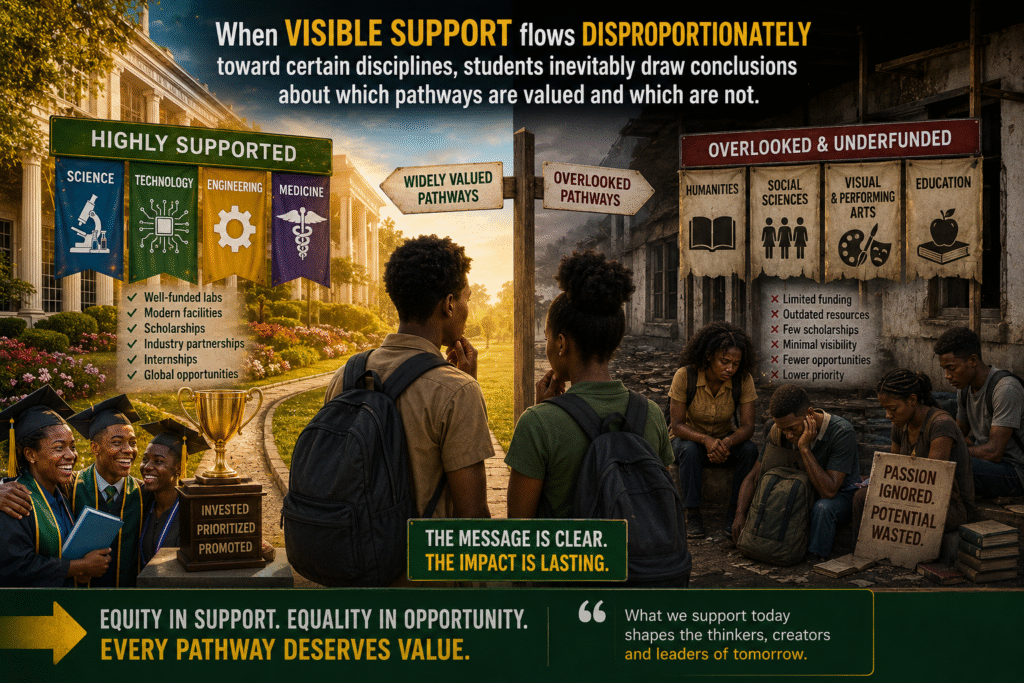
The market speaks.
Young people listen.
The difficulty is that markets and nations frequently operate on different timelines.
Markets excel at identifying immediate demand.
Nations must prepare for future uncertainty.
The distinction matters enormously.
A labour market may urgently require accountants this year, bankers next year, and software developers the year after that. Educational systems, however, cannot be rebuilt annually in response to fluctuating demand signals.
Scientists, engineers, physicians, researchers, agricultural innovators, and technical specialists require many years to develop.
The consequences of educational decisions made today may not become visible for fifteen or twenty years.
That is precisely why educational policy cannot simply follow market incentives.
Yet that is increasingly what appears to have happened across parts of Jamaica and the wider Caribbean.
Over many years, A-QuEST reports highlighted these emerging patterns and their likely implications. I briefed ministers, prime ministers, task forces, educational committees, and interested stakeholders.
The response was often remarkably similar.
The market knows best.
The market will decide.
The market is efficient.
Perhaps.
But efficiency is not the same thing as wisdom.
The present STEM recruitment crisis invites us to revisit that assumption.
The world’s most successful educational jurisdictions rarely allow market signals alone to determine educational priorities.
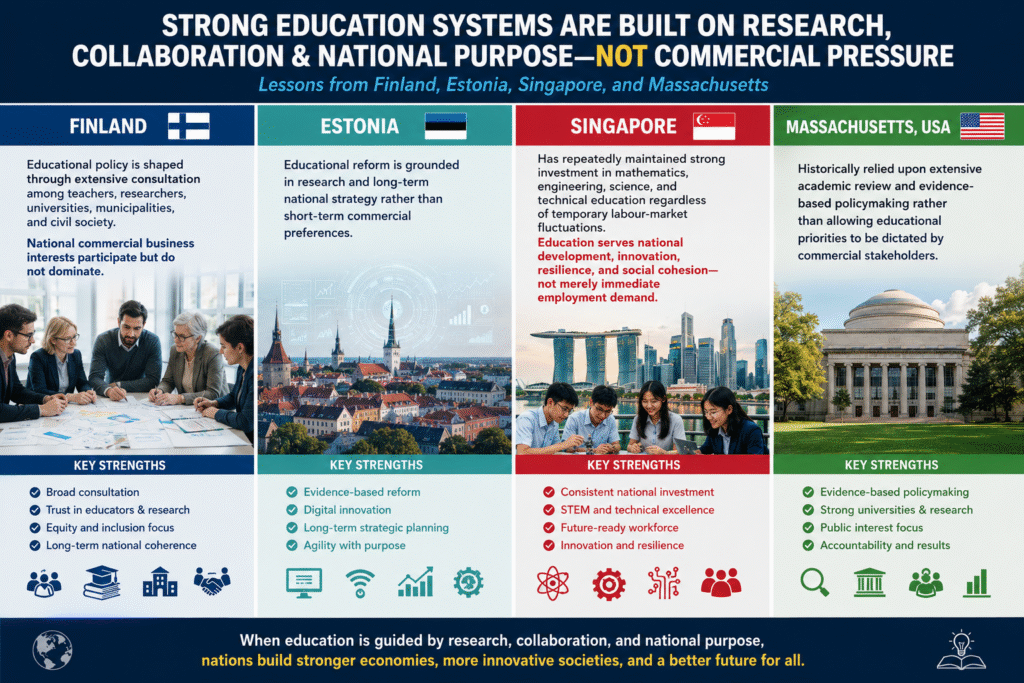
Finland provides an instructive example. Educational policy there is shaped through extensive consultation among teachers, researchers, universities, municipalities, and civil society. National commercial business interests participate but do not dominate.
Estonia similarly grounds educational reform in research and long-term national strategy rather than short-term commercial preferences.
Singapore, perhaps the most striking example, has repeatedly maintained strong investment in mathematics, engineering, science, and technical education regardless of temporary labour-market fluctuations. The nation understands that education serves national development, innovation, resilience, and social cohesion—not merely immediate employment demand.
Even Massachusetts, widely regarded as one of the strongest educational jurisdictions in the United States, historically relied upon extensive academic review and evidence-based policymaking rather than allowing educational priorities to be dictated by commercial stakeholders.
These societies do not reject markets.
They simply refuse to confuse market demand with national strategy.
That distinction is crucial.
No serious observer suggests that bankers maliciously captured Jamaican education. The reality is subtler and therefore more dangerous.
Governments responded to economic incentives.
Parents responded to employment trends.
Students responded to visible opportunities.
Schools responded to demand.
Over time, these individually rational decisions may collectively have produced an outcome that few intended.

A weakening STEM pipeline.
Today, universities are beginning to experience the consequences.
Dr Kevin Brown’s concern may therefore represent not an isolated university problem but the delayed arrival of educational decisions made years ago.
The irony is profound.
Jamaica may have spent decades consuming the accumulated scientific capital created by earlier generations of educators while investing insufficiently in its replacement.
The result resembles a farmer steadily harvesting a field without adequately replenishing the soil.
The harvest remains strong for a time.
Then the decline becomes unavoidable.
This is why the lessons of Titchfield School deserve renewed attention.
Its historical success suggests that educational excellence cannot be reduced to examination entry scores, social status, or market trends. It demonstrates the transformative power of school culture, inspired teaching, scientific aspiration, and educational leadership.
Most importantly, it raises a question that Jamaica can no longer afford to avoid.
Who decides what education is for?
If employers alone answer that question, education becomes workforce training.
If examination bodies answer it, education becomes credential production.
If politicians answer it, education risks becoming patronage.
But if society answers it, education must balance science, engineering, agriculture, business, humanities, citizenship, ethics, creativity, and critical thinking.
The current STEM crisis is therefore not fundamentally about physics, chemistry, engineering, or mathematics.
It is about governance.
It is about foresight.
It is about whether Jamaica possesses the institutional maturity to think beyond today’s labour market and prepare for tomorrow’s realities.
The market remains an invaluable servant.
But it is a poor strategist.
Educational policy must certainly listen to markets.
It must never become captive to them.

If we fail to understand that distinction, the concerns now being voiced by Dr Kevin Brown may prove to be merely the earliest warning signs of a much deeper national challenge still unfolding before our eyes.
PS: I Am a Fortis man so I attended the great KC for ALL of grades 7 to 13. There I learnt to Think Critically.
Syndicated from Our Today · originally published .
Legal context · powered by Jurifi
Get the legal angle on this story. Pick a prompt and Jurifi's AI will explain it using Jamaican law.
AI replies are based on Jamaican law via Jurifi. Not legal advice.
Other coverage

CSEC underperformance creating STEM crisis for Jamaica
Jamaica Gleaner
College pipeline crisis
Jamaica Observer
Crisis in Tertiary Enrolment | TVJ News
Television Jamaica (Video)Watch
Cedric Stephens | Jamaica's traffic crisis is a national risk event
Jamaica Gleaner
Cedric Stephens | Jamaica's traffic crisis is a national risk event
Jamaica Gleaner