
House Passes 20 Amendments to NaRRA Bill, Strengthens Consultation Rules
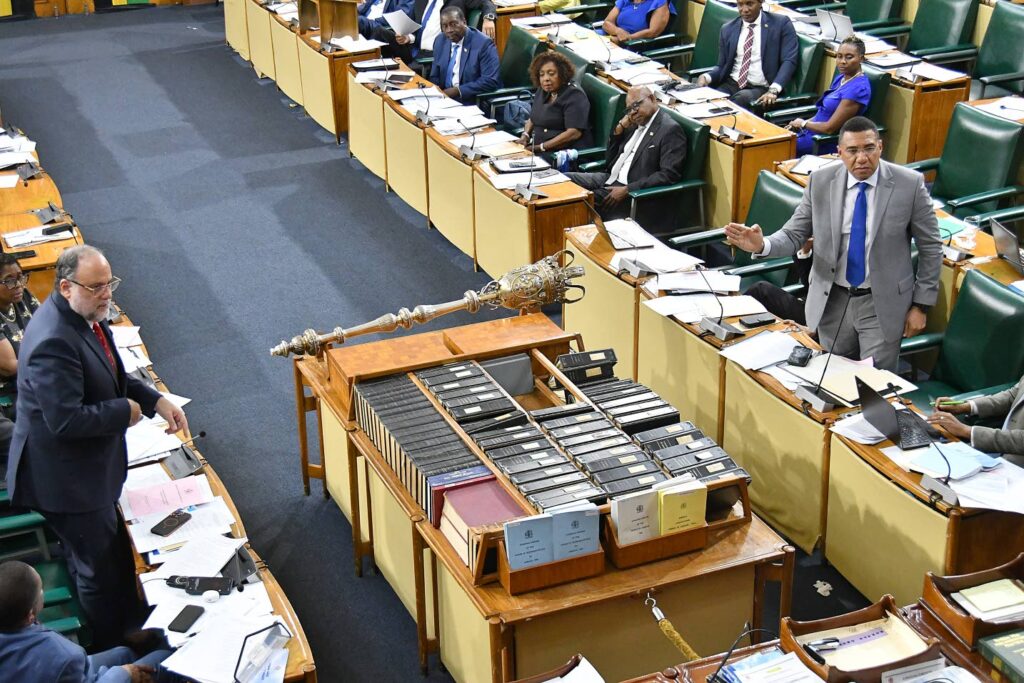
The National Reconstruction and Resilience Authority (NaRRA) Bill cleared the House of Representatives in the early hours of Wednesday with 20 amendments, headlined by a new requirement that the agency consult people affected by its reconstruction projects.
The consultation amendment was accepted by the Government after pushback from civil society groups, but lawmakers stopped short of agreeing to an Opposition proposal to create a governing board that would supervise the authority and hold its chief executive officer accountable.
NaRRA is being set up to lead post-disaster rebuilding and resilience work in the wake of Hurricane Melissa, which the Bill identifies as the strongest hurricane to make landfall in Jamaica's recorded history. The legislation also aims to speed up major public and private projects deemed critical to the country's economic recovery.
During the committee stage, members inserted language into Clause 17 obliging the authority to "hold consultations with persons affected or likely to be affected by the implementation of a project". The change responded to complaints that the original draft did not set out clear consultation duties.
Opposition Leader Mark Golding said an earlier version of the amendment, later trimmed by the Government, would have offered firmer protections by naming specific groups. That draft would have required consultations with affected communities, non-governmental organisations, women, persons with disabilities, the elderly, children and youth, alongside meetings every six months to gather feedback.
"Now that's a much more comprehensive requirement than this very truncated version which just says that in developing and for monitoring the implementation… hold consultations, but it doesn't say, it doesn't go into any kind of detail as to who should be included," Golding said.
Government members countered that broader wording would keep the door open to wider participation. Leader of Government Business Floyd Green argued that itemising categories could narrow the scope and slow the rollout.
"This gives the authority a wider breadth in terms of consultation, because it subsumes all the categories without individually listing them. And this is a much better approach, this gives us a wider array based on what is put in this new dispensation," Green said.
Prime Minister Dr Andrew Holness echoed that view, telling the House the administration's intent had always been wide community engagement. "The policy direction is we want the broadest consultations, and I believe the way in which the drafters have coined it in the clause gives a wider breadth than for us to go to name specific categories, which could be limited," he said.
While changes around consultation and reporting were accepted, the Government held its ground on the Bill's most disputed governance clauses. Clause 7 was left untouched, defeating the Opposition's bid to install a governing board of between five and nine members to oversee the authority and its chief executive.
"Madam Chair, the authority is going to be administering billions and billions of dollars of expenditure, much of which will be borrowed from international partners and with interest. It is necessary that the chief executive officer has to report to a body that can give effective oversight over how that person is conducting the affairs of the authority and all the more in the low-trust environment that exists in Jamaica," Golding said.
The Government argued that NaRRA was purposely shaped as an executive vehicle built for fast implementation rather than conventional corporate oversight. Holness said a board would risk bogging down decisions during a national rebuilding push.
"Where there is a very specific task for an entity to execute in a very well defined period, the need to have a board that will exercise discretion, interpret policy and deal with issues to do with the day-to-day management of the entity, those issues would not arise in this instance of an entity where the direction is specific and all that is needed to do is to execute," the prime minister said.
Several other disputed provisions also passed unchanged. Clause 5, which gives the prime minister the power to appoint the chief executive officer by instrument in writing, was kept despite Opposition concerns about concentrated executive control. Clause 6, which lets the authority and its chief executive delegate functions "to any person" with ministerial sign-off, was likewise retained, even after MPs flagged it as too broad and lacking checks on competence and transparency.
St James West Central Member of Parliament Marlene Malahoo Forte, a Government MP, argued that the clause should spell out qualifications for those receiving delegated authority, given the technical work involved. "All I'm saying is that 'any person' needs a qualifier, because it has to be someone who is duly competent to carry out the functions. These are technical functions," she said.
Wide-ranging powers over project approvals also remain. Clauses 21 to 24 were not amended and let the authority coordinate and accelerate approvals for reconstruction and strategic investment projects, issue directives to approving agencies and, in certain cases, allow the minister to issue "step-in orders" to override delays. Clause 25, also untouched, gives Cabinet the power to designate projects worth US$15 million or more as strategic investment projects across sectors including tourism, agriculture, logistics, healthcare, housing and mining.
Among the changes that did pass, Clause 9 was rewritten so that the authority's auditor will be appointed by the cabinet secretary with Cabinet approval, rather than by the chief executive officer with the cabinet secretary's sign-off. Clause 10 was tightened to require the chief executive to submit reports every six months to the minister, with copies tabled in both Houses of Parliament.
Clause 20 was expanded so the official project register kept by the authority will cover not only Government-approved reconstruction and resilience projects but also designated strategic investment projects with private-sector involvement. The register must also list the promoter behind each project, giving the public a clearer view of who is driving developments under the law.
A newly inserted clause exempts approved reconstruction and strategic investment projects from certain Public Investment Management System requirements under the Financial Administration and Audit Act, a move that could shorten approval timelines for some projects.
Syndicated from Jamaica Observer · originally published .
Legal context · powered by Jurifi
Get the legal angle on this story. Pick a prompt and Jurifi's AI will explain it using Jamaican law.
AI replies are based on Jamaican law via Jurifi. Not legal advice.