
Manufacturers urged to reformulate as sugar tax takes effect
With consumers now paying more for non-alcoholic sweetened beverages, manufacturers are being urged to pivot by reformulating their products to provide consumers with more affordable and healthier options while maintaining taste profiles.
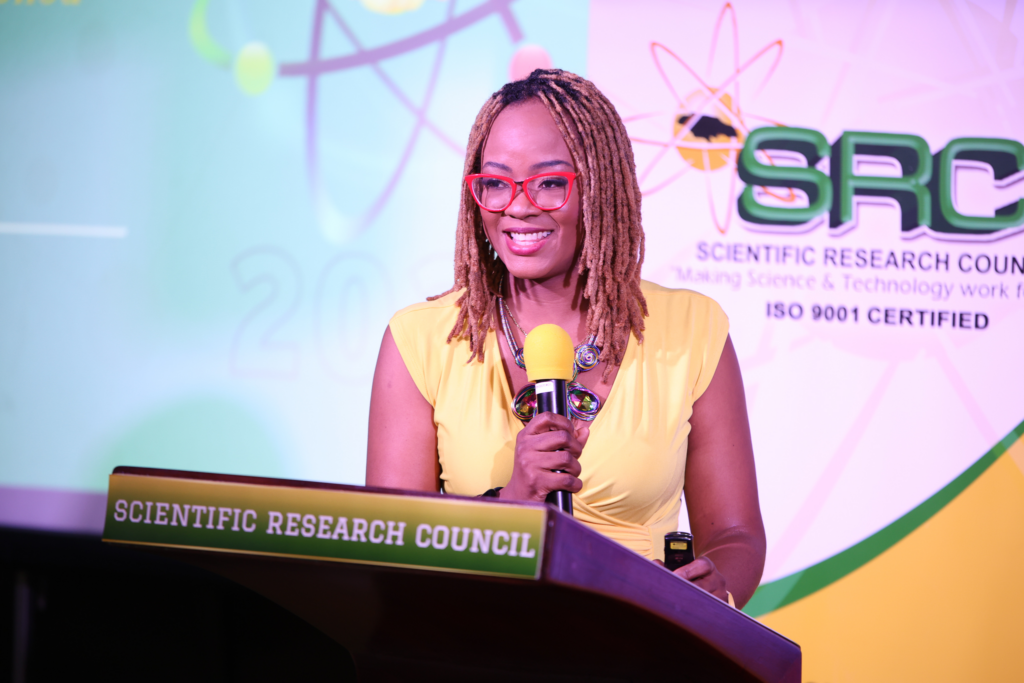
This call is coming from executive director of the Scientific Research Council, Dr Charah Watson, who says the SRC is willing to work with manufacturers to help them meet the new sugar regulations without compromising on customer experience.
“We’re supporting manufacturers in helping them to reformulate, identify appropriate alternatives and do the necessary quality tests. We can also assist them in doing the sensory evaluation with their intended market so, as they reformulate, we can actually assess how the consumer is responding to what they’re recrafting their products to be,” Watson told Observer Online.
As part of revenue measures in the 2026/2027 budget, the government introduced a Special Consumption Tax (SCT) of $0.02 per millilitre on non-alcoholic sweetened beverages (NASBs) containing added sugar or caloric sweeteners.
Stock image of colorful of carbonated soft drink pop soda bottles with plastic straw.
The government said the measure, which took effect on May 1, is also aimed at tackling non-communicable diseases (NCDs) among the Jamaican population.
Dr Watson says reformulating products to reduce sugar content could benefit both consumers and manufacturers by improving public health and helping businesses remain competitive under Jamaica’s new sugar tax regime.
“What the SRC is trying to do in support of the industry as well as keeping consumer consideration at the forefront is support manufacturers in their redevelopment, reformulation exercises to redevelop products that they already have to be compliant with the sugar levels that are being recommended because it’s gradual,” Watson said. “We are looking to gradually reduce the sugar content in our food products so that you can change the palate of our consumers.”
The SRC executive director said larger manufacturers have already begun producing lower-sugar alternatives since discussions around providing healthier options for students in schools began in 2018.
“This new initiative is now pushing for it to be wider – having more manufacturers reducing their sugar content. There have been companies, as far back as 2018, 2019, and consistently that have been engaging the SRC to support them in bringing products to market that are of a lower sugar level than what was the standard back then,” Dr Watson explained.
(L–R) Dr. Charah Watson, Executive Director, SRC; Tameka Clough, CEO Island Lemonade and SRC client; Carolyn Rose Miller, Divisional Manager, Marketing & Corporate Communications; and Arlando Dunkley, Divisional Manager, Process Development Division, share a moment while showcasing client products at the 2024 staging of SRC on Show at Hope Gardens Playfield.
Background: Eden Palmer, Event Moderator.
While larger companies have been reaching out to the SRC requesting its reformulation services, Dr Watson urged small and medium-sized enterprises (SMEs) to take advantage of the services available, to ensure their products meet the new regulations.
“The larger companies are reaching out. However, there are several small and micro-manufacturers that are in the market that are not as agile and not as responsive as the larger companies tend to be. So what SRC is doing is trying to engage and increase awareness that we have services here that are available to also support you so that you won’t be left out, so that you can actively participate, and so that you can also produce products that are desirable and compliant,” she added.
She said the SRC’s reformulation services are very affordable and usually start at approximately $65,000, depending on the complexity of the product.
“The SRC was created exactly for this purpose, to support the small and micro enterprises so that they can actively participate in the marketplace and continue to play their role to support the economy,” Watson said.
According to Watson, a reformulation exercise “is not simply just tweaking a thing”, but rather “a total rework”. She noted that the process involves a gradual change in the percentage or quantity of sugar in a product, moving from a relatively high level to a midpoint and then a low point. She, however, noted that communication plays a key role during the process as consumers adjust to the changes being made.
“I will encourage product manufacturers to also indicate it on the product label. They might want to alter the product label so persons know that it’s not exactly the same thing. You don’t want persons to have an assumption because they’re used to this product in this package,” Watson said. “So it’s how do you manage that transition, manage the change, and how you effectively communicate that to your customer.”
Dr Watson said the SRC has also developed ready-made low-sugar beverage formulations that manufacturers can license and commercialise, including flavoured waters and functional drinks designed to meet the new standards while offering healthier alternatives to consumers.
Syndicated from Jamaica Observer · originally published .
Legal context · powered by Jurifi
Get the legal angle on this story. Pick a prompt and Jurifi's AI will explain it using Jamaican law.
AI replies are based on Jamaican law via Jurifi. Not legal advice.
Other coverage

Parents Urged to Foster Good Reading Habits At Home
Jamaica Information Service
Parents Urged to Foster Good Reading Habits At Home
Ministry of Education and Youth
Roxan Wais-Shirley – doing well at Guardsman Group – Part I
Our Today
Push to eliminate period poverty among schoolgirls
Jamaica Gleaner
Residents In Parottee to Benefit from JPS Community Connect Pop-Up on May 7
Jamaica Information Service