
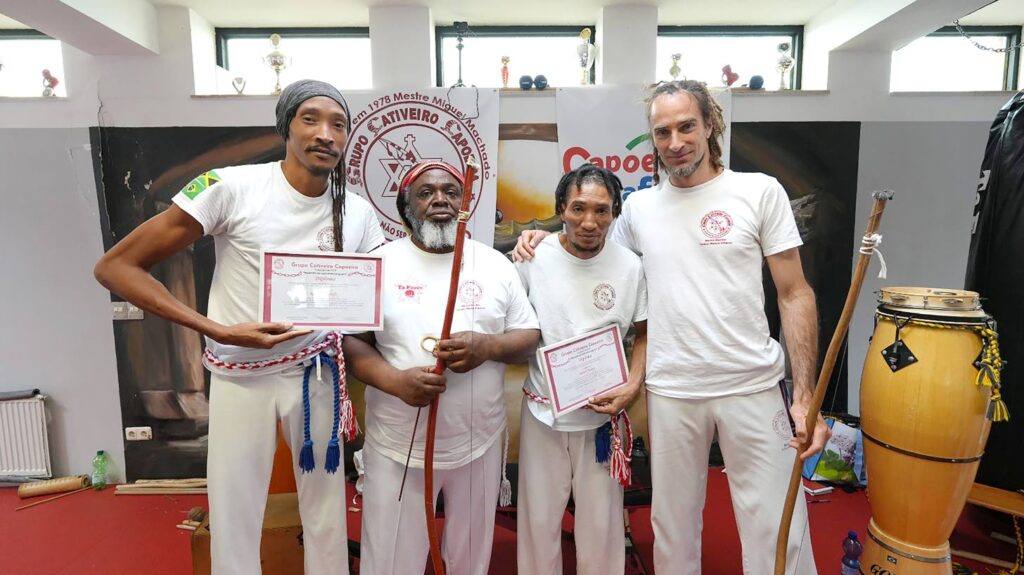
JAMAICANS Richard Murray and Rodane Radcliffe are now just two belts away from mastering capoeira, the Afro-Brazilian martial art, after earning their professor belts in Germany in May and becoming the highest-ranked instructors in Jamaica.
Capoeira is a dynamic, Afro-Brazilian martial art that uniquely blends acrobatics, dance, percussion, and song. Developed in Brazil by enslaved Africans, it was originally created as a covert method to practise self-defence and fight for freedom by disguising combat movements as fluid, rhythmic dance.
In capoeira, a professor is an advanced teaching rank, generally equivalent to a black belt in other martial art formats. Professors are highly skilled practitioners capable of leading an academy, conducting classes, and teaching students all aspects of the art.
Murray, 39, said he was first introduced to the martial art in 2005 by German native Dennis Eckart, who later founded Capoeira Alafia, a Jamaican-based charitable organisation working with children and young people — especially from Kingston’s inner-city communities — to teach them capoeira.
He shared that he was living in Mountain View, St Andrew, at the time. While on his way home, he said he saw Eckart engaging youth in the martial art and immediately became interested. Murray said he received his starter belt in 2006 and started teaching the art to other children in 2008, eventually matriculating to an instructor in 2011.
Previously considered an at-risk youth, he admitted that he had a temper that his grandmother tried desperately to quell, encouraging him to join community initiatives that would keep him out of trouble. For him, capoeira was just what he needed.
Rodane Radcliffe (left) and Richard Murray (centre) are presented with their professor belts by Dennis Eckart (right) during a ceremony at the Capoeria Alafia centre in Germany.
“It has taught me self-control. I have learnt how to control my emotions and also not to react when somebody gets angry or upset about something, but rather to solve that issue or problem before it escalates any further. Coming from the community where I was from, which is basically the inner-city community where you have a lot of violence and conflicts that would occur, it kept me away from these problems because being young, we tend to be drawn to certain badness and certain influences,” he told the
Jamaica Observer.
An alumnus of The University of the West Indies, Radcliffe said he was introduced to capoeira in 2010 while pursuing his degree. He said he accompanied a friend to a training session and fell in love with the art form, eventually enrolling for classes on the university compound.
Similar to Murray, Radcliffe said capoeira became a form of healing and provided much-needed mental health support, especially throughout his university years. He said the martial art was particularly helpful when it came to managing his anxiety levels and the stresses of exams.
When he enters roda — the traditional circular formation used to play the Afro-Brazilian martial art of capoeira — he said he feels truly at peace. Inside this circle, two players engage in a fluid, strategic game of combat and dance while the remaining participants sing, clap, and play percussion instruments to drive the energy.
“When you go into the roda, you don’t want to have anxiety and stress on you and you don’t want to be distracted because you’re in an environment where you can get hit, even if that’s not the intention of the other person; you’ve got feet flying to your face so you’ve got to be focused, you’ve got to be aware, and not too much in your head,” he shared.
Radcliffe said while the form of martial arts was challenging, it was enjoyable, and so he stuck to it, training under Eckart, who eventually invited both him and Murray to Germany to become certified as professors.
“Going there, learning sequences from his master, meeting other professors who are functioning, playing capoeira with them, that’s something that was very exciting and important as well. We don’t fight capoeira, we play capoeira because it’s like a game, that’s how we look at it. We were playing capoeira with other professors, other ministers, engaging with younger students from Germany, and exchanging knowledge as best as we could. Even with the language barrier, it was great,” he told the Sunday Observer.
Students, instructors, professors, and masters of capoeria at the Capoeria Alafia practise the form of martial arts in the streets of Germany.
For Murray, the experience was equally exciting. He shared that it was his first time out of the country, and he was proud to represent Jamaica.
“Anywhere we go, we raise the flag, no matter how small we may be. We likkle but we tallawah,” he declared.
“Once you are true to yourself and true to your nation, you will always remember the pledge, the anthem, everything, and you will never leave them,” he added.
He encouraged Jamaicans, youth especially, to practise martial arts, assuring them that they will be welcomed with open arms by instructors and students who will treat them like family. He said he often holds classes on Wednesdays at Emancipation Park at 6 pm, urging any interested individual to join the sessions.
Similar sentiments were expressed by Radcliffe as he talked about the value capoeira added to his life.
“If you’re looking for a social group where you can talk about life, get different perspectives, and just even meet people with different socio-economic backgrounds, this is it. Capoeira accepts everybody. It doesn’t matter if you’re rich or poor, and it helps you to socialise in that way where everybody’s on the same playing field. If you’re looking for something physical that’s challenging, that allows you to know your body better, I think capoeira does that,” said Radcliffe.
Syndicated from Jamaica Observer · originally published .
Legal context · powered by Jurifi
Get the legal angle on this story. Pick a prompt and Jurifi's AI will explain it using Jamaican law.
AI replies are based on Jamaican law via Jurifi. Not legal advice.
Other coverage

Jamaica Magazine 13.06.2026
Jamaica Information Service (Video)Watch
CVM Lead Story: June 19, 2026 | @CVMTVNews
CVM TV News (Video)Watch
CVM Lead Story | @CVMTVNews
CVM TV News (Video)Watch
Get the Facts - Manhood Before Fatherhood
Jamaica Information Service (Video)Watch
Webinar - Unlocking Growth Partnerships
JAMPRO (Video)Watch