
Big battle ahead!
From conference rooms in Ghana to expected clashes at the upcoming Commonwealth Heads of Government meeting in Antigua, former St Vincent and the Grenadines Prime Minister Dr Ralph Gonsalves says the Caribbean reparation movement is preparing for what could become its most coordinated international campaign yet.
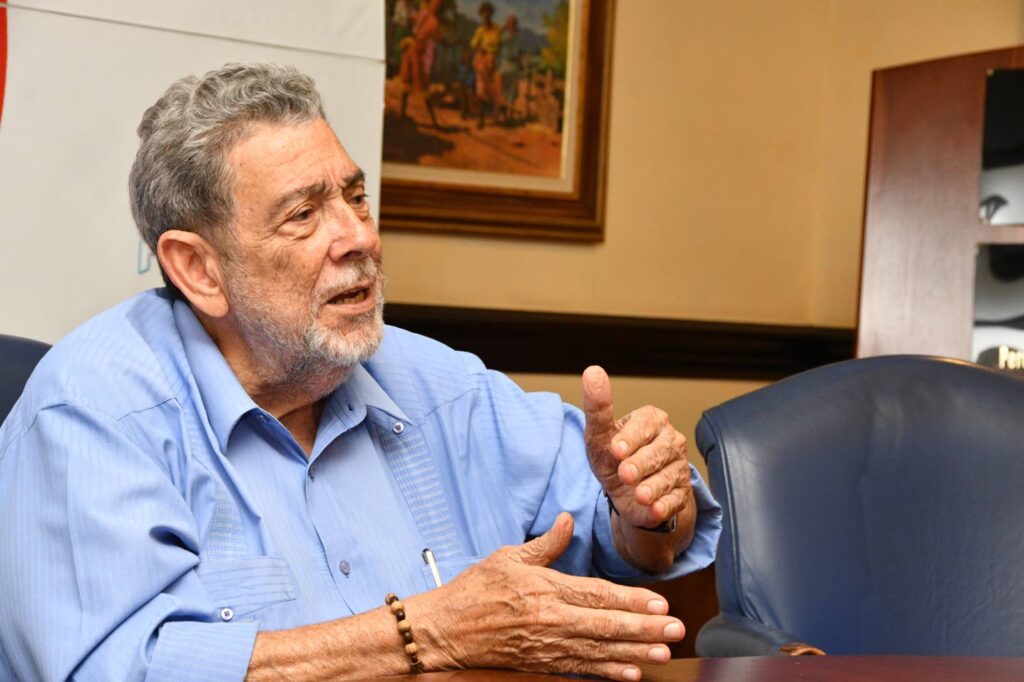
Speaking during a Jamaica Observer Press Club on Wednesday, Gonsalves outlined a packed calendar of diplomatic meetings, international conferences, and political lobbying efforts that he believes could significantly expand global pressure on Britain and other former colonial powers to address the legacy of slavery and colonialism.
The veteran Caribbean politician and Opposition leader in St Vincent, who now serves as senior adviser to the Repair Campaign, said the reparation movement is increasingly moving beyond regional advocacy into major international political and legal institutions, with the United Nations; African Union; United Nations Educational, Scientific and Cultural Organization (UNESCO); and the Caribbean Community (Caricom) all playing growing roles in the push for reparatory justice.
Repair Campaign, launched in 2022 by Irish businessman Denis O’Brien, works alongside the Caricom Reparation Commission (CRC) to support advocacy, research and public engagement surrounding reparation for Caribbean nations affected by slavery and colonial exploitation.
Gonsalves argued that the movement has now reached a stage where different institutions and organisations must collaborate to build international momentum.
“I want to see all these tributaries be conjoined into a mighty river towards reparatory justice. So that is CRC, the Caricom entities, they are the authoritative bodies. But other entities have to feed into them and work with them, and engineer the canals for the streams to come and build the bridges,” he said.
Gonsalves added that reparation advocates are now seeking to build on the momentum generated by a March 25 United Nations General Assembly resolution, backed by Ghana, Caricom, and African nations, which declared the transatlantic slave trade and racialised chattel enslavement of Africans “the gravest crime against humanity”, and called for reparatory justice.
According to Gonsalves, the next major step will come in June when Ghana hosts an international conference involving the African Union and other stakeholders to discuss the future direction of the reparations movement.
Another significant initiative, he noted, is an upcoming collaboration between the Caricom Reparation Commission and the University of London, aimed at deepening engagement with influential figures in Britain.
“I happen to know that the Caricom Reparation Commission and the University of London are working together to have an international gathering at the university… dealing with some British economic, political, social elites, people who are in the religious sphere. No date has been set there, but we want the Repair Campaign to work with the CRC on that,” Gonsalves explained.
The movement’s diplomatic push is also expected to intensify in July when Caricom Heads of Government meet in St Lucia.
Gonsalves said the Caricom Prime Ministerial Subcommittee on Reparations is expected to present a progress report and seek further direction from regional leaders.
By September, attention is expected to turn to the 25th anniversary of the Durban Conference Against Racism in South Africa, where world governments adopted a landmark declaration recognising slavery and the transatlantic slave trade as crimes against humanity and acknowledging their lasting consequences.
The Durban Declaration and Programme of Action has since become one of the key international documents underpinning modern reparation advocacy.
That international lobbying effort is expected to continue into the United Nations General Assembly later in September, where Caribbean leaders and reparations advocates are expected to build on the work done over the past months, and using that as leverage to press for deeper international engagement on reparatory justice.
After that, they will shift to what Gonsalves suggested could become one of the movement’s most politically contentious moments — the Commonwealth Heads of Government Meeting scheduled for Antigua in November.
“I expect that to be a big staging post for the English-speaking Caricom countries, dealing with Britain,” he said.
Gonsalves warned, however, that Britain and some of its allies may attempt to keep reparations discussions off the Commonwealth agenda.
“Now hear me this, in preparing for the conference I’m sure Britain wants to keep it off the agenda… and they could get support from Canada, from Australia, maybe New Zealand too. So, between now and then, we are going to have a big battle over preparation, [because] we can’ go back. The head of the Commonwealth, [King] Charles [III], already said that the time has come for this issue to be discussed and ventilated, so you can’t keep it off the agenda,” added Gonsalves.
Syndicated from Jamaica Observer · originally published .
Legal context · powered by Jurifi
Get the legal angle on this story. Pick a prompt and Jurifi's AI will explain it using Jamaican law.
AI replies are based on Jamaican law via Jurifi. Not legal advice.