Experts warn Jamaica not ready for next big hurricane
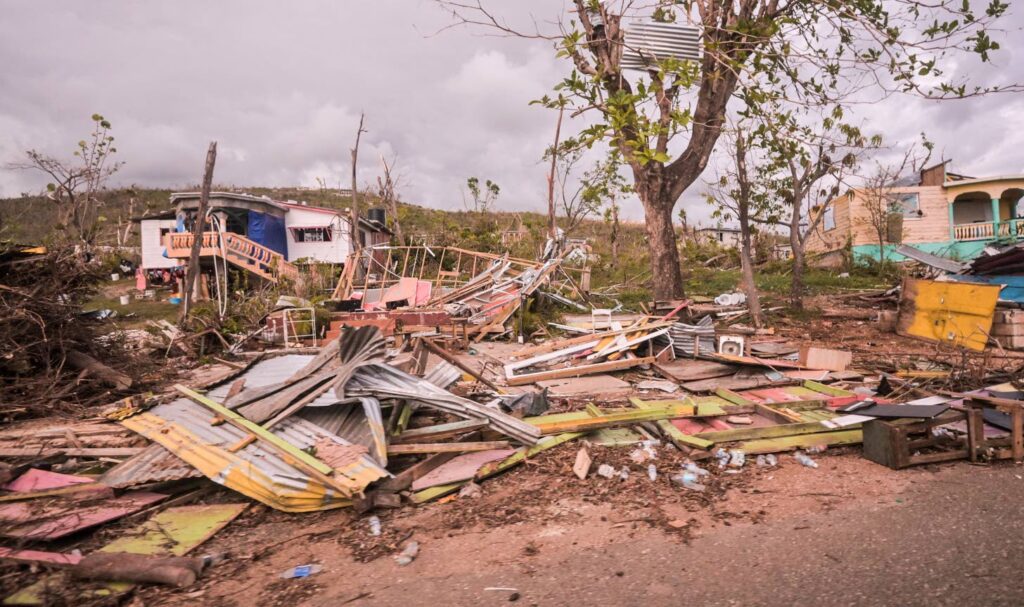
WITH the start of the 2026 Atlantic hurricane season mere weeks away and Jamaica still in the throes of recovering from Hurricane Melissa, civil engineer Dr Christopher Burgess says Jamaicans who “remain fragile” because of land tenure issues and the readiness of key institutions for another weather system are cause for real concern.
“There are about 30,000 homes that were totally destroyed. Majority of them, 90 per cent of them essentially, did not have secure land tenure. Nationally, there are 200,000 families that do not have secure land tenure — and tied to land tenure is fragility. They build with board house, not because they necessarily want to have a board house but because that’s what they can afford…it’s a land tenure issue,” Burgess said last Thursday.
He was a panellist in the National Resilience Dialogue Series.
The series, put on by the Higher Education Task Force for Disaster Resilience, brings together thought leaders in the private and public sector to discuss how Jamaica can rebuild stronger.
Noting that the first hurdle remains the issue of helping those 30,000 families that were wiped out by Melissa last October, Burgess pointed out that on a national scale, there are some 200,000 families that “live in these precarious situations”.
“If Melissa had gone down the centre of the country the way [Hurricane] Gilbert did [in 1988], we wouldn’t be dealing with 30,000 homes totally damaged, we would be dealing with more like 150,000 homes — so that’s the biggest problem I see facing us,” the respected professional stated.
“We remain fragile. And when you look at the numbers we’re just as fragile as we were with Gilbert, and we have to address that. Added to that would be our institutional readiness for another hurricane. I don’t believe we were ready for Melissa. Some would say, ‘Oh, we could never be ready for it.’ Well, I don’t believe we’ll be ready for another hurricane if it happened like that this year or next year. I believe that our disaster management systems are geared to responding to something more suited 30 years ago, 40 years ago,” he pointed out.
Said Burgess, “What we’re coping with now, in terms of another problem, is that in the last 30 years we have three times as many intense hurricanes per decade; and in terms of damage, we’re experiencing four times as much damage — from [$]2 billion each decade to now about [$]8 billion a decade nationally. You can’t respond with the same tool that you had 30 years ago, so that’s another problem.”
In the meantime, civil engineer Dr Omar Thomas, when asked what is the biggest problem facing the country in respect of the built environment, said: “I think one of the biggest problems is that we find that many buildings, many structures, are still not being built to the required engineering design standards.”
According to Thomas, “This is largely due to affordability, also due to the general construction practice in certain areas, and also the level of enforcement that the relevant agencies are able to give.
“But…I hope that this discussion will push the desire for us to have a higher level of construction standard and a push for owners to not only have…the desire to design for everyday conditions but we have to look to design for extreme events such as earthquakes, hurricanes. And so I hope that out of this discussion will be a greater awareness and a greater push in the industry to design and to construct to the required standards,” he told moderator, journalist and attorney Dionne Jackson Miller.
Meanwhile, Dr Carol Archer, professor of urban planning and public policy at the University of Technology, Jamaica, in endorsing Burgess’s land tenure pitch, said: “Given our colonial history, that’s an area that we have failed our people miserably with. And if you look at the areas, Westmoreland in particular that was most affected by Melissa, you will see that Melissa brought to bear the whole question of how we own and how we access land, so that has to be dealt with in a serious way.”
According to Professor Archer, lawmakers should “revisit our policy and our legislation as it relates to issues around ownership”, as well as the approach to resettlement.
“If you look across the Caribbean — in Dominica, in some sections of Barbados — they were able to enact legislation, implement policy to relocate persons who were affected. We have not efficiently and effectively implemented relocation strategies. In fact, because of the work that is required — and we do have a relocation legislation but it has not been properly applied because, for one thing…at the community level the institutions that are supposed to be in place — the community based-organisations, the community development committees — those have been disempowered, and so to work through and work with communities, the question of empowerment for access to land and to provide relocation services, those are non-existent,” she stated.
Furthermore, Archer said homeownership remains out of reach for the average Jamaican.
“There’s the issue of affordability…what is it that the average Jamaican can afford? And we have been building units that the average Jamaican cannot afford. As it relates to land tenure, adequate and affordable housing, we need to concentrate our efforts going forward to make sure that the people of Jamaica, we are properly served by access to land and affordable and adequate housing,” she noted.
Burgess, weighing in on the issues raised by Archer, opined that land titling does not need to be a difficult or time-consuming process.
“I believe if there’s no dispute as to who owns the land and where they are, I’m not seeing where land tenure is an issue and so I don’t want us to say that’s going to prevent formalisation from going forward if there’s no dispute. So, let’s solve the informal things by giving them a home and titling them afterwards. The 2022 Registration of Titles, Cadastral Mapping and Tenure Clarification (Special Provisions) Act makes it quicker, it’s just for us to get the process going like LAMP [Land Administration and Management Programme] did in the past. They did 30,000 titles in a few years. I think we can get it done if we apply ourselves and build affordable solutions,” Burgess said.
Engineer Dave Allen, in agreeing with Burgess, said the resolution of security of tenure and settlement issues affecting Jamaicans is paramount.
“With close to one-third of the population in informal settlements, it is a serious condition of our nation…I think my last number when I checked, it was in the vicinity of 900,000 people who are living in informal settlements, and so what we really need is affordable housing for them, but we also need titling. But beyond that, Government needs to ramp up whatever system they have in place to maybe formalise these settlements, but it needs an aggressive push from Government,” Allen said, noting that the “housing crisis has gotten worse since Melissa”.
Hurricane Melissa, which is historically the most catastrophic hurricane ever to hit Jamaica, packing winds of 185 miles per hour, made landfall on October 28 near New Hope, Westmoreland, causing ruinous flooding across the southern and western belt of the island.
The system, which battered the parishes of St Elizabeth, Westmoreland, Hanover and Trelawny, in addition to Montego Bay in St James — with the most impacted being St Elizabeth and Westmoreland — exited the country via the north-western coast after wreaking indescribable damage to infrastructure, livestock, vegetation, and lives.
A section of Westmoreland after Hurricane Melissa’s rampage last October. Photo: Garfield Robinson
Syndicated from Jamaica Observer · originally published .
Legal context · powered by Jurifi
Get the legal angle on this story. Pick a prompt and Jurifi's AI will explain it using Jamaican law.
AI replies are based on Jamaican law via Jurifi. Not legal advice.