
France reaffirms support for Guyana as Venezuela border tensions persist
As Guyana celebrates its 60th anniversary of Independence, French President Emmanuel Macron has reaffirmed his country’s support for Guyana’s sovereignty and territorial integrity amid the ongoing border controversy with Venezuela.

In a congratulatory letter to President Dr. Mohamed Irfaan Ali, Macron extended warm wishes to the government and people of Guyana while highlighting the growing partnership between the two nations and their shared commitment to peace and cooperation within the Guiana Shield.
“France reaffirms its commitment to the respect for Guyana’s sovereignty and territorial integrity, in accordance with international law,” Macron stated, referencing the ongoing proceedings before the International Court of Justice (ICJ) concerning the Essequibo controversy.

The French president noted that the occasion also marks 60 years of diplomatic relations between Guyana and France, underscoring the strengthening ties between the two countries, particularly following the opening of the French Embassy in Georgetown in September 2025. France became the first European Union nation to establish a full embassy in Guyana, a move both governments described as a significant step toward deeper political, economic and cultural cooperation.
Macron also expressed optimism about expanding cooperation in justice, security and defence, while welcoming the participation of the French Armed Forces in French Guiana during Guyana’s Independence celebrations.
France, through neighbouring French Guiana, has increasingly positioned itself as a key regional partner for Guyana, particularly as tensions with Venezuela over the Essequibo region continue to simmer. French officials have repeatedly voiced support for Guyana’s territorial integrity and respect for international law. Last year, French Senator Cédric Perrin described Venezuelan incursions related to the border controversy as “not acceptable” and said France was prepared to deepen defence and intelligence cooperation with Georgetown.

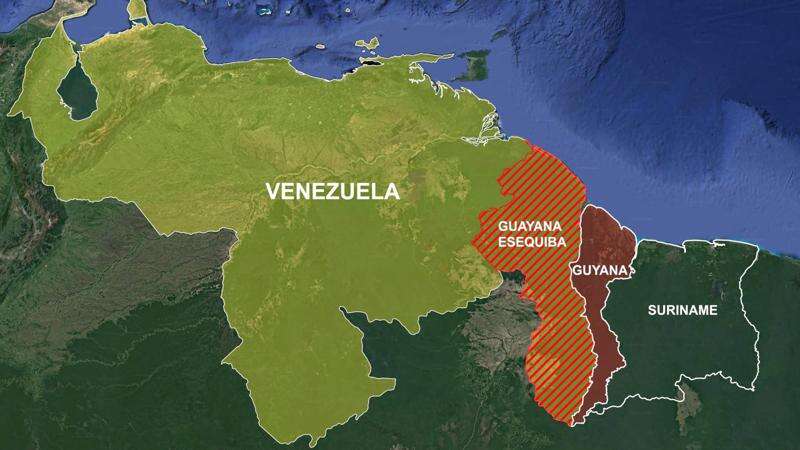
The decades-old territorial dispute centers on the Essequibo region, which makes up roughly two-thirds of Guyana’s landmass and is rich in natural resources, including oil and minerals. Guyana maintains that the border was legally settled by the 1899 Arbitral Award, while Venezuela argues the agreement was invalid. The matter is currently before the ICJ, where Guyana is seeking a final and binding ruling affirming the validity of the award.
France’s growing diplomatic engagement with Guyana also reflects broader strategic interests in the Caribbean and South America, particularly through its overseas department of French Guiana, which shares a border with Guyana. French officials have pointed to opportunities for closer collaboration in trade, climate resilience, sustainable development and regional security.
Macron said France looks forward to further strengthening ties with Guyana as the two countries continue working together on shared regional priorities and international cooperation.
Syndicated from Cnweekly · originally published .
Legal context · powered by Jurifi
Get the legal angle on this story. Pick a prompt and Jurifi's AI will explain it using Jamaican law.
AI replies are based on Jamaican law via Jurifi. Not legal advice.
Other coverage
Africa, The Global South & The Guyana-Venezuela Case
Jamaica Inquirer
Editorial | CARICOM’s free movement
Jamaica Gleaner
Guyana At 60: The Oil Is Flowing. So Why Are Guyanese Buying Tennis Rolls On Credit?
Jamaica Inquirer
France’s parliament votes to repeal slavery-era Black Code
Jamaica Gleaner
Editorial | Engage with France on reparations
Jamaica Gleaner