
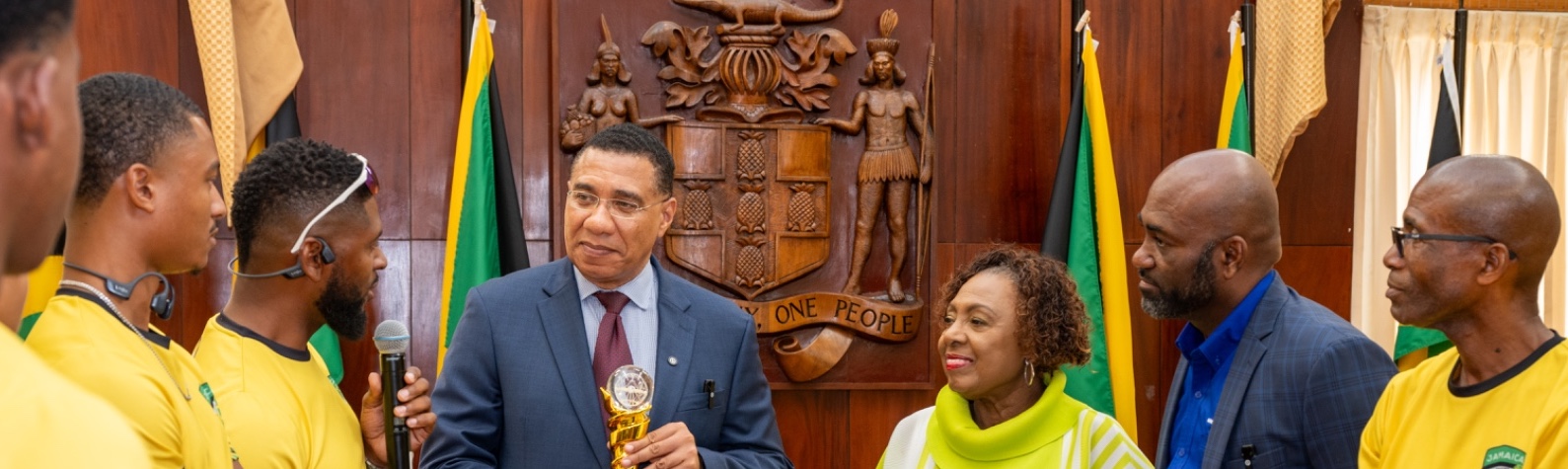
Holness welcomes Jamaica Drone Soccer Team
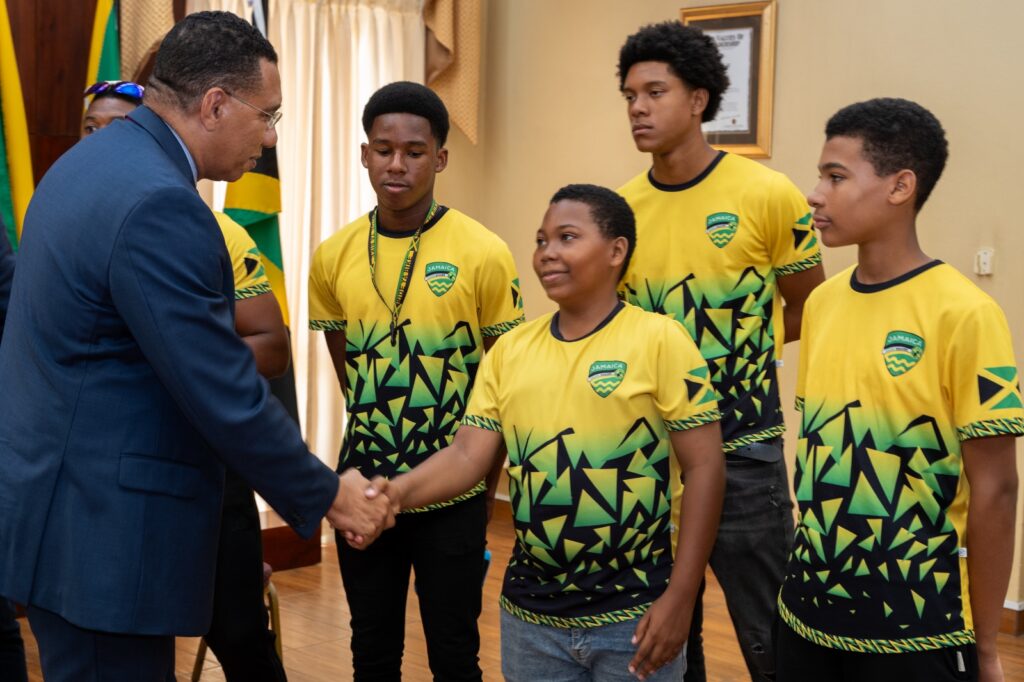
Sport advances STEM Innovation in Jamaica
Jamaica’s technological future was on full display at Jamaica House as members of Jamaica Drone Soccer staged an impressive live demonstration for Prime Minister Dr. the Most Honourable Andrew Holness and senior government officials, showcasing how drone technology, robotics and esports are opening new frontiers for STEM education, innovation and youth development across the island.
The showcase underscored the growing global influence of drone soccer, a technology-driven sport that combines aviation, coding, engineering and competitive strategy, while positioning Jamaica as a rising force in one of the world’s fastest-growing STEM-based disciplines.
Also in attendance were Minister of Culture, Gender, Entertainment and Sport Hon. Olivia ‘Babsy’ Grange and Minister without Portfolio in the Office of the Prime Minister with responsibility for Science, Technology and Special Projects Hon. Dr Andrew Wheatley, signalling the Government’s increasing commitment to digital transformation and technology-centred opportunities for young Jamaicans.

“This is where the future is heading. We have to create opportunities that connect young people to technology, innovation and creativity,” Prime Minister Holness said following the demonstration.
“It has become increasingly difficult to engage young people through traditional methods, but electronic sports and technology-based activities are helping to create new pathways,” he added.
The visit marked a major milestone for Jamaica Drone Soccer, whose rapid international success is now drawing attention to the country’s expanding role in advanced technology, education and competitive drone sports.
Prime Minister Takes Flight
One of the standout moments of the visit came when Prime Minister Holness personally flew one of the drones during the live demonstration, interacting enthusiastically with team members while learning about the precision, strategy and technical skill required in the sport.
Captain Carl Heron and Deputy Captain Timothy Lee led the demonstrations, guiding officials through aerial manoeuvres, defensive formations and scoring tactics that have helped Jamaica gain international recognition in the emerging discipline.
“This is not just a game. What I am seeing here is engineering, discipline, teamwork and innovation all working together. These are the kinds of skills we want our young people to develop for the future economy,” Holness said.
The demonstration reinforced how drone soccer is bridging sport and education while exposing young Jamaicans to real-world applications in engineering, robotics, aviation and digital technology.
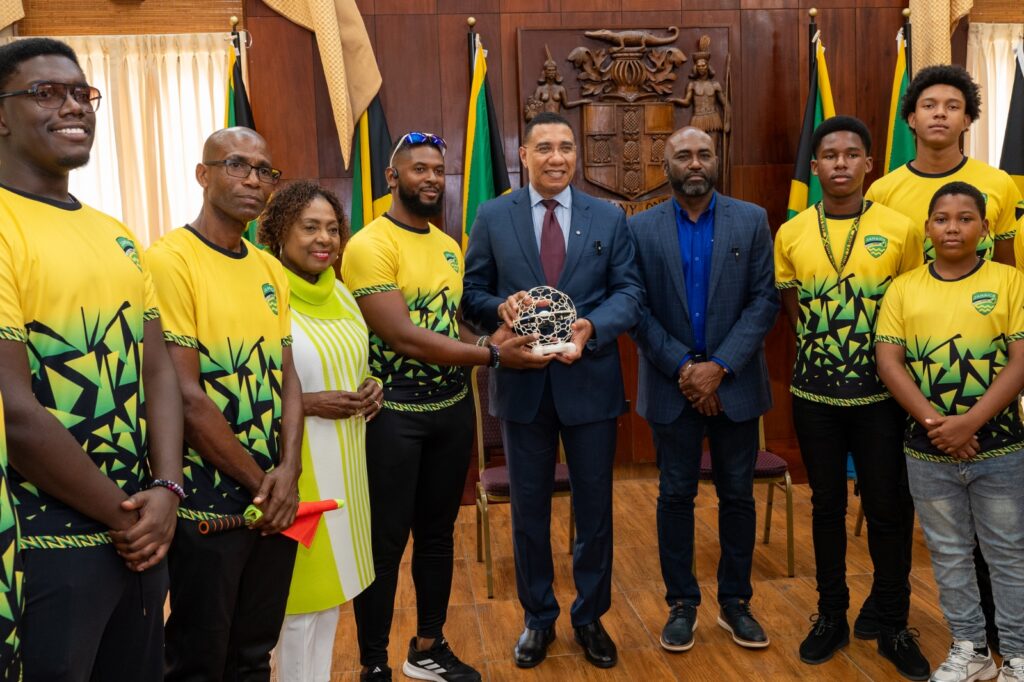
Jamaica Drone Soccer’s Rapid Rise
Founded under the leadership of Dervon McKellop Chief UAS Consultant at DRIFT Enterprise UAV Services and Jamaica Drone Soccer’s President and Coach, Jamaica Drone Soccer was established with the vision of introducing advanced drone technology and esports training to young Jamaicans while positioning the country competitively on the international stage.
“This organisation was built to give young Jamaicans access to opportunities in technology that they may never have imagined possible. Drone soccer is more than competition, it is education, innovation and career development wrapped into one experience,” McKellop said.
In less than a year, the organisation has grown into what has been described as the Caribbean’s only national drone soccer programme.
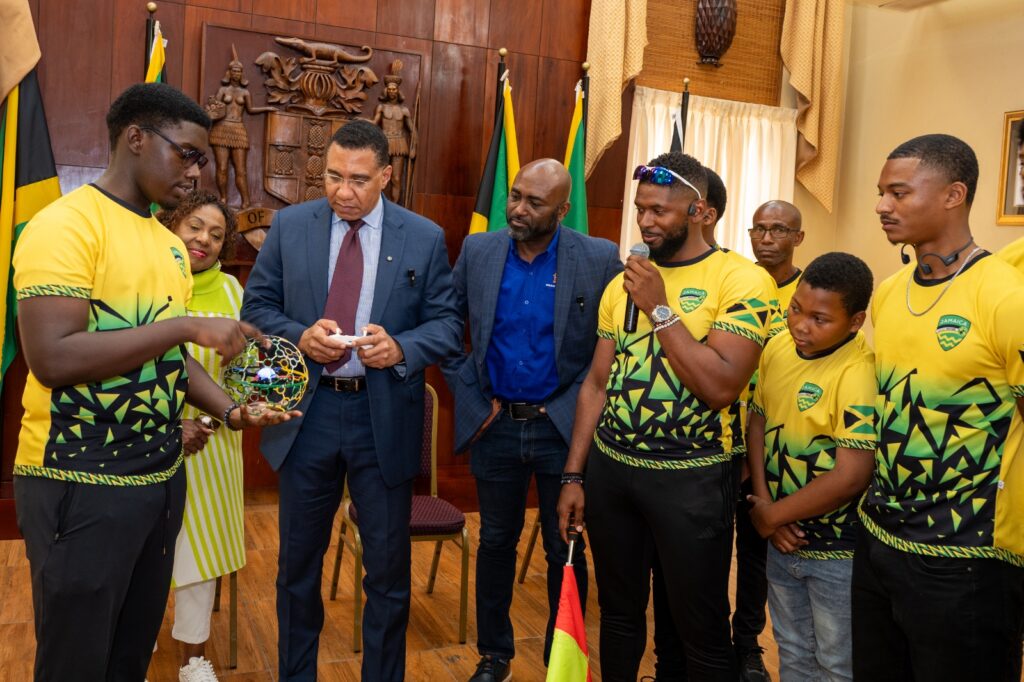
The team has already earned major international recognition after capturing gold earlier this year at the International Palm Springs Drone Fest in California, where Jamaica defeated teams from the United States, Canada, Mexico and Kazakhstan.
Jamaica’s squad also introduced a tactical system known as the “iI Formation,” developed locally by the team and credited as one of the key strategies behind its international success.
“We wanted Jamaica to stand out internationally, not just by competing, but by innovating. The ‘i Formation’ showed that we can create our own strategies and compete with the best teams in the world,” McKellop said.
The organisation’s rapid growth has drawn attention from countries across the Caribbean and beyond, with groups from Barbados, Turks and Caicos, Trinidad and Tobago, the British Virgin Islands and Ghana seeking guidance from Jamaica on developing their own drone soccer programmes.
Government Support for Innovation and STEM
The courtesy call to the Office of the Prime Minister represented more than symbolic recognition for the team.
For Jamaica Drone Soccer, the visit validated a year of hard work, innovation and personal sacrifice from team members and administrators who have worked to build the programme despite limited resources.
Minister Grange praised the initiative for blending sport with education and technology development.
“This is exactly the kind of innovation we want to encourage among our young people. Drone soccer introduces students to science and technology in an exciting and practical way while also promoting teamwork, discipline and creativity,” Grange said.
She added that programmes like Jamaica Drone Soccer can help expand opportunities for youth participation beyond traditional sporting disciplines.
Team Members Inspiring the Movement
Among the personalities drawing attention during the visit was Keith Carter, the oldest member of Jamaica Drone Soccer.
At 60 years old, Carter, a former police officer who retired from the Jamaica Constabulary Force in 2025 but continues to serve as a consultant, said his involvement in the association has given him a renewed sense of excitement and freedom.
“I enjoy being a part of the association because of the freedom it affords me,” Carter said. “You are always learning something new and working with young people who are passionate about technology and innovation.”
His participation has become a symbol of the sport’s inclusivity and broad appeal, demonstrating that drone soccer transcends age and professional background.
Drone Soccer and the Future of Education
Drone soccer was originally developed in South Korea as a STEM and STEAM educational platform aimed at introducing students to science, technology, engineering, arts and mathematics through competitive play.
Unlike traditional sports, participants must understand drone assembly, flight control systems, coding, robotics and communication strategy.
Played inside enclosed arenas using protective-caged drones, the sport challenges players to score goals while defending against opposing teams in fast-paced aerial competition.
Internationally, drone soccer continues to expand rapidly across Asia, Europe, North America and Africa, with governing organisations working to establish world championship structures and standardised competition rules.
For Jamaica, the educational potential is significant.
Programmes connected to drone soccer can expose students to aviation technology, robotics, coding, artificial intelligence and digital problem-solving skills that are increasingly important in the global economy.
“Technology is the future, and we want Jamaican youth to be prepared for it. Drone soccer creates a pathway for students to become innovators, engineers and creators while learning in an environment that is exciting and competitive,” McKellop said.
Jamaica Drone Soccer has already started introducing pilot programmes in schools, including initiatives in western Jamaica aimed at exposing high school students to drone operations and advanced technology training.
International Ambitions and Upcoming Competitions
Jamaica Drone Soccer is preparing for continued participation in international tournaments under the Federation of International Drone Soccer Association (FIDA), including the Intercontinental cup to be held in South Korea in July this year, the birthplace of the sport.
The organisation is also working to expand inter-school drone soccer competitions across Jamaica over the next two years as part of efforts to build a sustainable national programme.
“Our goal is to make Jamaica a regional hub for drone sports and STEM innovation. We want young Jamaicans to see technology not just as entertainment, but as a career path and a way to transform their future,” McKellop said.
How Jamaicans Can Support the Team
Despite its growing international success, Jamaica Drone Soccer continues to face challenges related to funding for equipment and travel expenses. In fact, the organization has started GoFundMe to raise the funds need to cover expenses for the upcoming intercontinental cup. The organisation hopes increased national awareness and corporate partnerships will help Jamaica become a regional leader in drone technology, robotics and esports education.
Syndicated from Our Today · originally published .
Legal context · powered by Jurifi
Get the legal angle on this story. Pick a prompt and Jurifi's AI will explain it using Jamaican law.
AI replies are based on Jamaican law via Jurifi. Not legal advice.
Other coverage

UTech, Jamaica in partnership with MIIC & Barita Foundation host “Know Your Numbers” Pitch to strengthen financial literacy among MSMES
University of Technology, Jamaica
From shipping software to national impact - ADVANTUM's Calmin Scarlett joins JTDA Council
Jamaica Gleaner
Terrelonge welcomes Fraser-Pryce’s participation in 11th Biennial Jamaica Diaspora Conference
Jamaica Observer
UTech, Jamaica hosts Research, Technology and Innovation Day… highlighting impactful STEM research by Faculty and Students
University of Technology, Jamaica
Jamaica’s Men’s Curling Team Wins Historic Medal in Scotland
Jamaicans.com