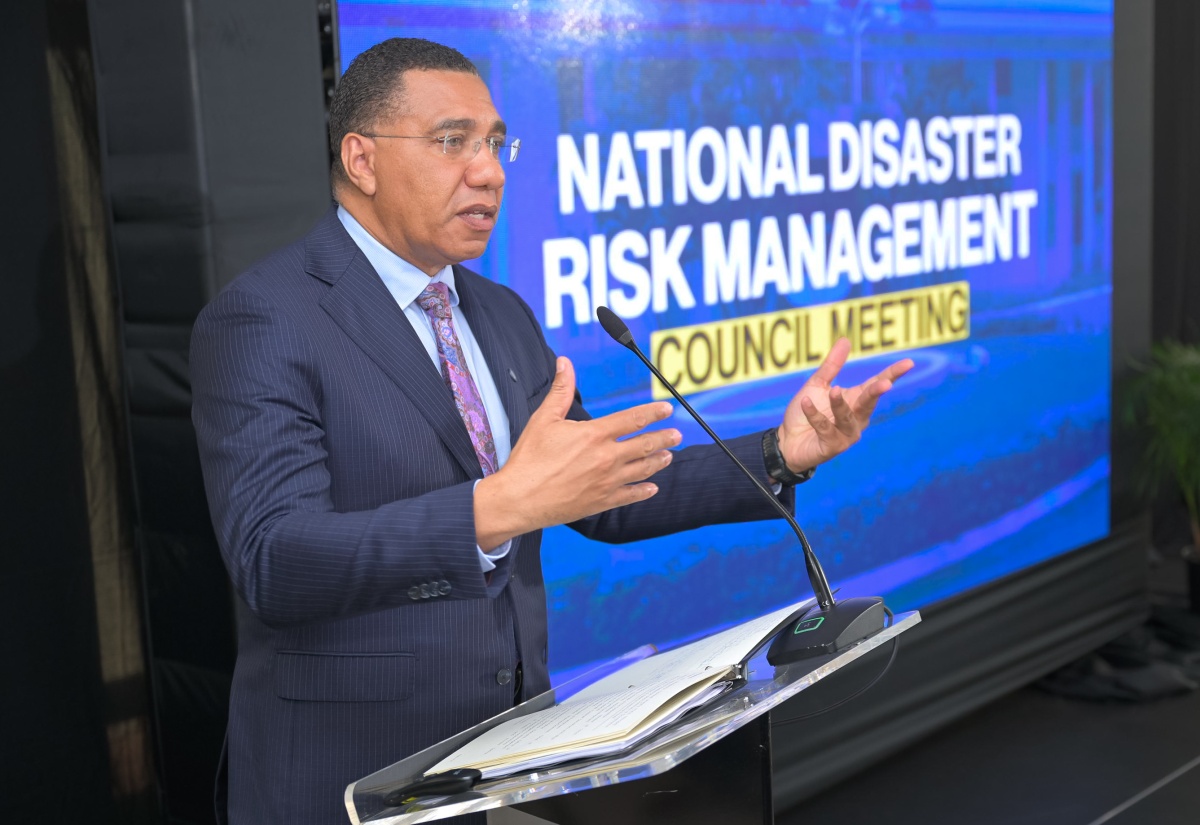

“The objective of the State is to preserve life. I want that to be the default position. We do not pay taxes to fund the police force for it to be the instrument that takes life or for any arm of the State for that matter. The objective is for the police force to preserve and protect life.” -Prime Minister Holness
Prime Minister Dr. the Most Honourable Andrew Holness says the preservation of life and professional standards must remain the defining principles of modern policing, stressing that while officers operate in high-risk environments requiring rapid tactical judgment, the use of force must remain lawful and proportionate.
Addressing the 91st Staff and Junior Command Course graduation ceremony at the National Police College of Jamaica today, Prime Minister Holness reflected on the recent fatal police shooting of Latoya Bulgin in Granville, St. James, and urged greater judgment, accountability, discipline, and command supervision within the Jamaica Constabulary Force (JCF).
The Prime Minister extended condolences to the family and community of Ms. Bulgin and noted the deep national concern generated by the incident, which has also attracted international attention.
“The objective of the State is to preserve life. I want that to be the default position. We do not pay taxes to fund the police force for it to be the instrument that takes life or for any arm of the State for that matter. The objective is for the police force to preserve and protect life,” Prime Minister Holness said.
The Prime Minister welcomed the swift administrative action taken by the police high command, including the interdiction of the officer involved, while emphasizing that the ongoing investigation must proceed independently, thoroughly, and transparently. He noted that Jamaica’s establishment of an independent investigative mechanism through INDECOM marked a significant advancement in accountability and public oversight of the State’s use of force.
Prime Minister Holness told the graduating officers that leadership within the JCF must ensure that officers do not approach policing with a mindset inclined toward the taking of life but instead with a professional commitment to lawful service and protection of citizens.
“There are some officers who might go out with the default position that they intend to take life. But as leaders, you must quickly identify those and correct that false notion that they have. That is your core duty as leaders, and therefore, having INDECOM established, sent a clear signal that the state of Jamaica and the agents of the state of Jamaica will be held to account for the unlawful taking of life. Any police involved in shooting or killing will be independently investigated to give assurance to the public that the State is not a purveyor of violence and not a purveyor of the ultimate violence, which is that of taking a life.”
At the same time, the Prime Minister underscored the realities confronting modern policing in Jamaica, including heavily armed gangs, transnational criminal networks, illicit firearms, and high-risk operational environments. He noted that officers are often required to make split-second decisions in volatile circumstances where threats can emerge rapidly and unpredictably.
The Prime Minister said these repeated exposures can create a state of hypervigilance among officers, which, while necessary for survival in dangerous situations, must be properly managed through training, supervision, discipline, and strong command culture.
“Understanding this reality is not the same as excusing error, indiscipline, or unlawful conduct. It is precisely because the environment is difficult that training, judgment, supervision, and accountability must be stronger,” he stated.
Prime Minister Holness also pointed to the Government’s sustained investments in strengthening the JCF, including expanded recruitment, advanced tactical training, intelligence capabilities, mobility, technology, and infrastructure. He said the Force has now reached its full establishment of 14,000 officers for the first time in its history.
The Prime Minister said the JCF today possesses some of the most advanced tactical capabilities in the region and reiterated that the State must maintain sole authority over the lawful use of force. However, he cautioned that tactical proficiency alone is insufficient without disciplined operational habits and sound decision-making.
Referencing the concept of “muscle memory” in tactical operations, Prime Minister Holness said repeated training shapes instinctive responses in high-pressure situations. He emphasized that the Force must remain vigilant in eliminating harmful operational habits and reinforcing lawful, professional conduct through continuous training and correction.
“Tactically, when you take on the criminals, you must win. And in terms of your daily operations and your interactions, you must maintain your integrity and professionalism,” he added.
Dr. Holness reminded the graduating officers that as middle managers and junior commanders, they will play a critical role in shaping the culture, conduct, and professionalism of the Force at the frontline level. He said leadership within the JCF must ensure that officers are not only brave and assertive but also controlled, disciplined, and capable of distinguishing genuine threats from civilians who may be frightened, confused, or vulnerable.
Prime Minister Holness urged the graduating officers to embrace the transformational responsibility of leadership within the Force, emphasizing that public confidence in policing depends not only on the JCF’s ability to confront criminality but also on its commitment to professionalism, restraint, accountability, and respect for human life. He said the continued strengthening of the Force must ultimately reinforce trust between the police and the Jamaican people while safeguarding the rule of law and the security of the nation.