
ETOC chief says Jamaica still lacks real fixes for boys’ school lag
Jamaica’s Primary Exit Profile (PEP) results keep improving overall, yet the country still has no clear answer to boys’ longstanding weaker showing in school. That gap prompted Education Transformation Oversight Committee (ETOC) Chairman Dr Adrian Stokes to say “a lot more” is needed to narrow an advantage that still sits with girls.
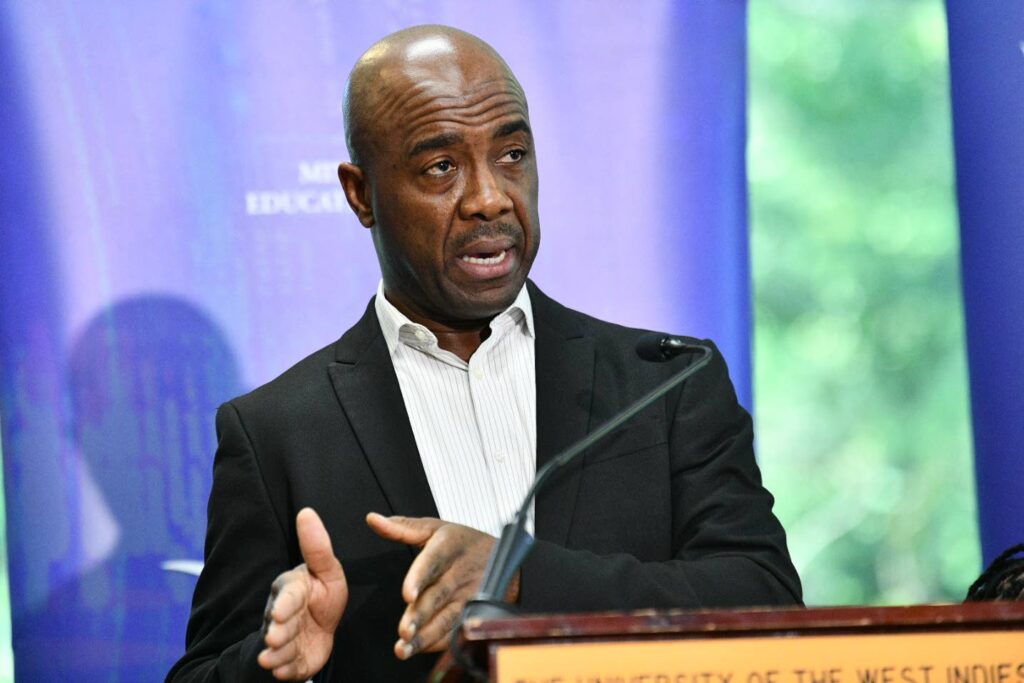
Stokes spoke at ETOC’s quarterly media briefing at The University of the West Indies’ Regional Headquarters last week. He said one of Jamaica’s hardest education problems remains open: boys keep falling behind girls in major measures, even after years of study.
This year’s mathematics figures made the split plain. Some 64.9 per cent of girls reached the “proficient” mark, against 57.2 per cent of boys. At the top end, 8.3 per cent of girls were rated “highly proficient,” slightly ahead of 7.7 per cent of boys. Boys were more heavily represented in the weaker performance bands.
For Stokes, the divide is no longer just another data point.
“The girls continue to outperform the boys in statistically significant ways. It’s not even close. The [Orlando] Patterson report highlights this issue, and indeed, all the entities that have taken a deep dive looking into the Jamaican education system — like the UNICEF report, the 2022 report — point out that Jamaica is one of the few places globally where girls outperform boys in mathematics, for example,” he said.
He recalled that the Orlando Patterson-led education review had probed the problem and flagged several social and psychological pressures on boys. Jamaica, he said, has still not built focused programmes strong enough to turn the pattern around.
“The Patterson report argued that the root cause was not favouritism. It’s not like girls are being given some advantage, knowingly. Rather, what the report highlights is that our boys, through social circumstances, or their abusive upbringing, cultural norms, but generally, let’s say, psychosocial issues that are putting our boys at a disadvantage… So the bottom line is, we have more work to do to find solutions that can close the gender performance gap,” he added.
The Ministry of Education has lately said it will set up a committee to look at how boys are taught. Stokes cautioned that the move alone would not solve the problem.
“We need to do a lot more than that… Let’s say that’s a first step, hopefully, to something meaningful… We need real initiatives. We need to pilot different ideas. As I said, I am not certain that anyone has a full slate of answers… The question is, how do we respond? Or, how do we modify or evolve the education system to accommodate these psychosocial issues that are playing out in society? So, hopefully, it’s a step in the right direction, but I’m not expecting, just from that committee, to see significant change, a lot more needs to happen,” Stokes noted.
Permanent secretary in the Ministry of Education, Skills, Youth and Information Dr Kasan Troupe backed a sharper focus on boys, saying biology and social context both shape how they learn. She said the ministry is already reviewing shifts in how lessons are delivered, how classrooms are set up, and how teachers are prepared.
“So, particularly, we have been talking about how we socialise our boys. Boys learn differently, boys like competition, and so that means our teachers have to be retooled. They have to be trained — we need the bingos, we need the dominoes, we need movements. There’s a whole raft of measures that we have to look at as it relates to how we are going to support our boys,” she said.
State minister Rhoda Moy Crawford was more upbeat, saying she expects the planned committee to deliver concrete gains and pointing to ETOC’s record since it was formed. She also found encouragement in the newest PEP outcomes.
“I know this committee that will be put in place to examine what we can do differently to benefit our boys, I know it will be a solid committee…and I’m also motivated by the fact that when we look at our recent PEP results, our top 10 students, out of those 10 students, seven were boys. So all is not lost,” she said.
Syndicated from Jamaica Observer · originally published .
Legal context · powered by Jurifi
Get the legal angle on this story. Pick a prompt and Jurifi's AI will explain it using Jamaican law.
AI replies are based on Jamaican law via Jurifi. Not legal advice.