
OT Equity Analysis | Alphabet’s sell-off shows AI leadership is no longer guaranteed
Alphabet, the parent company of Google, has become the stock of the day for a reason that goes beyond a normal market pullback. The company is now at the centre of one of the most important debates on Wall Street: can the original internet search giant remain a leader in the artificial intelligence era?
For years, Alphabet was viewed as one of the safest ways to own the digital economy. Google Search, YouTube, Android and its advertising platform gave the company a level of scale, data and cash generation that few businesses in the world could match. It was not just a technology company. It was one of the most profitable toll roads on the internet.
But the market is now asking a harder question. In a world where artificial intelligence is changing how people search, create content, write software and interact with information, Alphabet is no longer being judged only by the strength of Google Search. It is being judged by whether it can defend its position against OpenAI, Anthropic, Meta, Microsoft and other aggressive AI competitors.
That is why the recent weakness in Alphabet’s share price matters.
The stock has come under pressure after reports that key artificial intelligence researchers have left Google DeepMind for rival AI companies. In normal circumstances, the departure of a few employees would not be enough to unsettle a company of Alphabet’s size. But in the current market, AI talent is being treated almost like strategic infrastructure. The engineers and researchers building frontier models are now seen as part of the competitive moat.
For investors, this creates a new risk. Alphabet still has enormous resources, but money alone may not be enough if the best AI talent believes the most important work is happening elsewhere. The market is not only pricing earnings today. It is pricing confidence in who will lead the next decade of technology.
This is a major shift for Alphabet.
For most of its public life, the company enjoyed the benefit of doubt. Its core advertising engine generated so much cash that investors could tolerate experimental spending in areas such as self-driving cars, cloud computing, hardware and moonshot projects. Today, that patience is being tested. Artificial intelligence requires massive investment in data centres, chips, research teams and infrastructure. At the same time, investors want proof that this spending will produce strong returns.
That is the tension now sitting inside Alphabet’s stock.
The bull case remains strong. Alphabet has one of the largest user bases in the world, deep technical talent, leading AI research history, a powerful cloud business and unmatched distribution through Search, Gmail, YouTube, Android and Chrome. If the company successfully embeds AI across its products, it could defend its advertising franchise while opening new revenue streams across cloud, productivity tools and enterprise software.
In that scenario, the current sell-off may eventually look like an overreaction. Alphabet still produces significant cash flow, owns world-class assets and has the balance sheet to compete aggressively. Few companies can fund AI investment at the scale Alphabet can.
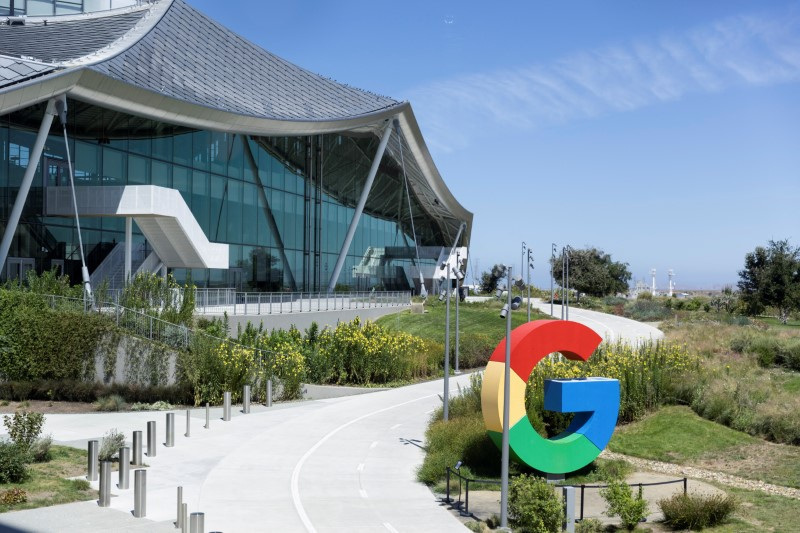
But the bear case has become more credible. Search is no longer seen as untouchable. AI chatbots and answer engines could gradually change how users find information online. If fewer people click through traditional search results, Alphabet’s advertising model could face pressure. At the same time, the company may be forced to spend more money just to defend its existing position, reducing the margin profile that investors have historically loved.
The talent issue adds another layer. If leading researchers continue to leave for younger AI companies, it may feed the perception that Alphabet is no longer the natural home for the most ambitious AI work. Perception matters in technology. Once investors begin to question whether a company is losing its edge, even strong financial results can be viewed with more caution.
This is what makes Alphabet today’s stock to watch. The company is not in trouble in the traditional sense. It remains one of the strongest businesses in the world. But the market is beginning to treat Alphabet less like an untouchable monopoly and more like a company that must prove it can win the next platform shift.
For long-term investors, the question is not whether Alphabet is still profitable. It clearly is. The question is whether the company can convert its scale into AI leadership without damaging the economics of its core business.
That is a much harder test.
Alphabet’s sell-off is therefore not just about one trading day or one group of employee departures. It is about whether Wall Street still believes Google can move from being the king of search to being one of the kings of artificial intelligence.
For now, the market is sending a clear message: in the AI era, even the strongest technology companies have to re-earn their premium.
Syndicated from Our Today · originally published .
Legal context · powered by Jurifi
Get the legal angle on this story. Pick a prompt and Jurifi's AI will explain it using Jamaican law.
AI replies are based on Jamaican law via Jurifi. Not legal advice.
Other coverage

Funded and Focused Episode 81
PBC Jamaica (Video)Watch
Funded and Focused Episode 77
PBC Jamaica (Video)Watch
Tropical Battery Company Limited (TROPICAL) Completes J$950 Million Sale-Leaseback of Ferry Road Headquarters
Jamaica Stock Exchange
Caribbean Dilemma – Growing Older Before Growing Rich
Jamaica Inquirer
Funded and Focused Episode 82
PBC Jamaica (Video)Watch