


July 21, 2026
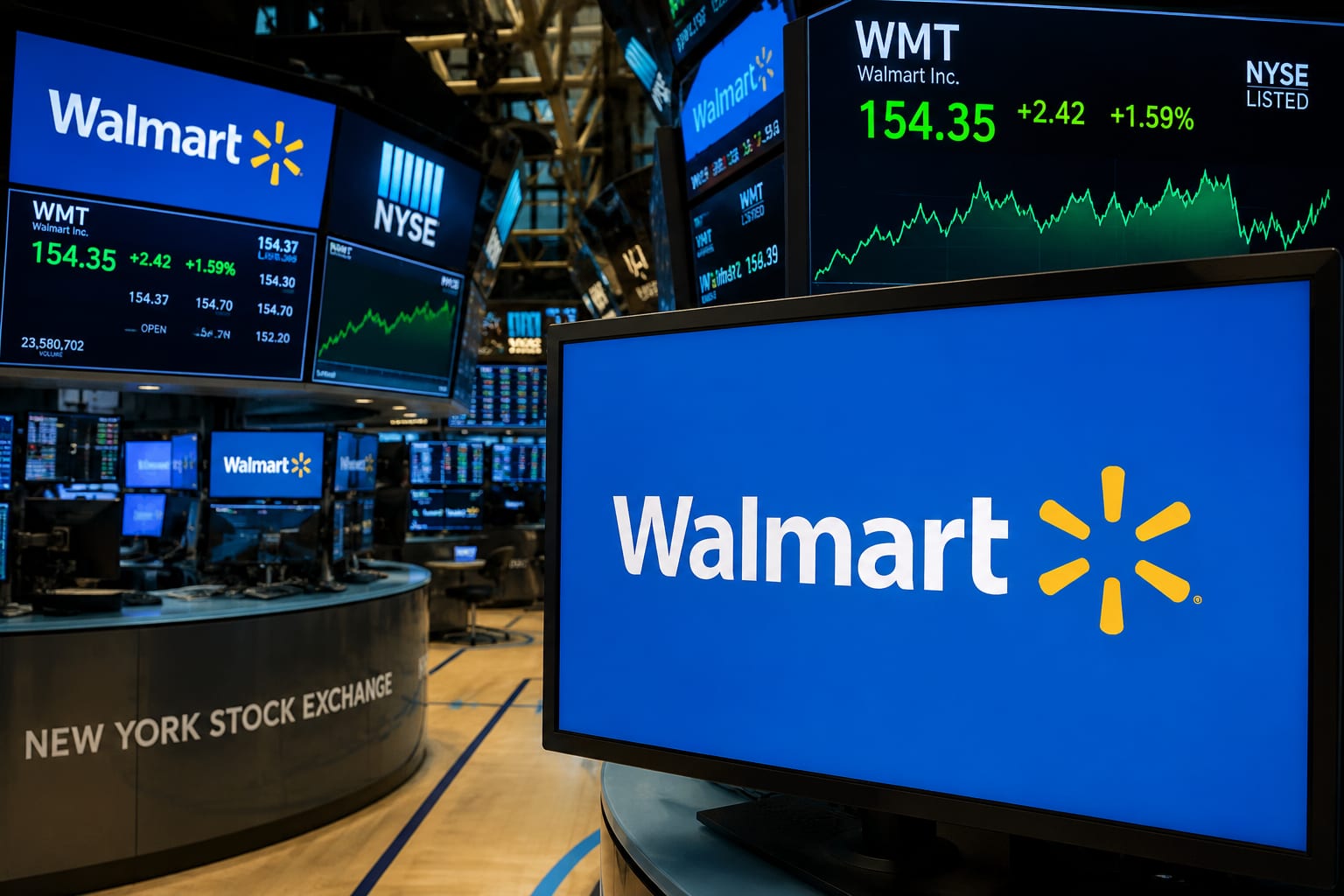
Walmart shares have spent the summer giving back some of their earlier gains, trading near $112 as of this week, down from an all time high above $135 set in May. The pullback has come alongside broader market jitters over tariff policy, food safety headlines following a lettuce recall, and a reshuffling of senior operational leadership in the United States business. None of it changes the underlying story. Walmart remains the largest retailer in the world by revenue, and the numbers coming out of its most recent quarter suggest the company is still finding ways to grow even from an already enormous base.

The Numbers
For the quarter ended April 30, 2026, Walmart reported revenue of roughly $175.7 billion, up just over 6 percent from the same period a year earlier and in line with what analysts had modelled. Adjusted earnings per share came in at $0.66, matching consensus. Management held to its full year adjusted earnings guidance of around $2.80 per share at the midpoint, a signal that the business is performing broadly as expected even with a more cautious consumer backdrop. Guidance for the following quarter, at roughly $185.4 billion in revenue, landed a touch below what the Street had modelled, which is likely part of what has weighed on the stock since.
The composition of that growth is worth dwelling on. Walmart has spent the past several years building out higher-margin businesses alongside its core grocery and general merchandise operations, namely advertising through Walmart Connect and membership income from Sam’s Club and Walmart+. Those segments carry better economics than shelf sales of paper towels and cereal, and they are a large part of why operating income has been growing faster than revenue even as the top line decelerates from its post-pandemic pace. The company has publicly targeted operating income growth in the high single digits this year, a level that would have been difficult to imagine for a grocery-heavy retailer a decade ago.
Reading the Valuation
At current levels, Walmart trades at close to 40 times trailing earnings, a rich multiple for a company most people still think of as a low-margin grocer. That multiple only makes sense once the market’s expectations are separated from the historical business. Investors are increasingly pricing Walmart the way they would a diversified platform business, one that happens to move groceries as its largest single activity but that also runs a growing retail media network, a logistics and fulfilment operation increasingly rented out to third parties, and a membership model with recurring, high-visibility cash flow. Whether that premium is justified is the real question for anyone considering the stock today. A 40 times multiple leaves little room for execution missteps, and the stock’s retreat from its May highs suggests the market is already testing that proposition.
For context, the stock underwent a three-for-one split in early 2024, which is why the per-share price looks modest relative to the company’s roughly $890 billion market capitalisation. Walmart also continues to pay a dividend, though the yield, at under 1 per cent, is not the reason anyone owns this stock today. The appeal is growth and margin expansion within a business most had assumed had matured long ago.

What Could Go Wrong
The risks are not exotic. Tariff policy remains an overhang for any retailer with significant import exposure, and management has been candid that pricing decisions this year have had to account for a moving policy backdrop out of Washington. The recent departure of the Walmart U.S. chief operating officer adds a layer of execution risk at a business unit that still drives the bulk of company profit, even if the succession appears orderly. And a business this large, this dependent on consumer spending patterns holding up, is inherently exposed to any broader softening in the American economy, particularly among the lower- and middle-income households that make up a large share of Walmart’s customer base.
There is also the more structural question of how much further the advertising and membership businesses can scale before their growth rates start to look like every other mature retail media platform. Amazon, Target, and increasingly Kroger are all chasing the same advertising dollars, and Walmart’s edge there, its sheer footfall and data on real-world purchasing behaviour, is significant but not permanent.
The Takeaway
Walmart is not a cheap stock, and it was not built to be one anymore. The company has successfully repositioned itself from a pure discount retailer into something closer to a diversified consumer platform, and the market has rewarded that shift with a valuation more typical of a technology-adjacent business than a grocer. The quarter just reported did nothing to undermine that narrative, but it did not accelerate it either, which is likely why the stock has cooled off from its highs. For investors already holding the name, there is little in the recent numbers to prompt a rethink. For those considering a new position, the entry point is more attractive than it was in May, though the multiple still demands that the higher-margin businesses keep delivering.
This analysis is for informational purposes and does not constitute investment advice. Prices and figures cited are as of July 21, 2026 and are subject to change.
Syndicated from Our Today · originally published .
Legal context · powered by Jurifi
Get the legal angle on this story. Pick a prompt and Jurifi's AI will explain it using Jamaican law.
AI replies are based on Jamaican law via Jurifi. Not legal advice.
Other coverage

Derrimon sales down a third, even as it moves beyond write-down
Jamaica Gleaner
AI stocks lead Wall Street higher, even as Brent oil’s price tops US$91
Jamaica Gleaner
Infantino’s enlarged World Cup gamble pays off with punters
Jamaica Observer
Editorial | PAAC falls short on Students’ Loan Bureau
Jamaica Gleaner
Lovers scoring during World Cup
Jamaica Star