

Douglas Levermore | On the Outside looking In: Will the Caribbean be left out of the AI sweepstakes?
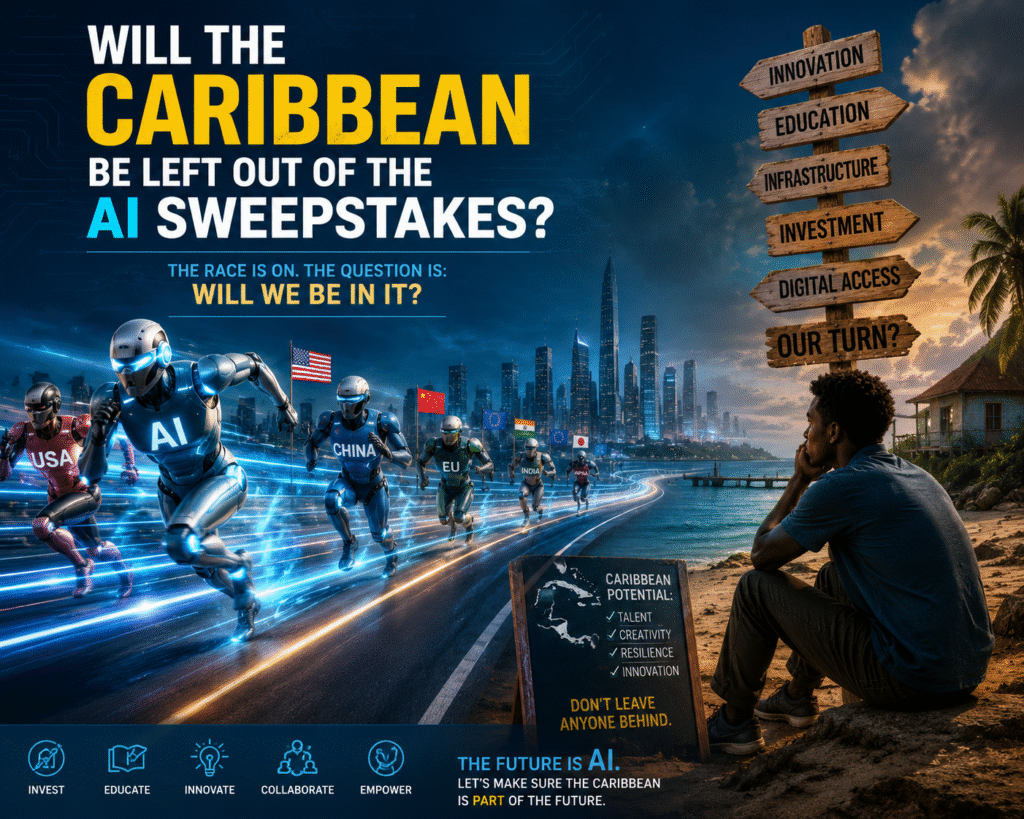
“The future is already here. It’s just not evenly distributed.” — William Gibson, Author
Every generation eventually encounters a technological wave so powerful that it reshapes industries, labour markets, education systems, political conversations, and even the rhythms of everyday life.
The steam engine transformed manufacturing. Electricity rewired society. The automobile redesigned cities. The internet revolutionised commerce, communication, entertainment, and finance within a single generation. Artificial Intelligence (AI) now appears poised to become the next great disruptive force, and unlike many previous innovations, this one is moving at breathtaking speed.
The problem for the Caribbean is not whether AI will arrive. AI is already here. The real question is whether the region will participate meaningfully in building this new economy or whether it will simply become another customer purchasing technologies designed, owned, and controlled elsewhere.
That distinction matters far more than many people realise.
When people casually use the term “AI,” they often imagine futuristic robots walking through offices, self-driving cars silently navigating city streets, or machines suddenly becoming sentient like something from a science fiction film. In reality, Artificial Intelligence is already deeply embedded in systems people use every day. Recommendation engines on Netflix and YouTube use AI. Fraud detection systems in banks rely on AI. Navigation systems, voice assistants, customer service chatbots, medical diagnostics, and the social media algorithms shaping public discourse are all increasingly powered by AI systems operating quietly in the background.

AI refers to computer systems capable of performing tasks that normally require human intelligence. These systems recognise patterns, analyse enormous amounts of data, generate language, solve problems, predict outcomes, and continuously improve through learning processes. The more sophisticated these systems become, the more computing power, electricity, cooling infrastructure, data capacity, and technical expertise they require.
That reality creates a deeply uncomfortable conversation for small island developing states (SIDS) like those in the Caribbean.
Many people still think of AI as something floating magically somewhere “in the cloud,” but the cloud is really just someone else’s computer sitting inside gigantic facilities consuming astonishing amounts of electricity. Behind every AI platform are massive data centers packed with servers, processors, networking equipment, backup systems, and industrial-scale cooling infrastructure operating twenty-four hours a day.
Some of the new AI campuses being developed in places like Arizona in the USA resemble industrial cities more than office parks. These facilities consume extraordinary amounts of electricity and water while requiring stable grids, redundant power systems, advanced telecommunications infrastructure, cybersecurity protections, transportation access, and enormous physical space. Entire regions such as Texas, Saudi Arabia, the United Arab Emirates, and parts of China are now competing aggressively to attract these investments because governments increasingly understand that AI infrastructure may become as strategically important as seaports, airports, highways, and oil refineries were during earlier economic eras. The size and scale of these facilities are immense. To put it into perspective, some of the newest AI data centre projects being proposed are so enormous that they resemble industrial cities more than technology campuses. Utah’s proposed “Stratos Project,” for example, reportedly spans roughly 40,000 acres — more than twice the size of Manhattan — highlighting the extraordinary scale, land demands, energy consumption, and strategic importance now associated with AI infrastructure.
There is now growing international research suggesting that Jamaica, the wider Caribbean, and many SIDS such as Barbados, Trinidad and Tobago, Fiji, Mauritius, the Maldives, and Samoa risk being left behind in the AI revolution. Studies from organisations including the United Nations, UNESCO, OECD, and regional telecommunications bodies repeatedly highlight major gaps in digital infrastructure, policy readiness, financing, technical talent, energy capacity, and AI research ecosystems across the region. The concern is not simply about missing the latest technology trend. It is about the possibility of becoming permanently dependent on foreign-built intelligence systems that shape commerce, education, healthcare, finance, media, and governance according to priorities established elsewhere.
Researchers increasingly warn of an emerging “AI divide” where countries lacking computing power, advanced data infrastructure, and AI development capacity become trapped primarily as digital consumers rather than meaningful creators or owners within the next global economic era.
The Caribbean’s structural realities make this challenge particularly difficult.
Land is limited. Flat land is even more limited. Much of the region’s most usable land is already under pressure from tourism expansion, housing development, agriculture, climate vulnerability, and infrastructure needs. It becomes difficult to justify converting valuable agricultural corridors into giant server farms while simultaneously worrying about food imports, rising food prices, and long-term food security. Jamaica simply cannot compete with Arizona or Texas in an infrastructure race built around massive land availability and ultra-cheap energy.
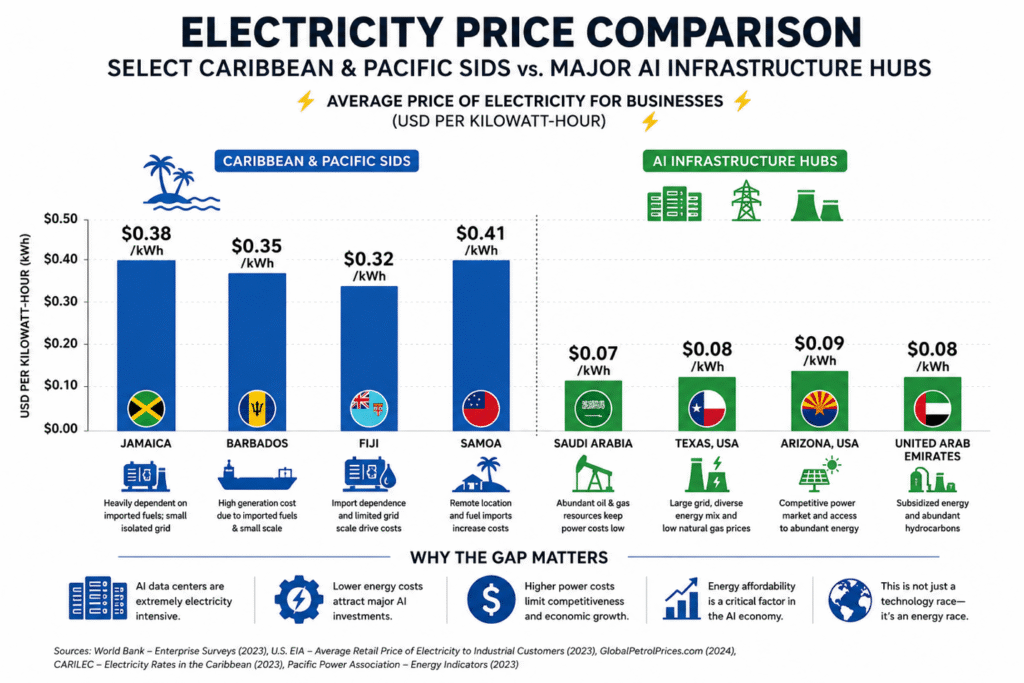
Energy itself may represent the Caribbean’s single greatest structural weakness in the AI era. Artificial Intelligence is extraordinarily power-hungry. Training advanced AI models consumes immense amounts of electricity, and running them continuously requires even more. Unfortunately, many Caribbean countries already struggle with some of the highest electricity costs in the hemisphere, creating long-standing challenges for households, manufacturers, and businesses alike. These constraints already affect competitiveness across multiple sectors. Attempting to build globally competitive AI infrastructure on top of those same limitations becomes economically daunting rather quickly.
Then comes the issue of technical talent. AI development requires highly specialized personnel, including data scientists, machine learning engineers, cloud architects, cybersecurity specialists, mathematicians, and software developers. The Caribbean certainly possesses intelligent people capable of competing globally, but many migrate overseas where salaries, venture capital ecosystems, research opportunities, and technological infrastructure are far more advanced. The region has battled brain drain for decades across medicine, engineering, finance, and academia. AI may intensify that problem even further if local systems do not evolve quickly enough.
Policy readiness presents another major concern. Many Caribbean governments are still modernising basic digital governance systems while larger economies are already debating AI ethics, algorithmic regulation, digital sovereignty, cybersecurity architecture, workforce disruption, and intellectual property disputes involving machine-generated content. Some countries in the region still lack comprehensive digital transformation strategies, much less integrated national AI frameworks tied to education reform, labour policy, innovation financing, economic planning, and long-term competitiveness.
That creates a dangerous possibility, because SIDS such as Jamaica and the Caribbean could become heavily dependent on imported AI systems developed abroad, trained on foreign datasets, controlled by external companies, and monetised primarily for the benefit of larger economies.
In that scenario, Caribbean economies would primarily function as purchasers rather than producers. Governments would procure foreign systems. Schools would adopt imported educational platforms. Hotels would license overseas tourism analytics software. Banks would subscribe to foreign fraud detection systems. Local economies would consume the technology while much of the wealth creation flows outward.
Jamaica, therefore, faces an important question. Will it become a meaningful provider of AI-enabled services and innovation, or will it simply become another market for global technology firms?
To be fair, the situation is not entirely bleak. The Caribbean possesses strategic advantages if policymakers, educators, and private sector leaders come together and approach AI intelligently rather than treating it as another trendy buzzword. The region already has strong service-oriented economies, English-speaking populations, and a relatively young, educated, and highly trainable workforce capable of adapting to digital industries. These characteristics provide advantages in outsourcing, digital support services, remote professional work, customer experience management, and AI-assisted business operations. The Caribbean also benefits from convenient time zones relative to North America, which matters enormously in the world of digital business and remote service delivery.
More importantly, the region does not necessarily need to compete directly with global superpowers to participate meaningfully in the AI economy.
The Caribbean is unlikely to become the next Silicon Valley. It probably will not dominate semiconductor manufacturing or hyperscale AI server production. Realistically, it does not possess the scale, capital base, energy surplus, or land availability necessary for that type of competition. However, that does not mean the region cannot carve out meaningful positions within specialised AI niches.
Climate adaptation may become one of the Caribbean’s most important AI opportunities. SIDS live on the front lines of hurricanes, coastal erosion, droughts, flooding, agricultural vulnerability, and rising sea levels. AI-driven climate forecasting, disaster response systems, water management technologies, agricultural optimisation tools, and insurance risk analytics could become areas where Caribbean expertise develops genuine global relevance.
Tourism presents another major opportunity. AI could improve visitor personalisation, transportation logistics, fraud prevention, hotel energy optimisation, language support systems, predictive travel analytics, and destination management. Healthcare also presents possibilities, particularly in telemedicine, diagnostics support, and public health monitoring.
Education, however, may determine everything. If Caribbean education systems continue emphasising rote memorisation over analytical thinking, coding, engineering, mathematics, systems thinking, and digital literacy, the region risks preparing young people for jobs that may disappear faster than policymakers expect. AI will not merely eliminate certain occupations. It will reshape entire categories of work.
Countries that prepare early may adapt successfully. Countries that hesitate may experience painful disruptions.
The deeper issue may ultimately be cultural and psychological.
For too long, many developing economies have unconsciously viewed advanced technology as something imported from abroad rather than something locally built, adapted, commercialised, or improved. That mindset becomes extremely dangerous during technological revolutions because innovation requires confidence, experimentation, investment, risk tolerance, and long-term strategic thinking.
There is also a deeper and far more uncomfortable conversation surrounding artificial intelligence that smaller developing regions, including the Caribbean, cannot afford to ignore. Technology has never been entirely neutral because the people designing systems inevitably shape the assumptions, priorities, values, and economic interests embedded within them. AI models are trained on data selected by human beings, designed by engineers operating within particular political and cultural environments, and financed by institutions pursuing commercial or national advantage.
The risk is not merely technological dependence. The risk is algorithmic dependence.
Smaller nations may increasingly consume digital products, information systems, educational tools, financial platforms, and AI-powered services created elsewhere without having meaningful influence over how those systems are designed, governed, monetised, or regulated. Bias within AI may not always appear dramatically. Sometimes it emerges quietly through whose accents are better understood, whose histories are better represented, whose languages receive support, whose markets receive investment, and whose economic realities shape optimisation models. Regions without meaningful participation in AI development risk becoming digitally invisible in subtle but deeply consequential ways.
The Caribbean will probably never outbuild the United States in AI infrastructure. It will not out -finance the Gulf states, nor will it out-manufacture China in advanced hardware production. That may not even be the battle worth fighting.
The real strategic challenge is ensuring that the region does not become permanently trapped as a passive digital consumer in a future increasingly shaped by nations building the underlying intelligence systems themselves. The countries shaping AI today are not simply creating products. They are building ecosystems of influence, productivity, education, healthcare, finance, media, defence, and governance that may define global competitiveness for decades.
The Caribbean therefore faces an urgent strategic choice. It can either position itself as an active participant within carefully selected AI niches where its geography, language capabilities, climate realities, tourism infrastructure, service culture, and human talent provide genuine advantages, or it risks becoming dependent on imported intelligence systems reflecting primarily foreign priorities rather than Caribbean realities.
The future may not belong solely to those with the biggest server farms, but it will almost certainly favour those capable of contributing meaningfully to the systems shaping the next global economic order.
The countries controlling the technology may eventually control far more than software. They may increasingly influence the flow of information, the direction of commerce, the future of labour markets, and perhaps even the balance of economic power itself.
Douglas Levermore, MBA, JP, is an independent management consultant and the founding Executive Director of Jamaica’s Public Investment Management Secretariat (PIMSEC)—the government unit established to strengthen project appraisal, fiscal discipline, and oversight of public investment, now known as the Public Investment Appraisal Branch (PIAB) within the Ministry of Finance and the Public Service. He also serves as a FINRA arbitrator and a commissioned Notary Public in the Commonwealth of Virginia. Douglas writes on social issues, leadership, management lessons, and organisational strategy, drawing on extensive real-world experience across both the public and private sectors.
Syndicated from Our Today · originally published .
Legal context · powered by Jurifi
Get the legal angle on this story. Pick a prompt and Jurifi's AI will explain it using Jamaican law.
AI replies are based on Jamaican law via Jurifi. Not legal advice.
Other coverage
Can The Caribbean Be The Next AI Data Center Valley?
Jamaica Inquirer
The Archbishop And The Chambermaid: Cuba and The Caribbean’s Impossible Choice
Jamaica Inquirer
Paul Golding | Pope’s AI warning: Who controls the future of humanity?
Jamaica Gleaner
When Grace Is Not Enough: Accountability in Faith Communities Across The Global South
Jamaica Inquirer
The Caribbean’s Powerful AI Future
Jamaica Inquirer