
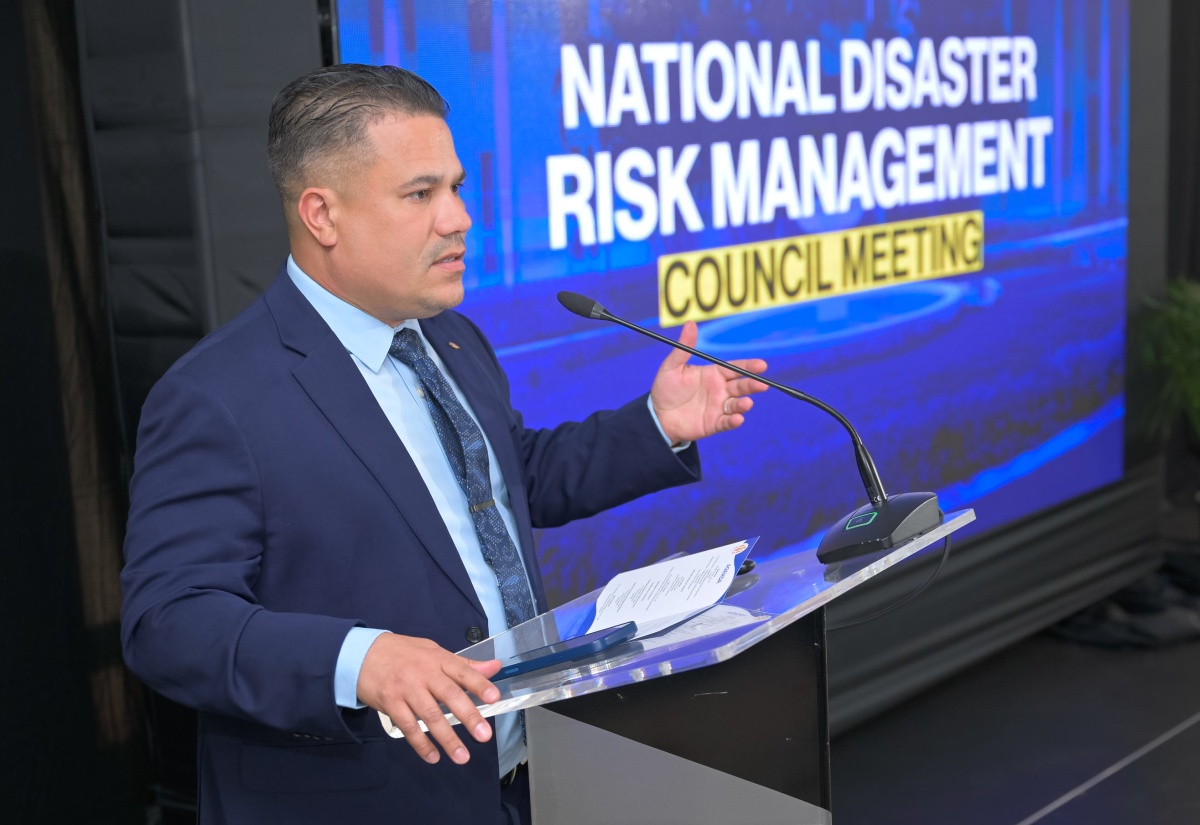
Minister Samuda Emphasises Importance of Adequate Climate Financing
Minister of Water, Environment and Climate Change, Hon. Matthew Samuda, has emphasised that adequate financing remains a critical pillar in addressing the existential threats posed by climate change and natural disasters.
Addressing Wednesday’s (May 27) National Disaster Risk Management Council Meeting at the Office of the Prime Minister (OPM), Minister Samuda noted that while climate financing facilities such as the Resilience Building Fund (RBF) and the Catastrophe Bond have been vital in supporting Jamaica’s recovery efforts, they remain insufficient to fully meet the country’s needs.
He pointed out that as the climate continues to change, Jamaica must identify effective strategies to mobilise the financing required to implement its National Adaptation Plan and strengthen the country’s resilience.
“We have to find a way and we have to work with all stakeholders, local and overseas, to unlock significant climate finance in a manner that mobilises significant infrastructure development to [bolster] our resilience,” Minister Samuda pointed out.
He added that the Government continues to invest in initiatives aimed at strengthening the country’s resilience.
Minister Samuda further noted that Jamaica must pursue sustained economic growth and buoyancy in order to build greater internal resilience and better mitigate the impacts of disasters.
“There is no shortcut; the challenge before us is, indeed, great. But the Government is ensuring that it puts in place the appropriate structures, that it gives the international community the appropriate confidence,” he indicated.
Mr. Samuda indicated that the Government has invested in initiatives such as ‘Adapt Jamaica’ , a US$50-million facility designed to help small farmers establish greenhouses and cold storage facilities while strengthening supply chains in a climate smart manner.
He added that the Government is also preparing to roll out additional programmes aimed at further enhancing national resilience.
“We have a programme that we will be launching very soon, which will see the rebuilding of our fishing villages in St. Elizabeth and southern Westmoreland. That will build climate-resilient structures to facilitate our fisherfolk while giving them the cold storage that they need, powered by solar,” Minister Samuda informed.
He stated that the Government will continue to engage the private sector through public private partnerships (PPPs) to expand the productive capacity of key sectors.
The Minister emphasised that this approach is essential to strengthening Jamaica’s fiscal capacity and enabling the country to better withstand the challenges posed by climate change and natural disasters.
“We will, indeed, look for partners to help us build our productive capacity on both water and sewage, which [are] critical [components] of our adaptation plan. We will build water treatment plants with private-sector investors to ensure that it is not a call on the public purse, and done in a manner that will, indeed, supply water at the volume that we need,” he expressed.
Minister Samuda cited the Rio Cobre Water Treatment Plant in St. Catherine as a successful example of the Government’s PPP initiatives.
“That plant will be completed next year May. It is, indeed, on track [and] will supply 15.5 million gallons a day,” he said, noting that the project will add another layer of resilience to Jamaica’s infrastructure.
Syndicated from Jamaica Information Service · originally published .
Legal context · powered by Jurifi
Get the legal angle on this story. Pick a prompt and Jurifi's AI will explain it using Jamaican law.
AI replies are based on Jamaican law via Jurifi. Not legal advice.
Other coverage

Government strengthening disaster risk financing framework ahead of hurricane season
Our Today
NaRRA Bill Now Law as Government Advances National Reconstruction Programme
Office of the Prime Minister
Audrey Marks | From Resilience to Resurgence
Our Today
STATEMENT FROM THE MINISTER OF FINANCE AND THE PUBLIC SERVICE
Ministry of Finance
Gov’t strengthening disaster risk financing framework ahead of hurricane season
Jamaica Gleaner