
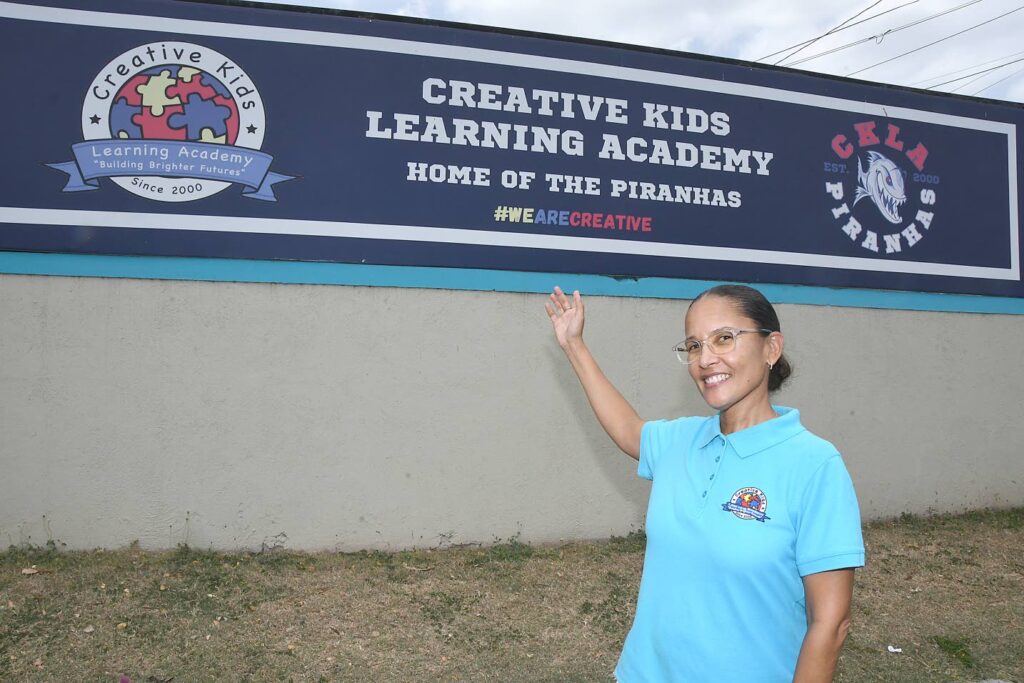
Confidence and curriculum: Creative Kids’ winning formula
FOUNDER and principal of Creative Kids Learning Academy Haedi-Kaye Holmes has pointed to the self-belief instilled in her students and a strict adherence to the Ministry of Education’s National Standards Curriculum (NSC) as the main factors behind the school’s success in the 2026 Primary Exit Profile (PEP) examinations.
Creative Kids emerged with the top boy, Neeraj Sahukar, and the top girl, Zurie Cousins, in this year’s PEP examinations with the two copping the Guardian Group Foundation Scholarship, which will support them throughout their five-year tenure at Campion College where they will continue their education journey.
Creative Kids had 36 students sit the PEP examinations this year, with four of them placed among the top 10 national performers.
On Thursday Holmes told the Jamaica Observer that the school’s success is due to its commitment to treating students as individuals first, to discover their strengths and build self-belief.
“If a student doesn’t have self-belief, then you’re going to find that it’s very difficult for them to achieve what they need to achieve. Our role as teachers here at Creative Kids is to get children to believe in themselves,” said Holmes.
“We try to get them to do the best that they possibly can. We tap into all their strengths, and we try to build on their weaknesses, and I think that’s how we created the top boy and top girl.”
Holmes added that the use of the Home and Family Life Education aspect of the education ministry’s curriculum was instrumental in developing self-belief in the students, with these classes spent ensuring that they were motivated to be the best version of themselves.
“We use that time in addition to devotion in the mornings to build that self-esteem to speak to them about so many issues, and we try to tap into their emotions and how they are feeling during those times. We also have core values at the school, and we try to talk about each of the core values,” added Holmes.
She said the school, with more 300 students, has implemented programmes to boost self-esteem and self-belief and to promote the core values of respect, responsibility, kindness, integrity, creativity, and cooperation.
Through a badge system that recognises exceptional students each month, students are motivated to excel and become the best version of themselves.
Holmes also told the Observer that another major factor behind the students’ performance was the school’s educators’ understanding of the NSC. According to Holmes, if educators thoroughly understand the NSC, its adaptation in the classroom should pose little to no challenge.
“With the NSC, you have to understand first of all what the objectives are and ensure that you’re looking at the objectives, you’re getting the objectives across, you’re not teaching from a textbook, you’re teaching using the curriculum, and I find that it works,” said Holmes.
She also urged educators to utilise the education ministry’s training sessions if understanding the NSC proves difficult. Holmes said she has taken part in some of the training sessions and found them very useful.
She added that when educators understand the NSC, it helps them understand the PEP examinations, enabling them to better help students excel.
“And I also urge them [teachers] that if you don’t really understand the NSC, or if you’re not clear on the objectives of the NSC, reach out to the Ministry of Education and see how best they can come in to offer workshops.
“If they [teachers] don’t understand the curriculum to its fullest, because it still is relatively new, they should reach out and see how best they can learn the curriculum a little more and understand the objectives a little better,” added Holmes, who teaches grades four and six.
She pointed out that the Creative Kids classroom structure helped with the students’ success in this year’s examinations.
Holmes explained that at the school class sizes are small to create an environment where each student is prioritised.
She admitted that it might be challenging for other schools to do the same, but pointed out that such a structure helps produce exceptional results, since no student is left behind and they feel comfortable sharing when they do not understand a concept.
“I know it’s hard for a lot of schools because they have bigger class sizes, and I think maybe sometimes teachers need more support, especially with the bigger classrooms, because I have support, so I routine teach, and it’s a little easier,” said Holmes.
She added that the school’s annual Grade Six cohort does not exceed 40 students and that these students are divided into two groups, resulting in smaller cohorts in which scheduled lessons are taught by different teachers.
Holmes scoffed at claims that her students perform well because of their affluent backgrounds and pointed out that students whose parents are not affluent are enrolled at the institution and perform very well.
The principal said she understands where the misconception arises, as some schools have more support than others, and she urged communities to come together to support schools that need extra help for students’ benefit.
“Yes, we have better resources, and yes, our parents may be better equipped to get them [the students] the help they need, or whatever resources they need, but I think that sometimes if you don’t ask, you won’t receive,” she told the
Observer.
“If you think that the schools that need the help are not getting the help, I think everybody should kind of reach out and try to solve this as a community, to help those schools that are in need, because it will make a big difference if they have support and help.”
Creative Kids has consistently produced top-performing PEP students who have matriculated to traditional high schools, but it is the institution’s first time having the top boy and top girl in its cohort since 2021, when the top PEP girl emerged from the institution.
For Holmes, this achievement made her happy, and she looks forward to building brighter futures for her students.
“So, for next year, I’m going to go back again to the drawing board. I’m going to look at the report that the ministry has sent. And no matter how well they did, we can always do better,” said Holmes.
Syndicated from Jamaica Observer · originally published .
Legal context · powered by Jurifi
Get the legal angle on this story. Pick a prompt and Jurifi's AI will explain it using Jamaican law.
AI replies are based on Jamaican law via Jurifi. Not legal advice.
Other coverage

FORCE4GOOD Podcast: S2 EP 9 – How PSTEB Is Making Jamaica's Roads Safer
JCF — Jamaica Constabulary Force (Video)Watch
What will football look like in a year? | SportsMax Zone
SportsMax (Video)Watch
Jamaica Magazine - 15.07.2026
Jamaica Information Service (Video)Watch
Government increases Public School allocation By 55% | TVJ News
Television Jamaica (Video)Watch
Thompson Town High to Get $15M Smart Greenhouse Lab
Ministry of Education and Youth