
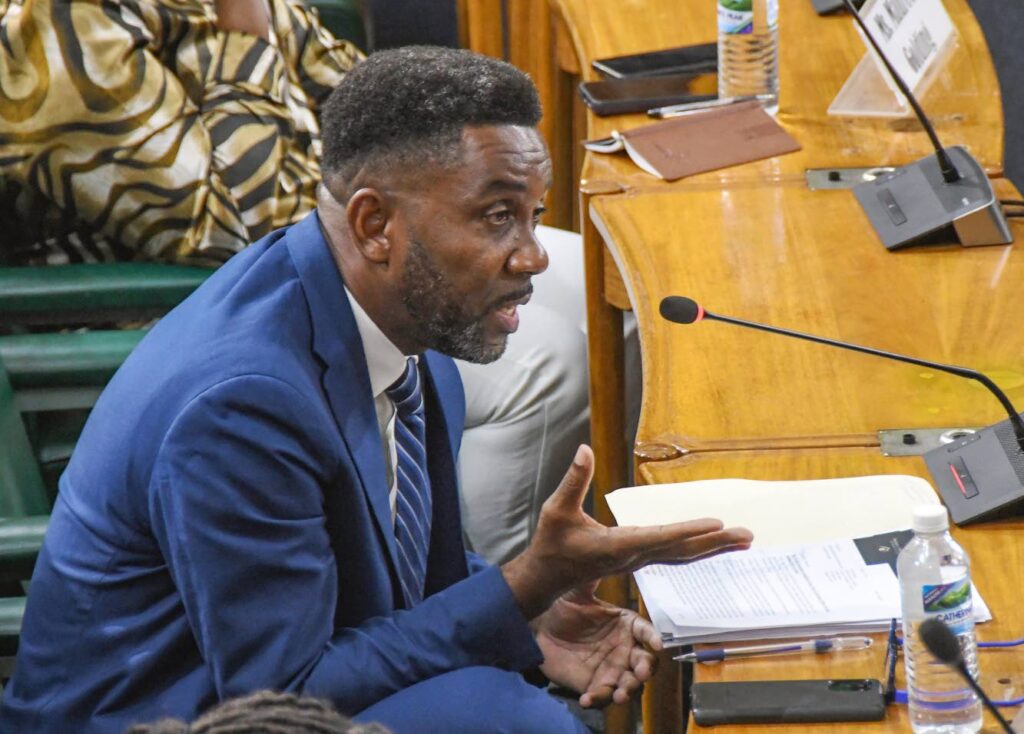
FORMER University Hospital of the West Indies (UHWI) Chief Executive Officer (CEO) Kevin Hall told Parliament’s Public Accounts Committee (PAC) on Tuesday that he was clueless as to how his signature appeared on a Customs document dated more than a year after he left office, prompting fresh scrutiny of the hospital’s procurement and importation controls.
Hall, who was summoned before the committee as part of its ongoing examination of a damning auditor general report into the operations of UHWI, found himself at the centre of intense questioning over a document that auditors said bore his signature, despite him having left the institution in October 2022.
Hall, who spent decades at UHWI and served as its CEO from November 2016 until October 31, 2022, was first asked to explain the hospital’s practice in relation to Customs forms used in the importation of goods.
Committee Chairman Julian Robinson pointed to concerns raised during the audit that some forms may have been signed in advance, potentially facilitating importation activities after Hall had demitted office.
In response, Hall acknowledged that a limited number of forms had occasionally been signed blank during his tenure to assist with urgent clearances. However, he stressed that those forms were intended only for internal administrative purposes and should not have remained in use after his departure.
“To facilitate emergency clearance, some of those forms, about four or five at a time, would have been signed blank. But let me hasten to say to the committee that upon submitting my resignation, a second letter was drafted to management informing management to remove my name from all accounts and other relevant documents that I would be required to sign in performing my duties. So it would have been unfortunate for someone to be using those few documents after my departure,” Hall told the committee.
He explained that the forms were typically handled by the hospital’s Department of Materials and Contracts, which worked closely with customs brokers responsible for clearing goods imported on behalf of the institution.
As the discussion progressed, Opposition Member of Parliament (MP) Peter Bunting, who represents Manchester Southern, questioned whether the practice of signing blank documents created unnecessary risk and could have opened the door to abuse.
“In hindsight, probably, but in operating at that level, there is some amount of trust. This is not a blank cheque, this is not a declaration. It’s a document used for internal processes, it is managed by senior persons within the organisation, and so I am wondering after a year or whatever that I left the organisation, why it would have been used. But it’s something that the current management needs to look at and to implement additional controls,” Hall replied.
The exchange took a dramatic turn when Auditor General Pamela Monroe Ellis clarified that investigators were not referring to an internal administrative document but to a Customs form obtained directly from Jamaica Customs’ ASYCUDA system.
“Based on what Mr Allen is saying here, he’s speaking to the letter, the concession letter, but it appears that Mr Allen does not know that his signature is on a C-84 form that is dated the 25th of November, 2023. Mr Allen declared here just now that he left in 2022, and it is for that reason why I think there was that outreach to speak to you to clarify this,” Monroe Ellis said.
The clarification appeared to fundamentally change the discussion.
Until that point, Hall had maintained that the only documents that may have carried pre-signed signatures were internal forms used to facilitate emergency processing. However, the Customs document highlighted by the auditor general was dated more than 12 months after he had left the hospital.
Robinson then sought to distinguish between the internal forms Hall described and the Customs document identified by auditors.
“So, Mr Allen, what is before us is more than just a form for internal purposes. This would be a form that would have authorised or certainly given Customs the authority to act based on a signature, believing that this is the chief accountable officer of the university hospital. So it would be more than just the internal document that would go to the procurement department with your signature,” Robinson said.
Faced with that information, Hall said he could not explain how his signature ended up on the document.
“Chair, in that case, I don’t know how my signature [would] reach on that document. I would not have signed such a document upon my departure. I don’t know anything about that transaction whatsoever. So I am clueless where that is concerned here,” he responded.
Government MP Juliet Cuthbert Flynn, who represents St Andrew West Rural, repeatedly pressed Hall on the issue, noting that he appeared willing to acknowledge signing internal forms in advance but was distancing himself from the Customs document under scrutiny.
She questioned how his signature could have appeared on the document if he had no involvement in the transaction and had been away from the institution for more than a year.
Hall remained adamant that he had no explanation.
“I don’t know. I cannot explain that. I don’t know. I am not a member of the team. I have not participated in the management of the organisation. I don’t know,” he said.
His answer drew a blunt response from Cuthbert Flynn.
“I’m baffled. I’m baffled,” she said.
The issue forms part of the auditor general’s wider investigation into UHWI’s procurement and Customs-related practices. The audit identified instances where the hospital’s tax-exempt status was allegedly used to facilitate imports for private entities, contributing to estimated losses of more than $23 million in duties and charges.
By the end of Tuesday’s exchange, Robinson suggested that Hall’s testimony had raised new questions rather than settled existing ones.
“You had said all the documents that may have been signed by you were solely for internal purposes, but not to trigger the procurement of goods through Customs. So given that you have said categorically that you didn’t sign those documents, then it raises other questions about how your signature, if it was your signature, or how a signature appearing to be one like yours, came to be on those documents,” Robinson said.
Syndicated from Jamaica Observer · originally published .
Legal context · powered by Jurifi
Get the legal angle on this story. Pick a prompt and Jurifi's AI will explain it using Jamaican law.
AI replies are based on Jamaican law via Jurifi. Not legal advice.
Other coverage

Interview with Bailey and Caelan Cadamarteri
Jff YtWatch
Questions mount over J$770 million left unused in Jamaican gov’t aid program
Cnweekly
Tony Deyal | Cricket tests and quadrennial football
Jamaica Gleaner
Sunday Sips with HG Helps | Why Anderson for NaRRA job?, Lisa Hanna and rumours, Any hope for fixing potholes?, and a lesson in football for Jamaica
Our Today
Resort Romance or Risky Assumption? | JACKET COURT Episode 6 | Saturdays @ 8:30PM
Television Jamaica (Video)Watch