
Jamaica failing in most SDG targets like its LAC counterparts
Prime Minister blames global pressures and Hurricane Melissa
Durrant Pate/Contributor
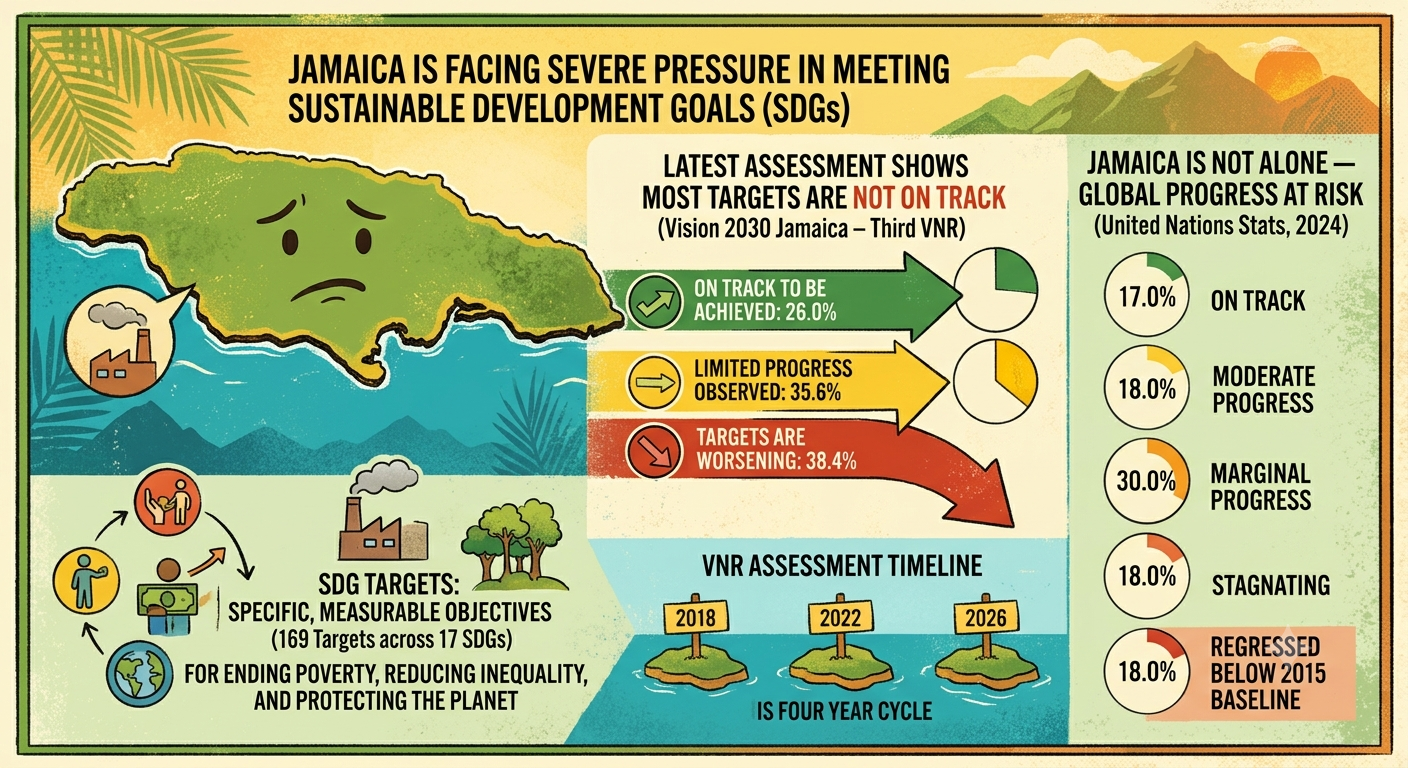
Jamaica is facing severe pressure in meeting its Sustainable Development Goals (SDGs), with the latest assessment showing it is failing in meeting most targets.
In fact, Jamaica’s third Voluntary National Review (VNR) of its SDGs, contained in the island’s Vision 2030 Jamaica – National Development Plan, shows that only 26.0 per cent of the targets are on track to be achieved, limited progress was observed on 35.6 per cent of the targets, while 38.4 per cent of the targeted areas are worsening. SDG targets are specific, measurable objectives established by the United Nations to achieve the 2030 Agenda for Sustainable Development.
There are exactly 169 targets spread across 17 SDGs, detailing actionable steps for ending poverty, reducing inequality, and protecting the planet. The VNR assessment is done every four years, dating back to 2018, then 2022 and now 2026.
Jamaica is not alone in failing to meet SDG targets, as the global progress towards SDGs is increasingly at risk, with 17.0 per cent of SDG targets on track to achievement, 18.0 per cent show moderate progress, 30.0 per cent show marginal progress, 18.0 per cent stagnating and 18.0 per cent have regressed below the baseline year of 2015 (United Nations Stats, 2024).
LAC situation concerning
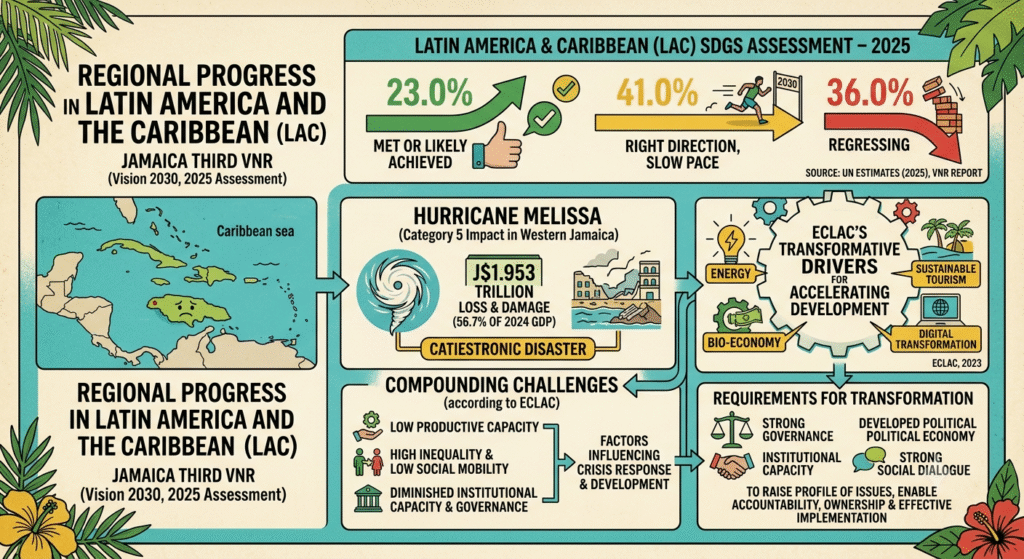
“Regionally, Latin America and the Caribbean (LAC) faces measurably better progress with 23.0 per cent of targets already met or likely to be achieved, 41.0 per cent in the right direction but at too slow a pace to meet the target by 2030, while 36.0 per cent regressing from the target, according to estimates from the United Nations in 2025,” the 386-page VNR highlighted.
The region’s progress is compounded by the low productive capacity hindering economic growth, high inequality and low social mobility, diminished institutional capacity and governance, according to the Economic Commission for Latin America and the Caribbean (ECLAC).
The report, which was tabled in the parliament last week, says these factors influence the ability of states to respond to crises while implementing programmes that can support development.
ECLAC has identified transformative sectors, namely energy, bio-economy, sustainable tourism and digital transformation, as critical drivers for accelerating development (ECLAC, 2023). Jamaica’s third VNR was prepared in a context of emerging global issues such as geopolitical conflicts and crises with significant economic and social consequences.
ECLAC emphasises that advancing the above-mentioned transformations requires strong governance, institutional capacity, a developed political economy and strong social dialogue to raise the profile of development issues and enable accountability, ownership and effective implementation.
The report points to resilience building as crucial for small island developing states like Jamaica, especially given Jamaica’s experience with Hurricane Melissa, a Category 5 storm that caused widespread devastation, mainly in the western region of the island, and far-reaching impact on the country and society as a whole. This single event generated loss and damage of J$1.953 trillion – equivalent to 56.7 per cent of 2024 GDP – representing one of the most catastrophic disasters in Jamaica’s history.
Prime Minister’s response
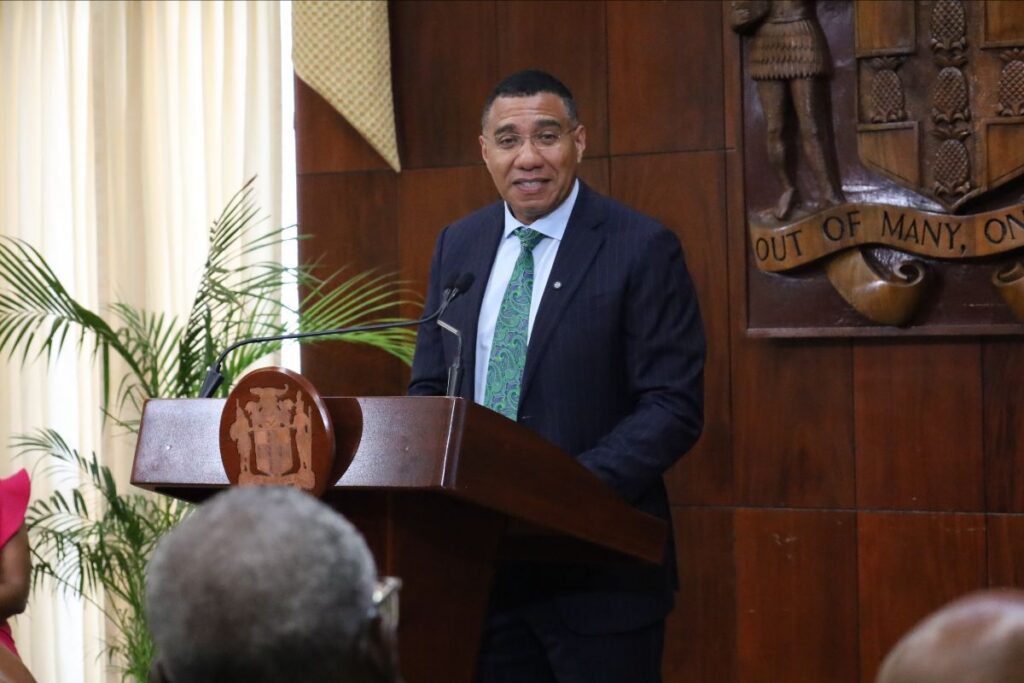
In the meantime, Prime Minister, Dr. Andrew Holness, sought to blame global uncertainties and Hurricane Melissa for Jamaica not showing a better performance in its VNR assessment, which he explains reflects on progress made, challenges encountered and the actions required to accelerate progress on its SDGs. “This review (VNR) is being undertaken against the backdrop of an increasingly complex global landscape, defined by overlapping crises, including climate change, economic uncertainty and the cumulative effects of recent global crises,” Prime Minister Holness reports.
However, he contends that since Jamaica’s last VNR in 2022, the country has continued to advance implementation of the SDGs through Vision 2030 Jamaica – National Development Plan, supported by successive Medium Term Socio-Economic Policy Frameworks. These instruments, he argues, have ensured sustained alignment between national priorities and the 2030 Agenda, while strengthening systems for monitoring, evaluation and accountability.
National analyses undertaken since 2022 have identified priority areas where acceleration is required, alongside key sectors that can achieve multiplier effects across the development landscape. These insights, he notes, have informed a more targeted and issue-driven approach to this review, allowing for deeper examination of the structural and emerging challenges shaping Jamaica’s development trajectory.
According to the Prime Minister, “while notable gains have been recorded across the social, economic and environmental dimensions, recent shocks have reinforced the need to move beyond a focus on stability towards a more deliberate and sustained emphasis on resilience. Jamaica’s development strategy is therefore increasingly anchored in strengthening institutional capacity, enhancing data-driven decision-making and building systems that are shock-responsive, inclusive and sustainable.”
In this context, he concludes that Jamaica remains firmly committed to the principles of the 2030 Agenda.
Syndicated from Our Today · originally published .
Legal context · powered by Jurifi
Get the legal angle on this story. Pick a prompt and Jurifi's AI will explain it using Jamaican law.
AI replies are based on Jamaican law via Jurifi. Not legal advice.
Other coverage

Jamaica Empowers Youth Voices to Shape Sustainable Development Agenda at the United Nations
Planning Institute of Jamaica
The Business Report—July 3, 2026
PBC Jamaica (Video)Watch
Dillon Alleyne | Public policy and the quest for economic growth in Jamaica
Jamaica Gleaner
Jamaica's Economy Contracts By 4.1% | Business Day
Television Jamaica (Video)Watch
Cops see more success in solving crimes
Jamaica Observer