

Private sector loans and advances grew to an annual growth of 2.3 per cent
Durrant Pate/Contributor
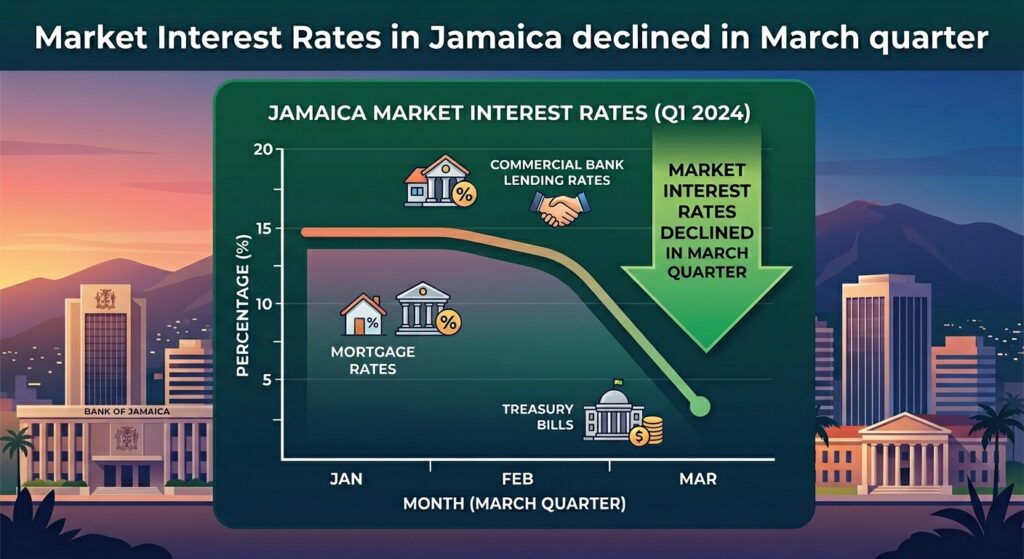
Money market rates in Jamaica have generally declined during the March 2026 quarter, according to the Bank of Jamaica in its latest Quarterly Monetary Policy Report for May 2026, which was tabled in parliament recently.
The 64-page document showed that when compared to rates at the end of December 2025, all rates declined except the 90- day T-Bill rate. The overnight (O/N) private money market rate ( PMMR), 30-Day PMMR, 14- day repo, O/N Interbank PMMR, 180-Day T-Bill, 270-Day T-Bill, and 30-day Certificate of Deposit (CD) rate declined by 45 basis points (bps), 31 bps, 31 bps, 11 bps, 5 bps, 3 bps, and 1 bp, respectively.
The 90-day T-Bill rate increased by 44 bps. The decline in market rates was influenced by increased average liquidity conditions as well as the Bank’s accommodative policy stance. The increase in the 90-day T-Bill rate largely reflected heightened economic uncertainty, leading to an increase in cost of funds in that market segment.
The estimated yield curve on Government of Jamaica (GOJ) J$ bonds at end-March 2026 was largely unchanged over the entire curve, relative to the yield curve at end-December 2025. Estimated sovereign risk increased while the exchange rate risk declined for the March quarter.
Private sector credit
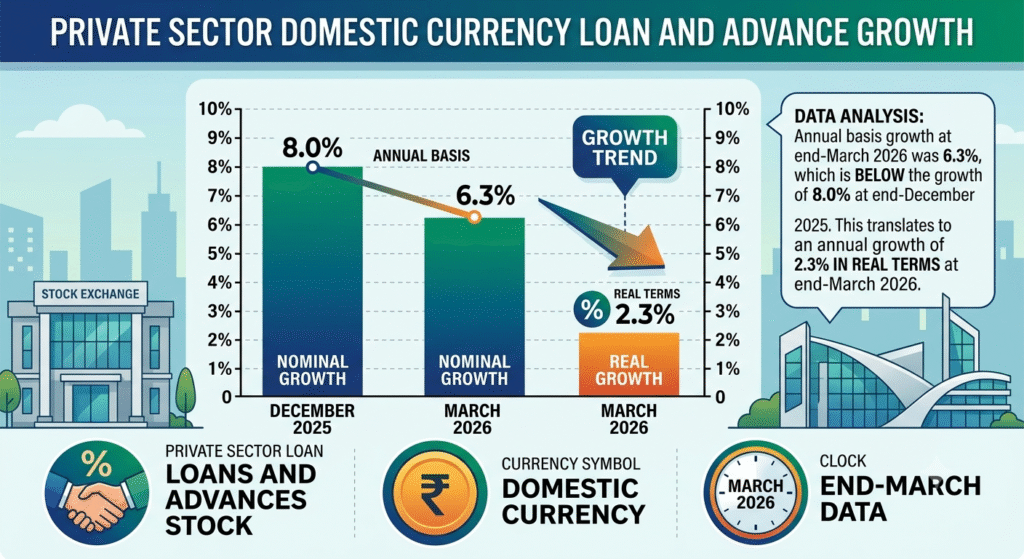
The stock of domestic currency private sector loans and advances grew on an annual basis by 6.3 per cent at end-March 2026, below the growth of 8.0 per cent as end-December 2025. This translates to an annual growth of 2.3 per cent in real terms in the stock of domestic currency private sector loans and advances at end-March 2026.
The stock of domestic currency private sector loans and advances at end-March 2026 was 34.3 per cent, slightly above the ratio a year earlier. The growth in total domestic currency loans and advances was underpinned by expansions of 7.1 per cent and 4.9 per cent in loans to consumers and productive sector, respectively.
Growth in loans to the productive sector was mainly attributed to the Construction, Distribution, and Transport sectors. Based on the BOJ’s monetary projections, broad money, which is a measure of a country’s total money supply, is expected to grow at an average annual rate of 9.4 per cent over the next eight quarters, below the previous projection of 10.1 per cent.
The projected growth in broad money reflects the expected spending on reconstruction activity and the expected impact of higher inflation on currency in circulation, while deposits may reflect income from rebound economic activity, partly offset by an erosion of savings due to higher expected inflation influenced by global political tensions.
Over the next eight quarters, Deposit Taking Institutions (DTI’s) private sector credit is forecast to grow at an average rate of 8.2 per cent, in line with the previous projection for growth of 8.2 per cent. The expected expansion in credit is primarily driven by the recovery in economic activity post Hurricane Melissa.
Syndicated from Our Today · originally published .
Legal context · powered by Jurifi
Get the legal angle on this story. Pick a prompt and Jurifi's AI will explain it using Jamaican law.
AI replies are based on Jamaican law via Jurifi. Not legal advice.
Other coverage

Speaking Notes: Review of Economic Performance, July–September 2025
Planning Institute of Jamaica
The Business Report—June 16, 2026
PBC Jamaica (Video)Watch
Force4Good Podcast: S2 EP 7 -The Strategy Behind St. Andrew North's Historic Zero-Murder 1st Quarter
JCF — Jamaica Constabulary Force (Video)Watch
Diaspora Encouraged to Invest in Jamaica’s Rapid Development
Jamaica Information Service
Speaking Notes: Review of Economic Performance, October–December 2025
Planning Institute of Jamaica