


A simple appreciation poll raises an important workplace question
After completing a six-month community project across several parishes, a small Jamaican non-profit organisation decided to thank its field implementation team unusually.
Throughout the six-month assignment, every team member continued to receive their regular monthly salary for their work. At the conclusion of the project, the team lead chose to offer an additional token of appreciation, not as payment, but simply as a heartfelt “thank you” for the commitment, sacrifices and long hours invested in helping the organisation achieve its objectives.
Rather than selecting the appreciation gift on behalf of employees, the project lead invited each team member to choose one of four options of how they wished to be recognised: The first poll offered four appreciation options: Dinner at a newly opened restaurant, a two-day, one-night Portland getaway with a complimentary massage (transportation and meals at the employee’s expense) A J$15,000 grocery voucher and a A J$10,000 spa gift certificate.
Shortly after launching the poll, however, the project lead noticed an unintended omission. The first option simply read “Dinner at a newly opened restaurant,” when the intention had been to offer a team dinner.
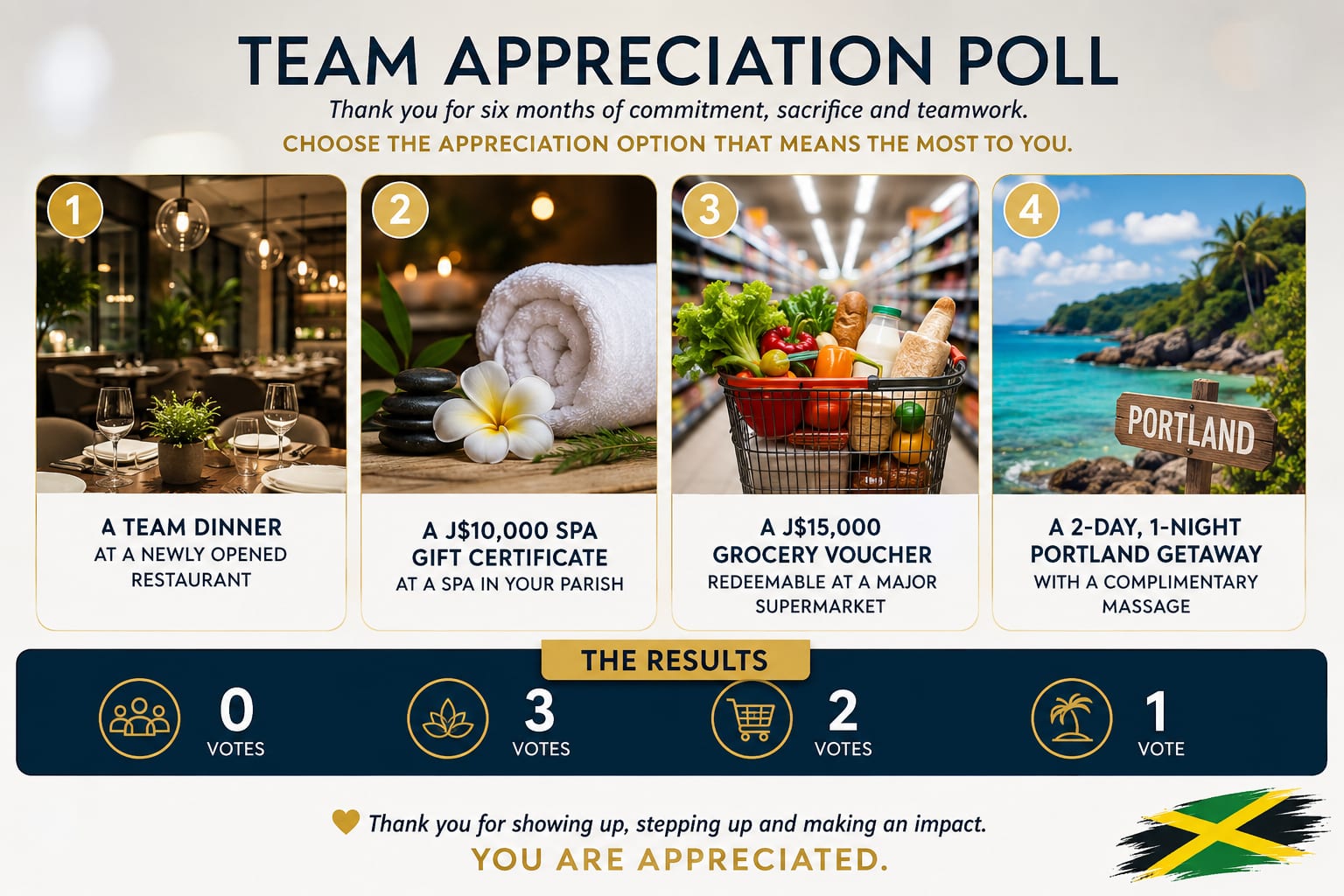
Concerned that the wording might have influenced responses, the poll was withdrawn and reposted with clearer descriptions. The revised options were: A team dinner at a newly opened restaurant. A J$10,000 spa gift certificate at a spa in the same parish where the team members live and work. A J$15,000 grocery voucher redeemable at a major supermarket. A two-day, one-night Portland getaway with a complimentary massage.
The results were both surprising and thought-provoking. Not one employee selected the team dinner. One employee chose the Portland getaway after privately asking how many people had already voted for it. She was encouraged to make the decision based solely on what she wanted and not on what anyone else had chosen. She did exactly that. Two employees selected the J$15,000 grocery voucher, and their reasons reflected the realities that many working families face today.
One explained that spending a night away from her husband was simply not practical. The grocery voucher, she said, would provide more value to her household. The other, a mother of two teenage children who is preparing to return to school, also felt that the additional financial support would better meet her family’s immediate needs. The remaining employees selected the spa certificate.
Interestingly, the project lead and another senior team member had been among the first to indicate that this was their preferred option. While impossible to know whether this influenced anyone else’s decision, organisational psychologists have long recognised that employees often look to leaders for subtle cues when making choices. Yet the most remarkable finding remained unchanged.
Zero votes for the team dinner.
The team had spent six months travelling together, solving problems together, working weekends together and successfully delivering every major project objective. By every operational measure, they had functioned as an effective team. However, when given the opportunity to spend personal time together outside of work, no one chose to do so. The outcome raises a broader question that extends far beyond one organisation.
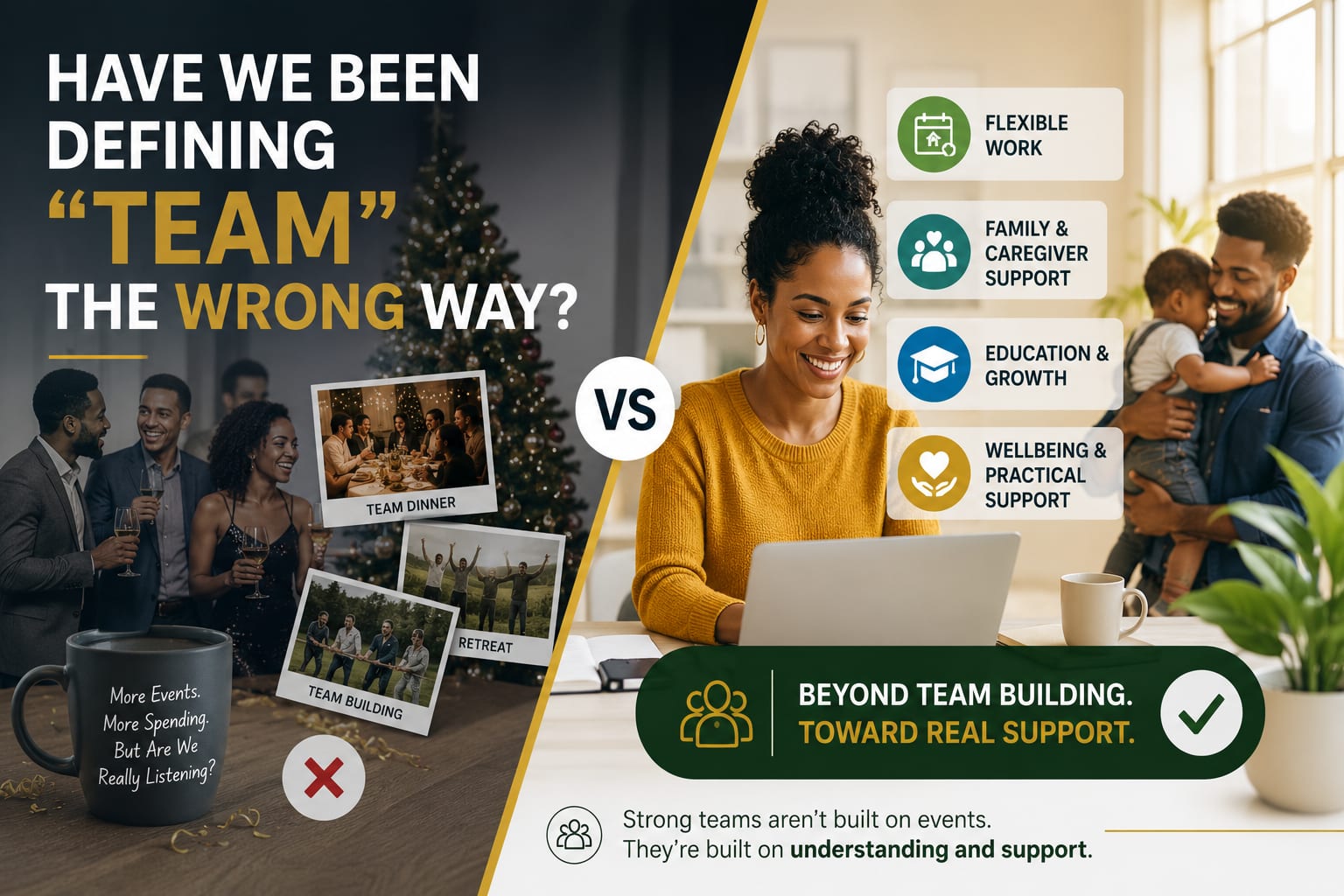
Have we been defining “team” the wrong way?
For years, organisations have invested heavily in staff dinners, retreats, Christmas parties and team-building activities, often viewing attendance as a sign of healthy workplace culture.
Perhaps today’s workforce is telling us something different.
Many employees value strong professional relationships without necessarily wanting social relationships. Others are navigating rising living costs, family responsibilities, caregiving duties and educational goals, making practical support far more meaningful than another evening with colleagues. This small appreciation poll was never intended to be a workplace experiment. Yet it raises a question that every employer, manager and organisational leader should ask.
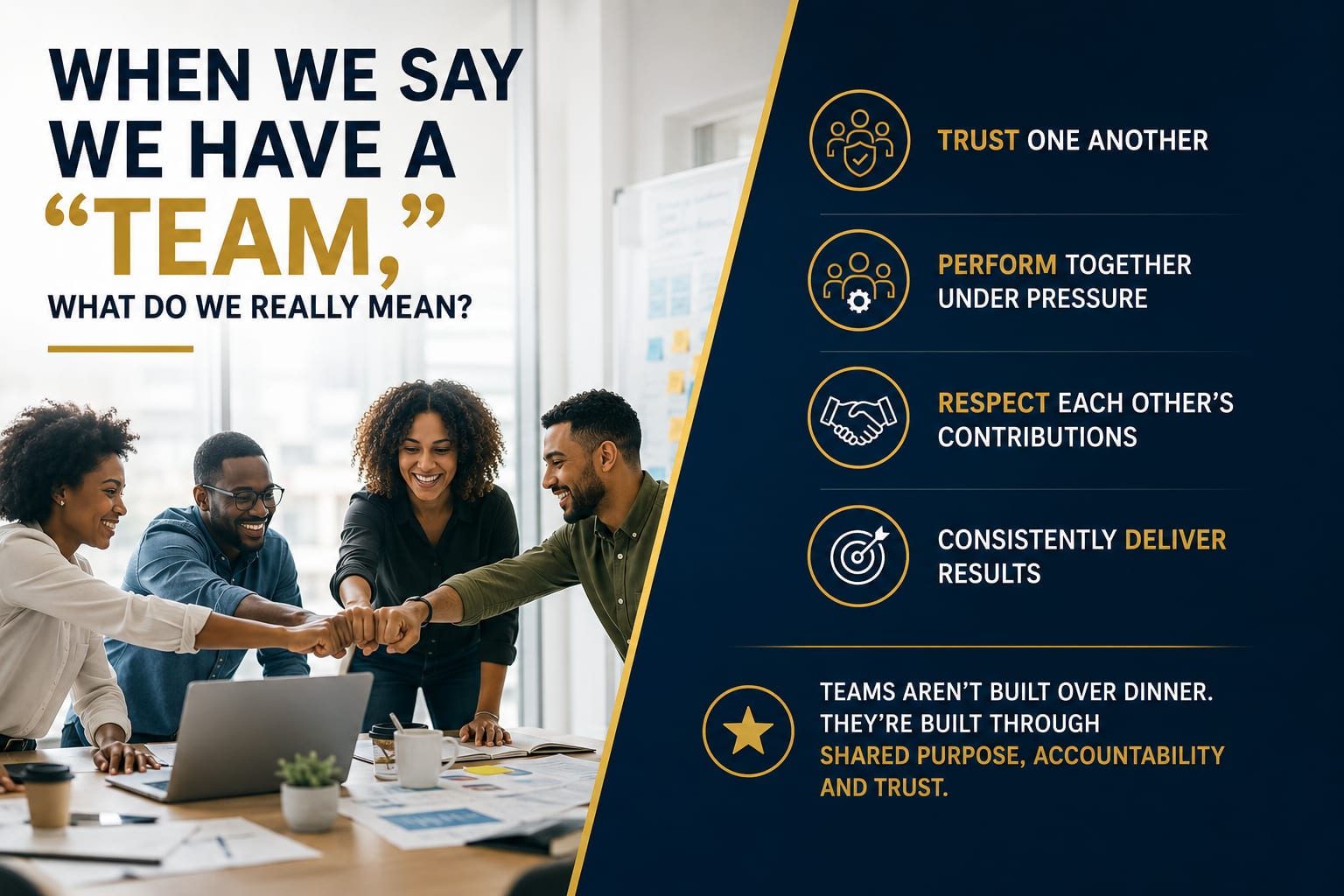
When we say we have a “team,” what do we really mean?
Strong teams are not necessarily those who dine together after work. They may simply be the people who trust one another, perform together under pressure, respect each other’s contributions and consistently deliver results before happily returning home to the people who matter most.
Perhaps the real measure of a team is not whether its members choose to spend their free time together or gather around a dinner table. It is whether they choose one another when the work is hard, the pressure is real, the stakes are high, and success depends on everyone doing their part. Perhaps, that is where teams are truly built, not over dinner, but through shared purpose, accountability and trust.
Olivia Rose is a performance management consultant and sports psychologist.
Syndicated from Our Today · originally published .
Legal context · powered by Jurifi
Get the legal angle on this story. Pick a prompt and Jurifi's AI will explain it using Jamaican law.
AI replies are based on Jamaican law via Jurifi. Not legal advice.
Other coverage
Small hands, big heart
Jamaica Observer
Different labels, one dream
Jamaica Observer
SSP Diaries | A dark side to sports and politics
Jamaica Gleaner
Unholy affair Husband found at nude beach with church sister
Jamaica Star
Dennis A. Minott | An open letter to the Ascot Primary School community
Jamaica Gleaner