
Peter Bunting | Jamaica’s productivity today is below where it was 25 years ago

Opposition Spokesperson on Productivity, Efficiency and Competitiveness Peter Bunting made his contribution to the Sectoral Debate today and bemoaned Jamaica’s woeful productivity rate.
Below is his full presentation :
Salutations: Thank Leader & Colleagues, Family & Friends, Personal Support Team, Councillors and Constituency Executive, and last but not least, the proud citizens of Southern Manchester.
Introduction: Stability Without Transformation
I rise today to address a portfolio that goes to the very heart of Jamaica’s economic future, yet one that receives far less attention than it deserves. In budget and sectoral debates, in corporate boardrooms and public policy discussions, we regularly hear the words productivity, efficiency and competitiveness invoked as though they are interchangeable concepts. For clarity, let me define what each means for the purposes of my presentation today.
Productivity is the rate at which an economy converts labour, capital, technology and knowledge into output. Efficiency refers to the extent to which waste is eliminated from that process. Competitiveness is the ability of firms, industries and countries to succeed against rivals in attracting investment, creating jobs and winning export markets.
Efficiency contributes to productivity. Productivity underpins competitiveness. Competitiveness ultimately determines whether a nation prospers or stagnates. Understanding these distinctions is not a semantic exercise. It is fundamental to designing policies capable of raising living standards and expanding opportunity for ordinary Jamaicans.
Jamaica’s central economic challenge today is no longer macroeconomic instability. Through years of sacrifice by taxpayers, public sector workers, pensioners and businesses, Jamaica succeeded in restoring a measure of fiscal discipline and financial stability. Debt-to-GDP ratios have fallen significantly. Inflation has generally remained within the target range. International reserves have strengthened. These achievements were important and necessary. That’s why the PNP administration led by the MH Portia Simpson-Miller started the process of economic reform, and did most of the heavy lifting in achieving the successes of the last 14 years. But stability was never intended to be the destination. It was the foundation upon which growth, productivity and prosperity could be built. Unfortunately, that transformation has not occurred.
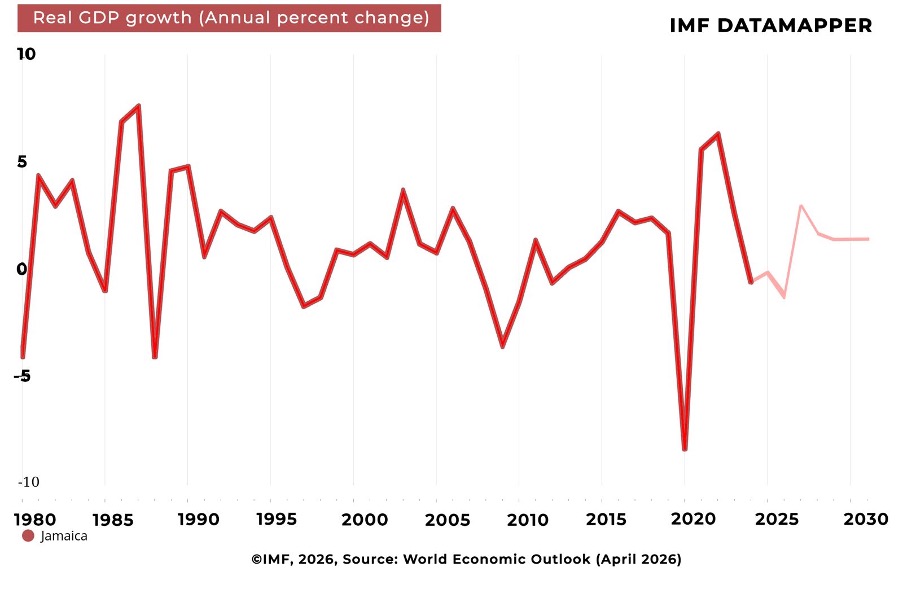
Jamaica’s long-term economic growth remains among the weakest in the developing world. Real GDP growth has averaged approximately one percent per annum over several decades. Labour productivity has declined. Foreign direct investment inflows have fallen sharply from their previous highs. Gross fixed capital formation has weakened. Real wages remain under pressure. Far too many of our brightest and best continue to leave in search of opportunities elsewhere. In short, we have stabilised the economy without transforming it.
The IMF, the World Bank, and the OECD have all reached broadly similar conclusions regarding the drivers of sustained economic growth. Countries that prosper over long periods do so because they continuously improve productivity, strengthen institutions, invest in human capital, encourage innovation and create an environment in which businesses can compete and grow. Countries that fail to improve productivity eventually encounter a ceiling beyond which growth becomes difficult, wages stagnate and economic opportunities diminish. That is precisely where Jamaica finds itself today.
Activity Is Not Productivity: A Response to Government Claims
My colleague MP from Manchester – Min. of Efficiency, Innovation, and Digital Transformation Audrey Marks – in her Sectoral Presentation cited increased numbers of online transactions, electronic payments and digital government services as evidence of progress. While these developments are welcome, activity should not be confused with productivity.
Many Jamaican businesses continue to encounter duplicated reporting requirements, fragmented government systems and lengthy approval processes. More than seventy percent of transactions in Jamaica are still cash-based. JAM-DEX adoption remains negligible despite significant effort by the Bank of Jamaica. Inter-bank payment systems continue to operate within constraints that reflect outdated institutional arrangements rather than the needs of a modern 24/7 economy. The Bank of Jamaica’s Real Time Gross Settlement (RTGS) operates from 8:30am to 2:30pm, while the Commercial Banks’ Automated Clearing House (ACH) is still next day payment.
My point is straightforward. Technology is an enabler, not a substitute for reform. If inefficient processes are simply transferred from paper to computer screens, what emerges is not efficiency but digital bureaucracy. Productivity gains arise when processes are fundamentally redesigned, responsibilities are clarified, duplication is eliminated and institutions become more responsive. Technology can facilitate that transformation, but it cannot replace it.
Jamaica’s Productivity Emergency
If there is one statistic that should concern every member of this House, it is the performance of Jamaica’s labour productivity over the last quarter century.
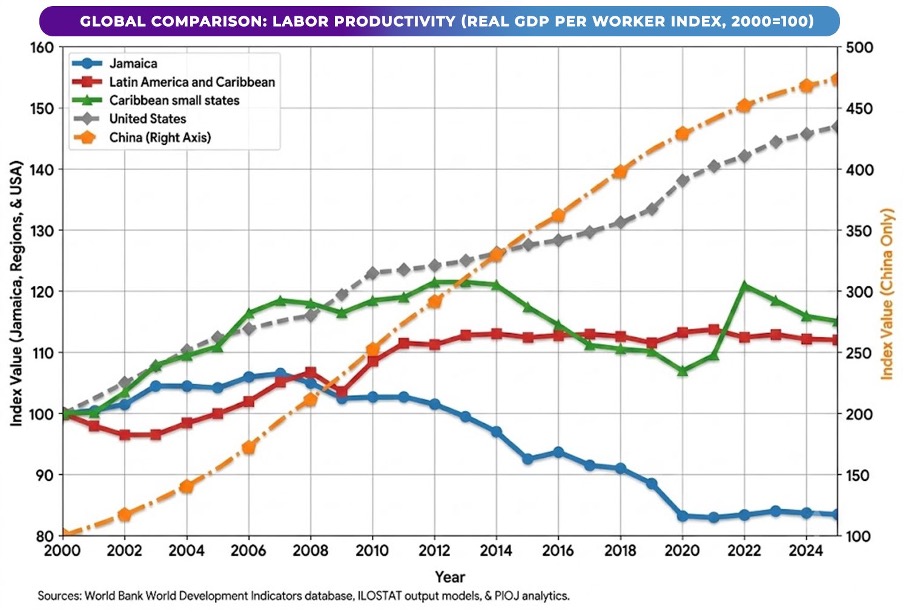
Jamaica’s labour productivity today, measured by real GDP per worker, remains below where it stood twenty-five years ago. During the same period, labour productivity in the United States increased by approximately fifty percent. China’s labour productivity increased by more than four hundred percent. Closer to home, countries in Latin America and the Caribbean with which Jamaica competes directly for investment and export opportunities have achieved substantially stronger outcomes.
Economists often focus on Total Factor Productivity, which measures the efficiency with which labour, capital, technology and organisational systems are combined. It captures innovation, management quality, institutional effectiveness, technological adoption and the allocation of resources throughout the economy. In successful economies, growth in Total Factor Productivity accounts for a significant share of long-term economic growth. In Jamaica, it has remained weak for decades. What the graph shows (since 2021 is the base year) is that for our entire history since independence Jamaica allocated and combined resources more efficiently than it is doing currently.
This matters profoundly because productivity growth is not simply another economic indicator. It is the primary source of long-term improvements in living standards. Nobel Laureate Paul Krugman famously observed that productivity is not everything, but in the long run it is almost everything. Workers cannot sustainably earn more than the value they produce. Governments cannot sustainably spend more than the economy generates. Businesses cannot sustainably raise wages unless productivity rises.
Human Capital, Education and the AI Revolution
If productivity is the engine of economic growth, human capital is the fuel that powers it. No country has achieved sustained productivity growth without simultaneously improving the skills, capabilities and adaptability of its workforce.
Jamaica faces a significant challenge in this regard. A recent newspaper article quoted UTECH’s President reiterating that approximately 30,000 students sit CSEC examinations annually, yet only about 6,000 achieve the minimum qualifications generally required for tertiary education. This means that four out of every five students leave secondary school without the credentials needed to fully participate in a modern knowledge economy. The education system continues to fail the majority of our students and needs to be fixed.
The economic implications of this reality extend far beyond the education sector. Employers consistently report shortages of workers with adequate literacy, numeracy, technical and digital skills, even while hundreds of thousands of Jamaican remain outside the workforce.
The challenge becomes more urgent when viewed against the backdrop of artificial intelligence. The IMF estimates that approximately forty percent of jobs globally will be affected by AI. Routine and repetitive tasks are increasingly susceptible to automation, while demand is growing for workers capable of exercising judgement, creativity, adaptability and complex problem-solving.
These developments have profound implications for Jamaica’s Business Process Outsourcing (BPO) sector, which is said to employ 50,000 Jamaicans directly. The sector generated employment opportunities and transformed local economies like Mandeville’s when we struggled to recover from the closure of the Kirkvine and ALPART alumina plants. However, many of the functions currently performed in customer service centres and back-office operations are precisely the types of activities most vulnerable to automation. My information is that one of the largest companies operating in the BPO sector has already cut its workforce by over 40%.
The Prime Minister in his Budget Presentation addressed low workforce productivity with his administration’s standard response = new acronyms! Having already introduced NaRRA, JAMRROC, and FAST, the PM continued “Starting in this financial year, HEART will introduce… a pilot of LEAP… (LEAP is the acronym for Learn, Earn, and Prosper) and expand CARE (Community Action for Rewarding Engagement).
Let me repeat “HEART will introduce… a pilot of LEAP this year.”, Perhaps the results of that pilot will be evaluated next year, and if positive, then maybe LEAP will be widely implemented in year three. HEART is a training institution whose curriculum evolves on a multi-year cycle, in an environment where the relevant AI driven technology changes every few months.
This reality demands a fundamental rethink of workforce development policy. HEART has made important contributions to Jamaica’s development, but it was designed for a different era. The pace of technological change now requires continuous workforce adaptation. The Opposition has stated repeatedly that the time has come to transform HEART into a workforce development funding institution. Rather than attempting to deliver training directly in every field, HEART should increasingly support employer-driven training initiatives, matching private sector investments in workforce development and allowing workers access to accredited training providers. Such a model would ensure that training resources are aligned with actual labour market demand and not institutional assumptions about future labour demand.
The Entrepreneurial Economy Under Attack from Tax Policy
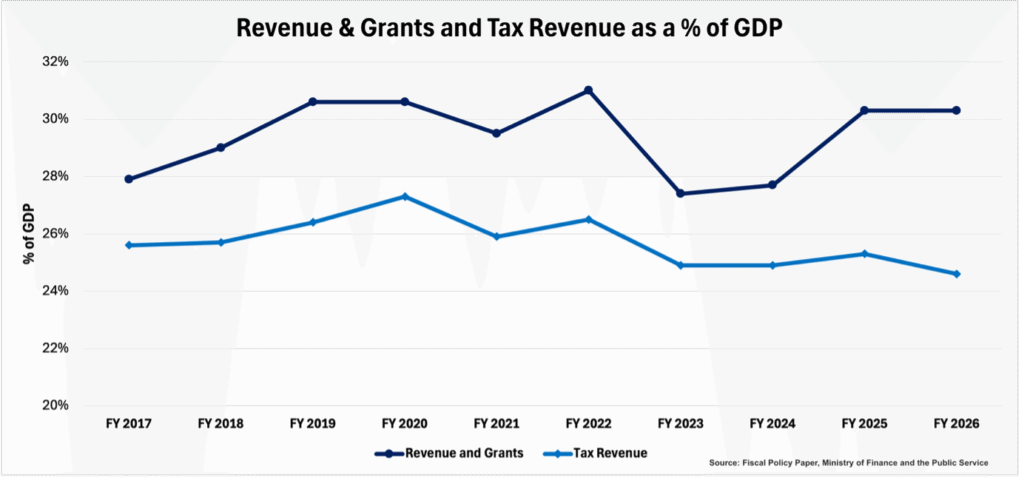
The chart above shows graphs of tax revenue, and the more comprehensive measure of revenue and grants that covers what the government extracts from taxpayers in fees, fine, levies, etc in addition to taxes. The latter has fluctuated between 27 – 31% of GDP. This is higher than the average for LAC which typically hovers around 21-22% of GDP and the world average of 16-17% of GDP.
So Jamaica is a highly taxed economy, and the tax system is largely regressive – meaning it favours larger enterprises and owners of capital. Consumption taxes falls heaviest on the poor who must consume most of their earnings, while income tax falls mainly on the middle class, public sector workers, and other PAYE employees. The wealthiest owners of capital consume only a small portion of their income so consumption taxes like GCT are low proportionally, a large portion of the wealthy’s income comes via capital gains which aren’t taxed, and many also use offshore structures to minimize their corporate and personal tax liabilities.
The majority of Jamaican firms surveyed find tax rates to be a major/severe obstacle to their operations. Equitable growth will only occur when thousands of individuals invest capital, take risks, and create opportunities. The overwhelming majority of Jamaican businesses are micro, small and medium-sized enterprises. They represent the backbone of employment, entrepreneurship, and innovation.
Economic growth does not emerge solely from large corporations or government programmes, yet Government policy appears designed around the needs of only these large firms while imposing additional burdens on smaller enterprises.
Short-term Rental Accommodation
The recent decision to impose General Consumption Tax of 15% on revenues of short-term rental accommodation is a prime example. The sector has been a success story – growing rapidly from 60,000 guests in 2017 to over 800,000 in 2024.
The short-term rental sector has democratised participation in the ownership of the accommodation sector. It has enabled thousands of Jamaicans to become tourism entrepreneurs. Unlike the dominant enclave tourism model, a greater share of the tourism dollar remains within local communities. Property owners, maintenance providers, transportation operators, restaurants and local suppliers all benefit from stronger linkages to the domestic economy.
Yet instead of encouraging this emerging growth sector, the JLP administration has chosen to respond with additional taxation. Any justification that the move is a necessary measure to level the playing field in the accommodation sector is just plain poppycock! Large hotel investments in Jamaica qualify for substantial benefits under the Omnibus Incentives Act and the Tourism Sector framework.
These huge multinationals enjoy significantly reduced corporate income taxes, productive input reliefs on equipment and construction materials, employment tax credits, and favorable capital write offs for building expenditures. They also benefit from the JTB’s cooperative marketing and advertising frameworks that help large hotel investments scale their occupancy and reach. None of these incentives are available to the short-term rental sector that is liable for income tax on earnings at the standard rate.
This type of behaviour prompted progressive leaders in the Caribbean and elsewhere to recently warn “Not to replace sugar plantations with hotel plantations” – a rebranded plantation economy built around leisure instead of sugar where the average Jamaican can only aspire to be a worker not an owner… an employee not an entrepreneur.
There will also be challenges in administering this tax. A single apartment complex often has a mix of short-term rental units, long-term rental units, and owner-occupied units. Some operators switch units between short and long-term rental depending on demand. Residential property rentals do not currently attract GCT, so will the tax be charged solely based on the booking platform used? There is no clarity around these questions.
This tax was imposed without any discussion with the short-term rental sector. Yet I feel certain Government met with the large hotel operators and their lobbyists. The Opposition is calling on the Government to meet with short term rental sector representatives around this proposed tax which will not benefit the sector. We must say NO to replacing the sugar plantation with the hotel plantation.
This is not a debate about taxation alone. It is a debate about ownership. Jamaica’s objective should not be an economy in which citizens can only aspire to become employees. It should be an economy in which all can become owners.
Tax Policy and Productivity
Another example of bad tax policy comes from a point I made in the 2018/19 sectoral debate. It is worth repeating at this time when geopolitical tensions have sent fuel prices skyrocketing and the pass through inflation now threatens our country, still struggling to recover from Hurricane Melissa, with the prospect of increased interest rates to battle this inflation. These high fuel prices will provide a tax windfall for the Government because of the ad valorem SCT on fuel. Now is the time to give both businesses and consumers some badly needed relief.
I support calls to cap the ad valorem SCT on fuel, but I go further and call on Government to eliminate SCT on fuels and instead include fuels in the base of GCT. Thiswould reduce the burden of cumulative consumption taxation on registered taxpayers, thus improving economic efficiency.
The SCT is particularly burdensome for firms in sectors where fuel costs are significant (e.g. transport, quarrying, heavy equipment rental) and can result in firms paying over 30% of sales (not profits) in combined Special Consumption Tax (SCT) and General Consumption Tax (GCT). Fuel is exempt from GCT, but subject to high levels of SCT, so firms end up paying both taxes stacked on top of each other, instead of being able to offset their fuel input taxes against their output taxes.
The IMF’s tax policy technical assistance missions over time have recommended the inclusion of fuels in the base of GCT, instead of the SCT.
Institutions and Bureaucracy Matter
One of the most damaging taxes in Jamaica is one that never appears on an invoice. It is the tax imposed by bureaucracy. Every entrepreneur experiences it. It is paid in delays, uncertainty, duplicated paperwork and lost opportunities.
Economists describe these burdens as transaction costs. In successful economies, institutions are designed to minimise them. In Jamaica, too many institutions continue to generate them. The result is lower investment, slower business formation and weaker productivity growth.
Productivity is not solely an economic issue. It is also a governance issue. The most productive economies in the world are characterised by strong institutions, predictable rules, and high levels of public trust. Investors do not simply evaluate tax rates or labour costs. They assess whether contracts are enforceable, regulations are predictable, and institutions operate fairly.
Recent controversies involving the treatment of independent oversight institutions should concern anyone interested in Jamaica’s competitiveness. These controversies include:
- The NaRRA Act which many see as a naked power grab by the PM, giving the agency and the PM sweeping executive powers, with a lack of institutional guardrails, and the ability to bypass traditional regulatory oversight.
- The PM overruled NEPA and granted a permit to mine in the ecologically sensitive Dry Harbour Mountains. The Constitutional Court in a recent landmark ruling declared the permit and the PM’s decision “unconstitutional, void, and of no effect”.
- The PM, in an unprecedented move for a sitting prime minister, took his own state oversight body -the Integrity Commission (IC) – to the Supreme Court. He filed over 20 applications seeking to nullify the IC’s investigative report and challenge the constitutionality of core provisions within the Integrity Commission Act passed by his government.
- Parliament’s oversight of the Executive is being undermined systematically, for example:
- The Presiding Officers have abandoned any pretence of impartiality and the three month delay in tabling the IC investigative report on the FLA is the most recent example.
- Ministers sitting on Parliamentary Oversight Committees such as the PAC examine Auditor General’s reports for periods covering their own stewardship of these MDAs including alleged improper Ministerial interference.
- Government members on the PAC and PAAC appear to do everything to obstruct the work of the Committees. Parliament’s email system is currently acting up, so just yesterday a sheet was circulated to members attempting to determine if PAAC members had received the emailed copy of its annual report. Every Opposition member confirmed receipt of the email while every government member denied receiving it.
- Independent media also plays a critical oversight role in democracies. In Jamaica, our remaining independent media houses and investigative journalists are barely surviving… in the Intensive Care Unit. There is an acute viability crisis for legacy print and broadcast organizations worldwide, and Jamaica is no different. Many close or merge, while others survive only as propaganda outlets for wealthy oligarchs or authoritarian leaning governments.
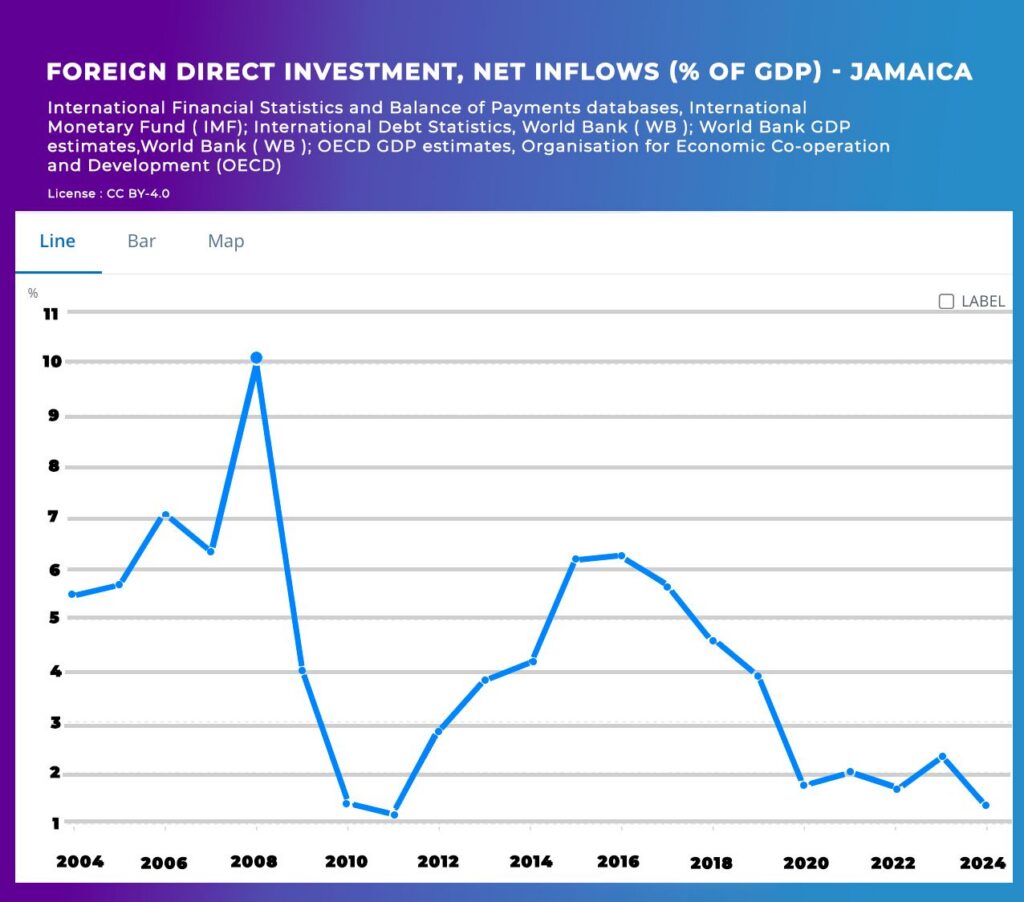
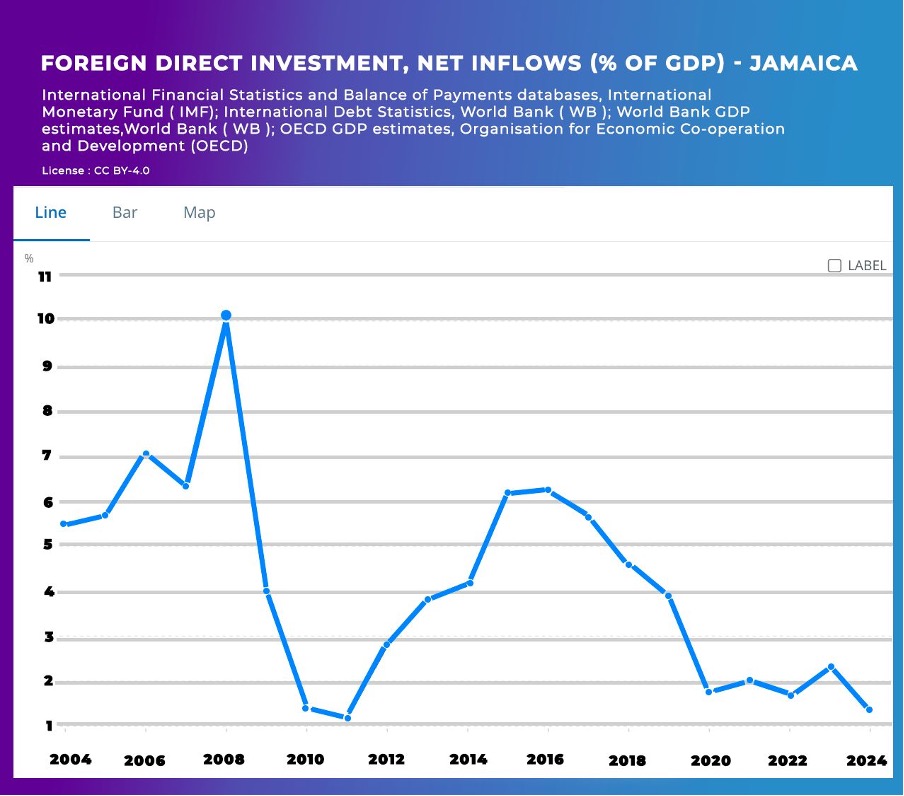
Given what is happening with our oversight institutions it should not be surprising that Net Foreign Direct Investment (FDI) inflows as a percent of GDP have declined to around 1.5 – 2% of GDP since 2020. This is less than a third of what we received ss recently as 2015 and 2016, when net FDI exceeded 6% of GDP.
Investors value certainty. Entrepreneurs value predictability. Businesses make long-term commitments when they believe that rules will be applied consistently and institutions will operate independently.
Strong institutions encourage investment because they reduce uncertainty. Weak institutions discourage investment because individuals and businesses must devote additional resources to navigating risk and unpredictability. Productivity therefore depends not only on economic policy but also on governance quality.
Conclusion: From Stability to Prosperity
The major economic achievement of the last 14 years was stabilisation. The great economic challenge of the next 14 years is transformation.
We have reduced debt, but we have not raised productivity. We have balanced budgets, but we have not strengthened institutions. We have improved some macroeconomic indicators, but we have not created an economy capable of consistently generating rising wages and expanding opportunities for our people.
The next chapter of Jamaica’s development cannot be written solely in the language of fiscal prudence. It must also be written in the language of productivity, efficiency and competitiveness.
Our workers and entrepreneurs in Jamaica are no less capable than their counterparts in Singapore, Dom Rep, or Panama. What differs is the quality of the institutions, the infrastructure, the policies and systems that surround them.
Jamaica possesses extraordinary advantages: talented people, entrepreneurial energy, a strategic location, a globally recognised and vibrant culture, and a large diaspora that remains deeply connected to the country’s future. What has been missing is the sustained commitment to transformational policies and institution building that convert potential into productivity, productivity into competitiveness, and competitiveness into the elusive prosperity.
That is the challenge before us. That is also the opportunity before us. And that is the productivity, efficiency and competitiveness agenda that Jamaica deserves.
Thank you.
Syndicated from Our Today · originally published .
Legal context · powered by Jurifi
Get the legal angle on this story. Pick a prompt and Jurifi's AI will explain it using Jamaican law.
AI replies are based on Jamaican law via Jurifi. Not legal advice.