
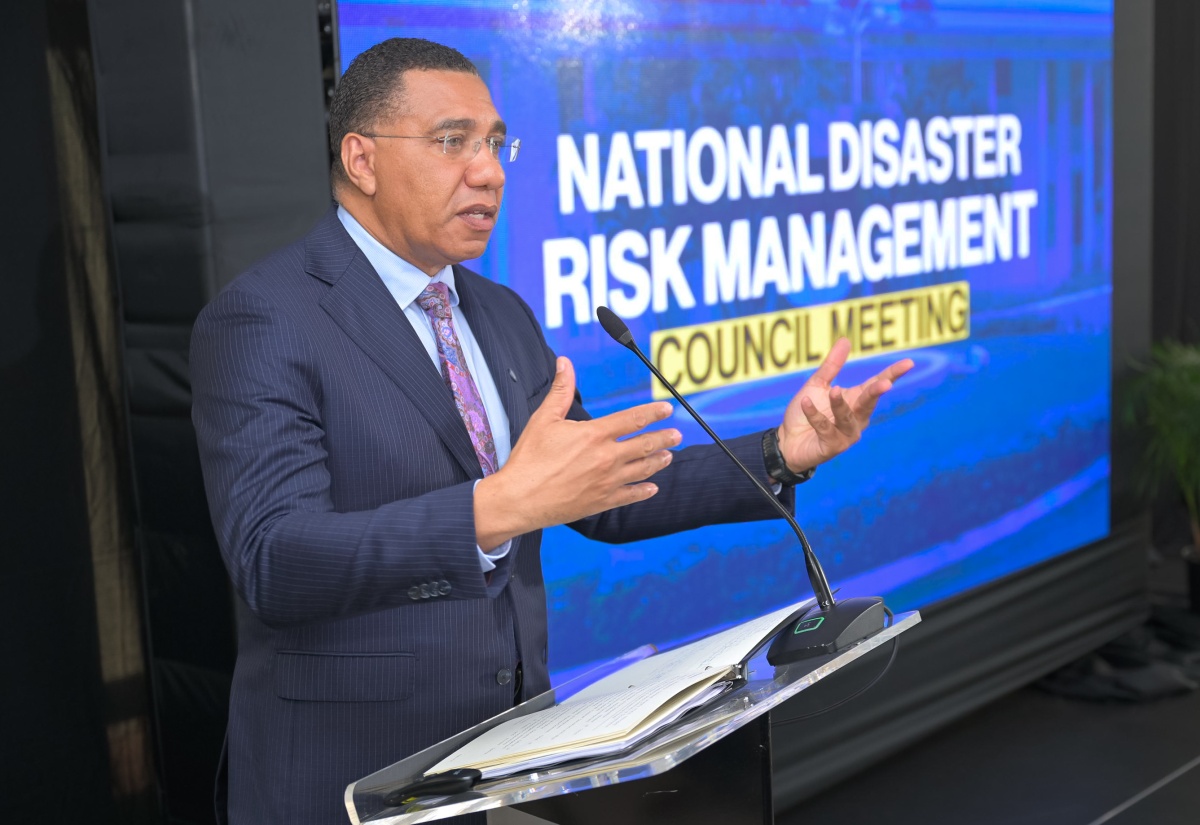
As the 2026 Atlantic Hurricane season approaches, Prime Minister, Dr. the Most Hon. Andrew Holness, is urging Jamaicans to heighten their level of preparedness and take proactive steps to safeguard lives and property.
“Preparedness is shared responsibility. Government has its role. But readiness begins in households, communities, farms, schools, clinics, police stations and fire stations.
“It also begins in the operations room of Flow and Digicel, in the control room of JPS (Jamaica Public Service Company) and NWC (National Water Commission), in the boardrooms of the companies that run our bakeries and our retail operations. All Jamaica must be preparing now for the hurricane season. We cannot control catastrophic events but we certainly can prepare and respond,” he said.
Dr. Holness made the call while addressing Wednesday’s (May 27) meeting of the National Disaster Risk Management Council, held at the Office of the Prime Minister. The meeting convened critical stakeholders to review national readiness.
“This is not ceremonial. It is where the systems of leadership must be developed and a shared understanding of the risks before us and the actions required are all discussed.
“We meet for the first time after Hurricane Melissa, an event that tested our assumptions about readiness, logistics, communications, shelter management, relief distribution, public order, fiscal resilience, and the State’s move from response to reconstruction. We must now speak from experience and responsibility,” he said.
Additionally, Prime Minister Holness emphasised that community resilience forms the foundation of national resilience, noting that the work of the Ministry of Local Government and Community Development is central to this effort.
“Strong agencies matter. But if households are not prepared, shelters are not known, vulnerable persons are not accounted for, and evacuation plans are not tested, national readiness is incomplete,” he pointed out.
Dr. Holness stressed that the Ministry of Local Government, along with Municipal Corporations and Parish Disaster Committees, must organise, document, test, and share local knowledge in advance of any event.
“A list in someone’s head is not a disaster plan. I’m sure there are many well-laid plans but nobody knows about them. A plan that has not been exercised is only a document,” he said.
The Prime Minister also noted that drills are important in preparing persons: “So, [Portfolio] Minister [Hon. Desmond McKenzie], I’m hopeful that during this season of preparedness… you will do some drills.”
Dr. Holness added that parish and community systems must be strengthened to sustain themselves for the first 72 to 96 hours after impact, through equipment, training, stronger community emergency response teams, “and full participation by Parish Disaster Committee Members, including Members of Parliament and Councillors”.
“OPDEM must become stronger, more technical, more operational, and more data-driven. The security forces and emergency services must institutionalise collaboration. The Ministry of Labour and Social Security must deepen vulnerability mapping while protecting personal information. Health facilities need continuity plans, backup power, water storage, medication protocols, and disease surveillance systems,” he said.
The Prime Minister added that the education system must ensure plans are in place for continuity of learning and the safe return of children to school.
“Water, electricity, and telecommunications are core resilient systems. Backup power at critical plumbing stations, emergency crews, fuel arrangements, priority restorations, protocol, and clear public communication must be strengthened.
“Public communications must fight misinformation. So, it’s not just PR, and use every channel, including offline systems, to reach communities when power and connectivity fail,” he noted.
Dr. Holness emphasised that scientific agencies must continue to modernise forecasting, monitoring, and GIS enabled early warning systems.
The Prime Minister stated that the private sector also has a central role, underscoring that businesses must develop continuity plans and be fully integrated into the national system.
“We need pre-arranged partnerships, not ad hoc arrangements, with clarity on supplies, storage, movement, and prices. Disaster preparedness is not an annual event… it is a perpetual state of national responsibility,” he said.
Meanwhile, Dr. Holness noted that the after action review of the category-five hurricane underscored that resilience depends not only on plans, equipment, and logistics but also on the well being of responders.
He noted that the psychosocial support for responders and disaster personnel must, therefore, be prioritised across all agencies.
“A system that protects the public must also protect those who serve the public. So, Minister of Local Government, Ministry of Health [and Wellness] and all the other entities responsible for the welfare and well-being of our workers, we will emphasise the psychosocial, mental health well-being of the persons who, themselves, are traumatised as they are dealing with victims and those who are suffering trauma. So, as we articulate our response strategy, this is one element of it that we will seek to embed,” the Prime Minister said.
The National Oceanic and Atmospheric Administration (NOAA) outlook for the 2026 Atlantic Hurricane Season, which runs from June 1 to November 30, projects a 35 per cent chance of a near normal season, a 10 per cent chance of an above normal season, and a 55 per cent chance of a below normal season.
Syndicated from Jamaica Information Service · originally published .
Legal context · powered by Jurifi
Get the legal angle on this story. Pick a prompt and Jurifi's AI will explain it using Jamaican law.
AI replies are based on Jamaican law via Jurifi. Not legal advice.
Other coverage

Prime Minister Holness Says Preservation of Life and Professionalism Must Remain Core Principles of Policing
Office of the Prime Minister
Jamaica Magazine 28.05.2026
Jamaica Information Service (Video)Watch
Gov’t strengthening disaster risk financing framework ahead of hurricane season
Jamaica Gleaner
MHPM Holness Labour Day 2026 Message
Jamaica Information Service (Video)Watch
Prime Minister Holness’ National Labour Day Message 2026
Office of the Prime Minister