

Scientific Research Council and its 66-year-old legislative architecture being modernized

Comprehensive review of SRC Act now underway to support its expanded role
Durrant Pate/Contributor
The Scientific Research Council (SRC), Jamaica’s principal agency, responsible for the promotion and coordination of scientific research and its application in the local environment is being overhauled and its 66-year-old legislative architecture being modernized.
To this end, the SRC Act, enacted in 1960, long before Jamaica’s modern governance frameworks, before its Science, Technology, and Innovation (STI) Policy, before biotechnology, digital transformation, and climate resilience became operational realities, is being overhauled. A new SRC Act is being planned, as Jamaica cannot build a 21st century innovation economy on a 1960 legislative framework.
The disclosure was made in parliament on Tuesday by Minister without Portfolio with responsibility for Science, Technology & Special Projects, Dr. Andrew Wheatley whilst delivering his Sectoral Debate presentation to the House of Representatives. A comprehensive review of the Act is being undertaken to modernize and harmonize it with current governance, accountability, and scientific mandates, ensuring the SRC has the legal foundation to fully execute its expanded role in the just announced House of Innovation concept.
The House of Innovation is the governing framework for Jamaica’s 10-year National Science, Technology and Innovation (STI) Strategic Plan 2026–2035, which Dr. Wheatley announced on Tuesday. Arguing that the SRC is one of Jamaica’s best-kept secrets, Wheatley declared that it will play a pivotal role in the execution activities of the House of Innovation.

Looking ahead to FY 2026/27
During the current 2026/27 financial year, the SRC will implement a Laboratory Information Management System to digitalize its operations, launch a digital solutions programme for MSMEs and expand its accredited analytical scope. In addition, the SRC will launch the Conversation in Science Podcast — a new public engagement initiative to deepen science literacy and support evidence-based national dialogue.
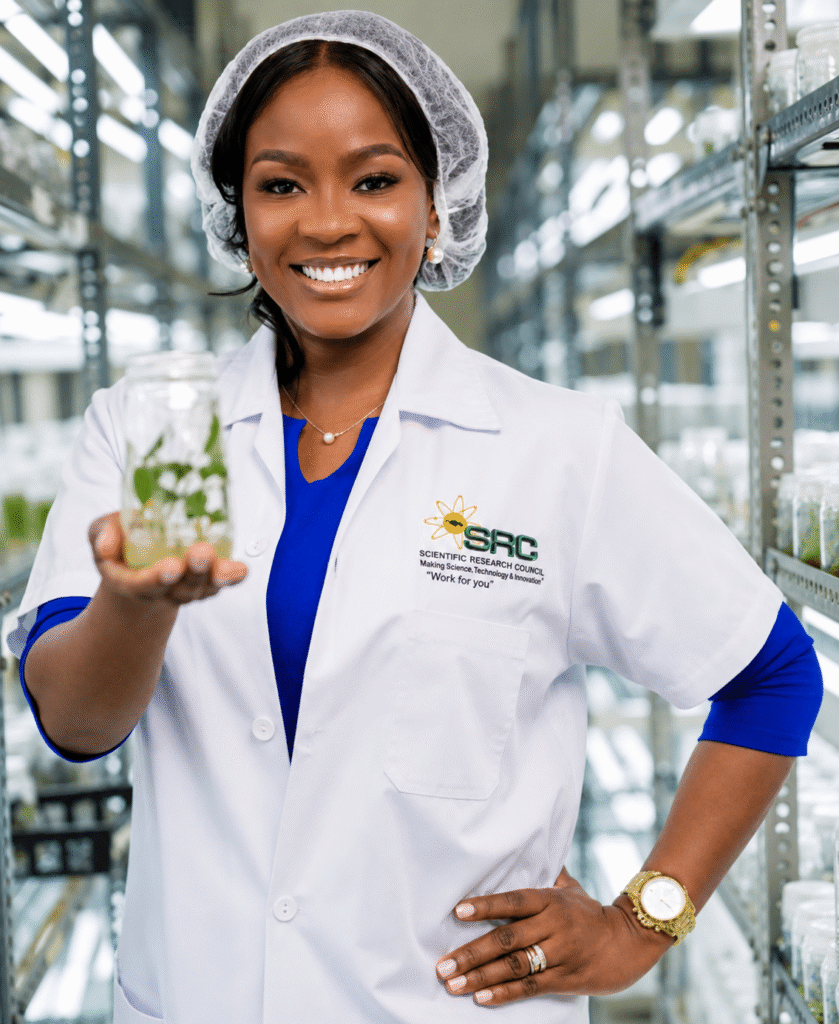
Turning to the 2025/2026 review period, the SRC delivered results that speak directly to Jamaica’s most pressing development challenges. In agriculture and food security, the SRC produced 30,000 tissue culture plants — yam, pineapple, and Irish potato to strengthen domestic food production, propagated 2,000 mangosteen plants in partnership with the Ministry of Agriculture, and advanced mutation breeding research for disease-resistant coffee, improved ginger lines, and faster maturing sweet potato.
In communities, 52 residents in Watermount, St. Catherine were trained in pineapple farming and juice processing, and 37 hot pepper farmers received training in jerk seasoning production to reduce wastage and increase income. Minister Wheatley argued that this is research for development in its most direct and tangible form.
SRC’s stand-out department performer
The SRC’s Analytical Services Department, the backbone of Jamaica’s public health and trade infrastructure completed 11,275 laboratory analyses between April and December 2025, protecting food safety, drinking water quality, and export integrity. Major laboratory modernization was completed this year with three new high-precision instruments deployed: a Discrete Analyzer for water-quality surveillance, an ICP-OES for heavy-metal and environmental monitoring, and an FTNIR spectrometer for food authenticity and adulteration detection.
Jamaica’s laboratory results remain ISO/IEC 17025 compliant — internationally recognized and trusted by our trading partners. On innovation and enterprise, the SRC developed 24 new food products and 2 personal care formulations, produced 115 nutrition facts panels strengthening consumer protection, and trained 87 entrepreneurs in science-based product development.
The Food Pilot Plant achieved a 12.5% increase in production output and a 283% increase in drying and milling volumes, directly supporting 68 MSMEs. In science education, 584 CSEC students from 100 schools received SRC workshops, 120 teachers were trained in science process skills, and science clubs are now active in over 100 schools with a focus on rural communities.
Syndicated from Our Today · originally published .
Legal context · powered by Jurifi
Get the legal angle on this story. Pick a prompt and Jurifi's AI will explain it using Jamaican law.
AI replies are based on Jamaican law via Jurifi. Not legal advice.
Other coverage

Wheatley announces ‘House of Innovation’ to drive growth
Jamaica Observer
National ST&I Strategic Plan 2026-2035 to Be Taken to Cabinet Soon
Jamaica Information Service
JISTV | Sitting of the House of Representatives | Sectoral Debate | June 2, 2026
Jamaica Information Service (Video)Watch
Sitting of the House of Representatives || June 2, 2026
PBC Jamaica (Video)Watch
Jamaica Cybersecurity Standards Framework Completed
Jamaica Information Service