
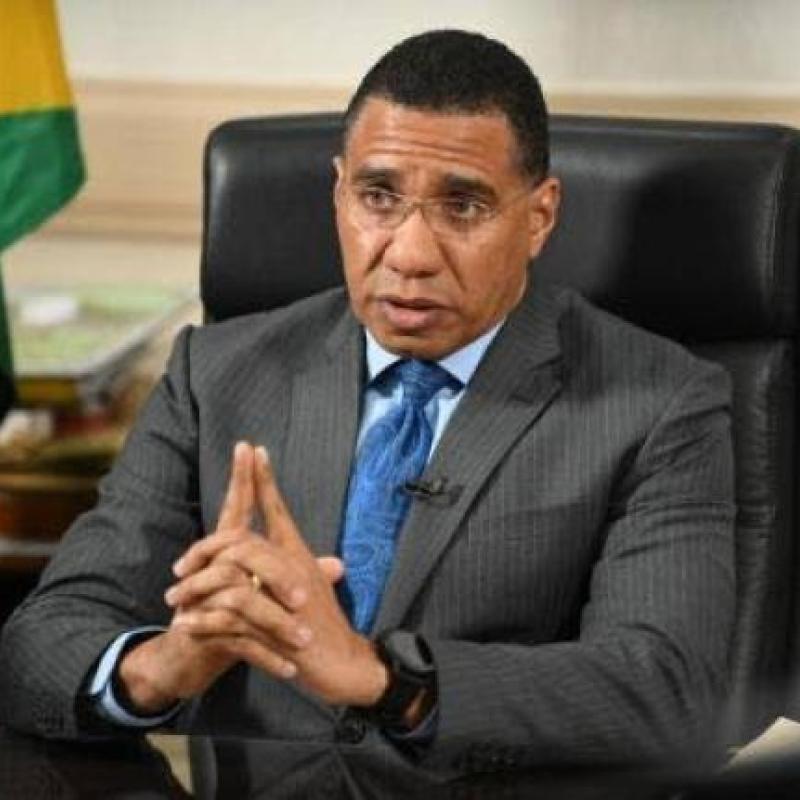
Holness Urges Jamaica To Target Residents And Investors In Dubai-Style Growth Plan
Prime Minister Dr Andrew Holness says Jamaica should study the development paths of Dubai and Singapore as it seeks to reposition itself as more than a holiday destination. He argued that the country must become attractive to people who want to settle, work, invest and build lasting economic ties.
Holness, however, said that kind of national shift would depend on deeper changes in how Jamaica approaches output, pay and the labour market.
Dubai, in the United Arab Emirates, and Singapore, the major financial centre in Southeast Asia, are widely recognised for transforming their economies quickly in recent decades. Their rise has been tied to strong geographic advantages, disciplined institutions, and policies that welcomed overseas capital and skilled people.
"Jamaica could become Dubai or Singapore," Holness told the Jamaica Chamber of Commerce 41st Annual Awards Banquet on Thursday night. "…where we are today, it is totally different from the 70s."
He continued: "If our economy grows, we might have to bring people in to keep the economy turning over. And, can you imagine that Jamaica has reached that stage?"
The prime minister also named the Cayman Islands and Antigua and Barbuda as Caribbean examples of smaller economies that have relied on migrant workers to support expansion. Those countries, he said, "have taken our labour to build their industries".
"We must not see ourselves as closed, insulated, xenophobic, isolated. We have to see ourselves as a country where people want to come and live. And we must embrace them," Holness said.
He said Jamaica’s long-used tourism strategy, centred on attracting visitors for brief stays, has to be recast. Tourism remains one of the main pillars of the national economy, but Holness said the country should place greater emphasis on long-term residents.
"The model of development and growth for many years has been how many visitors can we have in tourism. That model needs to shift. It has to be how many people can we get to come and live in Jamaica," he said. "It's not just the one-off five-day tourism dollar that gets circulated out of the country. We want people to come here and live and spend and hire and create and do business."
Holness connected that ambition to Vision 2030, the national development plan introduced in October 2007. He described its objective as making Jamaica "the place of choice to live, work, do business, raise family, and retire in paradise."
But he said that goal will be hard to achieve unless the country deals with crime, weak infrastructure and low productivity.
"Get the crime down, get the efficiency up, clean up the streets, start the reinvestment, you won't have a hard time to sell Jamaica," he said.
On wages and output, Holness said Jamaica has long faced a pattern in which pay rises that are not supported by stronger productivity feed higher prices.
"If wages don't match productivity and you increase wages, it's inflationary. It means you're going to come back again next year, ask for more wage increases because prices have increased, and you come back again the following year, and you're caught in this vicious cycle which we have been caught in for the last 40 years," he said.
He said Jamaica has the third-lowest productivity level in the region, which he presented as a key reason the country struggles to lift wages in a lasting way and compete with neighbouring economies.
"Productivity is the heart of growth. It is how we turn effort into value. It is how wages rise without pushing prices out of control," Holness said, adding that improving output "must become a national habit" across the public and private sectors.
In his Budget Debate contribution in March, Holness told Parliament that workers in Jamaica add an average of US$8.81 to gross domestic product for every hour worked. He said that was less than half the Caribbean average of US$20.50, about one-fifth of the United States figure, and only around a quarter of the level in Trinidad and Tobago.
"This is not a judgement on Jamaican workers," he said. "It is a diagnosis of our economic structure."
Holness also said in Thursday’s address that the labour market is presenting a contradiction that could hold back expansion. Although unemployment has fallen to record lows, he said employers continue to complain that they cannot find staff.
"Every day a business person said to me, 'Listen, Prime Minister, I cannot find people to work. But when I go out into the field, I see a lot of people not working,'" Holness said.
He called for a "new labour policy" for an economy moving close to full employment. Holness also urged the Jamaica Chamber of Commerce to speak more forcefully on the issue, saying business leaders should go beyond lobbying and engage workers and consumers in a wider discussion about work, pay and growth.
Jamaica’s jobless rate was 3.6 per cent in January 2026, the Statistical Institute of Jamaica reported in March. That was slightly below the 3.7 per cent recorded in January 2025.
Syndicated from Jamaica Gleaner · originally published .
Legal context · powered by Jurifi
Get the legal angle on this story. Pick a prompt and Jurifi's AI will explain it using Jamaican law.
AI replies are based on Jamaican law via Jurifi. Not legal advice.
Other coverage

CVM Lead Story | @CVMTVNews
CVM TV News (Video)Watch
Jamaica Chamber of Commerce Annual Awards Banquet || June 11, 2026
PBC Jamaica (Video)Watch
Post Cabinet Press Briefing || June 17, 2026
PBC Jamaica (Video)Watch
Bail Granted in Controversial Police Shooting Case | Jamaica Update
Realnews YtWatch
11th Biennial Jamaica Diaspora Conference 2026 || June 16, 2026
PBC Jamaica (Video)Watch