

Holness urges faster infrastructure approvals as Troy Bridge reopens in Trelawny
Prime Minister Dr Andrew Holness says Jamaica cannot continue with public-sector systems that allow vital infrastructure projects to stall for years, warning that long approval processes increase costs and leave citizens carrying the burden.
Holness made the remarks on Friday at the commissioning of the new Troy Bridge in Trelawny. The structure replaces the old bridge that went down in August 2021, and he said the experience shows why the Government’s approval and public investment framework must be changed.
“The system we have is quite effective at measuring the cost of building, but it is not effective at measuring the cost of not building quickly enough,” Holness said. “It would have cost us at least 30 per cent less if we had built this bridge four years ago.”
Addressing why residents waited about five years for the replacement, Holness said the matter required frank reflection. He said the delay was tied to the systems used by governments to protect public money and ensure it is spent properly.
He added that delayed infrastructure carries real consequences for ordinary people, from farmers taking longer routes to market to students losing extra hours on the road when a bridge remains out of service.
Speaking to residents and students at the ceremony, Holness said the reopening corrected the severe disruption communities had endured since 2021 and meant more than the completion of another works project.
He also reflected on the original Troy Bridge, built in 1869, which served communities in Trelawny and Manchester for more than 150 years before Tropical Storm Grace destroyed it. Holness described the bridge as part of both the community’s heritage and Jamaica’s wider story.
“The Troy Bridge is not simply a physical structure; it is part of the history of this community and part of the story of Jamaica itself,” he said, noting that it existed before motor vehicles and had survived many hurricanes as well as generations of social and economic change.
Holness used the opening to point to what he called a wider national problem: Jamaica’s ageing infrastructure. He said much of the country’s infrastructure was built more than 100 years ago and has gone beyond its expected service life.
“We are not going to be able to repair overnight the 20,000 kilometres of roadways that we have, much of which was built over 100 years ago,” Holness said, as he defended the Government’s SPARK road rehabilitation programme.
He said critics had questioned why the SPARK money was not simply used for patching roads. “Every year we are patching. Sometimes we are patching the patch that we patched,” he said, while also acknowledging the need for engineering checks, environmental assessments, procurement procedures and fiscal reviews.
Holness argued that procedures must lead to delivery. “The purpose of a process is to produce a result. Unfortunately, many of our bureaucrats and technocrats, and some of our politicians, and many in the civil society who criticise the work of government, believe that the end of a process is another process,” he said. “The objective is not to choose between accountability and efficiency. The objective is to achieve both.”
According to Holness, the Government intends to update the public investment and approval system by cutting repeated steps, reducing wait times for approvals and setting up faster routes for critical infrastructure projects.
“We are determined to modernise our public investment and approval system. We are determined to reduce duplication. We are determined to shorten approval timelines. We are determined to create accelerated pathways for critical infrastructure projects,” he said. Holness pointed to the establishment of the National Reconstruction and Resilience Authority, NaRRA, as part of the administration’s push to improve infrastructure delivery and strengthen Jamaica’s recovery capacity after natural disasters.
The closure affected communities on both sides of the bridge. Troy High, among other schools, lost several students after parents decided they would not pay the extra cost of sending them along the longer alternative route.
Business activity also suffered, as delivery trucks had to use longer roads and some enterprises lost customers when Troy was cut off from a key link.
Stephanie Codling-Smith, principal of Warsop Primary and Infant School, welcomed the new bridge, which has restored the connection between communities on either side of the Hector River below.
“Today is a wonderful day. It is a good day for us here in this part of Jamaica,” she said. “We are happy to see the bridge standing firm, standing tall, and we are very happy for that. So today is really a good day.”
Syndicated from Jamaica Gleaner · originally published .
Legal context · powered by Jurifi
Get the legal angle on this story. Pick a prompt and Jurifi's AI will explain it using Jamaican law.
AI replies are based on Jamaican law via Jurifi. Not legal advice.
Other coverage

Official Opening of the Troy Bridge, Trelawny
Andrew Holness (Video)Watch
P M Holness: new Troy bridge represents restoration of connection & dignity
Jamaica Inquirer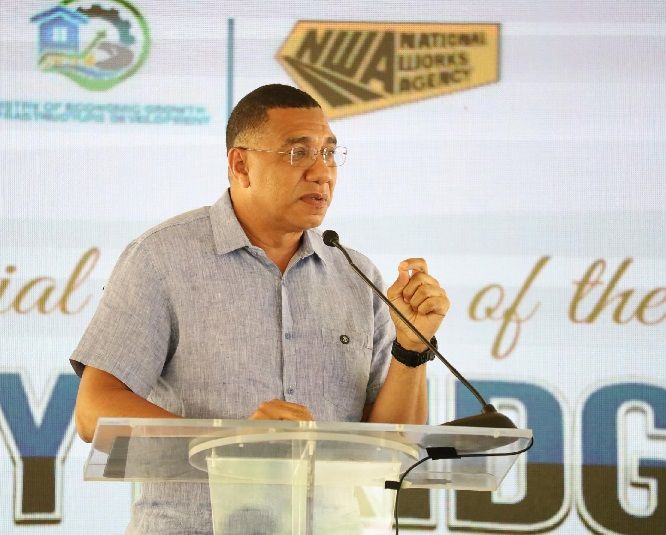
Prime Minister reiterates that efficiency is not the enemy of accountability
Jamaica Inquirer
Prime Minister Holness Says Jamaica Must Uphold Standards in Politics and Public Life
Office of the Prime Minister
P M Holness: new Troy bridge represents restoration of connectivity & dignity
Jamaica Inquirer