
Westmoreland residents face rising fuel prices, bills and fresh losses after Hurricane Melissa
People across Westmoreland say life has become increasingly difficult since Hurricane Melissa tore through the parish. Months after the Category 5 system, many residents are still dealing with damaged houses, closed or weakened businesses, long power disruptions and now steeper everyday expenses, including petrol prices affected by conflict in the Middle East.
Petrojam’s most recent ex-refinery listing added more strain for drivers. The price of 90-octane gasoline rose by $4.50 to $188.57 a litre, while 87-octane also climbed by $4.50 to $181.13 a litre.
At service stations in Westmoreland last Thursday, several motorists said the increases had come while they were still trying to put their lives back together after the hurricane. One taxi operator captured the mood in blunt terms: “[Hurricane] Melissa mash me up and now gas a mash me up bad.”
The cabbie said Melissa ripped the roof off his home and wiped out a small shop that had helped him earn additional money. Speaking with the Jamaica Observer, he said the amount he spends each day on petrol to run his taxi has moved from roughly $3,500 to no less than $5,000, taking his weekly fuel bill above $20,000.
“It’s the same fare me a collect,” the cabbie said. “[Cost of] tyre raise; one of my tyres was $10,000, now it is $12,000-plus, so everything — battery — everything gone up. It hard, but you have to gwaan because we can’t sit down. It’s tight; we want a fare increase badly,” he appealed.
For David Israel of Cave, petrol is just one pressure point. He said he is also trying to find the money to rewire his house because of damage caused by the hurricane.
“We have to hire electricians, and those electricians, after the storm, their prices are also going high. So everything is compounding since Melissa, and if you’re really not self-motivated and have a driven spirit to just get up back on your feet and move and not being hopeless, it will break your spirit,” he told the Sunday Observer.
“Everything just compounds, it’s one after the other,” Israel added, sounding somewhat weary but insisting that he plans to keep pushing ahead.
A Westmoreland teacher said the cost of moving around has forced him to think carefully about every journey. He said he now limits trips, shares rides when he can, walks where possible, or remains at home.
“We just have to ration wherever we go, carpool, where possible, and basically walk or tan a me yard, and it’s increasingly the last part — tan a me yard,” he said.
According to the teacher, $7,000 in petrol lasted only two days, even though that sum would usually cover his driving for a full week.
“It’s tactical choices — if we don’t absolutely have to go there, we don’t go there, or [we] walk, because even if we take taxi, that’s still at a cost,” he explained.
He said he would back work-from-home measures if they are put in place. However, he warned that online teaching would be challenging and could move the burden from transport costs to higher household bills.
“My light bill has gone up every month by 50 per cent, so I am dreading to see what the next bill will be like. If it’s work from home, we have to be careful how we do that, but I can understand the need to restrict general road movement,” he told the Sunday Observer.
Another resident of Cave, who identified herself as Mrs James, said using a generator had been costing her about $19,000 each week. She said she is thankful that electricity service has returned, but the speed with which a new electricity bill arrived has brought fresh concern.
“It wasn’t an easy task, still grateful for the current [electricity] that we get back, but I never expected a light bill so soon. The light bill was like $6,800 just for two weeks, and it’s not nice knowing that we’re working with minimum wage to pay the light bill, water bill, and send the kids back to school,” she said.
Mrs James said the hurricane also caused her to lose a business and some animals. “We are just hopeful that some better days are coming, but, to me, it just seems like it’s getting worse than how we expect it,” she said.
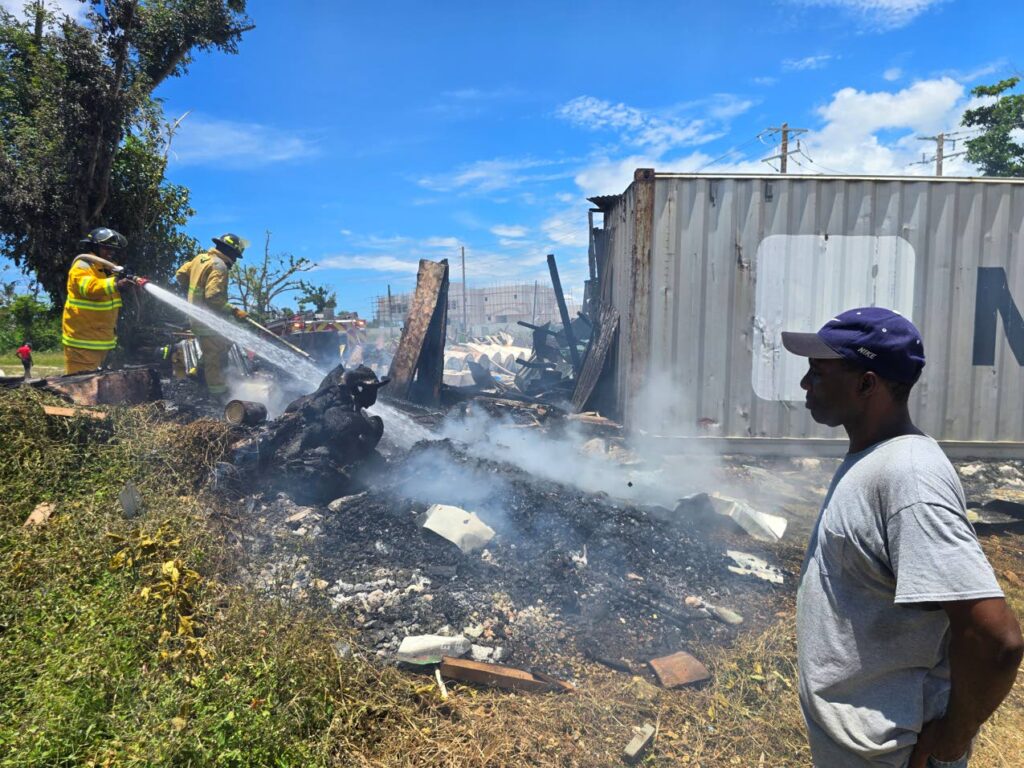
Delpert Rodney is facing a different loss. For him, the newest blow was not petrol, but a fire that consumed the small amount of goods he had managed to rescue after the storm.
Rodney, who operates a haberdashery in Belmont, said Melissa had already destroyed his store. He had moved the limited stock he recovered into a back room at a temporary building, but that room was gutted by fire last Thursday.
“We were at ground zero after Hurricane Melissa, and this happened. It’s really heartbreaking right now,” he told the Sunday Observer.
Rodney said business had been reasonable after the hurricane and he believed he was starting to regain his footing before the fire set him back again.
“From fire, there is nothing to be salvaged now. We just have to move on and pray,” he reasoned. “I’m of the view that once you don’t give up, there is always room for going forward. Once you give up, then everything is dead, but once you keep trying and putting the pieces back together, you will be good,” he said.
Syndicated from Jamaica Observer · originally published .
Legal context · powered by Jurifi
Get the legal angle on this story. Pick a prompt and Jurifi's AI will explain it using Jamaican law.
AI replies are based on Jamaican law via Jurifi. Not legal advice.