

July 22, 2026
AMD shares are having one of their sharpest moves of the year, jumping roughly 8 per cent to trade near $544 as the company uses its Advancing AI event in San Francisco today to unveil Helios, its first full AI server rack system built to compete directly with Nvidia’s equivalent offering. The stock is now within striking distance of the all-time high of $584.73 it set less than a month ago, and the move underlines just how tightly AMD’s valuation is now tied to a single story: whether it can carve out a meaningful share of the AI infrastructure buildout currently dominated by Nvidia.
What Was Announced
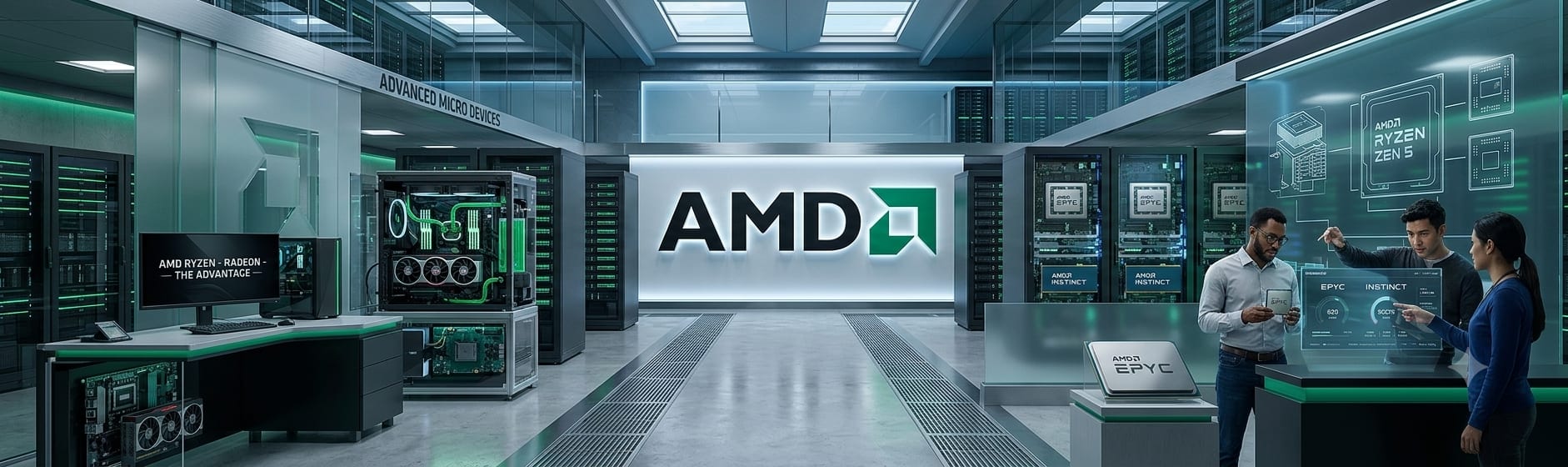
The centrepiece of today’s news is Helios, a rack scale AI computing system that packages AMD’s Instinct accelerators, EPYC processors, and networking components into a single integrated offering, the kind of turnkey system large cloud operators increasingly want rather than individual chips they have to assemble themselves. AMD confirmed that Microsoft and Meta have both signed on as customers for the new system, a meaningful validation given that both companies are among the handful of hyperscalers capable of deploying AI infrastructure at the scale that actually moves AMD’s revenue numbers. Reports ahead of the event had speculated the company might also use the occasion to detail a relationship with Anthropic, though AMD’s own confirmed disclosures centre on the Microsoft and Meta wins.
The Underlying Business
Today’s rally builds on a first quarter that already showed the AI transition working in AMD’s favour. Revenue for the period came in at a record $10.3 billion, with non-GAAP earnings per share of $1.37 comfortably ahead of the $1.25 analysts had modelled. Data Centre revenue, now the company’s single largest and fastest-growing segment, reached $5.8 billion, up 57 per cent from a year earlier on strong demand for EPYC server processors and continued shipments of the Instinct GPU line. The Client and Gaming segment was no laggard either, up 23 per cent to $3.6 billion, with the core PC processor business growing 26 per cent on strength in AMD’s newer Ryzen chips.
Management’s guidance for the second quarter, due to be reported on August 4, called for revenue of approximately $11.2 billion, which would represent growth of around 46 per cent year over year, alongside a non-GAAP gross margin near 56 per cent. Chief executive Lisa Su has been explicit that Data Centre is now the primary driver of both revenue and earnings growth at the company, a notable shift for a business that built its recent turnaround on PC and gaming chips before AI infrastructure spending took over as the dominant industry theme.

Valuation and the Case for Caution
None of this comes cheaply. AMD’s market capitalisation has climbed to roughly $888 billion, and the stock trades at well over 100 times trailing earnings, a multiple that only makes sense if the market’s assumptions about future AI infrastructure spending prove accurate and AMD continues taking share from Nvidia at the pace recent quarters suggest. The average analyst price target sits close to where the stock trades today, which is itself worth noting. After a run this dramatic, even bullish analysts have largely caught up to the price rather than continuing to chase it, and a stock trading roughly in line with consensus targets leaves less obvious margin of safety than one trading well below them.
The competitive picture is also a genuine risk, not a formality. Nvidia remains the dominant player in AI accelerators by a wide margin, with a more mature software ecosystem that AMD has openly acknowledged it needs to keep closing the gap on. Today’s Microsoft and Meta wins are real progress on that front, but AMD is still, by its own admission, playing catch-up rather than leading. A single large customer delaying deployments, a shift in chip architecture preferences, or a stronger-than-expected response from Nvidia’s own next-generation products could all weigh on a stock priced for continued, uninterrupted share gains.
The Takeaway
AMD has moved decisively from being a PC and gaming chip story to being one of the more direct ways to invest in the AI infrastructure buildout, and today’s Helios launch, along with confirmed commitments from Microsoft and Meta, gives that thesis fresh evidence. The first quarter numbers back it up with real revenue growth rather than just narrative. What investors are paying for at current levels, however, is not modest. A valuation near 100 times earnings assumes AMD keeps executing at an exceptional pace for years to come, and leaves little room for disappointment along the way. For anyone already holding the stock, today’s news is a clear positive. For anyone considering a new position, the entry point comes with a premium that assumes most of the good news still to happen actually does.
This analysis is for informational purposes and does not constitute investment advice. Prices and figures cited are as of July 22, 2026 and are subject to change.
Syndicated from Our Today · originally published .
Legal context · powered by Jurifi
Get the legal angle on this story. Pick a prompt and Jurifi's AI will explain it using Jamaican law.
AI replies are based on Jamaican law via Jurifi. Not legal advice.
Other coverage

AI stocks lead Wall Street higher, even as Brent oil’s price tops US$91
Jamaica Gleaner
The Business Report—July 15, 2026
PBC Jamaica (Video)Watch
Derrimon sales down a third, even as it moves beyond write-down
Jamaica Gleaner
Editorial | PAAC falls short on Students’ Loan Bureau
Jamaica Gleaner
The News—July 17, 2026
PBC Jamaica (Video)Watch