
UN court hears case over oil-rich region claimed by Venezuela, Guyana
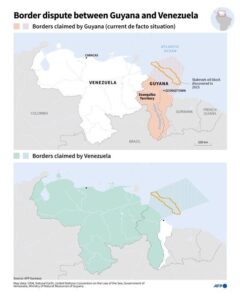
THE HAGUE, Netherlands — The United Nations’ highest court on Monday began examining competing claims between Venezuela and Guyana over an oil-rich territory, part of a centuries-old dispute between the South American neighbours.
The two countries have been wrangling over the Essequibo region since the 1800s, with the dispute intensifying after ExxonMobil discovered massive offshore oil deposits a decade ago, giving Guyana the largest crude oil reserves per capita in the world.
The Essequibo region comprises more than two thirds of Guyana, which currently administers it. Neighbouring Venezuela, however, claims the territory, which runs roughly along the western side of an eponymous river over an area of 160,000 square kilometres (62,000 square miles).
The International Court of Justice (ICJ) is due to examine the validity of the border that was established between the two countries in 1899 under British colonial rule.
“This case has an existential quality for Guyana, at stake is more than 70 per cent of our sovereign territory,” Guyana’s Foreign Minister Hugh Hilton Todd told the judges as he presented Guyana’s side.
“For the Guyanese people, it is tragic even to think about having our country dismembered by stripping from us a vast majority of our land, together with its people, its history, its traditions and customs, its resources and precious ecology,” he said.
“Guyana would no longer be Guyana without them,” he said, adding that Venezuela’s challenge of the border was “decades, no, a century too late to be raised as a matter of international law”.
Venezuela, which will present its position on Wednesday, has argued that the border should be drawn in accordance with a 1966 agreement that was signed before Guyana gained its independence.
It says that the Essequibo River, located much farther east than the current border, is the natural frontier, as it was in 1777 under Spanish colonial rule.
The ICJ, which is based in The Hague and settles disputes between states, confirmed its jurisdiction in the case after preliminary hearings in 2020, following a filing by Guyana in 2018.
The hearings are due to run through May 11.
Syndicated from Jamaica Observer · originally published .
Legal context · powered by Jurifi
Get the legal angle on this story. Pick a prompt and Jurifi's AI will explain it using Jamaican law.
AI replies are based on Jamaican law via Jurifi. Not legal advice.