
JTA hopefuls clash over teacher pay, housing and school leadership
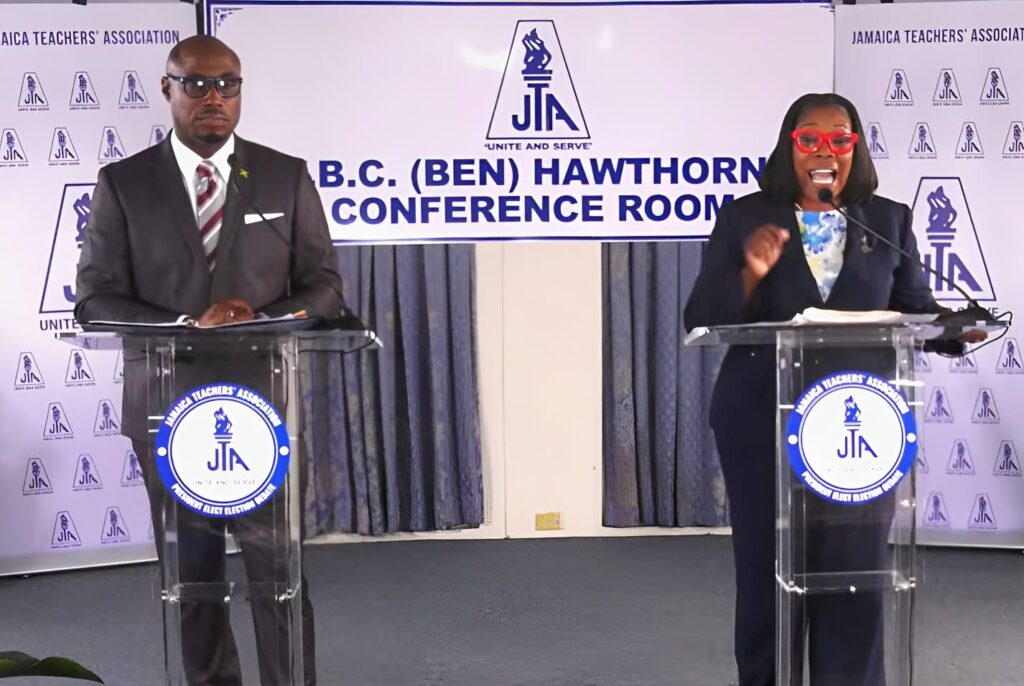
Plans to improve the working lives of Jamaican teachers dominated Monday’s Jamaica Teachers’ Association presidential debate, where president-elect contenders Dr Maureen Mullings-Nelson and Dr Darien Henry outlined sharply different priorities for the profession.
The two educators addressed some of the major concerns facing teachers, among them salaries, the cost of housing, the loss of educators from the system, special education pressures and the general path the sector should take.
Henry, who is principal of Montego Bay Community College, said teacher pay must be treated as a matter of national importance. He proposed that classroom teachers be paid between US$30,000 and US$35,000 a year, bringing their earnings closer to colleagues elsewhere in the region.
“There is no question that the international pressures as well as geopolitical issues in the Far East continue to influence our economic direction as a country. However, as it stands, we have to make some bold and transformative positions as a Government,” he said.
Henry also argued that the difference between what teachers earn and the salaries paid to elected representatives has become too wide, saying Jamaica will struggle to keep educators unless the issue is tackled more forcefully.
“For too long, Jamaican teachers have been ebbing and flowing at the bottom of the salary scale. That’s why they’re not staying here,” Henry said.
Mullings-Nelson, president of The Mico University College Staff Association, focused more heavily on housing assistance, welfare support and education benefits. Her proposals included wider access to National Housing Trust benefits and full tertiary scholarships for the children of teachers.
“What I have on my manifesto is for housing benefits for teachers across Jamaica. What I have on my manifesto is to engage the National Housing Trust, [which is] sitting on over $390 billion, to create low-income housing solutions for teachers right across Jamaica,” she said.
On the question of performance-based pay, the two candidates were aligned. Both said they would not support salaries being directly linked to performance assessments under the present circumstances.
“It would never, ever be something that is to be contemplated to tie teachers with performance-based pay,” Henry said. Mullings-Nelson said any such discussion would first require attention to the uneven levels of funding and resources across schools.
Special education was another key concern in the debate. Henry said the matter has reached an urgent stage, noting that many students are not being diagnosed because assessment services are limited and waiting times are long.
“There is a crisis,” he said. “Our teachers, as it stands now, they are seeing far more students who are presenting with special education needs, and they themselves are out of their pedagogical depth in reaching these students,” Henry added.
Mullings-Nelson said students who are struggling should face mandatory assessments. She also called for better financing for schools and more in-class support for children with special educational needs.
The debate became more pointed when Mullings-Nelson appeared to challenge Henry’s leadership record, referring to media coverage and complaints from staff at institutions where he has served.
“I heard my colleague mention two institutions and I would have served as vice-principal. The data is also there in terms of the media, so we’re not making up stories of a bakra master situation in some institutions and how some colleagues are feeling where leadership is concerned,” she said.
Mullings-Nelson said the JTA requires leadership that can pull together a membership she described as increasingly divided.
Henry rejected the criticism, saying it reflected his demand for accountability and strong standards. He referred to a June 19, 2021 report involving Cumberland High School, where he said the “bakra master” description had been used about him.
“I heard reference made to bakra master leadership and it harkens to a June 19, 2021 story which was done at Cumberland High School where I was enviably referred to as a bakra master. You know what I was a bakra master about? Ensuring that systems and processes were working so that there was effective teaching and learning and that schooling went on — and that has been recognised,” he said.
Henry said the outcomes at institutions he has headed support his leadership approach, naming Cumberland High School and Montego Bay Community College as examples where transformation had taken place.
Syndicated from Jamaica Observer · originally published .
Legal context · powered by Jurifi
Get the legal angle on this story. Pick a prompt and Jurifi's AI will explain it using Jamaican law.
AI replies are based on Jamaican law via Jurifi. Not legal advice.
Other coverage

Harrison calls for urgency in school repair - JTA president-elect says some temp facilities now failing
Jamaica Gleaner
Annie Palmer FBI Most Wanted | JTA President Warns Teachers Against Dangerous JTC Bill
Realnews YtWatch
JTA president-elect warns teachers to mobilise against 'dangerous' JTC bill
Jamaica Gleaner
Teachers schooled on writing textbooks for local classrooms
Jamaica Gleaner
REPAIR RAGE - Protest erupts over stalled reconstruction at Westmoreland high school
Jamaica Gleaner