

Jamaica calls for stronger global framework to help vulnerable economies navigate climate, technology and the future of work
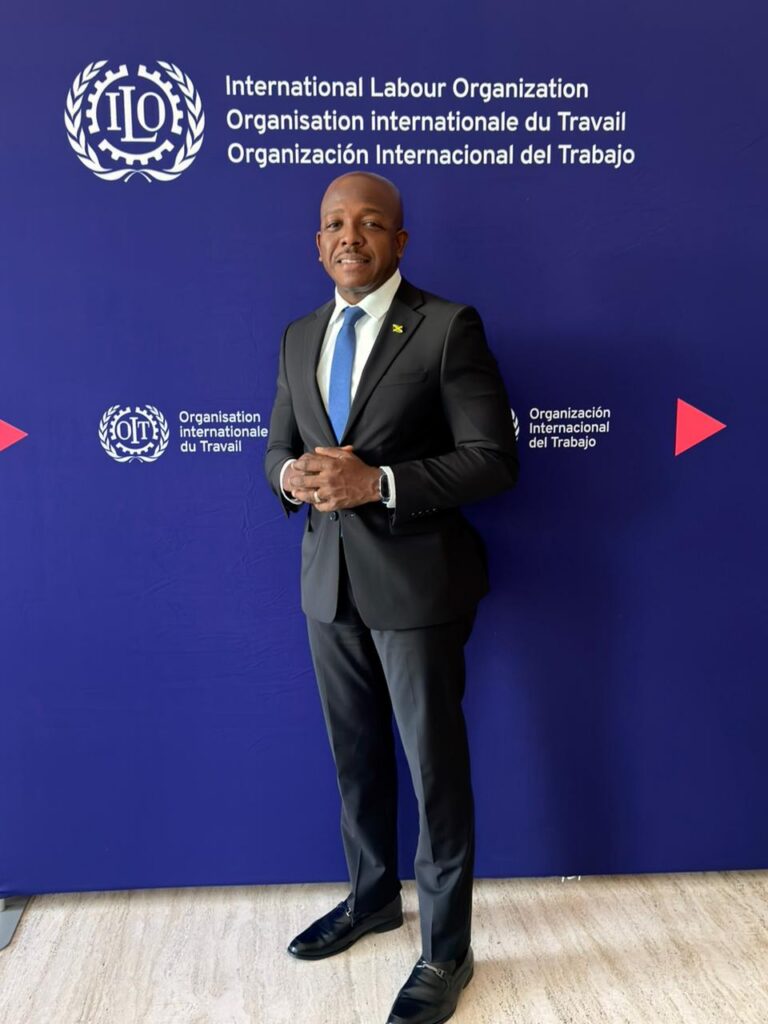
Jamaica has received special commendation on its National Statement delivered by Minister of Labour and Social Security, Pearnel Charles Jr, at the 114th Session of the International Labour Conference (ILC).
In the statement, the minister made a call for a stronger and more responsive international framework to help vulnerable economies navigate the converging pressures of climate change, technological disruption and labour market transformation.
Addressing delegates from the International Labour Organisation’s 187 Member States, Charles Jr argued that the pace of global change is exposing a widening gap between the challenges confronting developing economies and the institutional support available to help countries adapt and remain competitive.
Speaking before representatives of governments, employers and workers from around the world, Minister Charles said the global conversation on the future of work must move beyond broad aspirations and focus on building the resilience, capacity and adaptability required for countries to thrive amid unprecedented change. “The world of work is being reshaped by forces that do not operate in isolation. Climate change, artificial intelligence, digitalisation, and demographic shifts are converging to redefine how economies function, how businesses compete and how workers earn a living,” said Charles.
“Across the developing world, countries are being required to confront multiple transitions simultaneously. We are responding to climate shocks while adapting to technological change. We are building more resilient economies while preparing workers for jobs that are still emerging. We are navigating uncertainty while being asked to remain globally competitive.”
The minister stressed that for Small Island Developing States, resilience can no longer be viewed solely through the lens of recovery. “For small states, resilience can no longer be defined simply as the ability to recover. In today’s world, resilience must mean the capacity to anticipate, adapt and seize opportunity in the face of constant change.”
Drawing on Jamaica’s experience following successive major hurricanes, including Hurricane Melissa, Charles noted that climate-related events continue to place extraordinary pressure on vulnerable economies, affecting livelihoods, businesses, infrastructure and national productivity. At the same time, rapid advances in artificial intelligence, digitalisation and the platform economy are reshaping labour markets at a pace that many developing countries are struggling to match. “The future of work is arriving unevenly. Some countries are shaping it.
Others are struggling to keep pace with it. Our collective responsibility is to ensure that technological progress expands opportunity rather than deepens existing inequalities.
The minister warned that countries unable to successfully manage these transitions risk falling further behind, not because of a lack of ambition, but because the scale and speed of change increasingly exceed the capacity of existing institutions and support systems. Against this backdrop, Jamaica called on the International Labour Organisation to strengthen its support for Caribbean Member States and advance practical mechanisms that help governments, employers, and workers respond proactively to climate shocks, technological transformation and labour market disruption. “The international community must recognise that the future of work will not be experienced equally across all countries. The realities facing large industrialised economies are not always the realities facing vulnerable island states.”
“What is needed is a framework that reflects those realities and supports governments, employers and workers in managing change before disruption becomes crisis.”
Despite recent climate-related challenges, Jamaica continues to record historically low unemployment and positive labour market outcomes, achievements supported by the country’s longstanding commitment to tripartism, freedom of association and collective bargaining.
“Jamaica’s progress demonstrates that resilience is not built after a crisis. It is built beforehand through strong institutions, responsible social partnership and a shared commitment to national development.”
While acknowledging Jamaica’s labour market achievements, Minister Charles stressed that sustainable progress requires more than job creation alone. He noted that the Government is advancing a National Employment Policy that places a strong culture of work at its core, reflecting the vision articulated by Prime Minister Dr Andrew Holness that national prosperity depends not only on the availability of jobs, but also on cultivating an appreciation for the value of work, productivity, lifelong learning and active participation in economic development.
In closing, Charles urged Member States to embrace a broader and more forward-looking understanding of resilience, one that prioritises preparedness, adaptation and long-term competitiveness alongside recovery.
“The question before the international community is not whether transformation is coming. It is already here. The question is whether our institutions are evolving quickly enough to help workers and economies navigate it successfully. The future of work will be shaped by the choices we make today. Our responsibility is to ensure that workers, enterprises and economies are equipped not merely to withstand change, but to harness it. That is the challenge before us. It is also the opportunity.”
Syndicated from Our Today · originally published .
Legal context · powered by Jurifi
Get the legal angle on this story. Pick a prompt and Jurifi's AI will explain it using Jamaican law.
AI replies are based on Jamaican law via Jurifi. Not legal advice.