

Jamaica’s tourism product is shrinking and we must do much better – Purkiss

Opposition Spokesperson for Tourism and Linkages Andrea Purkiss made her contribution to the Sectoral Debate in Parliament and declared that Jamaican tourism workers are getting a raw deal while the sector is contracting.
She declared that for every tourism dollar spent, 70 cents leaves Jamaica. How can Jamaica grow if this is the reality?
Below is her full address:
This is not a celebration, Madam Speaker. It is an accountability audit.
Today I will examine our full tourism ecosystem from the skies to the roads, from the grand resort to the small hotel, from the stage to our displaced. I will open the books on what goes into Jamaica’s tourism pie, how it is being baked, who is getting the Lion share and who is being left to fight for the crumbs. We will ask the questions the Minister has not answered. And we will present the framework Jamaica needs.
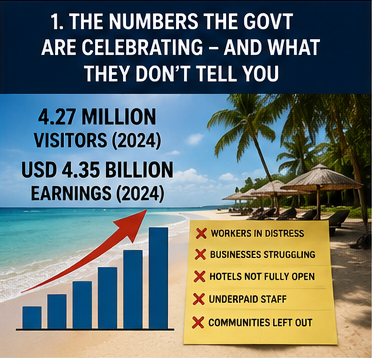
The numbers the Govt are celebrating – and what they don’t tell you
Madam Speaker, the Government loves a headline. Jamaica welcomed 4.27 million visitors in 2024, generating approximately USD 4.35 billion. These numbers are impressive. They reflect hard work across this industry.
Numbers don’t bleed. Workers do. However, behind every reported statistic is a workforce in distress and a local business sector under siege. So let us examine what this Government’s numbers actually tell us and what they are designed to conceal. And now, Madam Speaker, only 9 days ago, the Minister of Tourism was not in this Chamber. He was not in his constituency or meeting hospitality workers in month nine without pay. Instead, Madam Speaker, he was at The Kimberly Hotel in New York City, making yet another grand announcement. In the next ten years. Ten million visitors. Ten billion US dollars. A new acronym. A new press release. A new headline, likely another missed target and no mention of why full hotel reopening is slated for 2027.
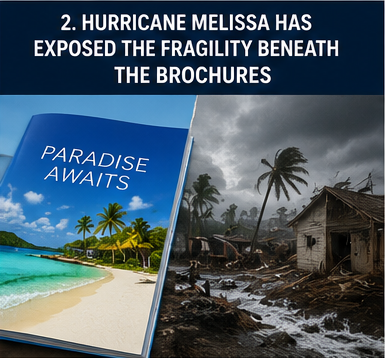
Hurricane Melissa has exposed the fragility beneath the brochures. The Minister speak of detailed assessments. Workers speak of nine months without pay. The gap between ministerial announcement and lived reality has never been wider.
The Tourism pie – Understanding what we bake and how it is shared
Madam Speaker, as someone who has worked directly in the trenches of the tourism ecosystem, I do not view tourism as a set of abstract macroeconomic figures. I do not view it as a collection of glossy press releases or international billboard campaigns.
No, Madam Speaker. Tourism is our pie our very, very important pie. It is an economic asset so vital to our national survival, so deeply funded by the sweat and taxes of our citizens, that every single Jamaican deserves to fully understand what goes into this pie, how it is being baked, its current condition, and most importantly, how it is being shared.
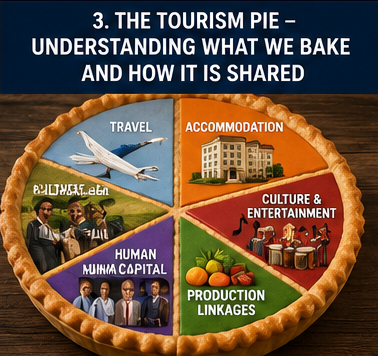
To understand the pie, we must first look at its core ingredients. Tourism is fundamentally defined as the travel and stay of people outside their home destinations and the activities they engage in. Therefore, our complete Jamaican tourism pie requires specific, deeply interconnected ingredients. Madam Speaker, these ingredients include the Travel Component, which relies primarily on international airlift, but also on our vital cruise shipping gateways.
The Accommodations: Ranging from the multinational all-inclusive resorts to our local boutique hotels, guest houses, and community short-term rentals such as AirBnBs.
Thirdly, Madam Speaker, the Culture and Entertainment: The unique experiences, our world-class music, heritage, our food, and the general way of life that draw people to our shores.

Fourthly, Madam Speaker, one must not forget the Production Linkages: The local farmers, manufacturing plants, and our entrepreneurs in the creative sector.
Finally, Madam Speaker, the Human Capital: The foundational bedrock of the entire operation is the moment of truth when our visitors interact with our hospitality workers, transport providers, our JUTA, JCAL, and MAXI drivers and craft vendors.
Madam Speaker, if you compromise, neglect, or spoil even one of these ingredients, you ruin the flavour of the entire pie.
The Real Dollar Leakage — The 70-Cent Scandal
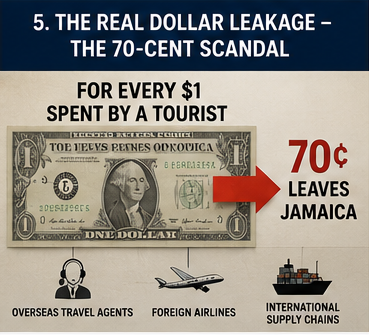
Madam Speaker, the Minister speaks eloquently about the ‘Tourism Linkages Network.’ Yet under his watch, ‘linkage’ has become a euphemism for massive economic leakage. International financial benchmarks reveal a scandalous reality: Yet under his watch, ‘linkage’ has become a euphemism for massive economic leakage. For every single dollar spent by an all-inclusive tourist in Jamaica, up to seventy cents leaks straight back out of our economy to overseas travel agents, foreign-owned mega-airlines, and international supply chains.
Every single dollar earned in this sector exits Jamaica immediately. It does not circulate. It does not multiply. It takes an immediate U-turn right back across our borders.
For every dollar the tourist spends in Jamaica, seventy cents leaves Jamaica. Our people bake the pie. Someone else eats it.

Linkages, agricultural failure
Madam Speaker, the linkages agenda was built on a simple premise: Jamaican tourism should generate Jamaican prosperity. The evidence before this House today shows that premise has not been fulfilled.
The Agricultural Linkage Failure — Ten Years of the Same Promise
.Madam Speaker, as far back as 2016. Minister Bartlett used what he termed as a tremendous opportunity for trade that could be as high as J$56.7 billion annually for processed foods, J$5.3 billion for fruits and J$1.6 billion for vegetables.

● Madam Speaker, the Minister stated that Annual leakage in the manufacturing sector is estimated atsome J$65.4 billion as the total annual expenditure by the tourism sector on manufactured goods.
● Madam Speaker, the Minister committed to working closely with local suppliers to help them overcome any constraints that may be preventing them from benefiting from the formal tourism sector, such as the inability to supply in large quantities, lack of consistency of supplies and poor quality of products. He went on Madam Speaker promised that his primary objective was to reduce imports and plug the economic leakage.
Madam Speaker, that was a decade ago. That must be the TEN he was talking about at the Kimberly Hotel. Far from reducing the leakage, the demand for fruits and vegetables in our sector has exploded to a staggering 67 billion Jamaican dollars, and processed foods have shattered all barriers to hit 115 billion dollars and are still being imported from overseas wholesalers. Madam
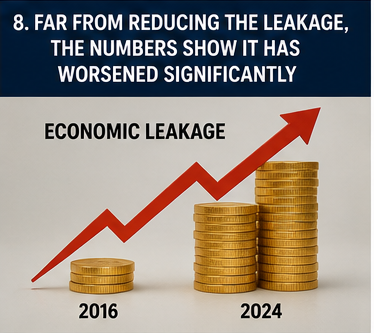
Speaker foreign-owned mega-resorts imports its fruits and processed meats from overseas wholesalers while hardworking farmers in St. Elizabeth and Hanover watch their crops rot in the field.
The very imports he specifically named and promised to eliminate have skyrocketed under his watch. Madam Speaker, Our national food import bill has hit an all-time record high of 1.46 billion US dollars.
He promised to fix the leakage. The leakage is now a flood. Ten years. One promise. Zero results.
The Diversification Myth

Madam Speaker, the Minister of Tourism announced a strategy to grow the tourism industry with a 5 Pillar plan. Chief among these was tapping into new markets and multiple occasions have lamented on Jamaica’s overdependence on North America. In 2019, the CovidPandemic he highlighted “one basket vulnerability” This, Madam Speaker, “We cannot put all our eggs in the one basket of North America. If that market sneezes, Jamaica catches pneumonia. True economic resilience demands that we open direct paths to the south and across the Atlantic.”
Again, in 2022, the Minister highlighted, and I quote, “our high dependence on source markets like the US and Canada leaves us entirely at the mercy of external border decisions, flight cancellations and foreign health advisories. Diversification is no longer an option; it is a matter of survival”.
Madam Speaker, I repeat for emphasis that the Minister said Diversification is no longer an option; it is a matter of survival. Again in 2024, Madam Speaker, the Minister reiterated that we are moving to break the historically singular reliance by opening the Middle Eastern and African markets. We need visitors whose travel habits are decoupled from the economic cycles of the United States,” Madam Speaker, speaking of the Middle East In 2022, he went to Riyadh and Dubai, promising a Middle Eastern corridor. By the end of 2025, the arrival count was a mere net increase of three hundred and thirty. Madam Speaker, what about Africa? The Minister went to Nigeria in 2021, staged a massive photo opportunity, and promised a historic gateway. What is the net increase? By the end of 2025, the arrival count was a paltry 1,440, a net growth of exactly 320 people over his baseline, while his visit to India, one of the largest and fastest-growing countries in the world, only produced 360 persons increase.
In Jamaica, there is a saying that talk is cheap, and this is costing us. Madam Speaker, there is a concept in the Ministry of Tourism that is termed Seat Support, which is merely a disguise for flights to Jamaica.
Since 2015, this administration has spent over 2.86 billion Jamaican dollars on Seat Support. Madam Speaker, it would be good if the Minister could report to the Parliament on the amounts spent on achieving less than half of a per cent of our visitor arrivals.2.86 billion Jamaican dollars. To guarantee empty seats on airlines serving markets that barely register. That is not diversification. That is expensive theatre.
Madam Speaker, despite the multiple utterances for the importance of diversification, what has happened to our primary market in the meantime? In 2017, the United States accounted for 64.17% of our total stopover arrivals.
By the end of 2025, our reliance on the US market had ballooned to 70.73%. Combined with Canada, North America now commands a staggering 84.01% of our entire market. Madam Speaker, things have not gotten worse but much worse.
The Minister spent billions of taxpayers’ dollars flying across the world to find new ingredients — and his own JTB statistics show he has made the Jamaican tourism pie more vulnerable to a single external economy than it was a decade ago.

The Cruise Sector collapse – While the world boomed, Jamaica shrank
Madam Speaker, the Minister is completely silent on our cruise shipping sector because the reality is an absolute embarrassment to his administration. He has made statements claiming that the cruise sector ‘lives up to expectations.’ But the only expectation that has been met is his expectation that nobody would check his math.
Let us unmask the numbers. In 2019, before the pandemic, Jamaica welcomed 1,544,233 cruise passengers to our shores. Fast forward to the end of 2025. Jamaica finished the year welcoming just 1,106,361 cruise passengers.
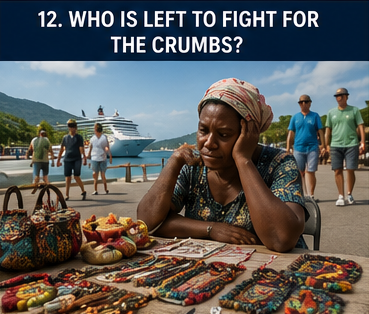
Madam Speaker, our cruise sector has declined by 28.4% compared to seven years ago. Madam Speaker, this is not immaterial. We are facing a massive shortage of nearly 438,000 visitors who are completely missing from our ports. 438,000 fewer visitors using our taxi services, to buy our crafts, to experience our attractions. Madam Speaker, let’s go deeper into the math, and math if you wish, the Government’s inability to reclaim cruise market share has cost our tourism our tourism practitioners over 3 million in passenger opportunities. An assumption of a $10 spend per guest would mean that the economy would have lost 30 million USD or 4.5 billion.
Madam Speaker, could it be that I am making an unfair critique of Jamaica’s Tourism Minister? Is it that the global cruise industry has not rebounded since the COVID-19 pandemic? The answer is a resounding no. Global Cruise global volume has skyrocketed to an all-time high of 37.2 million passengers, a 25.2% global expansion over 2019.
Further, Madam Speaker, could one say that the cruise travel trend has shifted away from the Caribbean while the global cruise industry booms? The answer is also a resounding No. Indeed, Madam Speaker, the Caribbean is dominating this boom, capturing 44% of all global cruise traffic.
Our neighbours took full advantage. Antigua boomed by 9.9% after building a brand-new terminal. Barbados is celebrating record-breaking numbers. Cozumel is handling 4.73 million visitors a year. And the Bahamas? The Bahamas Madam Speaker, what manner of malfeasance is that the Bahamas to grow by approximately 100% yet Jamaica has mot. In 2019, they had 5.4 million cruise arrivals.
The Bahamas grew by nearly 100%. Jamaica shrank by 28%. This is not a regional problem. It is a local management failure.
Ground transportation
Madam Speaker, JUTA the Jamaica Union of Travellers Association, was created by PNP Minister Francis Tulloch with one explicit mission: Jamaican hands drive Jamaica’s visitors. With one explicit mission, that it should be one avenue of Jamaican Ownership. Together with JCAL and MAXI, they represent generations of Jamaican families who built their livelihoods on tourism transportation.
Madam Speaker, these local, grassroots ambassadors are being systematically displaced. This Government has allowed Major hotel properties to establish their own in-house transportation companies, systematically cutting out JUTA and JCAL operators. Many all-inclusive properties, foreign companies control transportation while local drivers still pay park fees to access compounds. The all-inclusive model is a vertical integration machine: the room, the food, the entertainment, water sports, and now the vehicle all under one foreign corporate umbrella. It is colonisation all over again — the structure ensures the bulk of tourism revenue never touches Jamaican soil.
The Vacation Club Glass Ceiling
Madam Speaker, during my tenure in the hospitality industry, fourteen of them were inside the Vacation Club segment. I speak from personal and professional experience.
There are approximately twenty Vacation Clubs across fifteen hotel properties in Jamaica, the majority Spanish-operated. This segment generates approximately one hundred and fifty million United States dollars annually. And Jamaicans were strategically kept out of the management of every single one. Every project director, expatriate. Every sales director, expatriate. Paid in US dollars or Mexican pesos. Jamaican professionals? On the sales floor generating the revenue, demonstrating the competence while foreigners held the titles and collected US dollar-denominated salaries. One hundred and fifty million US dollars a year.
Barely a handful of Jamaicans in management positions. That is not a staffing policy. That is a system. But the indignity does not end there, Madam Speaker. It is compounded by a practice that is as insulting as it is deliberate. Many of these same Jamaican professionals, the ones deemed unworthy of the director title are routinely used to train the very expatriates who are then placed above them. Jamaican knowledge. Jamaican expertise. Jamaican institutional memory transferred, extracted, and handed to a foreign national who arrives knowing less, earns more, and leaves with everything the Jamaican taught them. The Jamaican trains the boss. The boss rules over the Jamaican. And this Ministry has never once asked why.
And there is something worse still. Madam Speaker, this a serious indictment on the Ministry of Labour as many of these directors do not arrive through any conventional recruitment processes. They arrive as vacationers checking into the very hotels they will shortly manage.
Within approximately two months, they are granted work permits for jobs that qualified Jamaicans are demonstrably capable of performing. They come as tourists. They stay as directors. And the work permit that should have gone to a Jamaican is issued in two months — to a vacationer who never left.
Meanwhile, the Jamaicans working beside them are hired on short-term contracts with mandatory contract breaks, the deliberate interruption of continuous employment to prevent them from accumulating the rights and permanence that Jamaican labour law would otherwise guarantee. The expatriate gets the work permit in two months. The Jamaican gets the contract break to ensure she never becomes permanent.
The hospitality worker betrayal – Hurricane Melissa and the labour crisis
Madam Speaker, in December 2025 I wrote to the Minister of Tourism seven specific demands on behalf of workers facing a year without income. The Minister’s response? Silence. So let this House hear what the Minister chose not to.
When Hurricane Melissa struck, hotel operators projected 120-day closures. Six-month mortgage moratoriums were granted. That was the plan. Then the plan changed. Hotels announced reopening in August. October.November. Nine months. Twelve months. But the moratorium remained at six months.
Tharp – The Promise that has not arrived
Madam Speaker, in the aftermath of Hurricane Melissa, the Tourism Enhancement Fund (TEF) launched the Tourism Housing Assistance and Recovery Programme, known as THARP. A programme that promised aid to tourism workers affected by the storm. Workers whose homes were damaged or destroyed while they were on the job, serving Jamaican visitors. A promise was made. Let me tell this House what that promise looks like in practice.
We are now nine days into yet another Hurricane Season. Nine days into a new season of potential devastation, the recovery from the last one is not complete. From my office, thirty names were submitted to the THARP programme. Tourism workers from Eastern Hanover. Men and women who lost roofs, lost walls, lost everything. To date, three have received assistance. Three out of thirty. From the office of the Member of Parliament for St. James Southern, twenty names were submitted. One person has received assistance. One out of twenty.
Thirty names from Eastern Hanover. Three helped. Twenty names from St. James Southern. One helped. That is not a recovery programme. That is a press release with a name. Madam Speaker, among those names still waiting is a Cost Control clerk. A woman. A mother. A family of three. She did her job. She kept the records, balanced the books, and held the hotel’s accounts together.
And when the storm passed, she had no home left.. Today, Madam Speaker, that woman is sleeping in her car. Her family of three lives under a tent. Waiting. Waiting for a programme that carries the name of the very industry she gave her nights to. Waiting for a government that promised to see her. Waiting for help that has not come. A Cost Control Clerk. A mother. A family of three. Sleeping in a car. Living under a tent. Still waiting. Grief, Madam Speaker. Grief.
Madam Speaker, I ask the Minister directly: what is the status of the THARP programme? How many applications have been processed nationally? How many workers have received assistance? What is the total disbursement to date? And what is the timeline for honouring the commitments made to the hundreds of tourism workers still waiting?
These are the men and women on whom this entire industry depends. They welcome visitors to our country paradise. They smile through the exhaustion. They serve with warmth and professionalism. And then they go home to a living nightmare. Damaged walls. Leaking roofs. Mould spreading where the floodwater came in. And a government programme with their name on it that has not reached them.
They welcome our visitors to our country paradise and then go home to a living nightmare. Jamaica cannot build a world-class tourism product on the broken homes of the workers who deliver it.
And the pattern is deliberate. Long-serving employees with eighteen years of service are summoned to HR departments and told to go home or face redundancy. While they sit at home, contract workers are deployed to those same properties.
This is not a coincidence. This is a strategy. Hurricane Melissa is being used as a pretext to casualise Jamaica’s hospitality workforce.
Three-month contracts. No security. No redundancy protections. No dignity. Michael Manley gave dignity to Jamaica’s workers. What this Government’s silence is enabling is the dismantling of everything he fought to establish. Tourism Workers deserve transparency on hotel reopening timelines; mortgage moratoriums extended to match actual reopening dates; and ministerial oversight of every redundancy process in this sector.
Performing Jamaica’s culture for someone else’s profit
Madam Speaker, Brand Jamaica is nothing without our music. It is history, resistance, joy and healing wrapped in rhythm. Reggae is Jamaica’s greatest cultural export. Yet
Madam Speaker, there is a painful irony. When visitors check into most all-inclusive hotels expecting the soul of Jamaica, they find imported overseas performers while our talented and gifted entertainers are home Idle, displaced in their own country. Watching foreigners profit off a sound their ancestors created. Madam Speaker, that is cultural exploitation.
The invisible backbone – small hotels, B&B’sand the 15% GCT Ambush
Madam Speaker, Jamaica’s small accommodation sector- the Air BnB’s, guest houses, boutique hotels, and family-run properties are the invisible backbone of our tourism industry. Jamaican-owned, community-embedded, locally rooted. They serve diaspora visitors, cultural tourists, and independent travellers who want to understand Jamaica, not merely consume it. 30 The Jamaica Hotel and Tourist Association has explicitly declared that our local properties require a sustained 70% national occupancy rate to remain healthy and comfortably support our workers. Yet this administration has failed that baseline target year after year. In 2017, occupancy slipped to 64.2%. In 2019, it fell right back to 64.2%. Following the passage of Hurricane Melissa, our occupancy has plummeted to a dismal year-to-date average of just 53.5%.
Our hotels are half-empty. Our workers are facing catastrophic shift cuts. And what was this Government’s response to small operators in crisis? It was not support. It was not relief. It was a tax that slipped through this Parliament like a thief in the night. 31 Near 2:00 AM on a Wednesday morning, at the tail end of a marathon sitting, this Government sneaked through a new revenue measure. They passed a law forcing our local Airbnb operators to pay a staggering 15% General Consumption Tax starting April 1, 2027, without a single shred of public consultation.
They demand first-world tax compliance from a backyard host, but give them third-world parish infrastructure in return. The Tourism Enhancement Fund spends millions making the hotel corridors pristine, while the roads leading to local guest houses are so riddled with craters that visitors cancel their bookings out of pure frustration. They subsidise foreign capital, but they penalise local hustle. 32 The global tourism trend is moving in the direction of small operators: authenticity, community experience, local character. We are squandering that positioning through neglect and punitive taxation.
The closing – The moral and political verdict
The People’s National Party does not believe that Jamaicans should be tenants in their own tourism industry.
We do not believe our people should settle for crumbs. We believe in a tourism model anchored completely on economic equity, local ownership, and structural dignity. I say this directly to the Government benches: govern for the worker, the artiste, the taxi driver, the guest house owner, the farmer, the pensioner not for the boardrooms.Jamaica’s tourism is our most powerful economic asset.
But an economy that extracts from Jamaicans while pretending to serve them is not a success story. It is a scandal with good photography. 36 The choice before us is clear. We can continue to manage a 21st-century plantation behind a five-star brochure or we can choose to build a democratic, inclusive economy where the people who bake the tourism pie finally get an equitable slice. Jamaica stands at a crossroads. The workers are watching. The artistes are watching. The long-serving employees in month nine are watching. Jamaica deserves better. They deserve better. And this Parliament must deliver
Syndicated from Our Today · originally published .
Legal context · powered by Jurifi
Get the legal angle on this story. Pick a prompt and Jurifi's AI will explain it using Jamaican law.
AI replies are based on Jamaican law via Jurifi. Not legal advice.