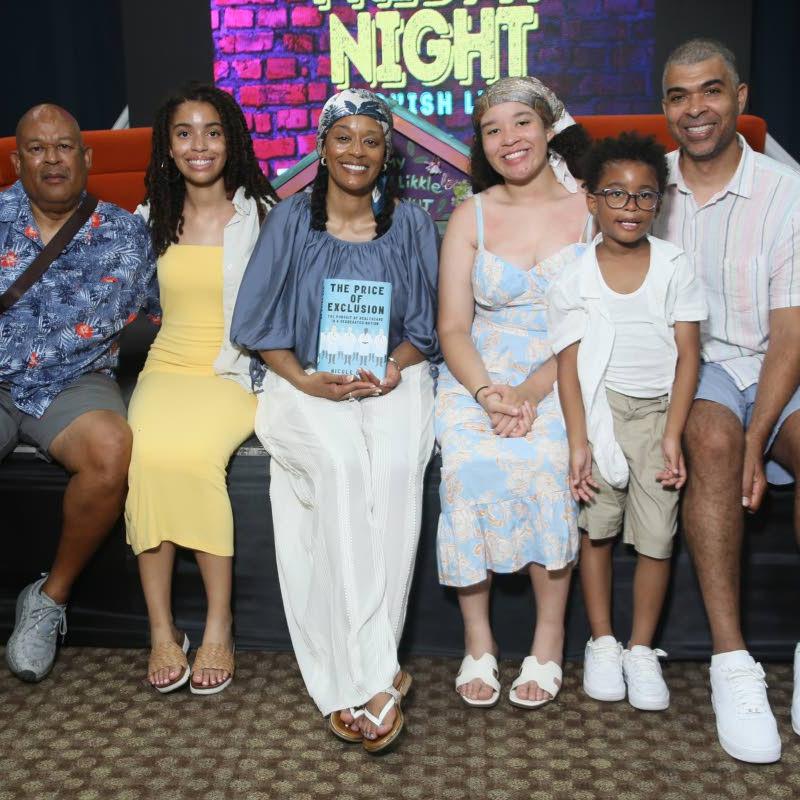
Award-winning journalist and author Nicole Carr says Jamaican sources were central to the research behind her book, The Price of Exclusion: The Pursuit of Healthcare in a Segregated Nation. That work also revealed fresh information about her family’s past and its ties to medicine.
“I had to bring this book back to Jamaica because it wasn’t possible without Jamaica,” Carr, a featured author at the Book Fairy Festival, said. “This was such a special experience to share with my father, who was reared in Port Antonio ... I had a chance to teach my family something about us that we didn’t know.”
She pursued records at the Jamaica Archives and Records Department, the National Library of Jamaica, the Gleaner Library and in Port Antonio, recovering strands of family history that had faded across generations.
The Price of Exclusion follows roughly 100 years of Black medical history through the careers of Black doctors, with substantial attention on Carr’s forebear, Dr Lawrence St Clair Ferguson. Born in Jamaica, Ferguson spent much of his professional life running the hospital in Port Antonio. Questions that surfaced during the COVID-19 pandemic pushed Carr’s inquiry outward into Black healthcare, who appears in medicine, and how African diaspora experiences connect.
“I also hope that people get from this book that they understand the impact of anti-blackness around the globe,” she told The Gleaner. “Too often we’re in these diaspora wars where we don’t even understand the ways in which our histories intersect.”
In her view, those accounts belong most rightly to the communities they describe. Reclaiming them, she said, honours the past and serves those still to come. “It’s on us to educate and actually reclaim histories. It’s on us to do that, not only for ourselves, but for our ancestors and for our descendants, those who are yet to come.”
Though the book is non-fiction, Carr wants it to engage audiences who rarely pick up historical titles. On how readers have responded so far, she said, “I’ve had people who say, ‘I don’t read non-fiction, but this reads like a novel to me’”. She especially hopes younger audiences will look past digital tools when learning about the past. “We start looking for artificial intelligence instead of ancestral intelligence,” she said. “I hope this reaches readers who say, ‘I didn’t know this before I read this book.’”
Her investigative reporting background also shaped how she spoke about journalism’s role in keeping history intact; older news files proved essential while she assembled the manuscript.
“I couldn’t have written this book without journalists, without the historic black press and The Gleaner press,” she said. “If we don’t have the people around to curate or author the first draft of history, then we’re lost.”
As an investigative journalist, professor and author, Carr said one standard underpins both reporting and book writing. “At the core of any good book or any good report is people,” she said. “Showing us the human face and the human toll of those facts and figures is what brings the story to life.”
Syndicated from Jamaica Gleaner · originally published .