
REFUSING to be sidelined as the Government moves ahead with plans to introduce new legislation governing non-profit organisations, civil society leaders are again insisting that their voices be included in the process, echoing the chant, “Nothing about us, without us”, as they call for a seat at the table.
At the core of their plea is the belief that the existing Charities Act of 2013 and the 2022 regulations, which seek to keep Jamaica in line with the standards of the Financial Action Task Force (FATF) and monitor non-profit organisations’ compliance with anti-money laundering and counterterrorism financing measures, are increasingly burdensome and onerous on charity organisations.
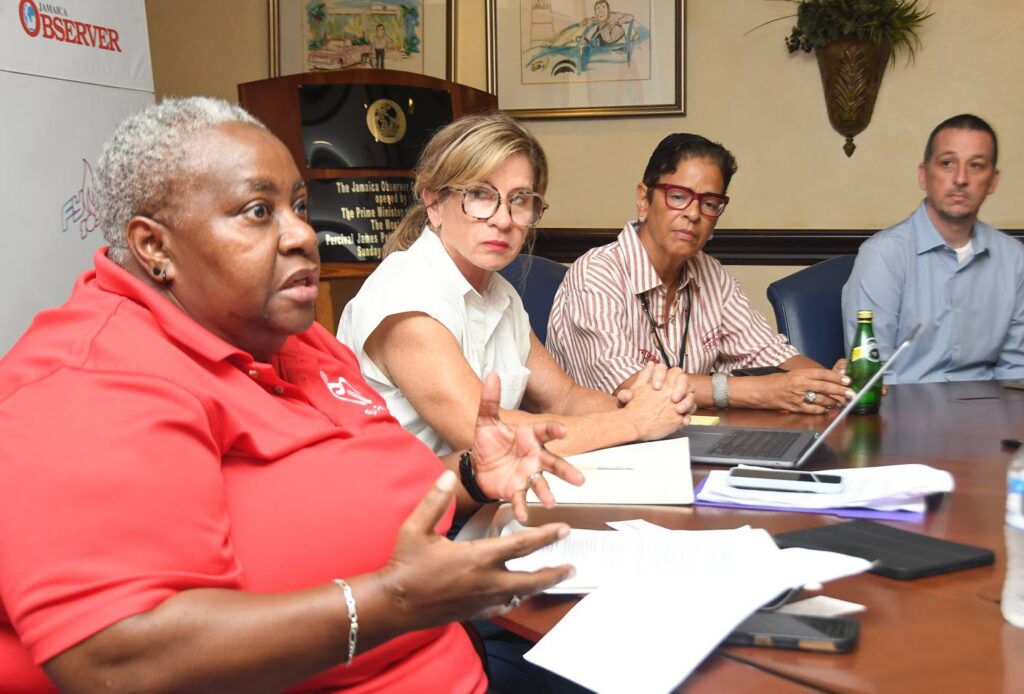
Addressing a Jamaica Observer Monday Exchange last week, the non-profit representatives: Nancy Pinchas, executive director of the Council of Voluntary Social Services (CVSS); Joy Crawford, executive director of Eve for Life Jamaica; Blake Widmer, CEO and founder of Deaf Can Coffee; and Christine Gore, director of the Phillip and Christine Gore Family Foundation, said with a new legislation — the Non-Profit Organisations (NPO) Act — expected to be introduced in October 2026, consultation needs to take place with non-profit groups to ensure effectiveness without compromising their operations.
Pinchas said through consultation with a network of non-profit organisations across Jamaica in April 2025, she found that many — particularly smaller community groups that were being held to the same reporting standards as larger organisations — were struggling to maintain compliance and drowning in paperwork.
She said the CVSS understands the importance of compliance and transparency for all non-profits, but stressed that the interpretation and application of legislation must be done in a way that shows it understands the nuances of non-profit organisations.
“We are not a marginal set, we are a diversified set, some very large corporate organisations, some very small, little grass-roots community-based organisations, and you are applying a set of requirements for reporting also that is not risk-based. The FATF speaks very clearly…We have 40 regulations that govern how a country monitors and manages AML [anti-money laundering] and CTF [counterterrorism financing]. Regulation 8 pertains to anti-money laundering and counterterrorism financing; regulation 8 speaks…to non-profit organisations,” said Pinchas.
“FATF is very aware of what happened in the past, that countries, not just Jamaica, had imposed these burdensome regulations and impacted the sector negatively. They came back in 2016 and were very clear in their language: Do not impose administrative burdens, regulatory burdens, and/or legislative burdens until you have done a risk assessment. Then you are applying what we call disproportionate approaches to counterterrorism and anti-money laundering. There has been no risk assessment. They have not assessed us to determine whether we represent a risk to what they are trying to protect Jamaica from,” she told the reporters and editors at the newspaper’s headquarters in St Andrew.
Pinchas insisted that no such assessment has been conducted locally.
“What is the real risk of a registered non-profit in Jamaica being used for anti-money laundering and/or terrorism financing? How many incidents have there been? And that’s a real question for the security from financial crimes unit. How many organisations in the last 10 years have been flagged and investigated?” she questioned, noting that despite multiple requests for responses, she lacks answers to these important questions and a blanket set of regulations has been applied to all non-profits that is disproportionate to their size and ability.
“All we’re asking is that prior to the formation of a new regulation in October — the time is not on our side — we have been pressing for the Government to co-create, to consult with civil society, ask us, involve us. In FATF, which uses very clear language, you must consult with your non-profit sector during the assessment. It’s not a question of will you have an assessment, you must have an assessment then you create, together with the sector, a set of guidelines to protect them,” she stressed.
Crawford, echoing similar concerns, said that FATF does not require Government to treat every non-profit as high risk, and it does not require excessive reporting from all charities.
“It does not require advocacy or civic participation against them, it does not put ‘to be restricted’, it does not impose blanket regulations without evidence, and it definitely does not require them to limit legitimate fund-raising and charitable work. It is repeatedly clarifying that countries should avoid a one-size-fits-all regulation and that is there, and that’s all we’re asking for,” she stressed.
For Widmer, the lack of consultation on the new legislation has created uncertainty for organisations that have spent years adapting to the existing legal framework.
“The existing legislation has been there for over 10 years, we’re familiar with it, we’ve adapted to it, and we’re working with it. Hearing that there’s going to be new legislation coming in that hasn’t included our voice and representation…that is just concerning, because it’s a big what if. What if the current manner of doing business completely changes? We understand there’s an expense that ties to regulation. We accept that, but we don’t want to be facing new legislative changes without any voice in the process or input into what’s going to happen,” he told the
Observer.
He argued that any proposed legislation should first be reviewed by a parliamentary committee and subjected to wider public scrutiny before being debated in the House of Representatives.
Echoing the advocacy slogan, “Nothing about us, without us,” he stressed that policymakers must recognise the diversity of the sector.
“They’re trying to create legislation without including our voice, without understanding how Eve for Life, CVSS, the Gore Foundation, and HarvestCall Jamaica, Deaf Can Coffee are absolutely fundamentally different from each other, but we’re all operating in a space and we actually all know each other. We work together, we have collaborative activities together, but we all actually function in very different ways because the needs of society that we’re addressing are fundamentally different in each situation,” said Widmer.
Driving home the point that non-profit groups are not opposed to oversight and regulation, Gore said organisation heads want a relationship with Government that is rooted in partnership rather than suspicion.
“We’re happy for you to properly monitor us. We’re happy for it because you’re also, in a proper system, you’re protecting us, and that’s what you’re supposed to be doing, you’re supposed to be protecting us; that’s what FATF said, ‘Protect them.’ We’re happy for the protection, we’re happy for the support, but that’s not what we’re getting.
“We’re not getting a lot. We’re not feeling that we’re in this together…and we are working to support those who need our support and to provide services that we provide in an environment that is legitimate, protected, and acknowledged by the international community as acceptable,” said Gore.
Pinchas further pointed to a similar legislative framework in Belize, which places non-profit organisations at the centre of conversations and implored Jamaica to take similar action.
“What we should also be looking at is an entire policy with respect to the sector. We are not an unimportant sector. Belize has a Senate [with] a civil society [representative]…a senator. They are also on the same timeline of co-creating a new piece of legislation exactly in October 2026. You know who’s drafting it? The Belize Network of [NGOs]. They are tasked with crafting the legislation. All we’re asking for is to co-create. All we’re asking for is to be consulted,” stressed Pinchas.
Syndicated from Jamaica Observer · originally published .
Legal context · powered by Jurifi
Get the legal angle on this story. Pick a prompt and Jurifi's AI will explain it using Jamaican law.
AI replies are based on Jamaican law via Jurifi. Not legal advice.
Other coverage

Official Opening of the Troy Bridge
Office of the Prime Minister
Senate Standing Orders Committee || June 26, 2026
PBC Jamaica (Video)Watch
CVM News At 7PM: July 3, 2026 | @CVMTVNews
CVM TV News (Video)Watch
Financing Options for Exporters | JAMPRO Information Session
JAMPRO (Video)Watch
NSWMA Long Service Awards Ceremony
Office of the Prime Minister