
FOR years, the arrival of Jamaica’s dry season has brought with it an all-too-familiar ritual for thousands of households: empty pipes, water trucking, and anxious residents wondering when supplies will return. But Water, Environment and Climate Change Minister Matthew Samuda says that cycle could soon come to an end for those living in the Corporate Area.
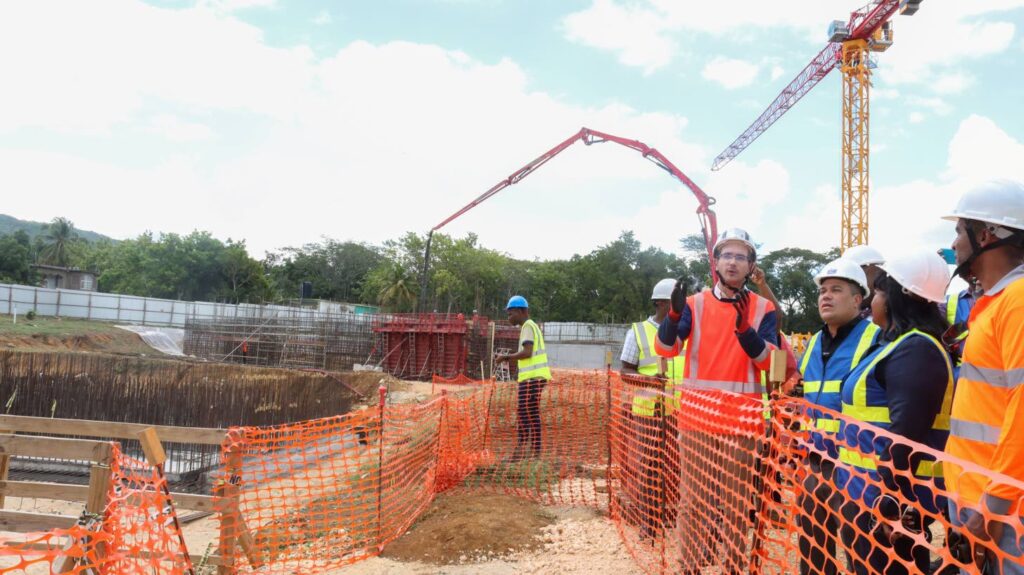
The minister pointed to the completion of the Rio Cobre Water Treatment Plant as a game-changing investment in the country’s water resilience. The US$92-million public-private partnership project, now under construction in Content, St Catherine, will treat raw water from the Rio Cobre and inject 15 million gallons of potable water into the National Water Commission’s (NWC) distribution system every day, supplying more than 150,000 customers across St Catherine, Kingston and St Andrew. The project remains on track for completion in May 2027.
Speaking at a Jamaica Observer Press Club at the newspaper’s St Andrew offices last Friday, Samuda said the plant is specifically designed to eliminate the deficit experienced during Jamaica’s worst droughts.
“The year 2022 was the worst drought that we experienced in the east of Jamaica, and during that period we were short between the corridor of Spanish Town and Bull Bay…We were short 12 million gallons a day. It is why we broke ground last year on the Rio Cobre treatment plant, which will harness water from one of your most reliable water sources, one that — even in times of critical drought now — are reliable in their supply to produce 15 million gallons of water a day.
“[During] your worst drought you were short 12, and you have signed, started and midway in construction for the development of a plant that can supply 15 million gallons. So, we believe that that’s a critical step in achieving water resilience so that next year I don’t know if we’re going to see a whole drought, certainly [not] in the Corporate Area and Spanish Town,” said Samuda.
He noted that the Rio Cobre project forms part of a broader national strategy to strengthen Jamaica’s water infrastructure, rather than relying on emergency responses whenever a drought strikes. He said investments made since 2015 have already significantly improved water efficiency in Kingston, St Andrew and Portmore, St Catherine, by dramatically reducing leakage across the network from 71 per cent to 37 per cent — contributing to the areas losing 12 million gallons less of water per day than in 2015.
SAMUDA…I expect to have this conversation with you on drought in February of next year and then not again in relation to Kingston (Photo: Naphtali Junior)
“The strain that you have on the network now, with the exact same rainfall as 10 years ago you would have had a much worse problem — so that also needs to be understood. It may feel like annually you’re having the same conversation but it’s not the same conversation as it was,” insisted Samuda.
Beyond the Corporate Area, Samuda outlined a series of major infrastructure projects aimed at making communities across the island more resilient to prolonged dry spells.
He said work is progressing on the Western Water Resilience Programme, launched following the severe 2024 drought that affected Montego Bay and Negril.
“We’ve started the project and it’s under construction, so this isn’t a might happen, could happen. This isn’t a political announcement. This is a project that is under way and under contract, so that deals with the north-west and builds significant resilience there.
“Now the next components of that have already gone through the public investment appraisal branch, and already being programmed are the investments that are in phase two in the significant rehabilitation and upgrades for the Martha Brae treatment plant and for the Great River Treatment Plant. That will add some 10 million gallons of production, accumulative, for those facilities with a network that will lose far less water because you change distribution,” said the minister.
He added that the third phase in the US$450-million programme will see the construction of two new water treatment plants, one at Rio Bueno in Trelawny and the other at Roaring River, which serves Savanna-la-Mar in Westmoreland.
Construction crews carry out works at the Phase One site of the Western Water Resilience Project in Rose Hall, St James, on July 6. (Photo: JIS News)
“As we gradually build the interlinked distribution network, when Roaring River is producing positively at 20 million gallons and we may not be getting rain in Trelawny, we could make adjustments that see interlinkage of the network — so that’s the plan for the north-west.
“It’s a plan that is under way. It’s not something that we’re thinking about, or trying to put together, or finding the financing for; we’ve started, and there are pictures of the work well under way,” said Samuda.
The minister also highlighted progress on several major projects across southern and central Jamaica. He said engineering contracts have already been awarded for the US$200-million Pedro Plains Irrigation Expansion Project, which will transfer water from Black River across the Pedro Plains in St Elizabeth. Land acquisition is under way while consultations continue with farmers expected to connect to the irrigation network.
Samuda added that the National Irrigation Commission (NIC) is also restoring several productive wells that will ultimately increase potable water supplies after the Essex Valley scheme comes into operation later this year, allowing some wells currently assigned to the NIC to be transferred to the National Water Commission.
“Once we’ve done that, you’ll see a fundamental shift in water availability in St Elizabeth,” he said.
He noted that the Greater Mandeville Water Supply Project is now between 70 and 80 per cent complete, with approximately $2.8 billion of the planned $4 billion already spent.
The project will transport water from the Pepper wells to Gutters, before distributing it throughout central Manchester and adjoining communities. It also includes an energy component that Samuda said will significantly reduce operating costs, once approved by the Ministry of Finance.
Meanwhile, he acknowledged that Clarendon faces long-standing infrastructure problems dating back to the 1960s, prompting plans for the Greater Clarendon water scheme centred on the proposed Rock River dam.
The project will address deteriorating pipelines, reduce non-revenue water in communities including May Pen and Mineral Heights, and combat saltwater intrusion affecting wells serving southern Clarendon.
“The Rock River dam and other development of sources is going to be critical because you are seeing compromise from some of your systems in southern Clarendon with saltwater intrusion. As we currently have sea level rise, the wells that would have supplied places like Rocky Point and below Milk River, going down to the coast, are having an experience of some challenges so this system is going to be critically important to move water from the hills of Clarendon, moving south — which is not a bad thing. It’s mostly gravity effects that will allow a lot of our energy costs to decline over time,” said the minister.
He added that substantial investments are also under way to improve water supply across rural St Catherine, including communities such as Water Mountain.
“We have a suite of investments right around the country that are under way. So the conversation this year is not just bringing on wells, it’s that we are midway, so I expect to have this conversation with you on drought in February of next year and then not again in relation to Kingston,” he told journalists at the Observer.
Syndicated from Jamaica Observer · originally published .
Legal context · powered by Jurifi
Get the legal angle on this story. Pick a prompt and Jurifi's AI will explain it using Jamaican law.
AI replies are based on Jamaican law via Jurifi. Not legal advice.
Other coverage

NWC Hosts Western Water Project Tour
CVM TV
NIC Undertaking Projects To Safeguard Agricultural Production And Food Security
Jamaica Information Service
NIC Upgrading Canals, Pipelines to Mitigate Dry Conditions
Jamaica Information Service
UTech, Jamaica and Miya Water Jamaica Limited Partner to Establish Campus Water Efficiency Project
University of Technology, Jamaica
Farmers urged to check on livestock as temperatures rise
Jamaica Star