
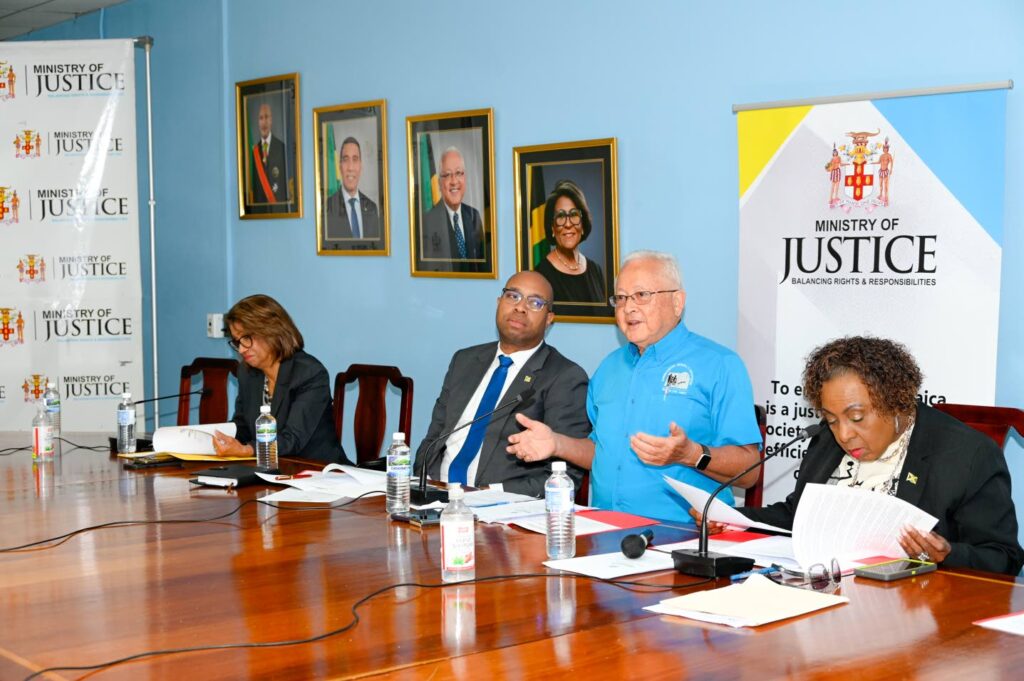
THE Government on Thursday opened consultations on the country’s sacramental cannabis framework during a high-level policy meeting at the Ministry of Justice and Constitutional Affairs.
Justice Minister Delroy Chuck; Minister of Culture, Gender, Entertainment and Sport Olivia “Babsy” Grange; minister of state in the Ministry of Justice and Constitutional Affairs Marisa Dalrymple-Philibert; and minister of state in the Ministry of Industry, Investment and Commerce Delano Seiveright led the talks with senior technocrats from the ministries.
The discussions were convened following recommendations of the Cannabis Industry Development Taskforce, chaired by Seiveright, which identified the need for a coordinated consultation on policy and operational issues affecting Jamaica’s sacramental cannabis regime.
The meeting considered the existing legal and administrative framework with the objective of providing greater clarity, consistency, and certainty while safeguarding the religious freedoms provided under Section 7C(2)(a) of the Dangerous Drugs Act, which makes provision for members of the Rastafarian community to possess ganja.
The meeting discussed matters relating to the recognition and oversight of sacramental organisations, approved cultivation lands and spaces, cultivation and possession limits, transportation arrangements, enforcement protocols, and the need to clearly distinguish sacramental cannabis activities from Jamaica’s regulated, commercial cannabis industry.
Jamaica’s commercial cannabis industry is regulated exclusively by the Cannabis Licensing Authority (CLA) under the Dangerous Drugs Act and its Regulations, with no other entity having legal authority to license or regulate commercial cannabis activities.
There have been growing concerns surrounding the misuse of the sacramental framework to facilitate unlawful activities, as well as persistent confusion about what the law permits.
In recent times there have been repeated allegations from Rastafarians about facing prosecution over their use of ganja, despite the provision in law for its sacramental use.
GOFFE…the Rastafari community is fed up with the continual targeting and unfair prosecution of members of the community for ganja,
Recently the
Jamaica Observer reported the case of Westmoreland resident Troy Harrison who had charges of possession of ganja and dealing in ganja against him dropped in the Westmoreland Parish Court.
The Crown offered no evidence on both charges on the basis that Harrison is a member of the Rastafarian community and therefore entitled to possess and use ganja for sacramental purposes.
“Some police continue to want to interpret the law how they want to,” attorney-at-law Marcus Goffe, who represented Harrison, told the
Observer.
“The Rastafari community is fed up with the continual targeting and unfair prosecution of members of the community for ganja, despite the 2015 amendments to the Dangerous Drugs Act intended to recognise and protect the community’s rights. It is clear that the narcotics police are not fully aware of the extent of Rastafari’s ganja rights or how they are to approach, investigate, determine, and resolve the rights of Rastafari in relation to ganja,” charged Goffe, who was then on a mission to have the seized ganja returned to Harrison.
Against charges such as the ones made by Goffe, the high-level meeting led by the Government ministers also explored mechanisms to strengthen coordination among the various ministries, the CLA, and the Jamaica Constabulary Force.
A significant part of the discussions focused on the possible transfer of responsibility for the operational governance and administration of sacramental cannabis matters to the Ministry of Culture, recognising the fundamentally religious and cultural character of the sacramental regime.
Ministers agreed that the proposal should form part of the ongoing consultation process as the Government works to strengthen governance; improve inter-ministerial coordination; and provide a clearer, more effective framework that protects legitimate sacramental rights while preserving public confidence, public safety, and the rule of law.
Syndicated from Jamaica Observer · originally published .
Legal context · powered by Jurifi
Get the legal angle on this story. Pick a prompt and Jurifi's AI will explain it using Jamaican law.
AI replies are based on Jamaican law via Jurifi. Not legal advice.
Other coverage
Ganja farmers rail over raids – Despite cannabis reforms, growers still facing police harassment, claims association head | News | Jamaica Gleaner
Miic
Seiveright warns cannabis farmers against scams
Our Today
Who Benefits From The Multi-billion Dollar Herb? - Part 3 | TVJ News
Television Jamaica (Video)WatchSpecial Cannabis Permit Road Tour a step to creating investor opportunities – Seiveright
Miic
SCAM ALERT FOR GANJA GROWERS
Jamaica Gleaner