
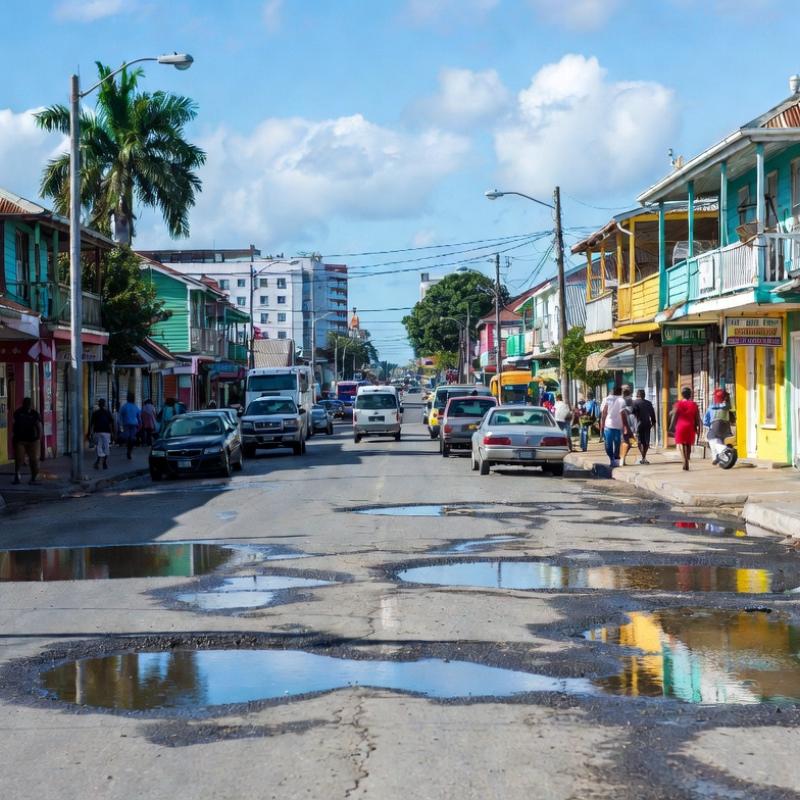
Engineers Support Jamaica Road-Building Standards As Pothole Concerns Grow
Jamaica’s engineering community is helping to shape proposed national standards for road construction, as the country looks for a stronger technical response to its worsening pothole problem.
“The Jamaica Institution of Engineers is involved in a leading way,” JIE president Dr Balvin Thorpe said in an interview with the Financial Gleaner. He said civil engineer David Allen, who leads the Road Construction Technical Committee responsible for preparing the standards, has been part of the process, along with JIE past president Dr Noel Brown and other members of the institution.
“With the involvement of the JIE the current draft standard specification for road materials has benefited from the input and oversight of the JIE and has its full support,” Thorpe said.
The Bureau of Standards Jamaica has opened the draft proposals for public feedback up to 4 July. The document lays out technical rules for the different layers used in building roads, with the aim of making completed works last longer and tackling public concern over repairs that fail too quickly.
“The works covered under these specifications include all labour, materials, equipment, and operations necessary for the construction of roadways, associated earthworks, structural backfill, granular layers, bituminous treatments, and asphalt concrete surfacing,” the BSJ draft document states.
The proposed standards are built on several existing references, including the Jamaican Standard Specification for Ready-mixed Concrete, the National Works Agency’s Technical Specification that took effect in December 2015, and standards used by the American Concrete Institute.
The consultation comes as Jamaica spends heavily on road works. About $40 billion is being disbursed under the Shared Prosperity through Accelerated Improvement to its Road Network programme, known as SPARK. That effort is running alongside the National Road Services Improvement Programme, the GO Road Rehab Programme, and road repairs being carried out at the parish level.
Even with that level of funding, many newly fixed road surfaces have been breaking down within months, in some cases after the first heavy rainfall.
The draft seeks to reduce those failures by spelling out tighter technical tolerances. For asphalt, it states that material must be laid at more than 135 degrees Celsius and that rolling must be finished before the temperature falls below 85 degrees Celsius. Engineers say asphalt placed or compacted outside those limits may not bind properly, making the surface more likely to crack and form potholes, a problem they consider common on Jamaican road projects.
The material standards are also demanding. Aggregate for the wearing course must show a Los Angeles Abrasion value of less than 40 per cent after 500 revolutions, a lab measure of how stone used in roads holds up under repeated impact. Base course material must also meet a minimum California Bearing Ratio of 80 per cent, a threshold meant to ensure the road base can handle Jamaica’s rainfall and traffic conditions.
Syndicated from Jamaica Gleaner · originally published .
Legal context · powered by Jurifi
Get the legal angle on this story. Pick a prompt and Jurifi's AI will explain it using Jamaican law.
AI replies are based on Jamaican law via Jurifi. Not legal advice.