

Jamaica’s food security conditions still worse than pre-Melissa says UNWFP
Durrant Pate/Contributor
Eight months after Hurricane Melissa, Jamaica’s food security conditions remain worse than before the storm, a new assessment of the United Nations World Food Programme is showing.
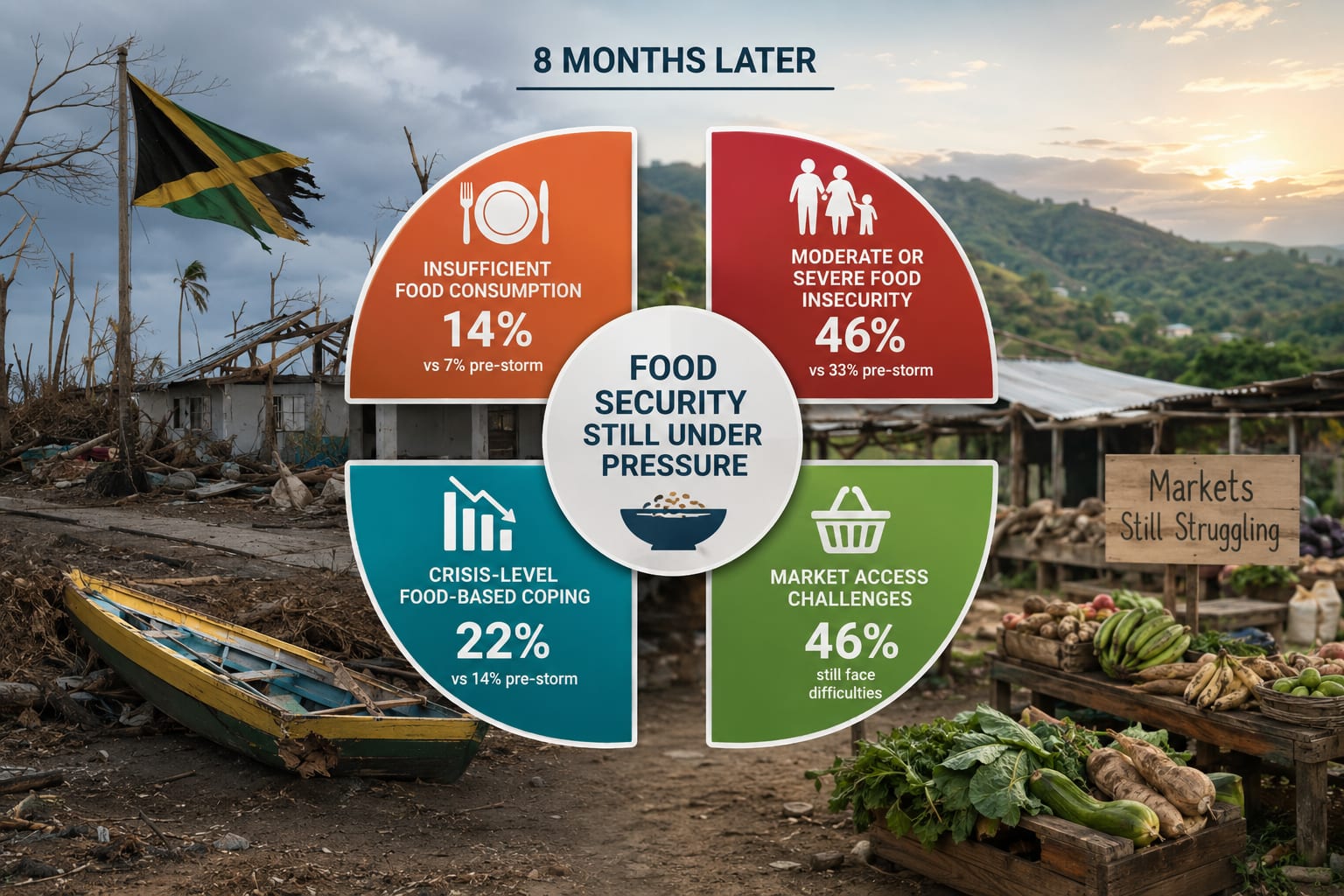
The assessment done by the UNWFPs Caribbean Multi-Country Office Research based in Barbados shows partial but uneven recovery, detailing that “insufficient food consumption has improved from the early peak of 30% to around 14% but remains roughly double the pre-Melissa baseline. Food-based coping has also plateaued with crisis-level coping back near 22% in months 7–8, while moderate or severe food insecurity remains high at 46%, 13 percentage points above baseline.”
The assessment carried out by the Assessment and Monitoring United showed, “livelihood stress persists; emergency coping remains above pre-event levels (13% versus 10%) and fewer households report no livelihood coping than before Melissa. Market access has not fully recovered, with 46% still reporting challenges and only 50% reporting no difficulty, underscoring continued pressure on households and market systems.”
Livelihood not getting easier
Livelihood coping shows only partial recovery eight months after Hurricane Melissa. While emergency coping has eased from its early post-storm peak, it remains above pre-event levels at 13%, and fewer households report using no coping strategies than before the hurricane. Market access deteriorated sharply after Hurricane Melissa, with challenges increasing from 35% pre-event to 54% two months after.
Although improving to 41% by four months, constraints rose again to ~46% at eight months, indicating a slowdown in recovery. Disruptions remain most acute in the west and north-west, where market functioning continues to lag.
Turning to the matter of insufficient food consumption, this has declined from its November peak (30%) to 14% eight months after, but remains roughly double the 7% pre-Melissa baseline, indicating an incomplete recovery and possible renewed pressure on household food access.
Crisis-level food-based coping remains elevated above pre-Melissa levels.
After rising from 14% pre-event to 36% one month after the storm, it declined to 18% by four months and 17% by six months, but increased again to about 22% in months seven and eight. This month-8 plateau indicates persistent consumption-related stress despite improvement from the immediate post-hurricane peak.

Households experience with food insecurity
Prior to Hurricane Melissa, 33% of households experienced moderate or severe food insecurity but this share rose sharply to 51% one month after the hurricane and peaked at 54% two months post-event. Food insecurity then improved to about 46% at month 3 and 41% at month 4 but did not continue to decline.
It remained around 42% in months 5 and 6 before rising again to 45% at month 7 and 46% at month 8. By month 8, it moderated; thus, severe food insecurity remains elevated at 46%, 13 percentage points above the pre-Melissa baseline, with both moderate (33%) and severe (13%) food insecurity still above pre-event levels.
Overall, the data show partial but uneven recovery: after early improvements, conditions plateaued and then worsened slightly, indicating persistent constraints in household food access.
Worst situation and where conditions are deteriorating the most
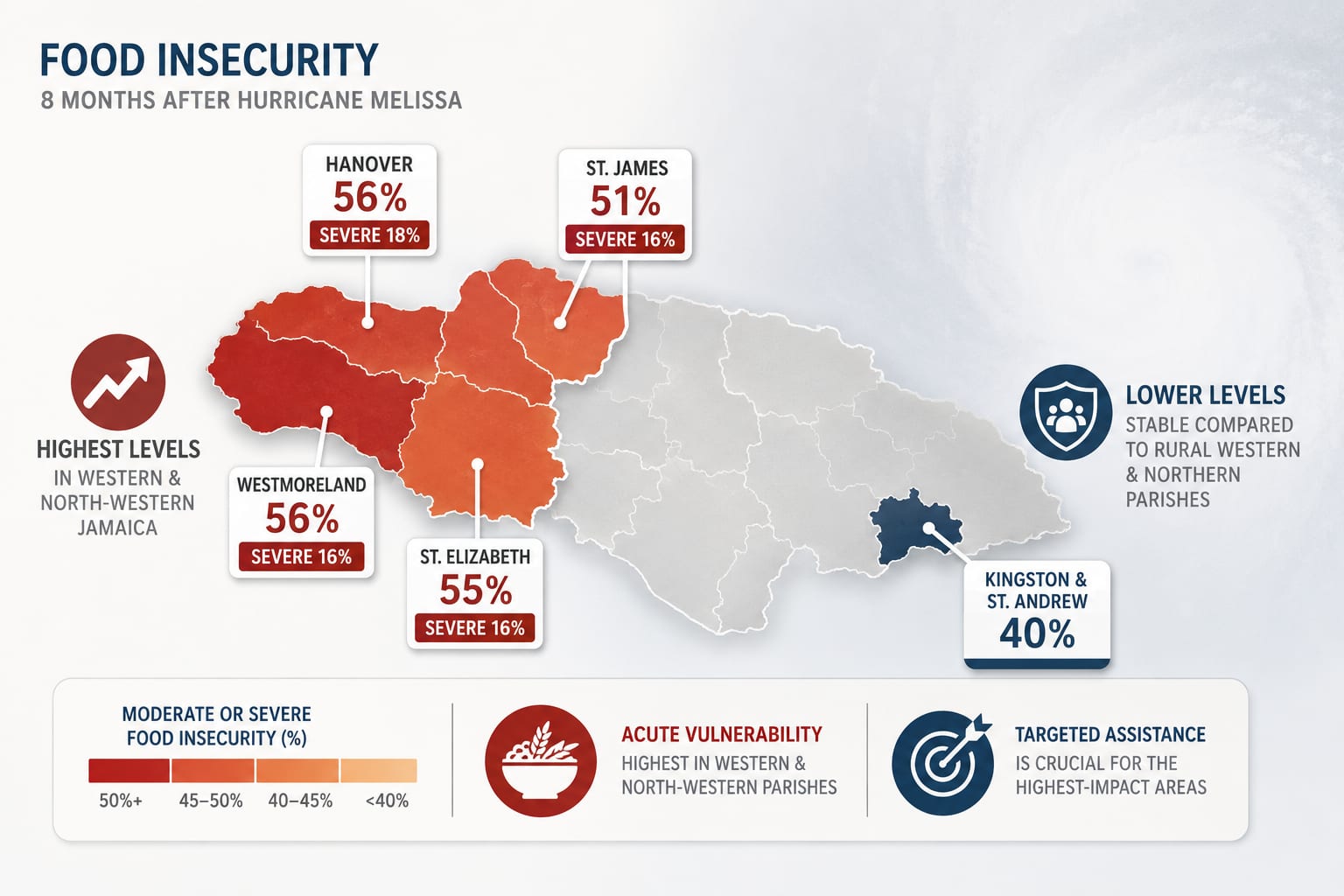
The researchers found that post-Melissa, rural western and north-western Jamaica, where Melissa’s impact was most severe, experienced the biggest jumps in food insecurity with both moderate and severe food insecurity rising sharply. At eight-months post-event, the highest prevalence of moderate or severe food insecurity is found in Westmoreland (56%), Hanover (56%), St. Elizabeth (55%), and St. James (51%) with severe food insecurity alone exceeding 15% in Hanover (18%), underscoring acute vulnerability in these areas.
In contrast, Kingston & St. Andrew reported much lower levels of moderate or severe food insecurity (40%) and remained relatively stable compared with rural western and northern parishes, reinforcing the need for continued and targeted assistance in the highest-impact areas.
Syndicated from Our Today · originally published .
Legal context · powered by Jurifi
Get the legal angle on this story. Pick a prompt and Jurifi's AI will explain it using Jamaican law.
AI replies are based on Jamaican law via Jurifi. Not legal advice.
Other coverage

Editorial | Tackling food waste
Jamaica Gleaner
Hunger is falling but is still higher than pre-COVID levels: UN report
Jamaica Inquirer
Richie Flo honours his roots
Jamaica Observer
Too late to explain?
Jamaica Observer
ODPEM Responds to Auditor General's Report - JIS Special Interview
Jamaica Information Service (Video)Watch