
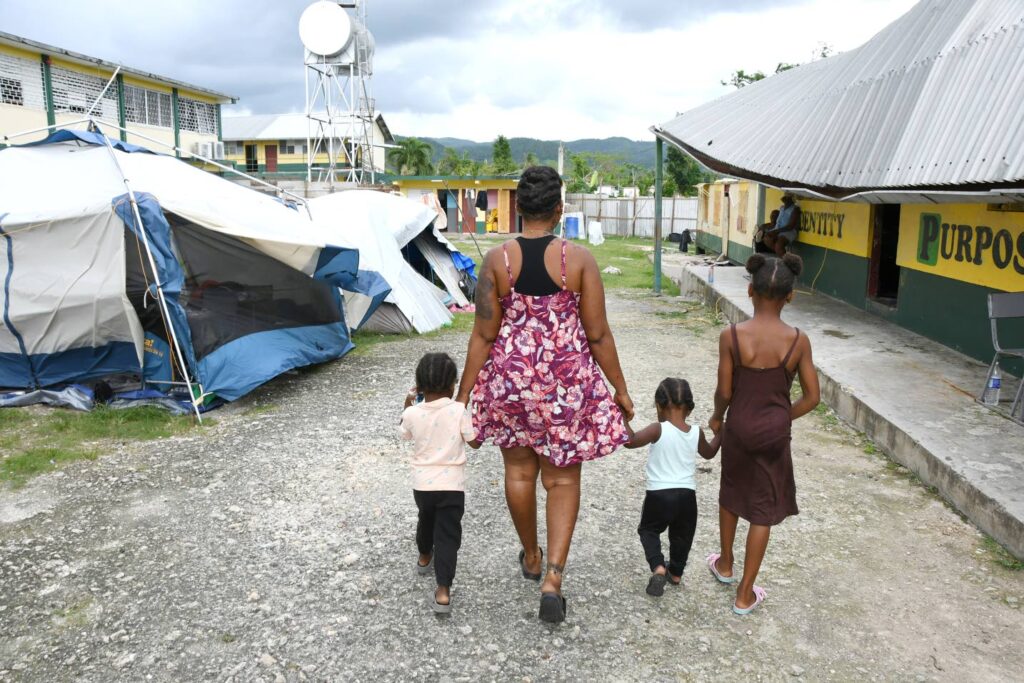
MANY Jamaican mothers will awake today to flowers, hugs, and the comfort of family celebrations marking Mother’s Day. But, for the women displaced by Hurricane Melissa, who were recently relocated to a teachers’ cottage in Shrewsbury, Westmoreland, after spending six months sheltering at Petersfield High School, each day has been a test of endurance.
Yet, amid the uncertainty, exhaustion, and the ache of watching their children grow up in cramped temporary spaces, these mothers have remained resolute, leaning on their faith and the support of one another as they nurture their children, struggle to chart a path towards stability, and cling stubbornly to hope that next Mother’s Day will find them back inside their homes where they can once again live with dignity.
On April 24, when the Jamaica Observer visited, 41 Jamaicans, comprising 16 families — including children — were housed at the Petersfield High School shelter, having been displaced by Category 5 Melissa last October.
Desks designed for the learning space became bed frames, tarpaulin served as curtains, mats were placed at the end of neatly made beds, and clothes were folded and stacked in a pile, each item seemingly having a designated location.
One woman even told this reporter to avoid stepping on the mats while entering, in true Jamaican matriarch style, not wanting the decorative pieces to become dirty.
Classroom corridors were used as support systems for clothing lines, bamboo sticks perched underneath them to make sure the clothes were kissed by the sun.
It was not the ideal home, but the women who lived there tried to make it one, relying on their resourceful nature.
While they have now been relocated a few miles from the school, their stories remain the same.
Tishane Haywood, a mother of six in her 30s — with three of her children all under 10 years old living with her in the shelter — said that, while the past six months have brought profound hardship, stripping her of her home, her livelihood, and forcing her to adapt to life in a shelter, she pushes forward by focusing on her children, and doing her best to set aside memories of the trauma unleashed by Melissa.
Even with limited means, she said she continues to make quiet sacrifices, using what little she has to buy small toys to keep her children occupied.
“The strength that I get is just looking at my kids and knowing that they’re at peace and they’re happy, because if something do me right now, I know that no one’s going to love them the way that I love them, and no one’s going to take care of them the way that I take care of them,” she told the Sunday Observer.
“It doesn’t matter how little they may be, just to see them have a smile on their face, even when I don’t have it, to say, ‘Here’s a juice,’ or something. When they get excited and happy, I feel good. They’re the reason I’m still here, they’re the reason that I’m pushing — just to see them happy. Even though they irritate me, and I tell you they do irritate me, but they’re mine, and they give me hope,” Haywood added.
“Every time I wake up and hear my son say, ‘I love you, Mommy,’ it feels good. My daughter and I are the same person; we can’t agree because she’s my identical person when it comes to personality, but I tell her I love her, and she loves me, too. It’s good to know that somebody out there loves me. I went through trauma as a child growing up, and to have so many little people running around that love you, I feel like I’m a superwoman, because when it comes to them, nothing is impossible for me to do,” she shared, a smile forming on her face.
Haywood said she also leans on other mothers and even grandmothers in the shelter who are more experienced, clinging to their words of encouragement and advice.
“As a young mother, they teach me a lot. They teach me that I don’t have to abuse my kids verbally, because when I’m upset I’ll use my words. They teach me that I can talk to my kids, put them one side, and talk to them… It’s nice to know that you have other people who love your kids and care about your kids as much as you do,” she said, smiling.
Haywood stated that, for her, Petersfield is more than just a shelter; it is the place she found an extended family.
“Being around them makes me take comfort that I have a family that I never really had, because my people don’t get along, and we don’t agree, so to be around people that make me feel like I’m their own, I feel loved, and my kids feel loved,” she told the Sunday Observer.
Jennifer Anderson, another displaced mother to eight children — three of whom reside with her at the shelter — said that although the transition has been difficult and uncomfortable, she is no stranger to seeking refuge with her children, having done so in 1988 when Hurricane Gilbert struck Jamaica.
“At that time, when I was over here, my first daughter was just 12 days old,” said Anderson, adding that her daughter is now 38 years old and is again living with her in the shelter following the passage of Hurricane Melissa.
The 62-year-old said she also has two other daughters with her in the shelter, one who is 22 years old, and the other 21 years old.
She shared that back in 1988 it was more difficult for assistance to get to people, but this time around it was a bit easier, with donors and the Government providing meals and clothes for those affected at a quicker pace. While she takes comfort in knowing that her children are adults who can take care of themselves, Anderson said she still wears the hat of a mother, praying for them and trying to keep their spirits high.
“I have to be talking with them because sometimes they will ask, ‘Mommy, when?’ And sometimes I get irritated because I don’t know, but I have to just stay calm for them and say, ‘We are waiting on the Lord for the day to come,’ ” she told the Sunday Observer.
Anderson said she is currently unemployed, having lost her job as a caregiver when an elderly lady she took care of died before Melissa hit the island. She said that two of her daughters have managed to find jobs, and the family is slowly trying to claw its way back to normal, but has not been able to find alternative shelter.
A long-time source of encouragement for her children in both good and bad times, Anderson said she often spends her nights in the shelter lying on a makeshift bed with the little they saved and have received after the storm, praying with them and urging them to keep hope for a better future.
“We have plans about how we are going to build our lives and what we are going to do after we leave here, so those things keep motivating us. We talk a lot about things and ask God to keep motivating us and helping us to do the things that we want to do for when we leave out here,” said Anderson.
“Sometimes with my big daughter, I will kiss her, and I will tap her on the bed and say, ‘Don’t worry, man, everything will soon be okay,’ ” she shared.
Even as she tends to the emotional, physical, and mental needs of her children, Anderson said she fights her own battles, mourning the loss of her home, privacy, and traditions.
“I used to be at home, living comfortably. I would sit down at night, watch my TV, get my glass, and I drink my red wine and go to sleep, but I can’t do that anymore. Mother’s Day, I would cook and enjoy myself, and if I plan to go out, then I would go out, but now it’s nothing, I am just stuck here,” she said, a brief moment of defeat washing over her before she quickly regained her composure and stated that she was trusting in the Lord to bring her through this moment.
“I can’t afford to sit here and be sad, because if I am sad then they are going to be sad. As a mother, you have to always show up for your kids, so I keep showing up for mine,” she said.
Anderson shared that she also finds comfort in the community of mothers inside the shelter, pointing out that they have all come together to give true meaning to the phrase ‘it takes a village to raise a child’.
“We are good to each other. We share thoughts with one another and we cook with one another, and we share everything that we have. We chip in where we can to help out. We are a community in here,” she told the Sunday Observer.
In a message to mothers who continue to show up for their children, even in the face of hardship, Anderson encouraged them to keep trusting in God and believe that He can carry them through any situation.
“Don’t be angry and don’t take your anger out on the kids. You have to just pretend like everything is okay, even when you know it’s not okay, and ask God to protect and guide your kids so that they may live to have a better life,” she said.
Tishnae Haywood, who resided at the Petersfield High School shelter for six months, embraces her son as he clings to her for comfort. (Photo: Karl Mclarty)
Jennifer Anderson (left) shares a brief message of encouragement with her daughter Sherese Jones inside their room at the Petersfield High school shelter on April 24, 2026.
Clothes are seen on a line at a section of Petersfield High School in Westmoreland, which had more than half the people who were still in school shelters following the devastation of Hurricane Melissa last October. (Photo: Karl Mclarty)
Syndicated from Jamaica Observer · originally published .
Legal context · powered by Jurifi
Get the legal angle on this story. Pick a prompt and Jurifi's AI will explain it using Jamaican law.
AI replies are based on Jamaican law via Jurifi. Not legal advice.
Other coverage

Force4Good Podcast: Season 2 EP 1 Protectors & Parents: Balancing Justice and Motherhood with CISOCA
JCF — Jamaica Constabulary Force (Video)Watch
2026 Popeyes Challenge Cup: Wednesday, May 13, 2026 - 2nd Match of the Day | CVMTV
CVM TV (Video)Watch
Ministry of Agriculture, Mining and Fisheries Post Sectoral Debate Press Briefing || May 14, 2026
PBC Jamaica (Video)Watch
JISTV | Ministry of Agriculture, Mining and Fisheries Post Sectoral Debate Press Briefing
Jamaica Information Service (Video)Watch
Young Spanish Town scholar overcomes odds with AFJ Support
Jamaica Gleaner