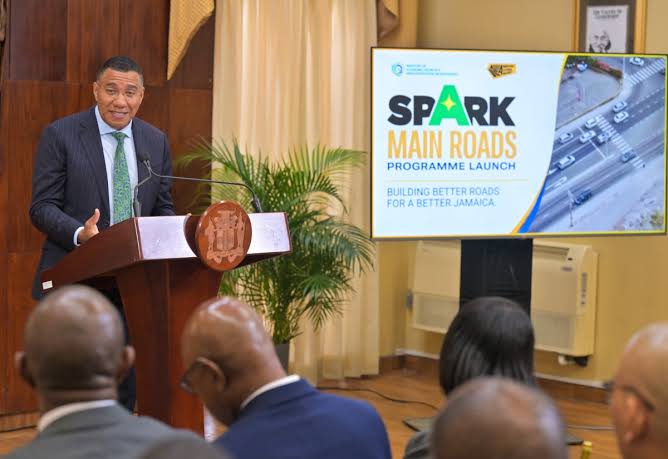
Keynote Address
by
Dr. the Most Honorable Andrew Holness ON, PC, MP
Prime Minister of Jamaica
at the
SPARK Main Road Launch
On
July 2, 2026
_______________________________________________________________________
The SPARK Programme is a $45 billion infrastructure programme. It provides $20 billion for main roads, $16 billion for community roads, $5 billion for water infrastructure, and $4 billion for engineering, designs, consultancy, supervision, and associated costs.
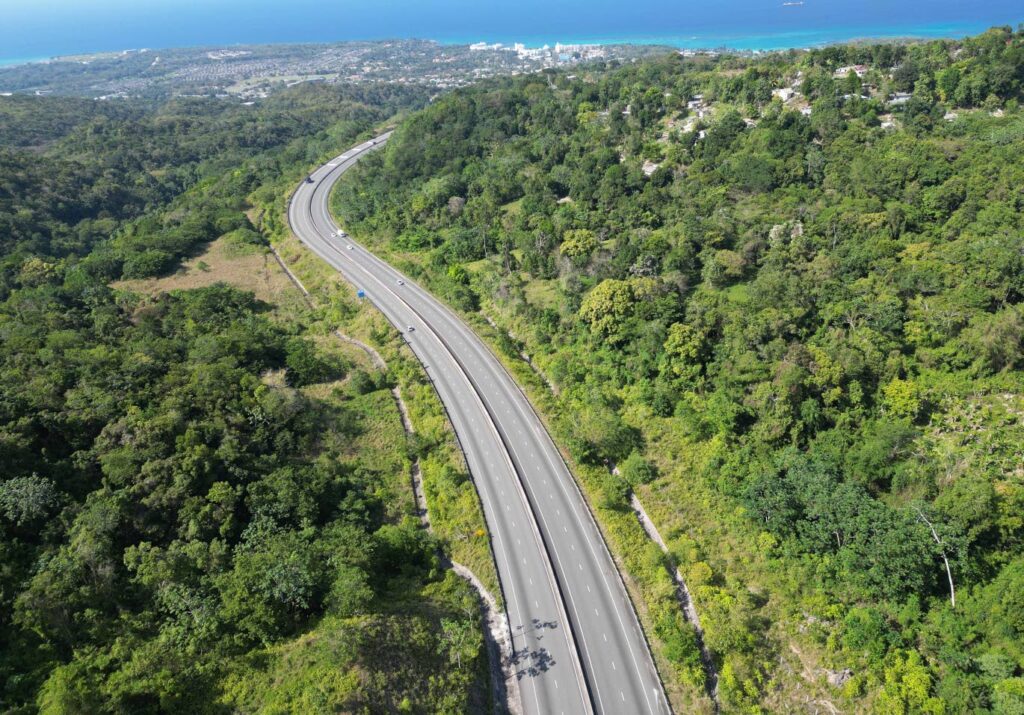
This is very important to know. Not all the roads are asphalt and pipes. Much of what we do is about planning for the road. So, this phase targets critical corridors and 63 main roads across the island that connect communities, parishes, and economic centers to improve the wider transportation network. The Government will be spending 20 billion dollars on Main Road component of the SPARK Programme.
So, even before we put a backhoe on the road, there is a significant volume of work that is done to ensure that the road is done well and will last. In fact, the proprietary works are just as important, if not more important, than the actual implementation and construction. So, I want the public to understand that for all the roads that we are doing under the SPARK programme, and indeed for any roads, a large part of the budget, or rather a significant part of the budget, goes towards the proprietary work; the engineering, the designs, and the environmental studies. We also have to do a business case, an economic case and the traffic studies. All of those things are done and that, of course, lengthens the implementation for the road.
Now, I want to acknowledge directly the frustration caused by the conditions of many roadways in Jamaica. I hear the protests and the calls to the radio stations complaining about your roads. I am in communities all over Jamaica and one of the topics that persons come to me about is the roads. I get many messages, emails, and calls and if I were to categorize them, roads would be a significant complaint.
Recently, I saw an article where one of our Members of Parliament, Duane Smith for Northwest St. Andrew, was tackled by the Citizens Association in his communities about their roads, and rightfully so, there are so many communities with roads that are deteriorating. There’s nothing that I say here that any of the residents who are suffering from bad road conditions will take comfort in, because the truth is that the citizens, they don’t judge the road programme of the Government by the contract sign or a lovely ceremony such as this one or the billions that I am announcing. That’s not what they’re interested in. What the public is interested in is that when they get up in the morning, they go in their car and they’re driving to work, they don’t hit a pothole. They want to just drive on a smooth road and back home.
For many of them, the question is, “Is that too much to ask? Is that too much to ask of our Government ?” Then there are those who will say, “I’ve traveled to other places, and they all have smooth roads and good infrastructure. Why can’t we?” So, I want to say I understand the frustration, but it is not so simple. I know that’s not what you want to hear. The roads, bridges, hospitals, water systems and sewer systems are very complicated and complex undertakings, not to mention they are very expensive. Nonetheless, your Government has the ambition to deliver to you the “carpets” that you want from your home to your work or to whatever endeavor it is and back.
You want the smooth road because it is a sign of modernity. It’s a sign of development. It is part of the quality of life that you experience. We want you to have the best experience and the best quality of life. So, that is why we have developed this SPARK Programme, which is the first attempt of the Government to not just patch roads, but to do mass rehabilitation of roads. I want to make that distinction. The Government can patch roads, and we do patch roads all over Jamaica, but to be fair, a patching programme will not bring the road network to the quality that you desire.
What you are seeing happening now is that we are beginning to patch the patches. The reason for that, friends, is that Jamaica’s road infrastructure is aged. This is a very difficult point to make to a citizen who is frustrated by the road that passes their gate. I will give you an example. So, in many of these cities, there are the communities in Northwest St. Andrew, in my own constituency, West Central St. Andrew, in West Kingston, but wherever it is across Jamaica, many of those roads were built more than 50 years ago. In fact, if you were to do a roster of all the roads in Jamaica and put a date as to when those roads were constructed, 90% of the roadways in Jamaica would have been constructed more than 60 years ago. If we are honest with ourselves and ask how many of those roads were totally rehabilitated, it would be less than 5%.
So, the challenge that you are facing now with roads is not just the weather. It’s not just the lack of maintenance or damage done to roads by how we use the roads. It is that the asphalt has reached its physical limit. It’s just the reality, and even if you were to patch it, that does not solve the problem, because the sub-base of the road has also deteriorated. But there is also another factor. These roads that were designed and built more than 60 years ago were not designed and built for the level of rain and water that they have to carry, for the level of traffic that used them, and for the weight. So, I’m not trying to ask for understanding of the country, because I do understand the frustration, but it is important that when we start to vent about the roads, we also appreciate what the challenge is. Now, you’ll never escape politics in the matter of roads. So, there is an argument that says there are some roads that you should focus on. So, there are some main roads. There are some critical thoroughfares. There are some roads that people are going to demonstrate for. So, in other words, politics can have an impact on the budget allocation, but then the question is, should it be that protests and demonstrations determine how Government s plan their road programmes? I’m not giving you an answer. I’m just asking you to consider that because were that to be the case, then the people who are going to quarrel louder and so forth may be the ones, but it may not be the economic best decision. It may not be the best strategic decision. I’m saying all of this to the public to appreciate the complexities that your Government must address in dealing with managing roads.
So where do we start in managing the road? What is the good news? Where is the hope that our roads will be repaired? What is it? Firstly, we have to improve the governance of our roads, how we manage our roads. My grandfather used to be a superintendent in the old PWD. I know that there are many people from that era who reflect upon the efficiency and good management of the Public Works Department. For them, the solution is, why don’t you go back to the Public Works Department? I have been asked this many times. There is a kind of romanticized view of the roads of old and how they were built. There is some value to that observation in the sense of how roads were administered. So first, there were very high standards for road maintenance at the time. There were high standards for road construction at the time, and they were invigilated. They were supervised. They were interrogated. People went and looked and checked but more than that, they maintained a gazette and a register. So, they knew all the roads that were built when they were built. The maintenance schedule could be generated from that.
A fiscal programme, meaning a budget, could be assigned based upon the projected useful life of the road. Somewhere along the line, that broke down to the point where, when I asked the question, how many kilometres of roads do we have, nobody could tell me specifically or exactly, because there are some roads on a register with the parish councils all over the country. There are some roads that have been built but not taken over by the parish council. So, there are orphan roads. There are some roads that are in the Ministry of Agriculture. There are farm roads. The Ministry of Agriculture doesn’t view them as roads. There are some roads that are in housing schemes that were built. Nobody knows of these roads. The NWA maintains a register of about 5,000 kilometres of roads. So, the first thing to do is, let’s do an inventory of our road assets, and that has been done. It’s not complete. It is ongoing I am told that we have about between 25,000 and 27,000 kilometres of roadways in Jamaica. Let’s just be clear on what that means. I mean, that’s about 16,800 miles of roads. Jamaica’s total square kilometres would be about 11,000. That means that we would have probably the highest density of roadways in the Caribbean. I don’t think there is another country that has the density of roadways that we do.
Globally, it is said that Japan would have the highest, and Jamaica, at some point was number two. We may have fallen, but for a country our size to have that level of density of roadways, it is significant and that happened because of our history. The history of the end of the period of enslavement, the rise of free villages, and then the building roads to connect the dispersed population all over the country would mean that we would have built out a very extensive road network. Today, when we have done this survey on all the roads that we have, we really have to start to look at some roads and determine whether or not those roads still carry economic value, whether or not they should still remain on our register of roads, because it’s one thing to have the road there and you’re not using it, yet it is still expected to be maintained.
That is why we have proposed the development of the One Road Authority: to return standards to road construction, to return standards to road maintenance, to ensure there is a budget for road maintenance that matches the economic and engineering life of the road, so that there can also be a preventative maintenance programme, but more importantly, there is a regulator and someone who will supervise road construction, road maintenance, and preventative work. In addition to that, an authority that has the legal powers to prosecute road users who destroy the national public assets in our roads by improper use or deliberate destruction. That’s the whole purpose of the One Road Authority. That is being worked on. I’ve charged Minister Morgan to have that delivered by early next year. As you know, there is a long process towards establishing an institution, developing the legislation, passing it through parliament, and getting it done. I think we can get it done. So, if we can address the governance issues as it relates to roads, then I think we would be 50% off the way to seeing how we can repair all our critical roads and bring them up to the standards that the public would want.
So, someone once asked me, what would it take to repair all the roads in Jamaica that would be in of need repair? I did some back-of-the-envelope calculations. Jamaica’s national budget, or last budget, was about $1.4 trillion Jamaican dollars. Just to put that in context, that is $1,000 billion. That’s $1 trillion. So, for us to repair, E.G. and Varden tell me that to do a kilometre of road in Jamaica properly, you would be looking at about $120 to $250 million. That is to put in the drains, and to put the proper chamber, and water mains, and to give you a good first world infrastructure. That’s what you’re looking at on average. So, if we were to repair that 21,000 kilometres to various standards, you’re looking at trillions of dollars. In fact, you would probably be looking at between $5 to $7 trillion.
So, in other words, we would need to use the national budget for about five years and do nothing else. No school, and that includes a pipeline. No school, no hospital, no police, no security, no pension, no public sector workers’ salaries, and no social programmes. So, we would have to forego everything for five years to make an impact. I’m just saying this for the public to understand the magnitude of the problem that we face. The Government isn’t trying to run away from it. In fact, I think this is the first administration that is really trying to grapple with all dimensions of this problem, and to deal with it in a meaningful way that will transform roads. So, the public may not necessarily appreciate that, however, that in the last 20 years, the way in which we have managed roads has changed significantly. I can point this out to you without any fear of contradiction. In the previous decade, let’s say between 2006 to 2016, on average, the Government would have spent something like $8 to $20 billion annually on roads and that would include some amount of emergency repairs.
In the last decade, 2016 to now, the Government is spending somewhere in the region of $25 to $75 billion on road repairs. Even if you were to take out inflation, this is still a significant number of resources that the Government is spending on roads. In fact, the Government has increased spending on roads more than threefold. The majority of the public will say, “I don’t feel it.” That is because of the magnitude of the problem. Let’s face it, we have 300 roads under SPARK. If you look at the number of people who would say, “I feel the improvement of SPARK” it would be very limited compared to everyone else who complains about their roadways, and the reason for that is the SPARK Programme has a community component, which is dispersed. It’s community roads. So, it’s the community that is benefiting from the road that would say, “Yes, my condition has improved.” When they leave the community to go elsewhere, they still encounter bad roads. So, all of that is negated.
So, now we have another element of SPARK, which would be the national roads. So, the community roads, they take you from your home to the main road, and this programme now takes you from the main road to your work, business, or play. It takes you from outside your community into a Commercial Centre or some other critical activity that’s needed for your life. So, those roads are what Varden had displayed. Some of them are very interesting and exciting prospects that will ease traffic congestion and that will increase economic activity. Some of them will require some significant engineering, including putting the road on top of Sandy Gully. Those are some serious engineering requirements, which I would really want to see before any work is done in that regard, because those are serious engineering requirements. They will certainly improve traffic flow within urban centers right across Jamaica.
As was shown, these projects are all over Jamaica. Now, internationally, most developed countries spend around 1% to 2% or 1.5% to 2% of their GDP on their road infrastructure. Generally, their road infrastructure is mature. They probably only need to do routine maintenance and some amount of new capital works. Jamaica is spending just about 2% to 2.5% of its GDP on roads. If we’re going to make an impact, we probably need to spend more like 3% to 5% of our GDP on roads. That would be significant because the question is: what do we cut? It’s an interesting prospect. I have been looking at it to see where else we could divert, or what new allocation we could make, to spend on roads. The answer is, really, there is nothing. We spend about $460 billion on salaries every year. Obviously, that can’t be cut. That’s the largest part of the budget. We spend quite a bit on education. We spend it on health, national security, and debt servicing. That’s 15% to 18% of the budget. As I said, public sector compensation, that’s about 30% of the budget. Grants, pensions and social programmes, that’s another 15% of the budget. So, it’s significant. What we spend on all the other things that make Jamaica run is quite significant relative to the challenges that we face with roads. So, the only way that we’re going to have an expanded budget without compromising all the other things that we’re doing is for there to be growth in the economy. That’s a subject that the people who complain about roads don’t always figure, meaning that it’s a balance, right? That if we’re going to spend it on roads, where is the money going to come from? It has to come from somewhere. It comes from growth, the productivity question.
The good thing about spending time on roadways is that it helps productivity. It helps to create growth. That’s why we are making these massive investments in our roadways, because they increase productivity, which will improve growth, which will give us the funds to reinvest in the infrastructure.
So, I hope today that I’ve been a little bit clearer. This is an explanation of why the roads are the way they are and what the Government is doing to ensure that we can address the road conditions in the country. This programme will, therefore, address the main roads. We have already issued work orders for 31 roads. This means that China Harbor, the contractor on the project, will begin to do the proprietary works before moving into the actual construction. Work on some roads could begin within a year, while others may take up to a year and a half before construction is complete. The public should be assured that these programmes are now officially launched and on the train.
As I close, I will say one last thing about roads. For us to be able to fix all the roads in Jamaica, we need contractors who can work at scale. One of the challenges that we’re facing with the current SPARK Programme is that we simply just don’t have the contracting capacity to manage all the roads at once. The Government is contemplating how we can support the development of a contractor class in Jamaica. I hate to put it that way, but how we must develop the contractor capacity in Jamaica. We need to move away from the notion of the contractor as a one-man operation, engaged on a short-term basis and essentially operating out a bag to the notion of the contractor who is a corporate entity that is invested with a balance sheet that can fund, finance, and carry the work that they are contracted to undertake and to move them to a higher level of professional conduct. We do have some contractors who are demonstrating the level of enterprise and operations that we need to do this level of operation but there are some that are continually disappointed and we will have to address that. As we move forward with this major project and with what we will be doing under NaRRA, contractors are a critical partner in our growth and development. We are working out a policy. We’ll come to the country with more details as to how we can support contractors, whether it is through training, access to financing, access to equipment, or partnering with other enterprise contractors. We must have a framework that develops a kind of new generation of contractors who can assist, who can be the credible partners that we need to carry out the infrastructure programme.
Look, tripling your capital budget is a major thing, and we have seen our fiscal commissioner report that sometimes we can’t spend the capital budget because the execution, which is a function of the contractors, is deficient. So, it’s one thing for us to have the funds but it’s another thing to be able to implement. So, we have solved the fiscal issues. We have the funds because we have tripled the budget, but the implementation is also a challenge, so we’re going to have to address that.
Ladies and Gentlemen, thank you.