
Trinity scholars uncover 9th-century Rome codex with oldest English poem in main text
ROME (AP) — A team of researchers based in Ireland stared at a monitor in disbelief as digitised folios from a medieval codex held at a Roman library scrolled past. Leaf by leaf, they reached the find they had been chasing: the earliest English verse still known to exist.
"We were extremely surprised. We were speechless. We couldn't believe our eyes when we first saw that," Elisabetta Magnanti, a visiting research fellow at Trinity College Dublin's school of English, told The Associated Press. She added that the verses sat inside the principal Latin narrative rather than at the edge of the page: "It was extraordinary."
Caedmon's Hymn, written in Old English, is attributed to a Northumbrian farm labourer in the seventh century. It survives inside certain copies of the Ecclesiastical History of the English People, Bede's Latin chronicle of the English church. Mark Faulkner, an associate professor of medieval literature at Trinity and Magnanti's colleague, notes that Bede's work ranks among the most frequently copied medieval texts, with close to 200 manuscripts in circulation. In his view, Caedmon's lines mark the opening chapter of English literature.
The Rome codex ranks among the earliest witnesses to that poem, copied in the ninth century. Two still older witnesses also preserve the hymn in Old English, yet only as late additions—rendered from the Latin and squeezed into margins or tacked on after the main copy was finished, the scholars explain.
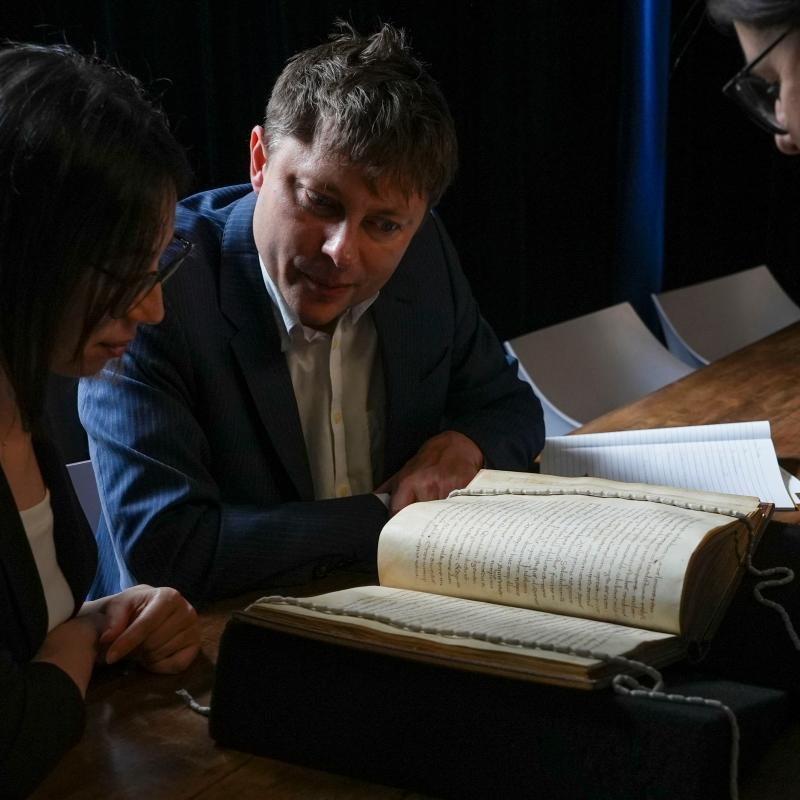
Magnanti and Faulkner travelled to Rome to examine the book on site for the first time. Faulkner said the find reframes how far English had spread, and how early it was valued, long before scholars had assumed. "Prior to the discovery of the Rome manuscript, the earliest one was from the early 12th century. So this is three centuries earlier than that. And so it attests to the importance that was already being attached to the English in the early 9th century," he said.
That the volume surfaced at all is remarkable given the route it took across centuries and continents.
Tradition holds that Caedmon composed the hymn while employed at Whitby Abbey in North Yorkshire. Faulkner recounts that guests at a feast were trading verses when Caedmon, ashamed that he had nothing fit to recite, withdrew and slept. "A figure then appeared to him in his dreams telling him to sing about creation, which Caedmon miraculously did, producing the nine-line hymn."
Roughly fourteen centuries on, that copy of his words turned up in Rome's chief public library—after crossing the Atlantic at least twice and passing through several private collections.
Monks produced this copy of Bede's history in the scriptorium of the Benedictine abbey of Nonantola, a leading medieval copying house near present-day Modena in northern Italy, according to Valentina Longo, curator of medieval and modern manuscripts at Rome's National Central Library.
When the abbey's influence waned in the seventeenth century, its large manuscript holdings were transferred to another Roman abbey, then to the Vatican, and finally to a small church. Some volumes vanished along the way, only to reappear in the early nineteenth century in the hands of prominent international collectors, Longo said.
This Bede volume eventually reached the English antiquary Thomas Phillipps. Financial pressure led him to sell portions of his library; Swiss collector Martin Bodmer acquired the book. It later surfaced in New York among stock held by Austria-born dealer H.P. Kraus in the twentieth century.
Italy's culture ministry had been hunting worldwide for manuscripts missing from Nonantola, purchasing them at auction and from dealers. It bought this Bede copy from Kraus in 1972, Longo said, and the codex has remained in Rome since—drawing little scholarly attention.
Magnanti had spent more than four years working on Bede's history and was assembling a catalogue of surviving copies. "I knew that the book was listed in the library's catalogue, so I was almost certain that the book was, in fact, still here," she said. "I realised that, because of the very complex history of this book, no Bede scholar had really looked at it. So it had been virtually unstudied."
She contacted the library, which verified the volume was in its stacks. Three months later, full digital facsimiles arrived.
The hymn in Old English reads:
Nupue. sciulun. herga. hefunricaes. puard. metudaes. maechti. and his.mod geðanc. puerc. puldur. fadur. suæhepundragiaesecidrichtin or astalde. he aeristscoop eor dubearnū hefentohrofe halig. sceppend. ða. middū. geard. moncinnes peard ecidrichtin. aefter. tia de. firū. on foldu. frea. allmechtig.
A modern English rendering:
Now we must praise the guardian of the heavenly kingdom,
the might of the creator and his intention,
the work of the father of glory, in that he of each wonder,
eternal lord, established the beginning.
He first created the earth for men,
heaven as a roof, the holy creator,
then the middle earth, the guardian of mankind,
the eternal lord, afterwards created
for men on earth, the almighty lord.
The library has digitised the full Nonantolan collection and posted it online at no charge, Longo said. Andrea Cappa, who heads the manuscripts division and the rare-books reading room, described a wider effort to open thousands of rare volumes to scholars globally. "The discovery made by the experts of Trinity College is just one starting point, a single manuscript that might pave the way for countless other discoveries, in countless other fields, through international cooperation like this," Cappa said.
Syndicated from Jamaica Gleaner · originally published .
Legal context · powered by Jurifi
Get the legal angle on this story. Pick a prompt and Jurifi's AI will explain it using Jamaican law.
AI replies are based on Jamaican law via Jurifi. Not legal advice.
Other coverage

Residents of Draxhall Country Club frustrated with board over ‘poor governance’
Jamaica Observer
Migrants ‘feared for their lives’ as Libyan gunmen fired on rescue ship
Jamaica Inquirer
‘I thought I was going to die’
Jamaica Observer
Jamaica News Today May 18, 2026 /Real News Media TV
Realnews YtWatch
Man who shot at cop fails in bid to overturn conviction
Jamaica Observer