
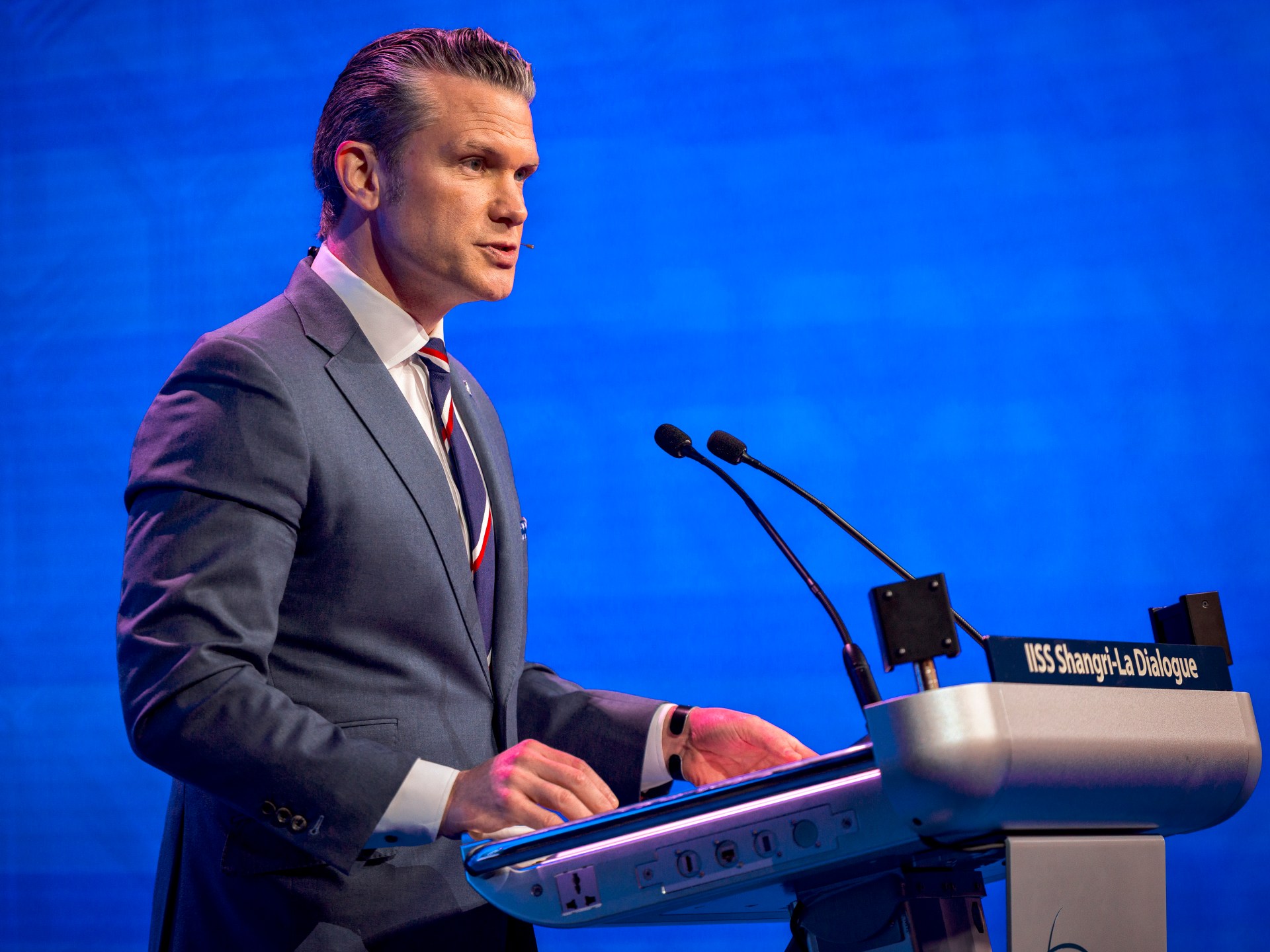
Hegseth lays out US positions on China, Taiwan, NATO and Iran at Singapore defence forum
United States Defense Secretary Pete Hegseth used a major security forum in Singapore to outline several of Washington’s leading foreign policy concerns. Speaking on Saturday at the Shangri-La Dialogue, he addressed China, Iran, NATO and Taiwan, the island that remains one of the most sensitive issues between Washington and Beijing.
The remarks came against the backdrop of the war launched by the US and Israel against Iran in late February. That conflict has unsettled world markets, deepened an energy crisis and left the US short of important weapons, including Terminal High Altitude Area Defence, or THAAD, interceptors that cost about $12mn each.
A report released on Wednesday by the Center for Strategic and International Studies said replacing four key munitions used heavily in the war would take two years, and in some cases more than three.
Hegseth’s sharpest language was reserved for China, which is broadly regarded in Washington as the country’s most serious geopolitical competitor. He voiced concern about Beijing’s expanding military activity across the Asia-Pacific.
“There is rightful alarm regarding China’s historic military buildup and the expansion of its military activities in the region and beyond,” Hegseth said.
The latest National Defense Strategy from Washington identifies China as the world’s second-strongest power after the United States. Hegseth urged American partners in the region to lift their defence budgets as part of a wider effort to balance Beijing’s growing influence.
Although he said US relations with China were “better” than they had been for many years, Hegseth warned that Beijing could dominate the region if other countries failed to respond.
“A Pacific dominated by any hegemon would unravel the regional balance of power,” Hegseth said. “No state, including China, can impose its hegemony and hold the security or prosperity of our nation and our allies in question.”
Taiwan has been strengthening its defences because of fears that China could attempt an invasion. The island has never formally declared independence from China, but it has operated in practice as a separate country since 1950, while Beijing continues to claim it as its own territory.
Earlier this month, President Donald Trump travelled to China for discussions with President Xi Jinping, who regards Taiwan as the central issue in China-US relations. Xi told Trump that “clashes and even conflicts” could follow if the Taiwan matter is handled badly.
Trump later warned Taipei not to make a formal declaration of independence from China. Taiwan responded that it was “sovereign and independent” while saying it intended to keep the current arrangement in place.
After meeting Xi, Trump said he was uncertain whether he would authorise an arms package for Taiwan valued at as much as $14bn. Hegseth indicated on Saturday that Washington’s position on Taiwan had not shifted, while making clear that Trump would make the final call on the proposed sale.
“Those decisions will depend on the president and the nature of that relationship. There’s been no change in our status,” Hegseth said.
Hegseth also repeated the Trump administration’s demand that allies carry more of their own military costs. Trump has frequently pushed partners to spend more on defence and rely less on American military strength as part of his America First approach.
European allies were recently left uncertain after Trump announced that 5,000 additional US troops would be sent to Poland, even though he had also promised to cut the American military presence in Europe. It is still not clear whether the Poland deployment includes troops that the Pentagon said would no longer be based in Germany.
“The era of the United States subsidising the defence of wealthy nations is over,” Hegseth said. “We need partners, not protectorates. We don’t have a strong alliance unless everyone has skin in the game. No freeloading.”
Iran was another major focus of Hegseth’s comments. Tehran and Washington are thought to be close to signing a memorandum of understanding that would make the end of the war permanent.
Hegseth, who as defence secretary has been central to the US war effort, said American strikes could restart if Washington does not secure an agreement it considers strong enough.
His warning came as the US tries to assure allies that the Strait of Hormuz will reopen soon. Iran closed the waterway at the beginning of the war in an effort to discourage American and Israeli attacks, and its reopening is expected to help ease energy prices.
Before the conflict, roughly 20% of global oil and liquefied natural gas moved through the strategic passage.
Syndicated from Jamaica Inquirer · originally published .
Legal context · powered by Jurifi
Get the legal angle on this story. Pick a prompt and Jurifi's AI will explain it using Jamaican law.
AI replies are based on Jamaican law via Jurifi. Not legal advice.
Other coverage

What we know and don't know about the possible deal to end the Iran war
Jamaica Gleaner
If Oman is unwilling to help open the Strait of Hormuz we will have to blow them up-Trump
Our Today
Iran condemns US strikes as a show of 'bad faith'
Jamaica Gleaner
‘Brick House’ hit makers say no to White House invite
Caribbean Life
HARSH REALITY - Jamaican medical students in Cuba plead for help amid deepening crisis
Jamaica Gleaner