
Pakistan-Afghanistan Border Strikes and Diplomacy Fail to Halt Militant Violence After Karachi Assault
Islamabad, Pakistan — Pakistan launched overnight strikes against what it described as militant hideouts in three Afghan provinces and called in Afghanistan’s envoy on Monday morning, following a weekend assault on a Sindh Rangers base in Karachi that left three paramilitary troops dead and four others injured.
Information Minister Attaullah Tarar said on X that security forces had hit targets in Paktia, Paktika and Kunar provinces, reporting that 25 fighters were killed. He also said a separate ground operation in Bajaur, in Pakistan’s northwestern Khyber Pakhtunkhwa province, on Sunday night killed several members of Jamaat-ul-Ahrar (JuA), including a senior commander, and that large stocks of weapons and ammunition were destroyed.
JuA, which claimed the Karachi attack, is a faction of the Tehreek-e-Taliban (Pakistan Taliban, or TTP), the network blamed for many of the deadliest bombings and killings Pakistan has faced in recent years.
On Monday, Foreign Office spokesman Tahir Andrabi confirmed that Afghanistan’s charge d’affaires — the country’s senior diplomat in Pakistan — had lodged a demarche, a formal diplomatic protest. Pakistan’s ambassador in Kabul delivered a separate demarche to the Afghan Ministry of Foreign Affairs the same day.
“Afghan soil and Afghan nationals continue to be used to orchestrate terrorist attacks inside Pakistan,” Andrabi said.
The Afghan Taliban — separate from the TTP and now governing from Kabul — has, however, maintained that the Pakistani strikes caused civilian casualties. Taliban spokesman Zabihullah Mujahid shared images of wounded children and accused Pakistan of hitting residential areas, saying dozens of civilians had been killed.
Neither side’s claims could be independently verified. Still, the Karachi attack, the raids on Afghan territory and the competing accounts fit a pattern that has increasingly come to define ties between Islamabad and Kabul.
Pakistan has repeatedly combined military action, deportations and diplomacy in efforts to dismantle armed groups it blames for attacks on its soil. Yet bombings and killings inside the country persist, fuelling calls from some analysts for Islamabad to rethink its approach.
The Karachi assault
Pakistan’s strikes and diplomatic moves followed the June 27 attack on a Sindh Rangers compound in Karachi’s Gulistan-i-Jauhar neighbourhood. JuA claimed responsibility.
Three Rangers personnel died in the assault, while three attackers were killed in return fire. One attacker was taken alive. Pakistani security sources named the detained man as Usman Ali, an Afghan national from Jalalabad in Nangarhar province. Investigators said he told authorities the attack team had entered Pakistan seven days before the raid.
Paramilitary soldiers stood guard outside a Rangers office after explosion and gunfire were reported on Saturday night in Karachi, Pakistan, on June 28, 2026 [Akhtar Soomro/Reuters].
Karachi had not seen an attack of this magnitude since February 2023, when TTP fighters stormed the Karachi Police Office on Shahrah-e-Faisal, killing four people.
According to the United Nations Security Council, JuA is based in Nangarhar, the Afghan province whose capital is Jalalabad — the same city Pakistani authorities say the captured attacker came from.
A faction seeking relevance
JuA’s ties with the TTP have long been unstable. The TTP, formed in 2007, has waged a sustained armed campaign against the Pakistani state and remains the dominant militant umbrella network, which Islamabad says largely operates from Afghan territory.
JuA broke away from the group in 2014, rejoined in 2020 and, by early 2025, had moved back toward semi-independence. When the TTP announced new leadership appointments in February 2025, JuA received no major roles, although no formal split was declared.
Ihsanullah Tipu Maseed, an expert on non-state armed groups in the Afghanistan-Pakistan region, said the Karachi attack showed JuA’s need to prove it still matters.
“Jamaat-ul-Ahrar has used this attack to send a message that they still possess the capability to carry out large-scale attacks inside Pakistan,” he told Al Jazeera. “There is always an internal competition among militant organisations to prove their capability to supporters and potential recruits. They want to demonstrate they can deploy multiple attackers to target key strategic security installations, independently of the TTP.”
Historically, JuA has been among the most hardline factions within the TTP network. The group claimed responsibility for the 2016 Easter bombing at Lahore’s Gulshan-e-Iqbal Park, which killed more than 70 people. The November 2025 suicide bombing at Islamabad’s district court complex, which killed 12 people, was also attributed to the group.
“This is not limited to Karachi,” Maseed said. “It can happen in Punjab. It can happen in any major urban centre.”
Pressure without resolution
Pakistan’s response followed a familiar script. A major attack occurs. Air strikes across the Afghan border follow within hours. Islamabad issues warnings. Kabul condemns civilian casualties. The cycle starts again.
The scale of the security threat is not in dispute. According to the Pak Institute for Peace Studies, an Islamabad-based think tank, attacks in Pakistan rose 34 percent in 2025, with 699 incidents recorded nationwide. At least 1,034 people were killed and another 1,366 wounded. More than 95 percent of the attacks were concentrated in Khyber Pakhtunkhwa and Balochistan provinces.
Since February this year, Pakistan has carried out Operation Ghazab Lil Haq, a sustained military campaign involving air strikes, artillery exchanges and ground operations across eastern Afghanistan. At the same time, Islamabad has deported close to one million Afghan nationals since September 2023 and pursued several rounds of ceasefire talks with the Taliban government in Kabul, including negotiations held in Urumqi in early April. While some of those talks produced temporary pauses in violence, none resulted in a lasting settlement.
Maseed said the repeated cycle reflected deeper flaws in Pakistan’s broader counterterrorism approach.
“The fundamental flaw I see in Pakistan’s counterterrorism strategy is the lack of a consistent approach and an overreliance on the use of force, while governance flaws are left unaddressed,” he said.
According to the Islamabad-based analyst, Pakistan’s cross-border strikes are “largely reactive”.
“I see no holistic strategy underpinning them. After every attack, social media accounts push for strikes on Afghanistan. It appears that instead of developing a coherent counterterrorism strategy, decision-makers succumb to that pressure, and conduct strikes simply to be seen doing something,” he added.
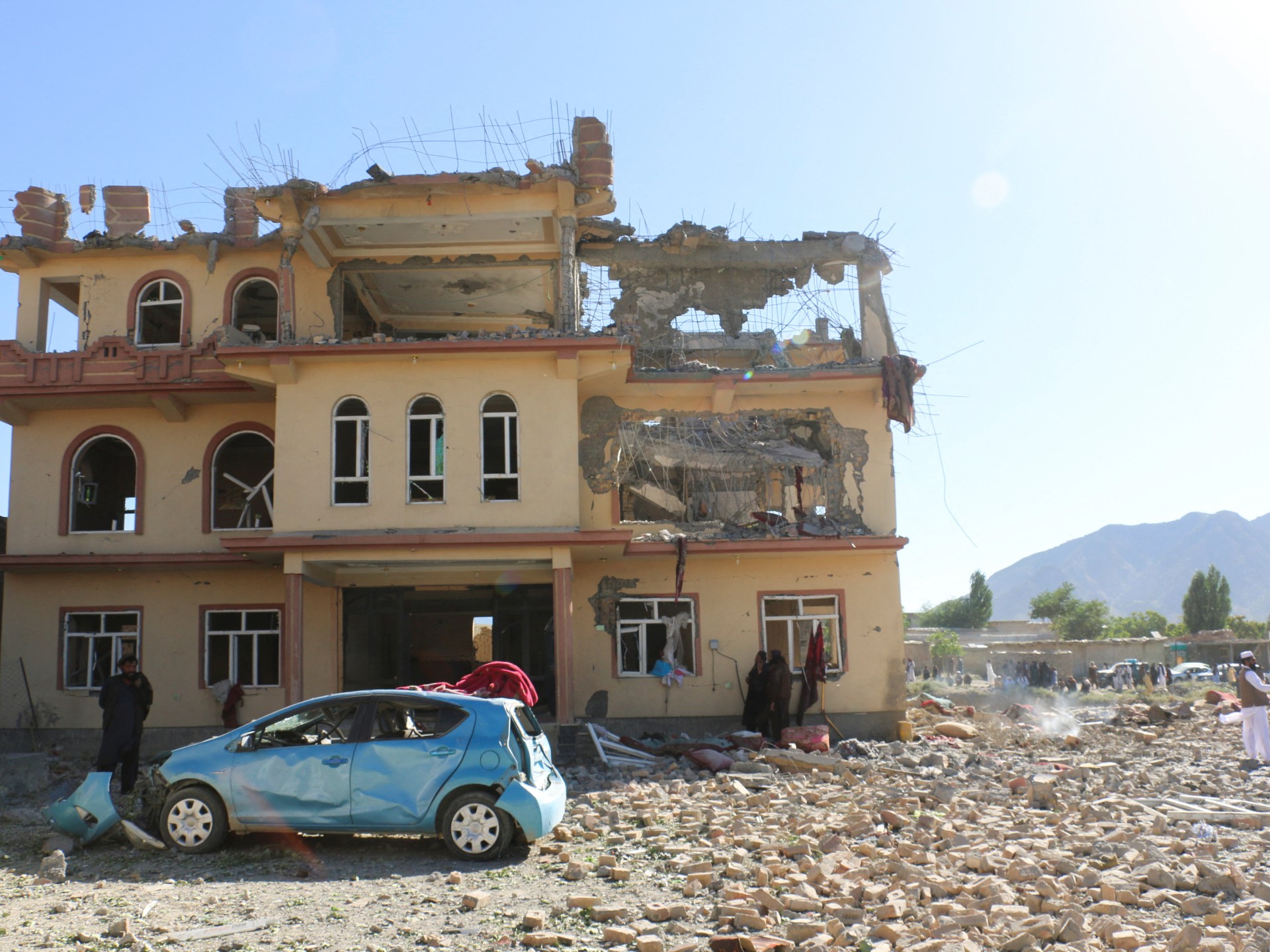
A Taliban security member stood on top of the debris of a house following an air strike that the Taliban said was carried out by Pakistan in Mani village, Spera District, Khost Province, Afghanistan, on June 10, 2026 [Stringer/Reuters].
Winning battles, losing narratives
Pakistan has pursued military pressure and diplomatic engagement at the same time. But analysts question whether either approach rests on sound assumptions.
Ibraheem Bahiss, an Afghanistan analyst at the International Crisis Group, described Pakistan’s posture as maximum pressure built on an unproven premise.
“The underlying assumption is that a Taliban crackdown will produce a reduction in violence inside Pakistan,” he told Al Jazeera. “Whether that premise is correct, valid, and sound is genuinely up for debate.”
Bahiss drew a distinction between the Afghan Taliban refusing to act against the TTP and directly supporting attacks inside Pakistan.
“While there is evidence of Afghans operating within TTP ranks, that does not in itself constitute conclusive proof that the Afghan authorities are directing or supporting those operations,” he said.
He added that Pakistan’s tendency to link every major attack to Afghanistan “strikes me as more politically driven than evidence-based”.
Independent accounts, including UN figures, have repeatedly documented Afghan civilian casualties from Pakistani air strikes. The UN recorded at least 372 Afghan civilian deaths and 397 injuries in the first three months of 2026 alone. This includes dozens killed in a missile strike by Pakistan that hit a drug rehabilitation facility in Kabul in March.
Sami Yousafzai, a journalist and expert on Afghan affairs, said the civilian toll was reshaping public opinion inside Afghanistan.
“Many Afghans now believe that Pakistan’s strikes are changing the conversation around the Taliban regime,” he told Al Jazeera. “Even Afghans who were critical of Taliban policies – on women’s education, for instance – are now saying: Set that aside, let us talk about Pakistani aggression. Pakistan is essentially handing the Taliban a narrative, and the Taliban are cashing in on it very effectively.”
Yousafzai said the strikes were also reinforcing a broader historical narrative.
“No Afghan government in the last 40 years has claimed to have bombed Pakistan or attacked Pakistani territory in response to cross-border incidents,” he said. “Pakistani air strikes are reinforcing the narrative that Pakistan is the aggressor, and that is a serious long-term problem for Islamabad.”
Bahiss warned that the current trajectory could not continue indefinitely.
“We cannot go another year or two like this. It is inflaming public sentiment on both sides, causing serious trade disruption. The two sides will have to negotiate. What is needed now are fresher minds and a genuine new approach, because what is being tried right now is clearly not working,” he said.
Syndicated from Jamaica Inquirer · originally published .
Legal context · powered by Jurifi
Get the legal angle on this story. Pick a prompt and Jurifi's AI will explain it using Jamaican law.
AI replies are based on Jamaican law via Jurifi. Not legal advice.
Other coverage

Overcrowded bus plunges into ravine in southwest Pakistan, killing 40 passengers and injuring eight
Jamaica Gleaner
JMDA Praises MOH's Response to Interns' Concerns | Midday News
Television Jamaica (Video)Watch
Sunday Sips with HG Helps | A protest at the right time, ‘Inaction’ Edwards doesn’t get it, World Cup star Doku deserves better, and weeping for Venezuela
Our Today
Deadly Shooting in Naggo Head | Jamaica News Today
Realnews YtWatch
Jamaica Homicide Outbreak | St. James Under Siege
Realnews YtWatch