

OT Equity Analysis | Knutsford Express: Recovery in Progress and the Final Quarter Test
Prepared for Our Today | Capital Markets & Investments Desk May 10 2026
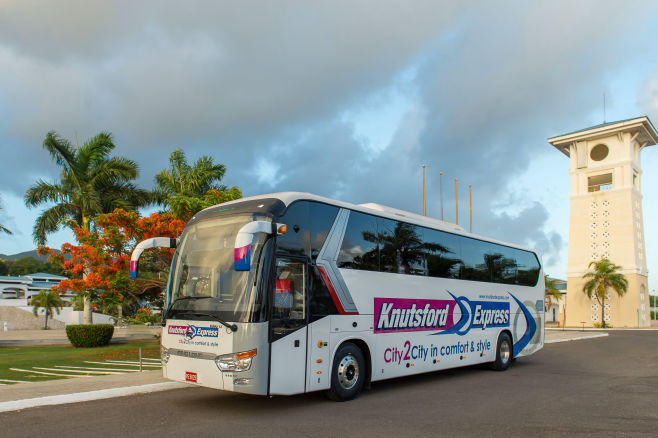
Of all the JSE-listed companies whose financial statements will carry the fingerprints of Hurricane Melissa through to the May 2026 year-end, few will tell the story more cleanly than Knutsford Express Services Limited (JSE Junior Market: KEX). The company operates routes across the western parishes that took the full force of the storm on October 28, 2025. Its second quarter, covering the three months to November 30, 2025, was the worst quarter in the company’s nearly twenty-year operating history. Its third quarter, to February 28, 2026, showed a return to profitability. Its fourth quarter, which closes at the end of this month, is the test. For investors trying to understand whether KEX is a recovery story or a structurally damaged one, the next set of numbers will settle the argument.

The Q2 wipeout
The November 2025 quarter was the longest operational shutdown in the company’s history. Routes across the western parishes were suspended for up to two weeks. The Luana, St Elizabeth location was so badly damaged it remained closed beyond the quarter end. By early December, the company was running on approximately seventy per cent of its pre-hurricane fleet. Quarterly revenue fell seventeen point four per cent to four hundred and thirteen million Jamaican dollars from five hundred million in the prior year. The quarter swung to a net loss of three point six million dollars against a profit of fifty three million a year earlier, a swing of fifty six point six million dollars on the bottom line.
The board described the period as presenting unprecedented challenges since the company’s inception, noting that it exceeded even the COVID-19 disruption in duration. That comparison is the one that matters. KEX has been through one operational shock in its corporate history that required it to suspend services for an extended period. Melissa was the second. In both cases, the test of the franchise was not whether it could absorb a single bad quarter, but whether the operating model recovered quickly enough to preserve the equity story on the other side.

Q3 and the partial recovery
The February 2026 quarter was the first data point investors could use to judge how the recovery was tracking. Net profit came in at fifteen point eight million dollars, a return to profitability but a sixty-eight point four per cent decline from fifty million in the same quarter the previous year. Revenue was five hundred and forty-four million dollars, down eight point two per cent from five hundred and ninety-three million. For the nine months to February 28, profit fell to seventy-eight point six million compared with one hundred and sixty-nine point seven million in the prior period.
The composition of the Q3 print matters. Revenue had recovered to within ninety-two per cent of the comparable prior year quarter, suggesting that route utilisation was returning even if the fleet was not yet fully restored. The margin compression, however, was severe. Going from a fifty-million-dollar quarter to a fifteen point eight million dollar quarter on only an eight per cent revenue decline tells you that the cost base did not shrink in proportion to the revenue. That is what you would expect in a recovery quarter. Operating capacity has to be maintained ahead of full demand normalisation. Driver costs, depot costs, and partial fleet operating costs all carry through even when route density has not yet returned to pre-storm levels.
The more interesting question is what the Q3 print does not tell you. It does not tell you whether the western parish routes had returned to full operational density by quarter end. It does not tell you what the courier business, which historically has run at higher margins than the passenger business, looked like through the recovery. And it does not tell you whether the Luana location had been reopened or whether the missing thirty per cent of the pre-hurricane fleet had been brought back into service. Those answers will arrive with the Q4 disclosure.

The fuel cost question
In April, KEX disclosed that diesel prices had risen approximately twenty-seven dollars per gallon since late February, reflecting the Middle East conflict that began with the Israel and United States strikes on Iran on February 28. Gasoline 87 prices from Petrojam moved from one hundred and fifty one dollars and thirty-two cents on February 26 to one hundred and seventy six dollars and eighty eight cents on April 16. For a transport operator, this is unambiguously a cost headwind. Diesel is one of the largest variable cost lines in any bus operation.
CEO Oliver Townsend framed the development differently in his April commentary. As fuel costs rise, he argued, the relative cost of individual travel increases, and the value proposition of consolidated transport strengthens. He indicated that a ticket price increase was unlikely at the current juncture. The strategic logic is sound. The arithmetic is less forgiving. A company that has just recovered from a hurricane-driven loss quarter, that is running at seventy per cent fleet capacity at the start of the recovery window, and that now faces a meaningful increase in its single largest variable cost line, has limited room for error in the final quarter of the fiscal year.
This is the genuine investment question for KEX over the next quarter. Either the demand response to higher individual transport costs is strong enough to absorb the diesel cost increase through volume, or the margin compression that began in Q3 extends into Q4. The data will arrive when the May 2026 fiscal year closes.
The strategic build-out that did not stop
One of the more underappreciated features of the KEX story through the Melissa quarter is that the strategic capital programme did not pause. The company has spent meaningfully on its Mandeville property over the past three fiscal years. It acquired the property for sixty-seven point one one million dollars in the May 2023 financial year, then spent sixty-one point five six million in 2024 and one hundred and thirty-one point nine six million in 2025 on construction. Through MVL Greenvale Limited, the property is being developed into a commercial and transportation hub. The opening of the Mandeville location, alongside a new Morant Bay location in St Thomas, was projected within the current financial year.
This matters for the investment thesis in two ways. First, KEX is positioning to capture traffic from the phase 1C Highway 2000 East to West extension between May Pen and Mandeville. The company’s Drax Hall location is the proof of concept. That location’s economics were transformed by the North-South Highway, and the operating logic for Mandeville is similar. Second, the willingness to continue capital deployment through a hurricane recovery period reflects how management views the storm. They are treating it as a one-time operational disruption, not as a reset of the underlying market. Investors will form their own view on whether that is the right call. But the capital programme is telling you what the company believes.

The Q4 read
Four things will determine whether KEX prints a clean recovery quarter for the three months to May 31, 2026. First, fleet utilisation. If the company is back at or above ninety per cent of pre-hurricane fleet by quarter end, the revenue line should show meaningful sequential improvement in Q3. Second, the Luana reopening. The St Elizabeth location was the most damaged, and its return to service is the cleanest single signal that the operating geography is whole again. Third, the diesel cost flows through. Whether higher fuel costs are being absorbed in margin or passed through in volume will show up in the operating profit line. Fourth, courier revenue. The courier business has historically been the higher margin segment, and it is also the segment that is most directly exposed to the post-Melissa rebuilding economy. Construction materials and small parcel logistics tied to reconstruction should be a tailwind through the May quarter and into FY2027.
The nine-month result is what it is. Profit of seventy-eight point six million against one hundred and sixty-nine point seven million the prior year is a fifty four percent decline in operating earnings over the worst three quarters this company has had since COVID. The Q4 result will tell investors whether that decline was the trough or the trend. Given what the management commentary has signalled, what the capital programme is doing, and what the regional reconstruction economy looks like over the next twelve to eighteen months, the probability sits with the trough reading. But probability is not certainty. The final quarter is the test.
The view from here
KEX trades on the Junior Market and has historically been one of the cleaner small-cap operating businesses on the JSE. It does one thing, it does it well, and it has a route network that is genuinely defensible in a Caribbean operating context where consolidated cross-country transport is structurally underprovided. The Melissa quarter does not change that. What it does is reset the trailing twelve-month earnings picture and create an unusually clean look at how the franchise behaves under stress.
For investors building positions in resilient operating businesses with proven management, recovery windows of this kind are typically where entry prices are set. The fiscal year that just closed will read poorly. The fiscal year that begins next month, against a reconstruction backdrop and a build-out programme that adds two new locations to the network, is the year that resolves the question. The final quarter of FY2026 is the data point that tells you whether to wait or to lean in. That number will arrive shortly.
This commentary is prepared for informational and editorial purposes only and does not constitute investment advice. Readers should conduct their own due diligence and consult a licensed financial adviser before making any investment decisions. All figures sourced from Knutsford Express Services Limited quarterly disclosures (Q2 and Q3 FY2026), Jamaica Gleaner, Jamaica Observer, and Business Access Television reporting.
Syndicated from Our Today · originally published .
Legal context · powered by Jurifi
Get the legal angle on this story. Pick a prompt and Jurifi's AI will explain it using Jamaican law.
AI replies are based on Jamaican law via Jurifi. Not legal advice.
Other coverage

Everything Fresh still smarting from Melissa as margins thin and debt climbs
Jamaica Gleaner
Iran war and Jamaica hurricane cost TUI €61m in half-year results
Jamaica GleanerKingston Properties reports strong start to 2026 financial year
Radio Jamaica News Online
Fontana reporting stronger third quarter performance
Radio Jamaica News Online
Mayberry loss widens to $2.2 billion in first quarter
Jamaica Gleaner