
Small businesses slow to embrace digital payments amid cost, fraud concerns
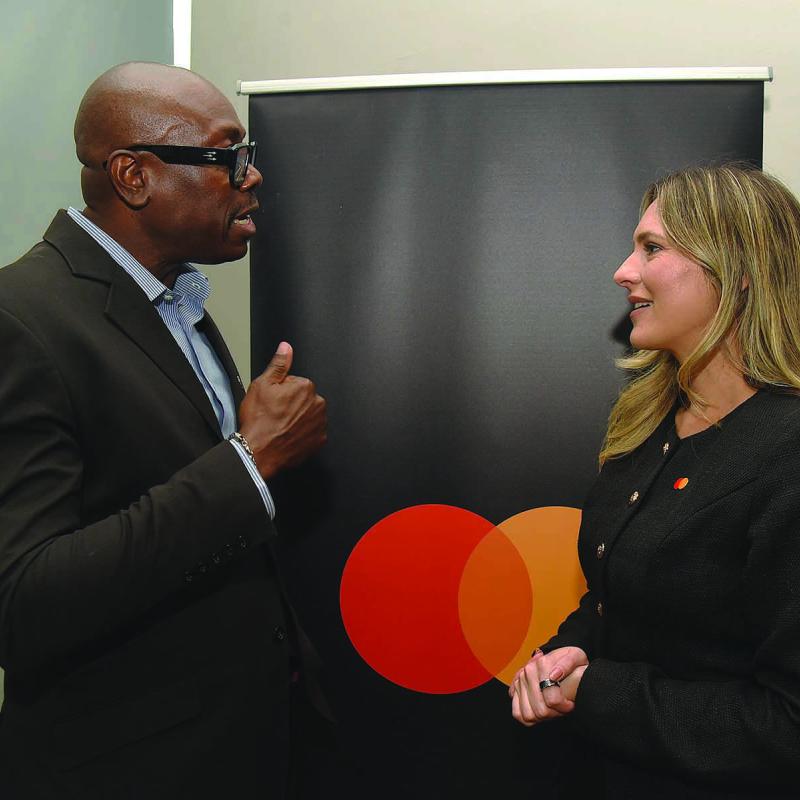
Despite evidence that digital payments can drive business growth, only eight per cent of small merchants in Jamaica use point-of-sale (POS) systems, with the country averaging 11 POS terminals per 1,000 inhabitants.
This was revealed in a recent MasterCard study on the state of digitalisation and financial inclusion in Jamaica, which highlighted that although the island has a strong foundation for wider digital payments, it faces critical merchant acceptance barriers.
“From a benchmark perspective, markets that are more digitised tend to have over 50 terminals per 1,000 inhabitants,” Dalton Fowles, MasterCard country manager for Jamaica, told journalists on Tuesday at a media roundtable. “So at eight per cent, we are way behind the target and it is impacting the state of digitisation.”
The study, conducted between February 11 and 23 this year, found that 92 per cent of consumers want more businesses to accept digital payments, while 88 per cent want greater access to digital payment options.
Despite that demand, cash remains king in Jamaica, accounting for 72 per cent of transactions. Contactless payments stood at 56 per cent, suggesting strong adoption among users who have access to the technology, but also highlighting the limited number of merchants offering the service.
The report noted that Jamaicans generally have strong knowledge of traditional banking tools and express high confidence in digital payment security.
According to the World Bank’s Global Findex 2021 report, 73.3 per cent of Jamaicans are banked.
Trust was identified as the most important factor influencing the choice of digital payment methods, with 94 per cent of respondents ranking it highest. Understanding of the technology followed at 92 per cent, while security was the third-highest deciding factor at 91 per cent.
Debit cards emerged as the dominant and most trusted everyday payment tool, with 55 per cent of Jamaicans actively using them, while credit card adoption remains exceptionally low at 22 per cent.
However, the study revealed that many Jamaican were unfamiliar with emerging digital payment methods.
Fowles argued that greater collaboration with government agencies is needed to close the digital literacy gap through public education campaigns.
“You can’t deploy the tech without the digital literacy programmes,” he said. “Giving someone a point-of-sale device without digital literacy is going to defeat the purpose, so it’s extremely important that that part of the partnership is there.”
President of the Small Businesses Association of Jamaica (SBAJ) Garnett Reid is of a similar view.
“What the Government and private sector need to do is to educate these business people to let them know that we need to get away from the cash society to digital, where they can use their credit cards, and so on,” he told The Gleaner yesterday.
Reid noted that while some small businesses have embraced the convenience and security of digital payments, others remain wary of the added costs associated with operating POS systems.
“I see a number of higglers, barbers, hairdressers, tailor shops get their phones and you put your card on it and it runs. But that is just a few, more needs to be done,” he said.
Fowles, in the meantime, stressed that closing the merchant acceptance gap is critical to Jamaica’s economic development and pointed to infrastructure challenges that continue to slow progress.
He said MasterCard is working with market partners to provide small and medium-sized enterprises with lower-cost digital payment solutions, including contactless technology, tap-on-phone services, and click-to-pay systems.
“Whether it is your informal vendors on the side[walk], whether it is your small shops in the communities, that segment is where we’re beginning to unlock,” Fowles said.
Jamaica has an estimated 425,000 small businesses operating across the island, but only about 14,000 are currently registered.
For many small operators, however, the shift to digital remains complicated.
Hairdresser Shanika McAdam, who has worked in the industry for more than a decade, told The Gleaner that she still relies mainly on cash payments.
Although she has considered getting a POS machine, she said the additional expense has discouraged her. She also signed up for a local digital wallet service, but said many clients are unfamiliar with it.
Still, McAdam acknowledged the security and convenience digital payments could provide.
“It would work better for me because 90 per cent of the time, I don’t have the time to go to the ATM or the bank to deposit the money, and sometimes you go to the ATM and they are not working,” she said. “It will save a lot of time going into the bank, and so on.”
Like McAdam, Richard Robinson, a taxi operator of five years, also mainly accepts cash, though some customers occasionally use bank transfers.
He admitted that concerns about fraud have kept him from embracing digital payments.
“From time to time, mi hear people seh deh sumn deh a scamming, when people seh di money send, it actually don’t send, so I actually stay far from dat. Mi rather the physical, hard cash,” he told The Gleaner.
Fowles reiterated MasterCard’s goal of helping to bring 50,000 small businesses into the formal economy by 2030, arguing that the solutions being introduced align with global trends.
He pointed to a previous MasterCard study which found that 91 per cent of SMEs already accepting digital payments have reported significant business growth.
“The market has shifted a lot in the last number of years. Almost all cards issued in the market are contactless, which means that if you provide the enabling acceptance solution, then we remove the friction at point of payment,” he said.
Syndicated from Jamaica Gleaner · originally published .
Legal context · powered by Jurifi
Get the legal angle on this story. Pick a prompt and Jurifi's AI will explain it using Jamaican law.
AI replies are based on Jamaican law via Jurifi. Not legal advice.
Other coverage

Road deaths pass the 100 mark but big 28 per cent reduction recorded
Jamaica Observer
Audrey Marks | From Resilience to Resurgence
Our Today
Jamaicans see unequal society, corruption becoming normalised — survey
Jamaica Observer
China’s e-commerce sector maintains steady expansion in January-April
Our Today
JIS News - 21.05.2026
Jamaica Information Service (Video)Watch