
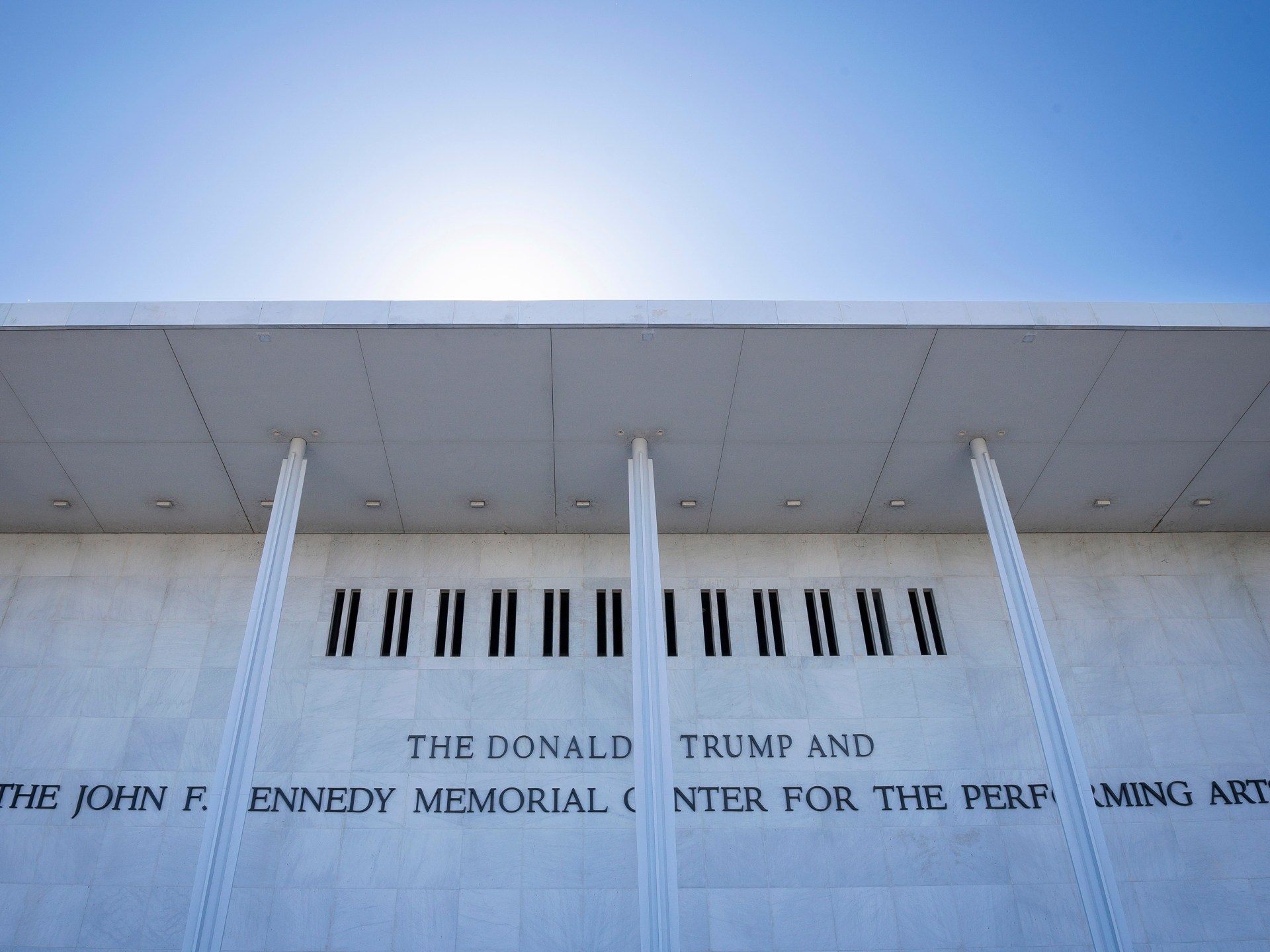
Trump pledges to withdraw from Kennedy Center after court strikes his name
UNITED STATES DISTRICT COURT FOR THE DISTRICT OF COLUMBIA JOYCE BEATTY , Plaintiff, v. DONALD J. TRUMP et al. , Defendant s . Case No. 25 - cv - 4480 (CRC) TABLE OF CONTENTS I. Background ................................ ................................ ................................ ...................... 4 A. Institutional Background ................................ ................................ ......................... 4 B. Statutory Background ................................ ................................ ............................. 6 C. Factual Background ................................ ................................ ................................ 8 1. May 2025 Bylaw Amendment ................................ ................................ ............ 9 2. Renaming ................................ ................................ ................................ ............ 9 3. Closure ................................ ................................ ................................ .............. 11 D. Procedural History ................................ ................................ ................................ 22 II. Legal Standards ................................ ................................ ................................ .............. 23 A. Summary Judgment ................................ ................................ .............................. 23 B. Preliminary Injunction ................................ ................................ .......................... 24 III. Analysis ................................ ................................ ................................ ........................ 25 A. Renaming ................................ ................................ ................................ .............. 30 1. Article III Standing ................................ ................................ ........................... 30 2. Section 76 l (b) Renaming Claim ................................ ................................ ........ 44 3. Ultra Vires Claim ................................ ................................ .............................. 53 4. Remedy ................................ ................................ ................................ ............. 55 B. Voting ................................ ................................ ................................ ................... 57 1. Article III Standing ................................ ................................ ........................... 58 2. Section 76 l (b) Voting Claim ................................ ................................ ............. 58 3. Remedy ................................ ................................ ................................ ............. 64 C. Closure ................................ ................................ ................................ .................. 65 1. Likelihood of Success on the Merits ................................ ................................ . 65 2. Irreparable Harm ................................ ................................ ............................... 83 3. Balance of Equities/Public Interest ................................ ................................ ... 86 4. Preliminary Relief ................................ ................................ ............................. 87 IV. Conclusion ................................ ................................ ................................ .................... 90 Case 1:25-cv-04480-CRC Document 50 Filed 05/29/26 Page 1 of 94
1 MEMORANDUM OPINION I n November 1962, President John F. Kennedy and First Lady Jacqueline Kennedy presided over “An American Pageant of the Arts ,” a televised fundraiser for what was then known as the National Cultural Center. The event boasted an impressive slate of performers, including poet Robert Frost, singer Harry Belafonte, and a seven - year - old cellist by the name of Yo - Yo Ma , among other famed (or soon - to - be - famous) artists . Addressing the gathering , President Kennedy expounded : [ A ] rt knows no national boundaries. Genius can speak in any tongue, and the entire world will hear it and listen . Behind the storm of daily conflict and crisis , the dramatic confrontations, the tumult of political struggle, the poet, the artist, the musician continues the quiet work of centuries, building bridges and experience between people s , reminding man of the universality of his feelings and desires and despairs, and reminding him that the forces that unite are deeper than those that divide . . . I am certain that after the dust of centuries has passed over our cities, we, too, will be remembered, not for victories or defeats in battle or in politics but for our contribution to the human spirit. 1 Congress chose to honor President Kennedy’s commitment to the arts — reflected in his lyrical remarks at the American Pageant — following his assassination a year later . It enacted legislation that formally designated the National Cultural Center as the “John F. Kennedy Center for the Performing Arts. ” Congress made clear that the Kennedy Center would serve as both the nation’s premier performing arts center and a living memorial , the sole one dedicated to the late Presiden t in the Washington, D.C. area. The Center has played those roles for over five decades. Early last year, however, rumblings of change reverberated through the Kennedy Center . In February 2025, President Donald Trump replaced several trustees on the Center’s Board of 1 See The Trump Kennedy Center, Creating the National Cultural Center , https://www.kennedy - center.org/memorial/jfk/highlights/national - cultural - center/ (last visited May 7, 2026); The Trump Kennedy Center, An American Pageant of the Arts , at 6:10 – 7:45 (YouTube, May 29, 2020), https://www.youtube.com/watch?v=pCIg6fTPA5U&t=51s [ https://perma.cc/PHZ9 - 9LGE ]. Case 1:25-cv-04480-CRC Document 50 Filed 05/29/26 Page 2 of 94
2 Trustees and appoint ed himself as a trustee, too . The newly - reconstituted Board then elected him chair and , under his direction, replaced the Center’s president. In May, the Board amended the governing bylaws, stripping ex officio trustees of their right to vote on board matters . In December , the Board decided to rename the institution the “Trump Kennedy Center,” a nd new lettering was affixed to the Center’s front portico the next day. On February 1 of this year , with no advance warning, President Trump announced that the Kennedy Center would close for two years pending “Construction, Revitalization, and Complete Rebuilding . ” The Board voted to approve the closure six weeks later . Ohio Congresswoman Joyce Beatty, an ex officio member of the Kennedy Center Board of Trustees, has sued to block several of these Board actions . R elevant here, she has moved for partial summary judgment on the name change and for a preliminary injunction (“PI”) to halt the imminent closure. The Defendants — who include the Kennedy Center, the Board, President Trump in his capacity as a trustee , and scores of its general and ex officio trustees — oppose Beatty’s motion for preliminary relief and ha ve cross - moved for summary judgment on her claims for relief . Having considered the parties ’ briefs and the factual record before it, the Court reaches several distinct conclusions. First , Representative Beatty is entitled to summary judgment on the renaming issue . The Kennedy Center’s organic statute makes crystal clear that the Center is to be named for President Kennedy, and it cannot bear any other formal name or public memorial based on the Board’s unilateral say - so . Congress gave the Kennedy Center its name , and only Congress can change it. Next, Beatty is entitled to summary judgment on the voting rights issue . The Center’s organic statute makes no distinction between the powers of general and ex officio trustees . Case 1:25-cv-04480-CRC Document 50 Filed 05/29/26 Page 3 of 94
3 Nothing in the statute permits the Board to discriminate categorically between the two as to fundamental trustee rights . And stripping ex officio trustees of their voting rights run s afoul of common - law trust principles incorporated in to the statute , principles which presumptively place trustees on equal footing when it comes to participating in the trust ’s administration. Finally, Beatty is likely to succeed on her claim that the Board violated its fiduciary duty in voting to close the Kennedy Center , “one of the more consequential decisions in the institution’s lifespan . ” Beatty v. Trump , No. 25 - cv - 4480 (CRC), 2026 WL 712814, at *10 (D.D.C. Mar. 14, 2026). The Center’s organic statute vests the Board with several overarching responsibilities. It must maintain the Center in good working order. It must also operate the Center as a performing arts venue and as a memorial to President Kennedy. As stewards of property held in trust for the American people, Board memb ers must go about fulfilling these duties consistent with common - law standards of prudence. The preliminary factual record before the Court reveals that, in ratifying President Trump’s closure announcement, the Board was derelict in discharging the full range of its responsibilities to the Center. More specifically, the Board based its decision on a n insufficient, one - sided presentation of information and neglected to consider the full range of its statutory obligations and potential adverse consequences of closure on programming and memorial functions . The deficiencies in the Board’s decision - making thus “fall [] below even a forgiving standard of prudence.” Id. at *10. Because Congresswoman Beatty has identified several irreparable harms that will f low from a two - year closure, and those harms outweigh any countervailing prejudice to the Defendants or the public , the Court will preliminarily enjoin the Defendants from effectuating the closure decision made at the March 16 Board meeting . However, the preliminary injunction will not prevent the Center from moving forward with the capital repair work it has planned, Case 1:25-cv-04480-CRC Document 50 Filed 05/29/26 Page 4 of 94
4 which the record demonstrates is sorely needed. Nor will it categorically prohibit the Board from closing the Center should it come to this decision anew after independently balancing its multiple obligations to the Center in a prudent fashion. I. Background A. Institutional Background The John F. Kennedy Center for the Performing Arts is a multifaceted institution. It is both the nation’s preeminent performing arts venue and a memorial to President Kennedy. It is a trust instrumentality of the United States that not only plans artistic programming, but also formulates arts - related policy and engages in community outreach. P hysically, the Center is more than just a grand marble building overlooking the Potomac River . I n addition to its famed theaters, concert halls, and Grand Foyer, the Center occupies a campus of seventeen acres, replete with a presidential grove, several smaller theaters and performance spaces, plazas and pavilions, offices, commemorative exhibits, classrooms, restaurants, and shops. See generally The Trump Kennedy Center, Explore Our Spaces , https://www.kennedy - center.org/visit/exploring - our - spaces/ (last visited May 6, 2026). As th e Court explained in its earlier ruling on Congresswoman Beatty’s request for a temporary restraining order (“TRO”) , “[t]he notion of a national cultural center in Washington, D.C. dates back to the mid - 1950s when President Eisenhower formed a commission to consider creating a public auditorium in the country's capital. ” Beatty , 2026 WL 712814, at *1. “ Both the idea — and the necessary fundraising — stalled for a few years, until President Kennedy resuscitated the effort in the early 1960s . ” Id. Then, after Kennedy’s assassination , “ Congress enacted a statute authorizing the federal government to provide millions of dollars to match private donations to the new institution , ” which would be named for and in honor of the late Case 1:25-cv-04480-CRC Document 50 Filed 05/29/26 Page 5 of 94
5 president. Id. Congress originally conceptualized the Center as a “bureau” in the Smithsonian Institution, see National Cultural Center Act, Pub. L. No. 85 - 874, § 2(a), 72 Stat. 1698, 1698 (1958) , and it continues to operate as such today , see 20 U.S.C. § 76h(a)(1). Designed by architect Edward Durell Stone, t he Kennedy Center opened for its first performance in 1971. See PI Mot. , ECF No. 13 - 4, Ex. B (“Board of Trustees Handbook”) at 10 . In its early years of life, t he Center was jointly administered by its Board of Trustees, which was responsible for artistic activities, and the National Park Service (“NPS”) , which kept up the facilitie s and grounds . See, e.g. , U.S. G ov’t Accountability Off. , GAO - 03 - 823, Kennedy Center: Improvements Needed to Strengthen the Management and Oversight of the Construction Process 4 (Sep. 2003), https://www.gao.gov/assets/gao - 03 - 823.pdf [ https://perma.cc/2W7S - Q7UF ] . But over time, that bifurcated arrangement proved difficult. As a result, in 1994, Congress passed the John F. Kennedy Center Act Amendments, which consolidated arts programming, presidential memorial activities, and overall facilities management in the hands of the Kennedy Center Board. S ee id. ; see also The Kennedy Center, Fiscal Year 2026 Congressional Budget Justification, at 6 - 3 https://www.kennedy - center.org/globalassets/our - story/mission/kennedy - center - fy26 - budget - justification - to - congress.pdf [https://perma.cc/94QC - 29JC]. 2 Today, the Center “is one of the few performing arts centers in the world to house every major artform under one roof.” Board of Trustees Handbook at 14 . U ntil recently, it had artistic affiliations with both the Washington National Opera and the National Symphony Orchestra , and it still oversees “ [m] arquee” awards programming like the Kennedy Center Honor s and the Mark Twain Prize for American Humor. Id. at 15 – 16. “M andated by Congress to serve as a leader for 2 The Court takes judicial notice of this official document, which is cited in one of Representative Beatty’s supporting declarations. See PI Mot., ECF No. 13 - 20 ¶ 16. Case 1:25-cv-04480-CRC Document 50 Filed 05/29/26 Page 6 of 94
6 arts education,” the Center additionally offers arts programming for students and educators, school districts, online users, and young artists. Id. at 17 – 18. B. Statutory Background The Kennedy Center is , at base, a creature of statute. A s noted , Congress organized the Center as a “bureau” within the Smithsonian Institution, directed by a Board of Trustees “whose duty it shall be to maintain and administer” the Center and “site thereof as . . . a living memorial to John Fitzgerald Kennedy, and to execute such other functions as are vested” in it. 20 U.S.C. § 76h(a)(1). The Board is composed of ex officio members who occupy positions in federal and D.C. government, as well as general trustees who are appointed by the President to serve six - year terms. Id. § 76h(a)(2), (b). Aside from their mode of appointment and term lengths , the statute does not disting uish between these two types of Board members in any way. Congress has assigned the Board several duties . One set might be termed its programming obligations . The Board “shall . . . present” a variety of performing arts from the United States and other countries; serve as a leader in developing national performing arts education, policy, and programming; and offer “facilities for other civic activities [ . ] ” Id. § 76j(a)(1)(A) – (D). Another set might be regarded as the Board’s memorial obligations. The Board “shall . . . provide within the [Kennedy Center] a suitable memorial in honor of the late President,” id. § 76j(a)(1)(E), and must also maintain the Hall of Nations, Hall of States, and Grand Foyer “in a manner that is suitable to a national performing arts center that is operated as a Presidential memorial and in a manner consistent with other national Presidential memorials,” id. § 76j(a)(2)(E). Finally, the Board has general maintenance obligations. “[W]ith respect to the building and site” of the Center, the Board “shall . . . plan, design, and construct each capital repair, replacement, improvement , rehabilitation, alteration, or modification necessary to Case 1:25-cv-04480-CRC Document 50 Filed 05/29/26 Page 7 of 94
7 maintain the functionality of the building and site at current standards of life, safety, security and accessibility.” Id. § 76j(a)(1)(G) . And it must provide “all necessary maintenance, repair, and alteration of, and all janitorial, security, and other services and equipment necessary for the operations of, the building an d site, in a manner consistent with requirements for high quality operations.” I d. § 76j(a)(1)(H)(ii) . To satisfy th ese tripartite statutory obligations , Congress has empowered the Board to do the kinds of things boards typically do: negotiate contracts, prepare budgets, employ personnel, solicit and accept gifts, transfer property, bargain with employees, procure insurance, and issue annual reports. Id. §§ 76j(a)(2)(A) – (D); 76k(a) – (d), (f); 76 l (c), (e). The statute further provides that the Board “shall have all the usual powers and obligations of a trustee in respect of all trust funds administered by it.” Id. § 76 l (b). Moreover, the Board is “authorized . . . to make such bylaws, rules, and regulations, as it deems necessary for the administration of its functions . . . including, among other matters, bylaws, rules, and regulations relating to the administration of its trust fund s and [its own] organization and procedure[.]” Id. § 76 l (a). Congress has also imposed some guardrails on the Board’s conduct . In a nod to the Center’s prior institutional arrangement with NPS, “[n]o change in the management and operation of the grounds may be made without the express approval of Congress and of the Secretary of the Interior.” Id. § 76j(a)(2)(F). In addition , “actions of the Board relating to performing arts and to payments made or directed to be made by the Board from any trust funds shall not be subject to review by any officer or agency other t han a court of law.” Id. § 76k(e). Furthermore, although the Board may “function notwithstanding vacancies,” “twelve members of the Board shall constitute a quorum for the transaction of business.” Id. § 76 l (a). In other words, the Board needs at least a quorum to conduct its core “business.” Case 1:25-cv-04480-CRC Document 50 Filed 05/29/26 Page 8 of 94
8 A few final points underscore the Center’s role not just as a national institution for the performing arts, but as a presidential memorial. Both the building and the institution are “designated” as the “John F. Kennedy Center for the Performing Arts.” See id. § § 76h(a)(1), 76i(a) . Congress commanded that the Center be “the sole national memorial” to President Kennedy “within the city of Washington and its environs , ” i d. § 76q , and that it be a “living” memorial, id. § 76h(a)(1). Wi th a handful of exceptions not relevant here , see id. § 76j(b)(2), “no additional memorials or plaques in the nature of memorials shall be designated or installed in the public areas” of the Center. Id. § 76j(b)(1). C. Factual Background Joyce Beatty is a member of the House of Representatives from Ohio’s third congressional district, encompassing part of Columbus and its northeastern suburbs. First Am . Complaint , ECF No. 12 (“FAC”) ¶ 13. By virtue of that position, Representative Beatty serves as an ex officio trustee on the Kennedy Center Board. Id. According to Beatty, prior to 2025, “the Board of Trustees conducted its affairs in a manner consistent with the Kennedy Center’s statutory mission: to maintain and administer the Center as a living memorial to President John F. Kennedy and as a premier performing arts instit ution for all Americans.” See PI Mot. , ECF No. 13 - 2 (“Beatty Decl.”) ¶ 3. In Beatty’s telling, t hings changed in 2025. In February of that year, President Trump fired the Board’s longtime chair and replaced several of its general trustees. Id. ¶ 4. He also appointed himself as a general trustee, and the Board promptly elected him as its new chair. Id. ¶ 5. Under President Trump’s direction, the Board sacked the Center’s president and replaced her with Richard Grenell. Id. Matthew Floca , who joined the Kennedy Center in 2024 as a facilities - focused vice president, recently replaced Mr. Grenell as Executive Director and Chief Case 1:25-cv-04480-CRC Document 50 Filed 05/29/26 Page 9 of 94
9 Operating Officer of the Center , making him the institution’s seniormost employee . See Pl.’s Resp. to Defs.’ Stmt. of Facts (“Pl. ’s Resp. to SMF”) , ECF No. 38 - 1 ¶ ¶ 18 – 19. 1. May 2025 Bylaw Amendment Following this initial upheaval, the reconstituted Board convened in May 2025 . It voted to amend the Center’s bylaws , rendering ex officio trustees “non - voting members” of the body and general truste es “voting members.” Beatty Decl. ¶ 8. The parties disagree whether this bylaw amendment reaffirmed or departed from the Board’s prior practice . Compare Beatty Decl. ¶ 6 and Pl.’s Reply in Supp . of TRO Mot., ECF No. 20 - 3 ¶¶ 4 – 6 ( declaration averring that ex officio and general trustees have shared the same voting rights in the past), with Opp. to TRO Mot., ECF No. 19 - 2 ¶ 2 ( declaration averring that ex officio members have not counted toward a voting qu orum in the past ). In recently - filed tax forms, the Center indicate d that it has 59 “voting” members and noted no “material differences in voting rights” between board members. See Not . of Supp l . Auth . , ECF No . 22 - 1 , at 6, 47 – 48. 2. Renaming Whatever the Board’s past practice, Congresswoman Beatty was not permitted to vote after the bylaw amendment was adopted . On December 18, 2025 , she logged on to a remote Board meeting convened at the residence of Defendant and general trustee Andrea Wynn. Beatty Decl. ¶¶ 9 – 10 ; Defs.’ Resp. to Pl.’s Stmt. of Mat. Facts, ECF No. 33 - 1 (“Defs. ’ Resp. to SMF”) ¶ 10 . To Beatty’s purported surprise, it was announced at the end of the meeting that the Board would vote on whether to add Trump’s name to the Kennedy Center title. Beatty Decl. ¶ 11. Renaming was not on the agenda for that meeting. Defs. ’ Resp. to SMF ¶ 11. Beatty tried to voice her opposition to the proposal , but found herself involuntarily muted. Beatty Decl. ¶ 12. It is undisputed that “[n]o discussion” took place “about the potential risks or consequences of Case 1:25-cv-04480-CRC Document 50 Filed 05/29/26 Page 10 of 94
10 the renaming.” Defs. ’ Resp. to SMF ¶ 16. Nor is there any indication in the available record that the Center’s counsel advised the Board on the statutory implications of the renaming . The Board voted and declared the result “unanimous .” Beatty Decl. ¶ 13. The Center would be renamed . The next day, President Trump’s name was affixed on the Center’s front portico above President Kennedy’s . Defs. ’ Resp. to SMF ¶ 19. The parties agree that “[g]iven the speed with which the signage was installed,” it was “prepared and/or purchased prior to the Board’s vote the day before.” Id. ¶ 20. They also agree that the website was promptly updated to refer to the institution as the “Trump Kennedy Center,” and that promotional materials and subscriber communications were sent out under that tag , as well. Id. ¶¶ 22, 23. On March 3 of this year , the Kennedy Center filed for a trademark with the U.S. Patent and Trademark Office, which shows the name “The Trump Ke nnedy Center” under a rendering of the main building. Id. ¶ 25. Ticket sales at the Center had already slowed over the course of 2025 , according to media reports . S ee , e.g. , PI Mot. , ECF No. 13 - 9, Ex. B ( Washington Post report on declining ticket sales ) . But i n the immediate wake of the renaming, numerous additional artists canceled performances . Defs. ’ Resp. to SMF ¶ 34 ; see also Am . Amicus Br., ECF No. 35 - 1, at 15 – 16 . At the beginning of this year, the Washington National Opera, “ the Kennedy Center’s resident company since 1971 ,” announced that it would part ways with the Center and find a new home . Defs. ’ Resp. to SMF ¶ 3 5. And “[a]n analysis of ticket sales reported by the Wall Street Journal showed a 70% drop in a week’s worth of 2026 sales compared to the three prior years.” Id. ¶ 36. On December 22, 2025, Beatty filed this lawsuit , challenging the name change as unlawful under 28 U.S.C. § 76 l and the common law of trusts and as ultra vires . Case 1:25-cv-04480-CRC Document 50 Filed 05/29/26 Page 11 of 94
11 3. Closure Fast forward to the more recent present. On February 1, 2026, President Trump took to Truth Social to announce that the Kennedy Center would close for two years, starting in July: After a one year review of T he Trump Kennedy Center, that has taken place with Contractors, Musical Experts, Art Institutions, and other Advisors and Consultants, deciding between either Construction with Closure and Re - Opening or, Partial Construction while continuing Entertainment Operations through a much longer period of time . . . I have determined that T he Trump Kennedy Center, if temporarily closed for Construction, Revitalization, and Complete Rebuilding, can be, without question, the finest Perform ing Arts Facility of its kind, anywhere in the World . . . . Based on these findings, and totally subject to Board approval, I have determined that the fastest way to bring T he Trump Kennedy Center to the highest level of Success, Beauty , and Grandeur, is to cease Entertainment Operations for an approximately two year period of time . . . Therefore, T he Trump Kennedy Center will close on July 4th, 2026, in honor of the 250th Anniversary of our Country, whereupon we will simultaneously begin Construction of the new and spectacular Entertainment Complex. Financing is completed, and fully in place! This important decision, based on input from many Highly Respected Experts, will take a tired, broken, and dilapidated Center . . . and turn it into a World Class Bastion of Arts, Music, and Entertainment, far better than it has ever been before. America will be very proud of its new and beautiful Landmark for many generations to come. Thank you for your attention to this matter! PI Mot., ECF No. 13 - 12, Ex. E (“Truth Social Post”) at 2 – 3 . Beatty again reports being taken aback . She was “aware that the Board had previously discussed plans for various capital improvements to the Center — including improvements funded by Congress’s recent $257 million appropriation, which the Board was informed were already underway — but to [her] knowledge th e Board had never discussed” an extended closure. Beatty Decl. ¶ 18. With the benefit of additional record evidence submitted by both sides, the story of the Kennedy Center’s abrupt closure comes into sligh tly clearer f ocus . Case 1:25-cv-04480-CRC Document 50 Filed 05/29/26 Page 12 of 94
12 a. The Need for Capital Repairs at the Kennedy Center For years, the Kennedy Center Board has understood that the facilities are in need of some major capital repairs. In 2021 and 2022, the Board issued successive Comprehensive Building Plans (“CBPs”), which followed “a complete survey of the facility and its systems” by “outside consultants.” See Pl.’s Supp l . Br. in Support of PI Mot. (“ Pl. ’s First Suppl. Br.”) , ECF No. 29 - 15, Ex. X (“2022 CBP”) at 8. 3 The CBPs outlined the need for fire alarm system replacement, overhang roof work , and waterproofing , and also indicated that certain piping, chillers , and boilers were approaching or had reached the end of their engineered service li ves . See, e.g. , 2022 CBP at 39, 79, 88 – 90, 94 ; see also Pl. ’s First Suppl. Br. , ECF No. 29 - 3 , Ex. L (“Second Floca Decl.”) ¶ 9. External consultant reports from 2022 (concerning a displaced soffit panel) and 2024 (concerning water intrusion at exterior column bases and main electrical vaults) further substantiated the need for repair wor k. Second Floca Decl. ¶ 9; see also Pl. ’s First Suppl. Br. , ECF No. 29 - 17, Ex. Z (“2022 Soffit Report”); ECF No. 29 - 18, Ex. AA (“2024 Leak Investigation Report Part 1”); ECF No. 29 - 19, Ex. BB (“2024 Leak Investigation Report Part 2”); ECF No. 29 - 20, Ex. CC (“2024 Leak Investigation Report Part 3”). The Center has not developed a new CBP since 2021. See DC Preservation League v. Board of Trustees of the John F. Kennedy Center for the Performing Arts , No. 26 - cv - 981 (CRC), Prelim. Inj. Hr’g Tr., ECF No. 39 , at 35:23 – 36:7 (“ DCPL Hr’g Tr.”). 4 And it is not clear from 3 The survey was part of an ongoing program since the early 1990s to “safeguard against a recurrence of the severe deterioration” that occurred in the campus’s “first 24 years,” during which time building conditions were apparently “not evaluated” and “defi ciencies were not addressed in a coordinated manner.” 2022 CBP at 8. Congress formalized the Board’s duty to regularly update the CBP in 1994. See 20 U.S.C. § 76j(a)(1)(F). 4 The Court may take judicial notice of evidence adduced in DCPL that is “not subject to reasonable dispute,” as th e two cases are closely related, and the parties have cross - cited liberally due to the overlap between them. See Fain v. Islamic Republic of Iran , 856 F. Supp. 2d 109, 115 (D.D.C. 2012) (citing Fed. R. Evid. 201(b)). In addition, the Defendants made the DCPL PI Case 1:25-cv-04480-CRC Document 50 Filed 05/29/26 Page 13 of 94
13 the record how many of the recommended projects from 2021 to 2024, if any, have been started or completed, given the years that have elapsed since the reports were generated. Although the CBPs and external reports recommended an assortment of renovation projects, none called for the complete closure of the Center in order to accomplish the repairs. See, e.g. , 2022 CBP at 130 (“In formulating this plan, projects were prioritized in terms of need. Projects have been scheduled in such a way as to keep the facility operating to the maximum extent, with efforts phased over the multi - year period . ”); 2024 Leak Investigation Report Part 1 at 8 2 (explaining that the next steps in addre ssing waterproofing and leak issues would be to consider “phasing, impacts to Kennedy Center operations, costs, and relative urgency classifications”). Indeed, according to Mr. Floca ’s recent testimony , the CBPs contemplated that any necessary renovations would be done while the building remained open. In his words, “[t]he schedules in the [CBPs] ha[d] always been phased.” DCPL Hr’g Tr. at 89:8 – 9. b. The Big Beautiful Bill Appropriation In July 2025, Congress passed the One Big Beautiful Bill Act (“OBBBA”). The statute appropriated, through September 30, 2029, roughly $257 million “for necessary expenses for capital repair, restoration, maintenance backlog, and security structures of the building and site of the John F. Kennedy Center for the Performing Arts.” See OBBBA, Pub. L. No. 119 - 21, § 60025, 139 Stat. 72, 157 (2025). Though Congress’s cash infusion w ould accelerate repairs, there was still no suggestion that the Center might need to shut down fully during renovations. To the contrary, the Kennedy Center’s annual budget justification submission for fiscal year 2026 represented that “as major capital projects necessitate disruptions in date availability hearing transcript a formal part of the record in this case by filing it with their post - hearing supplemental brief. See generally Defs. ’ Suppl. Br., ECF No. 45 - 1, Ex. A ( DCPL Hr’g Tr.) . Case 1:25-cv-04480-CRC Document 50 Filed 05/29/26 Page 14 of 94
14 in certain theaters, these disruptions need to be carefully planned and coordinated to not materially affect important programming initiatives.” The Kennedy Center, Fiscal Year 2026 Congressional Budget Justification, at 6 - 3. And in then - President Grenel l’s opening remarks at a September 2025 Board meeting, he looked forward to future performances and other events, describ ing his “excitement about ticket sale s and noting that the Center ha[d] raised the ticket prices for Honors, because the demand was so high,” and “[t]ickets [were] selling out.” Pl. ’s First Suppl. Br. , ECF No. 29 - 22, Ex. DD (“September 2025 Board Meeting Minutes”) at 4 . Grenell added that “America 250 [was] coming up” and promised that “the Center [would] be one of the premiere spots” for celebrating the occasion. Id. Serving in his facilities role, Mr. Floca also took the floor at the September Board meeting. He “presented a slide show” that addressed how the OBBBA appropriation would be allotted . Id. Floca would aim to “reduc[e] maintenance backlog (electrical system and plumbing systems),” “improv[e] security systems,” and engage in some “marble and granite restoration and structural repair.” Id. More specifically, he explained that the “building has had some problems for some time,” citing the water intrusion; t he need to restore seats, paint, and carpeting in various theater spaces; and the required infrastructure projects, which included HVAC, central plant, and plumbing upgrades. Id. at 4 – 5. Floca closed by “stat[ing] that they are moving quickly on everything.” Id. at 5 . At the September 2025 Board meeting, then, there was no hint that the Center might close pending OBBBA - funded renovations. Floca admits that he “tr[ied] for a long time to phase th[e]” work and to “look at exactly how” various spaces on the campus could remain open while addressing necessary repairs. DC PL H r’g Tr. at 99:1 – 6. And t here is likewise no suggestion that the December 2025 Board meeting involved any discussion of a wholesale shuttering, Case 1:25-cv-04480-CRC Document 50 Filed 05/29/26 Page 15 of 94
15 despite the fact that some capital repair work had already begun. See Pl. ’s First Suppl. Br. , ECF No. 29 - 23, Ex. EE (December 2025 Board meeting a genda) at 2 (noting that Floca would provide a report on the “Kennedy Center Renovation”); see also Beatty Decl. ¶ 18 (“I am aware that the Board had previously discussed plans for various capital improvements to the Center . . . but to my knowledge the Board had never discussed, deliberated upon, or voted to approve a closure of the Center for an extended period[.]”). c. The Closure Recommendation The record indicates that the Board learned of the plan to close the Kennedy Center at the same time the public did : on February 1, when President Trump announced it on Truth Social. Beatty Decl. ¶ 20. Though the P resident trumpeted a “one year review . . . that ha[d] taken place with Contractors, Musical Experts, Art Institutions, and other Advisors and Consultants, deciding between either Construction with Closure and Re - Opening or, Partial Construction while cont inuing Entertainment Operations through a much longer period of time,” Truth Social Post at 2 , the evidence of any such review is nil. Instead, the idea of full closure apparently came from Mr. Floca, who at some point changed his mind about the propriety and feasibility of carrying out the Center’s needed repairs while it remained open to the public . Floca testified that he came to that conclusion “[p]robably four months” before the Truth Social post, DCPL Hr’g Tr. at 80:17, after having “engaged” in a “review of the Center’s infrastructure needs” since his arrival at the Center in 2024, Second Floca Decl. ¶ 6. No evidence in the record substantiates that timing. In Floca’s words, he realized that closure was necessary after “an extensive analysis of expert evidence and internal operational data,” including the 2021 and 2022 CBPs, the external consultant reports from 2022 and 2024, and consultation with certain members of the Center’s Case 1:25-cv-04480-CRC Document 50 Filed 05/29/26 Page 16 of 94
16 operations, facilities, and contracting staff. Id. ¶¶ 7, 9, 11. 5 He acknowledges that there were “no other reports sourced from experts or advisors during the period from February 1, 2025 to February 1, 2026,” coinciding with President Trump’s purported “one year review,” and “to the best of [his] knowledge, no other experts or adviso rs who provided input on [his] review of the Center’s infrastructure needs” during the same period. Id. ¶¶ 6, 10, 12. Floca says he “analyze[d] . . . different options” with a “team,” “constantly . . . trying to figure out contracting mechanisms and solutions to partially operat[e] the building,” but ultimately concluded that it would be “irresponsible to do anyt hing other than holistic fixes.” DCPL Hr’g Tr. at 99:8 – 1 4 . There are no reports or other evidence in the record apart from Floca’s own testimon y to confirm the details of his “extensive analysis .” In late January, Mr. Floca recounts speaking with President Trump several times and suggest ing to the Chairman that “a singular, concentrated 24 - month closure [would be] the most cost - effective and efficient path for addressing the Center’s acute infrastructure needs,” tackling “the facility’s critical infrastructure failures while eliminating the hidden costs and safety risks inherent in a multi - year, phased renovation.” Second Floca Decl. ¶ 7. In Floca’s view, “there [were] very clear efficiencies, both from a cost standpoint and a schedule standpoint, to not have to work around thousands of patrons moving throughout the campus.” DC PL Hr’g Tr. at 73:3 – 6; see also id. at 74:6 – 10 (“There are clear efficiencies, cost efficiencies in doing the work in an unoccupied building. Just looking at the labor itself, working second shifts overnight, that’s a 20 - to 25 - percent increase in just the labor costs. So there’s clear ef ficiencies.”). Floca admits that his analysis was based on cost schedules from a years - old set of CBPs; in his estimation , 5 Floca attests that he consulted “Stagehand Daniel Yannantuono.” Second Floca Decl. ¶ 11. Mr. Yannantuono appears to be the only arts - oriented Kennedy Center staff member consulted about the closure. Id. Case 1:25-cv-04480-CRC Document 50 Filed 05/29/26 Page 17 of 94
17 there was “no need to” commission studies to compare the cost of phased versus full - closure construction. DC P L Hr’g Tr. at 89:14 – 90:5. Ultimately, Floca’s analysis was focused on closure “for the needs of the building.” Id. at 91:5 – 6. He conceded — when pressed — that doing the renovations with the Center open w as possible, though, in his view, “irresponsible.” Id. at 91:8 – 17. 6 He also acknowledged that he made no effort to quantify the costs of closure in terms of lost revenue or goodwill, see id. at 93:25 – 94:9, nor did he have any “information” related to those costs “in front of” him while developing his recommendation, id. at 94:23 – 24. Though Floca insisted that he was “not oblivious to what’s happening on the programming side” and did not “make the [closure] decision in a vacuum,” he conceptualized the Center’s programming and facilities needs as entirely separate , with the former “not a factor in deciding . . . what we need to do” on the latter. Id. at 95:3 – 4 , 5 – 7, 19 – 20, 23 – 24. He added that “[t]here’s always been one team trying to shut the building down and one team trying to keep it open [.] ” Id. at 100:5 – 7. The two had been at “odds” for decades. Id . Presented with a “unique” opportunity given the lapse in programming, the OBBBA appropriation, and “a leadership team that [would] prioritize” the renovation, Floca considered the next two years a “perfect time to do this work.” Id. at 75:10 – 17. d. Operationalizing the Closure Decision Once President Trump took to Truth Social on February 1 to announce the Kennedy Center’s closure, plans for the shutdown began to take shape. 6 Beatty has submitted a declaration by a licensed architect confirm ing that “the work identified in the 2021, 2022, and 2024 assessment documents can be performed while maintaining operations in the [] Center through phased sequencing of the work,” and that a “complete two - year closure . . . is not required to accomplish the deferred maintenance[.]” Pl.’s First Suppl. Br., ECF No. 29 - 24 ¶ 4. Case 1:25-cv-04480-CRC Document 50 Filed 05/29/26 Page 18 of 94
18 Roughly two weeks after the social media post, Mr. Floca developed a set of talking points to support the closure proposal. See Second Floca Decl. ¶ 8; Pl. ’s First Suppl. Br. , ECF No. 29 - 4, Ex. M (“Floca Talking Points”). “The Trump Kennedy Center should implement a full facility closure to execute the required mechanical overhauls and the invasive nature of the needed structural repairs,” his notes read. Floca Talking Point s at 2 . “Framing the project as a singular, concentrated event, rather than a mu lti - year series of patchwork repairs, is the most efficient and cost - effective path forward.” Id. The talking points elaborated that, “[w]hile a phased approach may be considered,” several “critical issues suggest[ed] that an occupied renovation would be unsafe and logistically impractical”: work on the structural steel and concrete deck defects woul d render the “primary public access points unusable”; performing the electrical vault waterproofing and parking garage fireproofing would create “significant liability and safety concerns”; operating the building during the requisite mechanical and electrical shutdowns would not be “ feasible ” ; and “[b]y opting for a full closure, teams avoid the hidden costs of phased construction, such as temporary life - safety systems, after - hours labor premiums, and the constant disruption of the patron experience.” Id. By mid - February, a high - level budget had been prepared, outlining several generic categories of work slated for the two - year closure ( i.e. , “Shell & Site Infrastructure,” “Public & Support Spaces,” “Performance Venue Revitalization,” and “Safety & Building Systems”). Pl. ’s First Supp l . Br., ECF No. 29 - 11, Ex. T ( project budget document ) at 2. The budget alludes to various discrete projects within those categories, such as “Rock Creek Parkway Stabilization ,” “Front of House Renewal,” “Sanitary & Domestic P iping” improvements, and “Electrical System Upgrades . ” Id. at 3, 6, 10. But it includes no additional information about these sub - Case 1:25-cv-04480-CRC Document 50 Filed 05/29/26 Page 19 of 94
19 projects, and Mr. Floca has since testified that there is no “one deliverable” that outlines the entirety of the work planned for the Kennedy Center. DCPL Hr’g Tr. at 83:18 – 19. Nevertheless, b y March 2, Floca was ready to present his recommendation to the Board’s Building and Grounds Committee. See Pl. ’s First Suppl. Br., ECF No. 29 - 7, Ex. P (“Building and Grounds Committee Meeting Minutes”) . Four committee members were present, along with Floca and two staff members. Id. at 2 . The meeting minutes reflect that “[m] anagement presented the rationale for a full main - building closure rather than a phased approach,” the latter of which “would take longer, cost more, and create operational inefficiencies.” Id. at 3 . The minutes continue, “Major infrastructure needs include HVAC and chilled water systems, electrical infrastructure, structural and concrete deficiencies, service tunnel conditions, waterproofing, roof and steel degradation, and life - safety systems.” Id. Under the topic “ c ontinuity of m ission d uring c losure ,” Floca advised the Committee that “portions of ” the Center’s expansion campus, known as the REACH, “ may remain active,” “the Skylight Pavilion may be used to maintain the memorial experience, and campus grounds may remain accessible when construction permits.” Id. (cleaned up) (emphas i s added). Some rehearsal studios might remain open. And “[e]xternal venue options, including Strathmore and Wolf Trap, remain under review.” Id. Floca said that 75 to 175 of roughly 300 employees at the Center would be affected by the closure. Id. Regarding “ n ext s teps,” proposals for the project apparently had already “been received,” with “ m obilization by July 6 . . . essential.” Id. (cleaned up). The motivation to shutter the Center by that particular date is not clear, aside from the fact that President Trump had already announced that closure would take place around Independence Day. There was no discussion of how the closure might implicate the Boa rd’s other trust obligations. Case 1:25-cv-04480-CRC Document 50 Filed 05/29/26 Page 20 of 94
20 On March 16, 2026, the Board met to vote on the closure proposal . See Def s .’ Cross - Mot. for Summ. J. (“Defs. ’ Cross - Mot.”) , ECF No. 34 - 5 (“Mar . 16 Board Meeting Minutes”) , at 3 – 11. Based on the record before the Court, t he trustees not on the Building and Grounds Committee had received no plans or details about the closure — at least until , two days before the meeting, th is Court granted Congresswoman Beatty’s TRO seeking further information about the planned work . See generally Beatty , 2026 WL 712814, at *9 – 10. President Trump confirmed that the Board meeting was somewhat of a formality. In a wide - ranging press conference immediately preceding the Board vote, he remarked: As I announced in February after a one year review based on input from highly - respected experts and subject to board approval today, we determined — it’s a little late for the board because we ’ ve already announced it, but these are . . . minor details . . . I think everybody agrees, but subject to board approval, we determined that the fastest way to bring the Trump Kennedy Center to the highest level of success , beauty , and grandeur is to cease the entertainment operations for a two - year period of time as we complete high - quality, really high - quality construction. And we’ve already purchased seating . . . We’ve already purchased a lot of the marbles and some of the things that are hard to get . . . [T]his temporary closure will enable us to complete the wor k much faster and . . . of a much higher quality. Pl. ’s Reply in Supp. of PI Mot. (“PI Mot. Reply ” ) , ECF No. 37 - 3 (“Mar . 16 Press Conf. Tr.”) , at 15 – 16 (emphasis added) (cleaned up) . After President Trump addressed the press , Mr. Floca presented a slide deck on the need for capital improvements at the Center and explained why a full shutdown would facilitate the “big undertaking . ” Mar . 16 Board Meeting Minutes at 6 – 7. Although the Center’s General and Associate General Counsel were in attendance, they do not appear to have offered legal guidance on the closure , at the meeting or otherwise. Id. at 1, 3. Representative Beatty then spoke, rela y ing her opposition to the closure vote while maintaining that “she had no opposition [to] the n eed for repair.” Id. at 7. Other trustees raised issues about the state of the premises , including asbestos remediation and potential liability from allowing public access during renovations, and Case 1:25-cv-04480-CRC Document 50 Filed 05/29/26 Page 21 of 94
21 expressed their support for the closure. Id. at 7 – 8. After some discussion, the Board ratified President Trump’s motion “to conduct an orderly wind - down of programming activities through the Spring of 2026, and close [the Center’s] doors entirely effective July 6, 2026, for such a time as is required to complete the repair and restoration funded” by the OBBBA. Id. at 8 – 9. The meeting was brought to a close, having lasted 34 minutes in total . Id. at 5, 9. e. Latest Developments Though the Kennedy Center’s full closure is not scheduled to take effect until July, the “wind - down” has begun . The closure will affect several existing performance contracts. See Pl. ’s First Suppl. Br. , ECF No. 29 - 5, Ex. N ( list of performance contracts impacted by closure ) . The Center has laid off at least two tranches of staff members, including various programming personnel. See generally PI Mot. Reply , ECF No. 37 - 5, Ex. PP ( Washington Post reporting ) ; ECF No. 37 - 6 , Ex. QQ ( additional Washington Post reporting ) . Mr. Floca reports that just ten members of the programming staff remain . DC P L H r’ g Tr. at 92:24 – 25, 93:6 – 10. At the same time , t he details of the planned work and scope of the shutdown remain murky — perhaps because there is no up - to - date document that outlines construction plans with any specificity. Mr. Floca has attested that “[n]o new structure or building will be erected on the campus”; the “exterior of the Center’s main building will not be materially affected”; and “the planned construction, renovation, and renewal efforts will not tear down the Center to its structural ste el and rebuild a new structure from those foundations .” DC PL , Defs. ’ Opp. to PI Mot. , ECF No. 27 - 2, Ex. A (“Fourth Floca Decl.”) ¶ 6. Yet s tructures inside the building — for instance, various stages and seats — will be demolished and rebuilt ; structural steel will be “reconfigur[ed]”; and historic marble will be replaced , among other changes . See Defs. ’ Cross - Case 1:25-cv-04480-CRC Document 50 Filed 05/29/26 Page 22 of 94
22 Mot., ECF No. 34 - 4 (“ Third Floca Decl. ”) ¶¶ 7, 10; see also Ma r. 16 Press Conf. Tr. at 16 (“[W]e’ve already purchased the seating . . . We’ve already purchased a lot of the marble . . .”). As for scope , Mr. Floca has confirmed that “[t]he majority of the grounds directly around the building will be behind a construction fence [ . ] ” DC PL H r’g Tr. at 69:10 – 12. Material from President Kennedy’s memorial exhibit will be moved to REACH, and the Skylight Pavilion will serve as the “temporary home of the memorial [ . ] ” Id. at 69:16 – 23. “ [S] ome” of the Center’s “education functions” will “continue” at the REACH. Id. at 69:13 – 14; 72:5 – 9. P lans for continued artistic programming are more tentative. See, e.g. , id. at 71:7 – 13 (“[W]e are . . . looking at how we maintain some of our duty to present in the REACH.”). D. Procedural History Representative Beatty originally filed this lawsuit in December 2025, following the Kennedy Center’s renaming , and amended her complaint to include claims challenging the Center’s imminent closure in early March 2026. She promptly moved for a TRO , asking th e Court to direct the Defendants to provide her with information about the planned renovation and to allow her to participate in and vote during the March 16, 2026 Board meeting. The Court granted the TRO in part and denied it in part , conclud ing that s he was entitled to certain information and owed the right to participate in Board meetings as a trustee of the Kennedy Center , but that she was not entitled to vote at the upcoming meeting because the TRO factors did not weigh decisively in her favor. See Mar . 14, 2026 Mem . Op . and Order. Beatty also moved for a PI barring the Kennedy Center’s imminent closure. After the March 16 Board vote, she supplemented her PI motion with an additional brief supported by hundreds of pages of documents she was given in response to the Court’s TRO orde r, which shed some light on the planned work. She has also since filed a motion for partial summary judgment Case 1:25-cv-04480-CRC Document 50 Filed 05/29/26 Page 23 of 94
23 on the issue of the Center’s renaming. The Defendants have responded by not only opposing Beatty’s PI and summary judgment motions, but also cross - moving for summary judgment on the claims in Beatty’s FAC . Beatty has opposed the Defendants’ cross - motion and requested summary judgment on the voting issue, though she did not formally so move . Individual former members of the Kennedy Center Board, the President’s Advisory Committee on the Arts, and the President’s Committee on the Arts and the Humanities, a long with the Committee for the First Amendment, have filed an amicus brief in support of Beatty’s request for injunctive relief. The Court held a hearing on all the pending motions in this case o n April 28. It also held a hearing the following day on a PI motion in the related DC PL case, during which Mr. Floca testified . Although only the plaintiffs in the DC PL case requested Floca’s testimony, the Court allowed Beatty’s counsel to briefly cross - examine him at the hearing. The Court also permitted the parties in both cases to submit simultaneous post - hearing supplemental briefs addressing the impact of Mr. Floca’s testimony. The pending motions in this case are now ripe for adjudication. II. Legal Standards A. Summary Judgment A court “shall grant summary judgment” to a particular party on a particular claim “if the movant shows that there is no genuine dispute as to any material fact and the movant is entitled to judgment as a matter of law.” Fed. R. Civ. P. 56(a). A fact is “material” if “a dispute over it might affect the outcome of a suit under governing law.” Mayorga v. Merdon , 928 F.3d 84, 89 (D.C. Cir. 2019) (quoting Holcomb v. Powell , 433 F.3d 889, 895 (D.C. Cir. 2006)). And a dispute is “genuine” if “the evidence is such that a reasonable jury could return a verdict for the nonmoving party.” Id. (quoting Holcomb , 433 F.3d at 895). Case 1:25-cv-04480-CRC Document 50 Filed 05/29/26 Page 24 of 94
24 “In considering a motion for summary judgment, judges must ask themselves not whether they think the evidence unmistakably favors one side or the other but whether a fair - minded jury could return a verdict for the plaintiff on the evidence presented.” Stoe v. Barr , 960 F.3d 627, 638 (D.C. Cir. 2020) (cleaned up). “And in viewing the evidence in the light most favorable to the nonmoving party and drawing all reasonable inferences in [its] favor, the court’s role is not to weigh the evidence and determine t he truth of the matter but to determine whether there is a genuine issue for trial.” Id. (cleaned up). “In short, credibility determinations, the weighing of the evidence, and the drawing of legitimate inferences from the facts are not the functions of the court. These are matters for a jury if the court determines that there is a genuine i ssue for trial.” Id. (cleaned up). Furthermore, “[a]lthough a moving party may not be required to support its motion with affidavits, it is still clear that summary judgment should only be granted in cases when whatever [evidence] is before the district court demonstrates that the standard for the entry of summary judgment . . . is satisfied.” AFL - CIO v. Chavez - DeRemer , 789 F. Supp. 3d 66, 80 (D.D.C. 2025) (cleaned up). B. Preliminary Injunction “A preliminary injunction is an extraordinary remedy never awarded as of right.” Winter v. Nat. Res . Def. Council , Inc., 555 U.S. 7, 24 (2008). To secure a preliminary injunction, a plaintiff “must establish that he is likely to succeed on the merits, that he is likely to suffer irreparable harm in the absence of preliminary relief, that the balance of equities tips in his favor, and that an injunction is in the public interest.” Id. at 20. “The movant has the burden to show that all four factors, taken together, weigh in favor of the injunction.” Abdullah v. Obama , 753 F.3d 193, 197 (D.C. Cir. 2014) (cleaned up) . And if the movant carries her burden, “[c]rafting a preliminary injunction” remains “an exercise of discretion and judgment, often dependent as Case 1:25-cv-04480-CRC Document 50 Filed 05/29/26 Page 25 of 94
25 much on the equities of a given case as the substance of the legal issues it presents.” Trump v. Int’l Refugee Assistance Proj. , 582 U.S. 571, 579 (2017). III. Analysis Representative Beatty challenges three actions by her fellow trustees on the Kennedy Center Board: (1) the ir renaming the institution after President Trump ; (2) their stripping ex officio Board members of the right to vote; and (3) their decision to close the Center for at least two years pending what all agree to be at least a substantial renovation of the premises. The Court tackles each of the three issues — renaming, voting, and closure — in turn. Before diving into the fray, however, some verbiage from the Kennedy Center’s organic statute requires upfront attention because its interpretation will lay the groundwork for the Article III standing and cause - of - action analyses to come. Section 76 l (b) of the statute affords the Board “all the usual powers and obligations of a trustee in respect of all trust funds administered by it.” 20 U.S.C. § 76 l (b). The Board, in turn, is “composed of” ex officio and general trustees. Id. § 76h(a)(2). The Court t hus reads the statute to confer “all the usual” trustee “powers and obligations” on the Board’s members. Beatty , 2026 WL 712814, at *6. As at the TRO stage, the parties appear to agree that this choice of statutory language indicates that “Congress intended to legislate against the backdrop of common - law trust principles.” Id. After all, it referred to “ all the usual powers and obligations” that a trustee has. Id. (emphasis added). Moreover, “[w]here Congress uses terms that have accumulated settled meaning under either equity or the common law, a court must infer, unless the statute otherwise dictates, that Congress means to incorporat e the established meaning of these terms.” NLRB v. Amax Coal Co. , 453 U.S. 322, 329 (1981); see also Jazz Pharm s. , Inc. v. Kennedy , 141 F.4th 254, 261 (D.C. Cir. 2025) (explaining that the “words of a statute must be read in their context Case 1:25-cv-04480-CRC Document 50 Filed 05/29/26 Page 26 of 94
26 and with a view to their place in the overall statutory scheme,” and with an eye toward “statutory history,” and, in appropriate circumstances, “considerations of incorporation and the old - soil canon”) (cleaned up) ) ; cf. Cent . States, Se. and Sw. Areas Pension Fund, Inc. v. Cent . Trans p. , Inc. , 472 U.S. 559, 570 (1985) (explaining that in the ERISA context, “rather than explicitly enumerating all of the powers and duties of trustees and other fiduciaries, Congress invoked the common law of trusts to define the general scope of their authority a nd responsibility”). What to make of the last clause in the sub - section, which vests trustees with the usual powers and obligations “in respect of all the trust funds” they “administer[]”? In a late - breaking development, the Defendants suggest that, in light of testimony from Mr. Floca at the motions hearing, the statute’s reference to “trust funds” means that trustees only have the “usual” common - law powers and obligations with respect to “private donations and revenues from performances.” Defs.’ Supp l . Br., ECF No. 45 , at 2 . 7 But the statute does not expressly define the term “trust funds.” To the extent the Kennedy Center’s officers interpret the phrase in a specific way in their day - to - day management of the institution, see id. , the Court owes that interpretation no deference when it comes to parsing statutory meaning. Cf. Loper Bright Enters . v. Raimondo , 603 U.S. 369, 400 – 01 (2024). The Court looks elsewhere for guidance. One pertinent source of authority is the common law, given the backdrop against which the organic statute must be read. Cf. Antonin Scalia & Bryan A. Garner, Reading Law: The Interpretation of Legal Texts 320 – 21 (2012) (“A statute that uses a common - law term, without defining it, adopts its common - law meaning.”). In common - law parlance, “trust funds” is not so much a special term of art as it is a straightforward 7 The Court m ight not have bothered to address this eleventh - hour argument, which was raised in a post - hearing supplemental brief to which Beatty had no meaningful opportunity to respond, except that the Defendants have styled it as a potential jurisdictional issue. Case 1:25-cv-04480-CRC Document 50 Filed 05/29/26 Page 27 of 94
27 way of referring to the “funds” that belong to the “trust.” See, e.g. , Restatement (First) of Trusts § 179 cmt. b (A.L.I. 1935) (“It is the duty of the trustee not to mingle trust funds with his own funds.”); Restatement (Second) of Trusts § 181 cmt. c. (A.L.I. 1959) (“The trustee is liable if he fails to invest trust funds which it is his duty to invest . . .”). Another pertinent source is the rest of the Kennedy Center ’s organic statute, which uses the term “trust funds” several other times. The statute does indicate that the term encompasses “gifts, bequests, or devises of money, securities, or other property of whatsoever character,” which “the Board is authorized to sell or exchange and to invest or reinvest.” 20 U.S.C. § 76k (a) . But it would be unnatural to read “trust funds” to include only private gifts and donations. When the statute was first enacted in 1958, Congress contemplated that the Kennedy Center might receive funds from different places, requiring the Boad to subm it to the Smithsonian “an annual report of its operations under this Act, including a detai l ed statement of all public and private moneys received and disbursed by it.” National Cultural Center Act § 6(c). Following President Kennedy’s assassinat ion, Congress appropriated up to $15.5 million in federal funds matching private donations to encourage the Center’s development. Pub. L. No. 88 - 260, § 8, 78 Stat. 4, 4 (1964). Starting in 1994, Congress began authorizing regular appropriations directly to the Kennedy Center for its maintenance, repair, and security needs, at the same time transferring relevant pieces of “property, liabilities , contracts, records, and unexpended balances of appropriations, authorizations, allocations, and other funds” fro m the Secretary of the Interior to the Kennedy Center. John F. Kennedy Center Act Amendments of 1994, Pub. L. No. 103 - 279, §§ 4, 7, 108 Stat. 1409, 1411, 1415 – 16 (1994). If “trust funds” refer s only to private gifts, as the Defendants now suggest, the Board’s trustees would lack the “usual powers and obligations” to administer any of the other substantial Case 1:25-cv-04480-CRC Document 50 Filed 05/29/26 Page 28 of 94
28 funds the Center has or may receive. There is nothing in the text or structure of the statute to require that odd result . The Defendants’ proposed interpretation would also require an unduly cramped construction of the Board’s power to make “bylaws, rules, and regulations relating to the administration of its trust funds.” 20 U.S.C. § 76 l (a). It cannot be that the Board may make bylaws relating to the administration of private funds, but is powerless to do so with respect to the Center’s administration of public dollars. Such a read ing also runs headlong into the Defendants’ assertion that “Congress affirmatively conferred on the Board broad authority to manage its own affairs.” See Defs.’ Opp. to TRO Mot., ECF No. 19, at 9 (emphasis added) (citing 20 U.S.C. § 76 l (a) ) . Finally, this interpretation of “trust funds” would seemingly leave any “actions of the Board relating to . . . payments made or directed to be made by the Board from any” non - private funds “subject to review” by any number of other “officer[s]” and “agenc[ies].” 20 U.S.C. § 76k(e). The Defendants have argued precisely the opposite elsewhere in their briefing in this case and DC PL . See Defs. ’ Cross - Mot. at 28 – 29 (asserting that § 76k(e) of the organic statute “grant[s] the Center its independence from ” any “external review,” not solely with respect to decisions about private funds); see also DCPL , Defs. ’ Opp. to PI Mot. at 19 (“The Board’s actions ‘relating to’ its expenditure of funds appropriate by Congress for capital repair and restoration fall squarely within the plain text of the limitation in § 76k(e).”). In short, the Defendants’ last - minute attempt to cabin the scope of Section 76 l (b) to the administration of private funds is unavailing. Their construction would impose an illogical restriction on the Board’s inherent powers, one unsupported by the common law and the structure of the statute, not to mention Defendants’ own statutory constructions advanced elsewhere in this litigation and related litigation . The Court declines to adopt such a disruptive Case 1:25-cv-04480-CRC Document 50 Filed 05/29/26 Page 29 of 94
29 read over the far more sensible understanding that “all the trust funds” encompasses “all” funds belonging to the Kennedy Center trust. 8 In any event, even if the Court were to endorse the Defendants’ awkward understanding of “trust funds” as denoting only private funds, it would not materially change the scope of Representative Beatty’s powers and obligations as a trustee with respect to the claims in this case. The Center’s renaming implicates private funding because Defendants’ use of the “Trump Kennedy Center” name has evidently had an impact on private donations and revenue generation. See Am . Amicus Br. at 15 – 16 ; see also Defs. ’ Resp . to SMF ¶ 34. The categorical right of ex officio members to vote bears on the use of private funds insofar as the Board is often called to vote on matters involving their use. And according to the record, the Center’s imminent closure is poised to affect the Center’s privately - funded arts programming and reduce revenue generation for two years, if not far longer. See PI Mot. , ECF No. 13 - 19 (“Borda Decl.”) ¶¶ 7 – 15; ECF No. 13 - 20 (“Taylor Decl.”) ¶¶ 6 – 13; ECF No. 13 - 21 (“Borenstein Decl.”) ¶¶ 11 – 25; ECF No. 13 - 22 (“Miller Decl.”) ¶¶ 11 – 17; see also Am . Amicus Br. at 8 – 13. In assessing Representative Beatty’s claims, then, the Court understands that the Center’s trustees must discharge their relevant duties in a manner consistent with the common law of trusts. And having cleared that brush, it is time to embark on an admitt edly lengthy trek through the many claims and issues raised by the competing motions before the Court. Let’s begi n with the Center’s renaming. 8 To be clear, this conclusion does not mean that the Center’s private and public funds are somehow interchangeable. It is entirely appropriate that the privately - generated funds, which Mr. Floca refers to as “trust funds,” see DCPL Hr’g Tr. at 84:21 – 25, are kept separately from appropriated funds because the statute prohibits appropriations from being “used for any direct expense incurred” on the programming side, 20 U.S.C. § 76r, and uniquely subject s appropriated funds to Inspector General oversight, id. § 76 l (d). Case 1:25-cv-04480-CRC Document 50 Filed 05/29/26 Page 30 of 94
30 A. Renaming The parties have cross - moved for summary judgment on the lawfulness of the Kennedy Center ’s renaming . In resolving the cross - motions, the Court first considers Representative Beatty’s Article III standing to challenge the renaming, then discusses her asserted causes of action and their merits, and finally addresses the appropriate remedy. 1. Article III Standing Under Article III of the Constitution, federal courts have jurisdiction to adjudicate “Cases” and “Controversies.” § 2, cl. 1. “For a lawsuit to constitute a case within the meaning of Article III, the plaintiff must have standing to sue,” and “[t]o demo nstrate standing, plaintiffs must answer a basic question — What’s it to you?” Diamond Alt. Energy, LLC v. EPA , 606 U.S. 100, 110 (2025) (cleaned up). “In other words, plaintiffs must show that they possess a personal stake in the dispute and are not mere bystanders.” Id. at 110 – 11 (cleaned up). “When determining whether a plaintiff has Article III standing, the court must assume that [the plaintiff] will prevail on the merits.” Comm. On Judiciary of U.S. House of Reps. v. McGahn , 968 F.3d 755, 762 (D.C. Cir. 2020 ) (en banc). At the summary judgment stage, plaintiffs must generally substantiate standing “by affidavit or other evidence.” Ass’n of Flight Attendants - CWA, AFL - CIO v. D ep’t of Transp. , 564 F.3d 462, 465 (D.C. Cir. 2009) (cleaned up). Standing has three elements: injury - in - fact, causation, and redressability. Lujan v. Defs. of Wild life , 504 U.S. 555, 560 – 61 (1992). “The first requirement, injury in fact, requires the plaintiff to demonstrate an injury that is concrete, particularized, and actual or imminent, not speculative.” Diamond Alt. Energy , 606 U.S. at 111 (cleaned up) . “The second and third requirements, causation and redressability, are usually flip sides of the same coin.” Id. (cleaned Case 1:25-cv-04480-CRC Document 50 Filed 05/29/26 Page 31 of 94
31 up). Causation entails a showing that the plaintiff’s injury was likely caused by the defendant, whereas redressability requires that the injury would be redressed by judicial relief. Id. The parties ’ standing dispute here centers on whether the Congresswoman has experienced a concrete injury - in - fact. Beatty contends that she has suffered a concrete and particularized injury because “[s]he is a fiduciary charged with protecting the Center,” and “as a direct result of her co - trustee[s’] unlawful actions, [she] cannot fulfill and is in breach” of her fiduciary duties. See Pl.’s Mot. for Part. Summ. J. (“Pl. ’s PSJ Mot.”) , ECF No. 30 - 1, at 19 – 20. The Defendants disagree, arguing mainly that B eatty has already fulfilled any fiduciary duty she owes by registering her dissent to the renaming and filing this lawsuit. Defs.’ Cross - Mot. at 17. Representative Beatty has the better of the argument. In fact, her injury - in - fact is not nearly as “complicated” as the Defendants make it out “to be,” Bost v. Ill. State Bd. of Elec. , 607 U.S. 71, 73 (2026) (cleaned up), but given the considerable ink spilled on the subject in the parties’ briefs, the Court will elaborate in perhaps greater - than - necessary detail. a. Beatty’s Legal Obligations as a Trustee It is plain that, as a trustee, Beatty bears certain fiduciary duties to the Kennedy Center. One of her elemental duties is to “administer the trust, diligently and in good faith, in accordance with the terms of the trust and applicable law.” Restatement (Third) of Trusts § 76(1). That duty applies equally to private and charitable trustees. See G. Bogert et al. , Bogert’s The Law of Trusts and Trustees § 394 (May 2025 Update) (“ Bogert’s Law of Trusts ”) (“[A] charitable trustee has the same duty as a private trustee to administer the trust according to its terms and applicable law.”). And a subcomponent of that duty is to “protect[] trust property.” Restatement (Third) of Trusts § 76(2)(b). Case 1:25-cv-04480-CRC Document 50 Filed 05/29/26 Page 32 of 94
32 Beatty has another legal obligation, as well. She must “use reasonable care to prevent a co - trustee from committing a breach of trust and, if a breach of trust occurs, to obtain redress.” Restatement (Third) of Trusts § 81(1) – (2); see also Restatement (Second) of Trusts § 224 (explaining that a trustee is liable to a beneficiary if he “neglects to take proper steps to compel his co - trustee to redress a breach of trust”). The Defendants insist that D.C. trust law governs here. S ee, e.g. , Defs. ’ Cross - Mot . at 34 . Assuming they are right, the District’s Uniform Trust Code imposes a similar responsibility, unless the terms of the trust provide otherwise , s ee D.C. Code § 19 - 1307.03(g) (“[E]ach trustee shall exercise reasonable care to: (1) Prevent a cotrustee from committing a serious breach of trust; and (2) Compel a cotrustee to redress a serious breach of trust”). Notably, this duty of reasonable care atta ches even where the trustee “does not join in” her co - trustee’s conduct and thus is not otherwise “li able for the action.” Id. § 19 - 1307.03(f). And it, too, applies with equal force in the charitable context. Id. § 19 - 1301.02 (“This chapter applies to express trusts, charitable or noncharitable, and trusts created pursuant to a statute, judgment, or decree that requires the trust to be administered in the manner of an express trust.”). If Beatty is right that changing the Center’s name directly contravenes its organic statute, the renaming prevents her from fulfilling her fiduciary duty to administer the trust according to its terms and governing law, and more specifically to protect the trust res . See FAC ¶ ¶ 13 – 14, 74 – 76 (attesting that Beatty is harmed by the Defendants’ actions because they “prevent her from fulfilling her statutory duties to maintain the Center as a living memorial to John F. Kennedy” and explaining, specifically, th at the renaming violates the Kennedy Center’s trust terms) . 9 The renaming decision constitutes an alleged breach of trust that Beatty must take “reasonable 9 Beatty’s amended complaint is verified, see FAC at 37, which means that “it has the same evidentiary value as a plaintiff’s affidavit or sworn declaration,” Grimes v. District of Columbia , 794 F.3d 83, 94 n.5 (D.C. Cir. 2015). Case 1:25-cv-04480-CRC Document 50 Filed 05/29/26 Page 33 of 94
33 care” — and is perhaps even obligated — to redress. In other words, as a trustee, Beatty has “standing to commence” legal proceedings to “secure compliance with [fiduciary] duties or otherwise to enforce the trust.” Bogert’s Law of Trusts § 394. The Defendants insist that Beatty has “discharged” all pertinent fiduciary duties by “noting her dissent, seeking to convince her co - trustees not to proceed, and declining to join in the Center’s renaming.” Defs. ’ Cross - Mot. at 17. This assertion rests on shaky ground. For one thing, the parties agree that Beatty was not permitted to vote — or even speak — at the meeting where the Board voted to rename the Center. See Defs. ’ Resp. to SMF ¶ 15. So , she had no formal opportunity to dissent or persuade her co lleagues to vote differently. For another, even if Beatty had registered her dissent at the renaming meeting, she would not have fully discharged her legal duties. As previously noted, if Beatty is right on the merits, the renaming prevents her from administering the trust in accordance with its terms and governing statute. Common - law trust principles require a trustee to do more than merely oppose a breach of fiduciary duty by her colleagues; after the breach transpires, she must also “use reasonable care . . . to obtain redress,” Re statement (Third) § 81(1) – (2). Framed another way, she must act to “[c]ompel a cotrustee to redress a serious breach.” D.C. Code § 19 - 1307.03(g); see also Bogert’s Law on Trusts § 584 (“[E]ven co - trustees who dissent have a duty to prevent their co - trustees from committing serious breaches of trust, and to require a co - trustee who does commit a serious breach to redress the breach.” (citing Unif. Trust Code § 703(g))). Dissentin g from a board decision may be enough to discharge a duty to take reasonable care to prevent a breach, but once the breach occurs, something more is required. Beatty insists that “something more” necessarily entails an affirmative lawsuit. See PI Mot. Reply at 6. Common - law authority gestures in that direction — one wonders how else, aside Case 1:25-cv-04480-CRC Document 50 Filed 05/29/26 Page 34 of 94
34 from a lawsuit, a trustee would be able to “compel” or “require” her co - trustees to redress a serious breach. 10 Yet the Court need not definitively resolve that question to find that Beatty has been injured. Even though she did not lead the charge to rename the Center or support the decision, she has suffered a harm because, due to her colleagues’ alleged misfeasance, she cannot fulfill her duty to administer the trust in accordance with its terms and protect the trust res in the manner contemplated by the Kennedy Center’s governing statute. And whether a lawsuit is the only way for a minority trustee to discharge her duty of reasonable care, assuming Beatty is right on the merits, she will satisfy her administrative duty if she prevails on her renaming claim. The satisfaction of that duty is a b enefit that gives her a “personal stake” in this dispute. Bost , 607 U.S. at 76 (quoting FDA v. All. for Hipp. Med. , 602 U.S. 367, 379 (2024)). 11 10 The Defendants suggested, at the motions hearing, that on Beatty’s framing of her Article III injury, she entirely discharged her duty merely by filing the present lawsuit. As a result, they suggested the case may already be moot. See Mot. Hr’g Tr. , ECF No. 44, at 51:10 – 18 (“[I]f the theory is she must sue to extinguish her liability, then we don’t know why she would be entitled to anything more. Right? By . . . coming to federal court and opposing in that way, we think that’s [in tension] with the idea that s tanding needs to remain throughout the case . . . Because if the idea is you have to file a lawsuit or else I’m going to potentially be sued, well the congresswoman filed a lawsuit.”). This line of argument ignores Beatty’s more fundamental obligation to administer the trust in accordance with its terms and protect the trust res . Playing courthouse “ding dong ditch” can hardly be said to satisfy these legal obligations. 11 At the motions hearing, Defendants contended that if the crux of Beatty’s theory of injury is a fear of future liability, that fear is too “speculative” to amount to an Article III injury. See Mot . H r’ g Tr. at 52:3 – 7; cf. Khalid v. TSA , 172 F.4th 866, 872 (D.C. Cir. 2026) (holding that speculative allegations of future possible injury do not satisfy Article III’s requirements). But Beatty’s theory of Article III harm does not strictly rely on some hypothetical lawsuit — though, as she po ints out, the possibility is far from fanciful, see PI Mot. Reply at 4 (“[A]t the last meeting of the Kennedy Center’s Board, President Trump even raised the specter of suing past trustees for allegedly breaching their duties.”); see also DCPL , No. 26 - cv - 981 (CRC) (in which the Board has been sued for allegedly violating its statutory obligations). Her principal theory of injury rests on the fact that she has been effectively induced to breach her duty to administer the trust and protect the res . Assuming she is right on the merits, that induced breach has already occurred, regardless of the likelihood of a suit against her in the future or the merits of her defense to any such suit. Case 1:25-cv-04480-CRC Document 50 Filed 05/29/26 Page 35 of 94
35 b. Supreme Court Authority Supreme Court precedent also lends clear support to the notion that trustees have Article III standing to enforce the terms of a trust and prevent or redress breach. Consider, first, Sprint Commc ’ ns Co., L.P. v. APCC Servs. , which held that “an assignee of a legal claim for money owed has standing to pursue that claim in federal court, even when the assignee has promised to remit the proceeds of the litigation to the assignor.” 554 U.S. 269, 271 (2008) (“ Sprint ”). It was of no moment that the sought - afte r relief would ultimately run to the assignor, as “federal courts routinely entertain suits which will result in relief for parties that are not themselves directly bringing suit.” Id. at 287. After all, the majority reasoned, “ [t]rustees bring suits to benefit their trusts ; guardians ad litem bring suits to benefit their wards; receivers bring suit to benefit their receiverships; assignees in bankruptcy bring suit to benefit bankrupt estates; executors bring suit to benefit testator estates; and so forth .” Id. at 287 – 88 (emphasis added). The dissent, for its part, agreed that these types of suits fell well within Article III’s bounds, albeit for more specific reasons. “Trustees hold legal title to the assets in the trust estate and have an independent fiduciary obligation to sue to preser ve those assets,” Chief Justice Roberts, joined by Justices Scalia, Thomas, and Alito, explained. Id. at 305 n.2 (Roberts, C. J., dissenting). He elaborated that “[t]he trustee’s discharge of its legal obligation is an independent, personal benefit that s upports the trustee’s standing to sue in federal court.” Id. True, this observation is dicta in a dissent. But the majority likewise recognized that, “[t]o the extent that trustees, guardians ad litem, and the like have some sort of ‘obligation’ to the parties whose interest they vindicate through litigation, the same [was] true in respect to the [assignees]” in Sprint , who had a contractual obligation to litigate on behalf of the assignors and had standing by virtue of needing to fulfill that obligation . Id. at 288 (quoting the dissent at 305 n.2). Case 1:25-cv-04480-CRC Document 50 Filed 05/29/26 Page 36 of 94
36 Both the majority and dissent in Sprint thus support Beatty’s theory of Article III injury. As explored above, she owes fiduciary duties to the trust res and its beneficiaries, and she is required to fulfill them. Her discharge of those duties redounds to her advantage, representing an “independent personal benefit that supports [her] standing to sue in federal court.” Id. at 305 n.2 (Roberts, C. J., dissenting). Even more fundamentally, as both the majority and dissent recognize, a trustee has a unique legal relationship with the trust res . She does not just represent the trust in court, as a lead plaintiff in a collective action might represent a broader class of individuals or an associational plaintiff might represent its members. She is not merely a “nominal party” standing in for some other “real party in interest.” Id. at 305 n.2 (Roberts, C. J., dissenting). She is a steward of the res , holding a legal interest in it that is “subject to an equitable obligation to keep or use that interest for th e” American public. Bogert’s Law on Trusts § 1. And the legal rights she seeks to vindicate are “first - party, not third - party” ones. Sprint , 554 U.S. at 290. Next, consider Thole v. U.S. Bank N.A. , which concluded that beneficiaries of a defined - benefit retirement plan lacked Article III standing to sue under the Employee Retirement Income Security Act (“ERISA”) because they would be entitled to the same monthly benefit payments whether they won or lost the lawsuit and thus had “no concrete stake” in the dispute. 590 U.S. 538, 541 (2020). The Defendants submit that Thole precludes Beatty’s suit because she, too, has no stake in the dispute, as the harms stemmi ng from renaming flow to the Kennedy Center and not to her personally. Thole presents no such obstacle to Beatty’s suit ; like Sprint , it supports her theory of standing. The Thole plaintiffs were retirement plan beneficiaries who “possess[ed] no equitable or property interest in the plan.” Id. at 538. Unlike the plaintiffs in Sprint , they had not been Case 1:25-cv-04480-CRC Document 50 Filed 05/29/26 Page 37 of 94
37 “legally or contractually assigned” any other party’s right to sue. Id. at 543. And unlike “guardians, receivers, and executors,” the plaintiffs had not been “legally or contractually appointed to represent the plan.” Id. at 544. Trustees, by contrast, fall squarely into this latter bucket. Thole points out that, within the “regulatory phalanx” of actors who police trusts, “fiduciaries (including trustees who are fiduciaries) can sue other fiduciaries — and they would have good reason to sue if [as alleged in that case] one fiduciary were using the plan’s assets as a ‘personal piggybank.’” Id. at 545. Nowhere does Thole suggest, as the government insinuates in its papers, that “trustees may sue in federal court only to pursue finan cial claims for contribution or indemnity.” Defs. ’ Cross - Mot. Repl y , ECF No. 39, at 6 (emphasis added) (citing Thole ). Case in point: one co - trustee suing another to prevent him from “using the plan’s assets as a ‘personal piggybank’” does not stand to gain financially from the suit. Instead, the first trustee does so to protect the trust property from being raided, t o fulfill her legal responsibility as a fiduciary, and to protect herself from potential liability. She need not wait until a lawsuit is o n the horizon to act. Perhaps recognizing that Sprint and Thole are hard to reconcile with the notion that trustees lack standing to pursue claims for anything other than “contribution or indemnity,” the Defendants retreated from this hardline position at the motions hearing. They acknowledged that a private trustee “has a legal interest, a property right” in the trust res and may sue to “vindicate” that interest and right when, for instance, the trust’s assets have been depleted. Mo t. H r’ g Tr. , ECF No. 44, at 48:14 – 16. In th e Defendants’ view, such would be “an ordinary case” involving a “normal injury” that one would “see in federal court” “quite often.” Id. at 48:17 – 20, 50:9 – 12. The case at bar is different, they maintained, because Beatty “is proceeding in a representational Case 1:25-cv-04480-CRC Document 50 Filed 05/29/26 Page 38 of 94
38 capacity on behalf of the public,” and enforcement of any such public interest is reserved for the “Executive Branch and not . . . any one individual.” Id. at 48:21 – 49:3. This distinction does not take the Defendants far, at least for Article III standing purposes. No one disputes that Congresswoman Beatty is the trustee of a charitable government trust, not a private trust. “The powers, duties, and liabilities of trustees of a charitable trust are, with only a few exceptions, the same as the powers, duties[,] and liabilities of private trusts.” Bogert’s Law of Trusts § 391. And a “charitable trustee has the same duty as a private trustee to administer the trust accordin g to its terms and applicable law.” Id. § 394. The charitable nature of the Kennedy Center trust does not magically relieve Beatty of the fiduciary duties that she would discharge by pursuing and prevailing in this lawsuit. Nor does the Bogert treatise’s description of the charitable trustee as proceeding in a “representational capacity” suggest that Beatty is somehow divested of the powers and duties of her private counterpart. See Mot . H r’ g Tr. at 48:21 – 49:3. As a prefatory matter, all trustees — whether private or charitable — are understood to “represent” the interests of the trust beneficiaries in some sense. Cf. Trustee , Black’s Law Dictionary (12th ed. 2024) (defining “trustee” as “[s]omeone who stands in a fiduciary or confidential relation to another ; esp., one who, having legal title to property, holds it in trust for the benefit of another ” (emphas i s added) ) . 12 More to the point, Beatty is justified in exercising her trustee powers precisely 12 See also G.G. Bogert, Handbook of the Law of Trusts (1st ed. 1921) § 91 (“The trustee [generally] has implied authority to represent the cestui que trust in all actions respecting the trust estate . . . ”); Corcoran v. Chesapeake & O. Canal Co. , 94 U.S. 741, 745 (1876) (noting that a trustee has a “duty” to “represent and protect” the cestui que trust ); Kerrison v. Stewart , 93 U.S. 155, 160 (1876) (explaining that under appropriate circumstances, a duly - appointed trustee “may represent his beneficiaries in all things relating to their common interest in the trust property” and “is in court for and on behalf of the beneficia ries”). Case 1:25-cv-04480-CRC Document 50 Filed 05/29/26 Page 39 of 94
39 because she “hold[s] a fiduciary interest that distinguishes” her from the public, Bogert’s Law of Trusts § 413, so her grievances are anything but “generalized,” Defs. ’ Cross - M ot. at 11 – 12. 13 Relatedly, the Defendants seemed to imply at the hearing that Beatty’s “property right” in the trust res is diminished because she is a charitable trustee. Mot. H r’ g Tr. at 50:11. If the Court correctly understands the Defendants’ position, it would mean that Beatty could not sue to redress a co - trustee’s hypothetical embezzlement from the trust’s funds, 14 a rather surprising proposition. In any case, that position lacks a basis in trust law. The “hallmark of a charitable trust” is “a fiduciary relationship with respect to property, subjecting the person by whom the title to the property is held to equita ble duties to deal with the property for a charitable purpose.” He Depu v. Yahoo! Inc. , 950 F.3d 897, 90 3 (D.C. Cir. 2020) (quoting Restatement (Second) of Trusts § 348). To suggest that a charitable trustee lacks a property interest in the trust res would be to hamstring the former in both day - to - day trust management and larger administrative decisions. One wonders, for instance, how a charitable board of trustees could vote to authorize renovations to a trust property without a legal right to admin iste r the trust res how they see fit. 13 To the extent the Defendants suggest that the A ttorney G eneral has an acknowledged role in enforcing charitable trusts too, that point goes to Beatty’s cause of action and “is distinct from Article III standing.” He Depu v. Yahoo! Inc. , 950 F.3d 897, 90 5 & n.11 (D.C. Cir. 2020) . 14 See Mot. Hr’g Tr. at 49:22 – 50:12 (“THE COURT: So I was going to ask you to respond to the hypothetical of . . . a two - trustee trust. One is embezzling from the trust. The other objects to it. Can’t do anything about it and so sues to enforce the trust. Your position would be that that . . . plaintif f may well have standing, but that is not this case because the interest would be on behalf of the American people, even if the American people are losing the money that is being embezzled? MR. MAYERS: Yes, Your Honor, we think there is a difference. So the Marshall case [the plaintiff] point[s] to from the Northern District of Illinois and also the Sprint and Thole cases we discussed are all in those . . . asset depletion cases where the trustee would have this . . . property interest, this legal right. That’s a much more normal injury that Your Honor would see quite often.”). Case 1:25-cv-04480-CRC Document 50 Filed 05/29/26 Page 40 of 94
40 To sum up, Representative Beatty’s Article III standing is entirely consistent with dicta in Sprint and Thole confirming the ability of trustees to sue on another for violations of their fiduciary duties. The fact that she is a charitable trustee, rather than a private trustee, does not diminish the relevance of these on - point Supreme Court authorities. c. History and Tradition If the foregoing analysis were not enough, “history and tradition” confirm that Beatty’s is the “type[] of case that Article III empowers federal courts to consider.” TransUnion LLC v. Ramirez , 594 U.S. 413, 424 (2021) (quoting Sprint , 554 U.S. at 274). It is “[un]dispute[d]” that “suits by trustees . . . make up a settled continuous practice ‘of the sort traditionally amenable to, and resolved by, the judicial process.’” Sprint , 554 U.S. at 305 n.2 (Roberts, C. J., dissenting); see also Restatement (Firs t) of Trusts § 200, cmt. d (“If there are several trustees, one or more of them can maintain a suit against another to . . . compel him to redress a breach of trust committed by him.”). Charitable trusts, in particular, “have long been enforceable . . . by co - trustees[.]” Bogert’s Law of Trusts § 967; see also Restatement (First) of Trusts § 391 cmt. b . Prominent historical treatises underscore that courts regularly entertained suits between trustees. For instance, Justice Story’s well - known 1844 treatise on equity jurisprudence described that “one trustee” may sue “another to compel to replace the trust stock,” and in such an instance, “the cestuis que trust need not be made parties” for the action to be valid. Joseph Story, Commentaries on Equity Pleadings and the Incidents Thereof According to the Practice of the Courts of Equity, of England and Ameri ca 245 – 47 (3rd ed. 1844); see also id. at 94 – 95 n.2 (explaining that “[i]n cases concerning trust property, . . . the cestuis que trust are always the persons interested in the subject of the suit, and yet they are very frequently not to be introduced Case 1:25-cv-04480-CRC Document 50 Filed 05/29/26 Page 41 of 94
41 among the parties,” “[w]here[as], for instance, there are trustees to sell an estate, receive the purchase money, and pay it to particular individuals . . .”). 15 The Defendants point out that it is not enough that “traditionally, trustees may bring actions to compel co - trustees in common - law courts” — it is the underlying harm that must be analogous, not the cause of action. Defs. ’ Cross - Mo t. at 15 – 16. To be sure, cases like TransUnion and Spokeo hold that Congress cannot legislate an Article III injury into existence. But the history - and - tradition analysis asks whether the present injury is analogous to a harm “traditionally recognized as providing a basis for lawsuit in American courts.” Tr ansUnion , 594 U.S. at 427. Here, the answer to that question is undoubtedly yes. In the distant and more recent past, courts have routinely considered suits brought by trustees against current or former co - trustees accused of having engaged in improper conduct o r breach of fiduciary duty. See, e.g. , Elmendorf v. Lansing , 4 Johns. Ch. 562 (N.Y. Ch. Ct. 1820); Marshall v. Caldwell , 125 Mass. 435 (Mass. 1878); Laroe v. Douglass , 13 N.J. Eq. 308, 1861 WL 1979 (N.J. Ch. Ct. 1861); Crane 15 Other treatises suggested that haling a scofflaw co - trustee into court was not just an option, but an obligation. “It is the duty of one trustee,” an 1845 commentator on trusts wrote, “to protect the trust estate from any misfeasance by his co - trustee, upon being made aware of the intended act, by obtaining an injunction against him ( a ), and if, the wrongful act has been already committed, to take measures by suit or otherwise to compel the restitution of the property and its application in the manner required by the trust ( b ).” James Hill, A Practical Treatise on the Law Relating to Trustees, Their Powers, Duties, Privileges and Liabilities 3 14 ( 1st ed. 1845) (emphasis added); see also James Hill, A Practical Treatise on the Law Relating to Trustees 433 (2nd ed. 1854) (“When more than one trustee is appointed, and all have accepted the trust, it is the duty of each one to protect the trust property from the acts of his colleagues.”); Jairus W. Perry, A Treatise on the Law of Trusts and Trustees 530 – 31 (4th ed. 1889) (“In all cases, if a trustee becomes aware of any fact tending to show that his cotrustee is committing a breach of trust, or if he learns any fact endangering the trust fund, he must communicate it to his cotrustees or make applicat ion to the court, and take active measures to protect the fund, or he will be personally liable for its loss.”); Bogert, Handbook of the Law of Trusts § 120 at 490 (similar). Although trust law has understandably evolved to limit liability for trustees who refuse to participate in their co - trustees’ misconduct, historical commentators recognized that “a trustee is not absolutely and under all circumsta nces free from liability with respect to his co - trustees.” John Pomeroy, Treatise on Equity Jurisprudence 2488 – 89 (4th ed. 1918 – 1919). Case 1:25-cv-04480-CRC Document 50 Filed 05/29/26 Page 42 of 94
42 v. Hearn , 26 N.J. Eq. 378 (N.J. Ch. Ct. 1875); Morville v. Fowle , 144 Mass. 109 (Mass. 1887); Eastman v. Allard , 149 Mass. 154 (Mass. 1889); Crawford v. Nies , 220 Mass. 61 (Mass. 1914); Skinnell v. Mahoney , 197 A.D. 808 (N.Y. Sup. Ct. App. Div. 1921); Tracy v. Cent . Tr . Co. , 327 Pa. 77 (Pa. 1937); Equitable Tr . Co. v. Schwebel , 32 F. Supp. 241 (E.D. Pa. 1940); Gilbert v. McLeod Infirmary , 219 S.C. 174 (S.C. 1951); see also Richards v. Midkiff , 48 Haw. 32 (Haw. 1964); Holt v. Col l. of Osteopathic Physicians & Surgeons , 61 Cal. 2d 750 (Cal. 1964). Implicitly or explicitly, the basis for such suits is the trustee’s need to protect the trust res and discharge her legal duty as a fiduciary. See, e.g. , Crane , 26 N.J. Eq. at 381 – 82 (explaining that it was trustee’s “duty” to “file[] his bill in this cause to restrain” his co - trustee from “expending” trust assets); Richards , 48 Haw. at 42 (basis for trustee’s suit against co - trustees was trustee’s common - law duty to compel co - trustees to redress their alleged breach). 16 Thus, co - trustee actions to redress misconduct or breaches of trust have not just been categorically available for centuries, but also regularly litigated, without concern that the injury in question was somehow insufficiently personal to the trustee plain tiff. The historical evidence quiets any doubt that Beatty has established an injury - in - fact. Trustees have been suing each other for at least two centuries to enforce trust terms and fulfill their own legal obligations. * * * 16 See also Smith v. Pettigrew , 34 N.J. Eq. 216, 218 (N.J. Prerog. Ct. 1881) (“It is the duty of one trustee to protect the trust estate from any misfeasance by his co - trustee . . . and if the wrongful act has been already committed, to take measures, by suit or otherwise, to compel th e restitution of the property and its application in the manner required by the trust.”); cf. Bartlett v. Hatch , 17 Abb. Pr. 461 (N.Y. Sup. Ct. 1864) (“I have . . . no doubt that a trustee may, in case of a threatened breach of trust by his colleague, institute an action for the purpose of restraining the threatened act, and it may be his duty to do this for his ow n protection and the protection of the property as it is the duty of every trustee to protect the trust property and faithfully execute the trust; and if he cannot do these without the aid of the court, I see no reason why he may not resort to the court fo r such purpose.”). Case 1:25-cv-04480-CRC Document 50 Filed 05/29/26 Page 43 of 94
43 With the injury - in - fact element of standing out of the way , the Court straightforwardly concludes that the causation and redressability requirements are satisfied. If Representative Beatty is right that the renaming violates the Kennedy Center’s organic statute, and she has a cognizable personal injury stemming from the Board’s failure to administer the trust in accordance with its governing terms, her injury is directly traceable to the renaming decision. And an order enjoining the renaming of the Kenned y Center without Congressional authorization would redress that injury. Summing up, one of the questions posed by the Article III standing inquiry is whether the plaintiff has “anything to gain from this lawsuit.” Fox v. McCormick , 20 F. Supp. 3d 133, 141 (D.D.C. 2013). The answer here is “a lot.” The Congresswoman is one of a select group of individuals who possess a fiduciary duty to administer the Kennedy Center trust. If she is right on the merits and prevails on her renamin g claim, she will have fulfilled her personal legal obligation to ensure that the Kennedy Center retains its original identity — meaning that she does not seek relief on some generalized ground or solely based on harm to a third - party. See Hollingsworth v. Perry , 570 U.S. 693, 708 (2013); see also Sprint , 554 U.S. at 290. The benefit of discharging that legal duty, coupled with guiding Supreme Court precedent and a strong historical foundation, is more than enough to satisfy the injury - in - fact element of the standing inquiry. The consequences of holding otherwise would ripple through the administration of all variety of trusts, potentially upending centuries of settled trust law in the process. 17 17 The Court also notes that the Defendants make no effort to distinguish contemporary case law confirming that trustee - against - trustee suits do not raise serious Article III hang - ups. See, e.g. , Marshall as co - trustee of 4 - M River Farm Tr. v. Munder , No. 23 - cv - 1985, 2023 WL 7325935, at *3 (N.D. Ill. Nov. 7, 2023); see also Cook v. Marshall , 126 F.4th 1031 (5th Cir. 2025); Brown v. Brown - Thill , 762 F.3d 814 (8th Cir. 2014); Grede v. Bank of N.Y. Mellon , 598 F.3d 899 (7th Cir. 2010); Monahan v. Holmes , 139 F. Supp. 2d 253 (D. Conn. 2001). Case 1:25-cv-04480-CRC Document 50 Filed 05/29/26 Page 44 of 94
44 2. Section 76l(b) Renaming Claim Reassured that Representative Beatty has Article III standing to challenge the renaming, the Court turns to the contents of her challenge. a. Cause of Action First, does Beatty have a cause of action? Section 76 l (b) of the organic statute — coupled with Section 76k(e), which expressly contemplates judicial review of Board actions related to performing arts and the payment of trust funds — authorizes Beatty to sue her co - trustees to enforce the terms of the trust and to prevent or rectify a bre ach of trust. See Beatty , 2026 WL 712814, at *6 – 7. At the risk of repetition, the statute’s language expressly bestows all the “usual powers and obligations” on trustees. 18 In so legislating, “Congress intended to impose on trustees traditional fiduciary duties,” especially as the statute includes no “unequivocal[] express[ion]” of an “intent to the contrary.” Cobell v. Norton , 240 F.3d 1081, 1099 (D.C. Cir. 2001) (quoting NLRB v. Amax Coal Co. , 453 U.S. at 330). “[M]uch as the Supreme Court has regularly turned to the Restatement and other authorities to construe trust responsibilities, it is appropriate for the district court to consult similar sources.” Id. Such authorities confirm that the Kennedy Center trustees’ “usual powers and obligations” include the ability to sue to enforce the terms of the trust. 19 18 Congress’s unequivocal word choice distinguishes the Kennedy Center trust from other government trust relationships in which applicable treaties, statutes, or regulations have been held not to create judicially - enforceable fiduciary duties. See, e.g. , Arizona v. Navajo Nation , 599 U.S. 555, 564 (2023); Power v. McDonough , 163 F.4th 1162, 1190 – 91 (9th Cir. 2025). 19 See, e.g. , Restatement (Second) of Trusts § 184 (“If there are several trustees, each trustee is under a duty to the beneficiary to participate in the administration of the trust and to use reasonable care to prevent a co - trustee from committing a breach of trust o r to compel a co - trustee to redress a breach of trust.”); id. § 391, cmt. b (“A suit for the enforcement of a charitable trust can be maintained by one or more of several trustees against the other trustees.”); Restatement (Third) of Trusts § 81 (“Each trustee . . . has a duty to use reasonable care to prevent a co - trustee from committing a breach of trust and, if a breach of trust occurs, to obtain Case 1:25-cv-04480-CRC Document 50 Filed 05/29/26 Page 45 of 94
45 The Defendants’ principal rejoinder is that Beatty’s asserted cause of action is foreclosed under D.C. law. See Defs. ’ Cross - Mot. at 33 – 34. In this jurisdiction, they point out, “the traditional rule has been that only a public officer, usually the state Attorney General” may “bring an action to enforce the terms of [a charitable] trust.” Hooker v. Edes Home , 579 A.2d 608, 612 (D.C. 1990). “An exception to th[is] general rule . . . exists where an individual seeking enforcement of the trust has a ‘speci al interest’ in continued performance of the trust distinguishable from that of the public at large.” Id. In order to proceed under the “special interest” exception, a plaintiff must demonstrate that she belongs to a “particular,” “sharply defined,” and “limited” class of potential beneficiaries and that she challenges more than “an ordinary exercise of disc retion on a matter expressly committed to the trustees.” Id. at 614 – 15. The Defendants contend that Beatty lacks a “special interest” and thus canno t maintain this suit. Assuming the Defendants are correct that D.C. trust law governs here, which is not patently obvious, the Court stands by its reject ion of the Defendants’ argument in its TRO ruling: Hooker , its underlying rationale, and its progeny do not “restrict the availability” of a trustee’s cause of action against her co - trustees. Beatty , 2026 WL 712814, at *8. For one thing, both statutory and common - law authorities that govern in the District acknowledge a co - trustee’s ability to challenge a colleague’s miscondu ct. Again, D.C.’s Uniform Trust Code provides both redress.”); id. § 94(2), cmt. c (authorizing “suit for the enforcement” of charitable trust by co - trustee); see also Bogert’s Law of Trusts § 394 (explaining that a co - trustee may “commence” legal “proceedings to enforce charitable trust); id. § 413 (“In certain instances, standard trust doctrine allows trustees or successor trustees to sue cotrustees or trustees of the same trust.”); id. § 871 (“The action to obtain relief for a breach of trust may be brought on behalf of the beneficiary . . . by a co - trustee[.]”); Scott and Ascher on Trusts § 37.3.10 (6th ed. 2023) (“Although it is frequently said that only the Attorney General has the power to enforce charitable trusts, this is not strictly true. When there are several trustees, any one or more of them may maintain an action against the ot hers to enforce the trust or to compel redress of a breach of trust.”). Case 1:25-cv-04480-CRC Document 50 Filed 05/29/26 Page 46 of 94
46 that trustees “shall exercise reasonable care” to “[p]revent a cotrustee from committing a serious breach of trust” and “[c]ompel a cotrustee to redress a serious breach of trust.” D.C. Code § 19 - 1307.03(g). It further provides that the settlor “of a cha ritable trust, among others , may maintain a proceeding to enforce the trust.” Id. § 19 - 1304.05(c) (emphasis added). For another, local case law bolsters Beatty’s position. In 2002, the D.C. Court of Appeals considered whether the directors of a local charitable corporation known as the Washington City Orphan Asylum could sue to challenge the institution’s board of trus tees’ breach of fiduciary duty, among other alleged torts. See Bd. o f Dirs. Of the Wash. City Orphan Asylum v. Bd. of Trs. o f the Wash. City Orphan Asylum , 798 A.2d 1068 (D.C. 2002). The directors sued in their capacity either as “co - trustees or sub - trus tees, or as persons holding a special interest in a charitable trust under” the Restatement and Hooker . Id. at 1075. The Court of Appeals concluded that the directors had “made colorable arguments regarding their status as persons who have a special interest in the enforcement of a trust or as intermediate beneficiaries of a trust sufficient to give them stand ing,” but did not address whether the directors could independently sue as trustees. Id. A subsequent Court of Appeals decision — Family Fed’n for World Peace and Unification Int’l v. Hyun Jin Moon — clarified that even though charitable corporation directors enjoy special interest standing, they also “fall within the definition of ‘among others’ in D.C. Code § 19 - 304.05 . . . for enforcement of charitable trusts” and therefore may maintain a proceeding to enforce the trust, separate and apart from their special interest standing. 129 A.3d 234, 244 n. 16 (D.C. 2015) (“ Moon I ”). Ten years later, th e case made its way back to the Court of Appeals, which again applied the special interes t standing test as a “prerequisite for certain private plaintiffs who wish to challenge the actions of a ‘charitable trust[.]’” Family Fed’n for World Case 1:25-cv-04480-CRC Document 50 Filed 05/29/26 Page 47 of 94
47 Peace and Unif ication Int’l v. Hyun Jin Moon , 338 A.3d 10, 27 (D.C. 2025) (“ Moon II ”). But the Court of Appeals was careful to note once more that “[s]ome private plaintiffs do not need to establish special interest standing where their standing is established by statute.” Id. at 27 n.7. The Court th us remains persuaded that Beatty ’s cause of action hews to D.C. trust law. To be sure, public officers have unique common - law standing to enforce the terms of a charitable trust. See, e.g. , Mount Vernon Mortg. Corp. v. U.S. by Att ’ y. Gen. , 236 F.2d 724, 725 (D.C. Cir. 1956) (recognizing the Attorney General’s special capacity to “sue to prevent” a charitable trust’s property “from being diverted to private profit”). And “the traditional rule” has been that others do not have that same sta ndin g. Hooker , 579 A.2d at 612. Otherwise, a risk exists that “any and all” beneficiaries of a charitable trust — who are a “large and constantly shifting” class — might engage in “vexatious litigation” and place “recurring burdens on the trust res.” Id. at 611 – 12 (quoting, in part, G. G. Bogert, The Law of Trusts and Trustees § 411 (2d ed. 1977)). Allowing trustees to sue pursuant to the D.C. Code’s “reasonable care” provision does not upset this careful balance. D.C. Code § 19 - 1307.03(g). The statute carves out a sharply defined and limited group — trustees — who are specially positioned to challenge trust - related misconduct. And consistent with Moon I and II , trustees fall within the category of “others” who, alongside settlors and directors, may “maintain a proceeding to enforce a trust.” Id. § 19 - 1304.05(c). Read in parallel with the Restatement and the Bogert treatise’s embrace of trustee - against - trustee suits, cf. He Depu , 950 F.3d at 901 n.2 (recognizing these sources as “authoritative”), D.C. trust law does not foreclose Beatty’s cause of action. 20 20 What’s more, permitting trustees to sue to protect trust property strikes the Court as entirely sensible. The Attorney General “serves as a potential surrogate who is able to represent the public interest,” and thus represents a “ supplement to, rather than a replacement for, the trustees acting in the name of [a charitable trust] to vindicate [the trust’s] rights.” In re Bos . Reg ’ l Med . C t r . , Inc. , 328 F. Supp. 2d 130, 147 (D.D.C. 2004) (emphas i s added). It is crucial Case 1:25-cv-04480-CRC Document 50 Filed 05/29/26 Page 48 of 94
48 b. Merits With that threshold issue out of the way, it is time to get down to brass tacks. May the John F. Kennedy Center for the Performing Arts be renamed absent Congressional authorization? The answer, plain from the face of the statute, is no. Nor can any oth er individual be memorialized on the front portico of the building. There are no genuine disputes of material fact on this score, so Beatty is entitled to summary judgment on her renaming claim. To start, the statute instructs the Board to “construct for the Smithsonian Institution . . . a building to be designated as the John F. Kennedy Center for the Performing Arts,” built on a particular parcel of land in the District overlooking the Potomac River and nested between Rock Creek Parkway, the Potomac River Freeway, and the Roosevelt Bridge. 20 U.S.C. § 76i(a) (emphas is added). The verb “designate” possesses a particular meaning . Around the time of the Kennedy Center’s naming, Black’s Law Dictio nary tells us it meant to “indicate or set apart for a purpose or duty,” Designate , Black’s Law Dictionary (4th rev. ed. 1968); today’s edition defines it as “represent[ing] or refer r [ing] to (something) using a particular symbol, sign, name, etc.,” , Designate , Black’s Law Dictionary (12th ed. 2024). Congress intended the Kennedy Center, so “ designated by [the] subchapter,” to be “the sole national memorial to the late John Fitzgerald Kennedy within the city of Washington and its environs.” 20 U.S.C. § 76q (emphasis added). The evolution of the organic statute over time is also telling. The C enter was originally known as the “National Cultural Center.” National Cultural Center Act § 2(a). In 1964, Congress amended the statute to “renam[e] the National Cultural Center as the John F. Kennedy that a sovereign have the power to step in to enforce a charitable trust where the trustees have been derelict. But all else equal, a “charity’s own representative has at least as much interest in preserving the charitable funds as does the Attorney Gener al who represents the general public. The cotrustee is also in the best position to learn about breaches of trust and to bring the relevant facts to a court’s attention.” Holt , 61 Cal. 2d 750, 756 (citation omitted). Case 1:25-cv-04480-CRC Document 50 Filed 05/29/26 Page 49 of 94
49 Center for the Performing Arts,” which entailed “striking out” the former name “each place that it appear[ed]” in the original act and replacing it with the latter. Pub. L. No. 88 - 260, 78 Stat. at 4. It is hard to imagine a more intentional legislative effort to call the Center by its chosen name. There is more. Congress honored the fallen president not just with a building, but an entire institution. According to the statute, [t]here is established in the Smithsonian a bureau , which shall be directed by a board to be known as the Trustees of the John F. Kennedy Center for the Performing Arts . . . whose duty it shall be to maintain and administer the John F. Kennedy Center for the Performing Arts and site thereof as the National Center for the Performing Arts, a living memorial to John Fitzgerald Kennedy [.] 20 U.S.C. § 76h(a)(1) (emphas i s added). The law refers to the institution as the “John F. Kennedy Center for the Performing Arts” no fewer than two dozen times. There can be no confusion about the name Congress gave it. 21 The organic statute also takes pains to ensure that the Kennedy Center’s public spaces honor President Kennedy and President Kennedy alone. With a handful of enumerated exceptions that do not apply here , 22 “the Board shall assure that after December 2, 1983, no 21 The Defendants contend that even if the “building” is to be named the Kennedy Center, the name of the complex more broadly — including the building and the “site thereof” — is in fact the “National Center for the Performing Arts.” See Defs. ’ Cross - Mot. Reply at 17 n.6. That contention is beside the point — even if Congress gave the Center some third name, it certainly has not authorized the Board to rename the institution after President Trump. The Defendants’ contention is wrong in any event. Properly read, the cited language reflects Congress’s directive that the Board of Trustees should “maintai n and administer” the Kennedy Center and site thereof “ as the National Center for the Performing Arts,” just as it should administer the institution as “a living memorial to John Fitzgerald Kennedy.” 20 U.S.C. § 76h. Defendants are therefore hard - pressed to argue that the institution has been the “National Center for the Performing Arts” this whole time. 22 The statute permits “any plaque acknowledging a gift from a foreign country”; “any plaque on a theater chair or a theater box acknowledging the gift of such chair or box”; and “any inscription on the marble walls in the north or south galleries, the Hall of States, or the Hall of Nations acknowledging a major contribution,” “which plaque or inscription is permitted under policies of the Board in effect on December 2, 1983.” 20 U.S.C. § 76j(b)(2) . Case 1:25-cv-04480-CRC Document 50 Filed 05/29/26 Page 50 of 94
50 additional memorials or plaques in the nature of memorials shall be designated or installed in the public areas of the John F. Kennedy Center for the Performing Arts.” Id. § 76j(b)(1). The prohibition is unambiguous, and the narrow exceptions only serve to reinforce the breadth of the bar on public memorials and plaques. Indeed, Congress was so wary of diluting the power of the public dedication to the slain president tha t, when it authorized the REACH expansion in 2012, it noted that the Board could “ac knowledge private contributions” that made the expansion possible, but only “in the interior of the project” and not “on the exterior[.]” Id. § 76i(c)(3). Taken together, these citations establish that the Kennedy Center must be named for, and is meant to honor, President Kennedy alone. The Defendants have identified no statutory sources that empower the Board to change the name or designate new memorials i n the public areas of the Center without Congressional approval. To the contrary, Congress has definitively established the Center’s name and prohibited the installation of any “memorials or plaques in the nature of memorials,” aside from a few minor carv eouts not relevant here. Accordingly, in voting to formally rename the Center after President Trump and allowing his name to be mounted alongside President Kennedy’s on the front portico of the main building, the Board has violated the terms of the trust and governing statute. Cf. Restatement (Third) of Trusts §§ 70 (trustee’s powers “limited by statute or terms of trust”); 76 (requiring trustees to administer the trust “in accordance with the terms of the trust and applicable law”). The Defendants do not contest that the Center must be named for President Kennedy. Nor do they deny that memorials in public spaces of the Center are generally verboten or suggest that the new lettering falls into one of § 76j(b)’s enumerated exceptions. They instead submit that everything is not what it seems. This decision was not a renaming, insist the Defendants, and President Trump’s name on the front portico is not a “memorial.” Not so fast. Case 1:25-cv-04480-CRC Document 50 Filed 05/29/26 Page 51 of 94
51 On the first point, Defendants posit that the “Trump Kennedy Center” is merely a “secondary name.” See Defs . ’ Cross - Mot. at 31 – 32. That convenient reframing is too cute by half — and belied by the record. According to White House Press Secretary Karoline Leavitt , the Board formally “voted” to “ rename the Kennedy Center to the Trump - Kennedy Center” on December 18, 2025. Defs.’ Resp. to SMF ¶ 18 (emphasis added). The next day, President Trump’s name was affixed to the front portico of the main Kennedy Cent er building — above President Kennedy’s, to boot. Id. ¶ 19. The joint name has since been featured on the Center’s official website, email communications, letterhead, and logo. Id. ¶¶ 22 – 24, 26 – 28. The Center even filed a trademark application with the institution’s new name and logo. Id. ¶ 25. These official changes reflect far more than an innocuous nicknaming. The rechristening is not, as Defendants suggest, like calling the “Bureau of Consumer Financial Protection” the “Consumer Financial Protection Bureau,” which is merely a clerical rearrangement. Nor is it akin to calling the Federal National Mortgage Association “Fannie Mae,” which, as even the Defendants admit, is simply a “play on the pronunciation of its acronym.” The administration’s efforts to alter the names of other institutions — calling the Department of D efense the “Department of War,” for example — are beside the point . Most fundamentally, none of these examples implicate a presidential memorial that was legislatively intended to honor a specific public figure. The “Trump Kennedy Center” label adds an entirely new name to the Center’s formal title and relegates President Kennedy’s name to second place. If that is not a renaming, what is? On the second point, Defendants suggest that physical addition of President Trump’s name to the face of the building is not a “memorial” or “plaque in the nature of” a memorial under § 76j(b). That suggestion is risible, both in light of the record eviden ce and as a matter of Case 1:25-cv-04480-CRC Document 50 Filed 05/29/26 Page 52 of 94
52 common sense. The lettering literally reads: “The Donald J. Trump and John F. Kennedy Memorial Center for the Performing Arts.” Defs.’ Resp. to SMF ¶ 17 (emphasis added). When Press Secretary Leavitt announced the Board’s vote to change the Kennedy Center’s name, she explained that the decision was taken “because of the unbelievable work President Trump ha[d] done over the last year in saving the bui lding,” “[n]ot only from the standpoint of its reconstruction, but also financially, and its reputation.” Pl. ’s PSJ Mot., ECF No. 30 - 7, Ex. HH (“Leavitt X Post”) at 1. “Congratulations to President Donald J. Trump,” her social media post continued, “and likewise, congratulations to President Kennedy, because this will be a truly great team long into the future! The building will no doubt atta in new levels of success and grandeur.” Id. Similarly, the Center’s vice president of public relations Roma Daravi told Fox News that the vote “recognizes that the current Chairman saved the institution from financial r uin and physical destruction.” PI Mot. Reply, ECF No. 37 - 2, Ex. MM (Fox News reporting) at 2. Absent any contrary evidence from the Defendants, the Court cannot but conclude that the renaming was meant to honor President Trump’s work on the Center. And no wonder — why add an individual’s name to the very title of an institution if not to com memorate him? The Defendants also quibble with the terms of Congress ’s clear proscription , arguing, for instance, that the lettering on the front portico is permissible because a “memorial” can only honor some “past impression” of a person or entity, and Mr. Trump is the sitting president . This is more than a stretch. Defs. ’ Cross - Mot. at 33 – 34. As a textual matter, Congress has not just banned public “memorials” at the site, but “plaques in the nature of memorials.” 20 U.S.C. § 76j(b)(1) . In any event, according to the Press Secretary, the “Trump Kennedy Center” name recognized the “unbelievable work President Trump” had already done to “salvag[e]” the Case 1:25-cv-04480-CRC Document 50 Filed 05/29/26 Page 53 of 94
53 building during the first year of his second term. See Leavitt X Post at 1. The renaming was thus an effort to ensure that future visitors would be aware of the President’s “past” work. At the motions hearing, the Defendants pressed that the “best” way to read 20 U.S.C. § 76j(b) was as a prohibition on memorializing “deceased” individuals, based on a passing reference to a piece of legislative history that they did not cite in their briefs. See Mot . H r’ g Tr. at 63:4 – 64:21. But nothing in the plain text of the statute endorses such a constricted reading. And nothing in the ordinary meaning of “memorial” suggests that the word necessarily denotes posthumous commemoration, even by the Defendants’ own cited dictionary definition. Cf. Scalia & Garner, Reading Law 69 – 72 (des cribing the ordinary - meaning canon). In sum, the Board clearly violated the Kennedy Center’s organic statute — and the terms of the trust — when it formally renam ed the Center after President Trump and memorializ ed him on the face of the building. There is no genuine dispute of material fact on this point, just a lackluster attempt to recast the renaming as something it was not : a casual nicknaming. Beatty is therefore entitled to summary judgment on Count One of her FAC . 3. Ultra Vires Claim In the event that Section 76 l (b) does not establish a cause of action by which the Congresswoman may challenge the unlawful conduct of her colleagues, her fall - back ultra vires claim embedded in Count Four of the FAC would do the trick. Such a claim is available when a government entity or official acts “outside of the authority Congress granted.” Nat’l Ass’n of Postal Supervisors v. U.S. Postal Serv. , 26 F.4th 960, 970 (D.C. Cir. 2022). “To prevail on an ultra vires claim, the plaintiff must establish that (1) review is not expressly precluded by statute, (2) there is no alternative procedure for review of the statutory claim, and (3) the challenged action is plainly in excess of t he agency’s delegated powers and contrary to a specific prohibition Case 1:25-cv-04480-CRC Document 50 Filed 05/29/26 Page 54 of 94
54 in the statute that is clear and mandatory.” Glob . Health Council v. Trump , 153 F.4th 1, 20 (D.C. Cir. 2025) (cleaned up). The third requirement means that “[o]nly error that is patently a misconstruction of the [relevant statute], that disregards a specific and unambiguous statutory directive, or that violates some specific co mmand of a statute will support relief.” Fed. Express Corp. v. U.S. Dep’t of Commerce , 39 F.4th 756, 764 (D.C. Cir. 2022) (cleaned up) (“ FedEx ”) ; see also Changji Esquel Textile Co . Ltd. v. Raimondo , 40 F.4th 716, 722 (D.C. Cir. 2022). As ultra vires review “could become an easy end - run around the limitations” of judicial review statutes, the Supreme Court has “strictly limited” its scope. Nuclear Reg. Comm’n v. Texas , 605 U.S. 665, 681 (2025). The exception does not apply “simply because” an administrative action “does not comport with law.” Id. (cleaned up). Rather, the challenged conduct must be patently “unauthorized by any law and in violation of the rights of the individual.” Id. (cleaned up). Due to these stringent requiremen ts, an ultra vires claim is often characterized as a “Hail Mary pass.” Nyunt v. Chairman, Broad. Bd. of Governors , 589 F.3d 445, 449 (D.C. Cir. 2009). Still, “it is not insurmountable.” Nat’l Trust for Hist. Pres. v. Nat’l Park Serv . , No. 25 - cv - 4316 (RJL), 2026 WL 877779, at *6 (D.D.C. Mar. 31, 2026) (referencing successful ultra vires claim in lower court decisions leading to Lea rn ing Res., Inc. v. Trump , 146 S. Ct. 628 (2026), as well as Nat’l Ass’n of Postal Supervisors , 26 F.4th at 972 and Chamber of Comm. of U.S. v. Reich , 74 F.3d 1322, 1324 (D.C. Cir. 1996)) , op . clarified , 2026 WL 1027744 (D.D.C. Apr. 16, 2026) . If the Section 76 l (b) claim is not available to Congresswoman Beatty, the three ultra vires criteria are satisfied here. First , judicial review is not expressly precluded by the Kennedy Center’s organic statute. Again, review is specifically contemplated by 20 U.S.C. § 76k(e), which provides that the “actions of the Board relating to performing arts and to payments made Case 1:25-cv-04480-CRC Document 50 Filed 05/29/26 Page 55 of 94
55 or directed to be made by the Board from any trust funds shall not be subject to review by any officer or agency other than a court of law ” (emphasis added). Second , if a cause of action under Section 76 l (b) were unavailable , there would be no alternative procedure for review of Beatty’s claim because the Kennedy Center does not qualify as an “agency” under the APA. Cf. Dong v. Smithsonian Inst . , 125 F.3d 877 , 882 (D.C. Cir. 1997) (holding that the Smithsonian does not qualify as an “agency” for APA purposes). And third , as the Court has just concluded, the Kennedy Center statute makes abundantly clear that the Center is to be named after John F. Kennedy alone. As a result, the Center’s renaming plainly “disregards a specific and unambiguous statutory directive” and “vi olates [a] specific command of a statute.” FedEx , 39 F.4th at 764. P lacing President Trump’s name on the front portico of the building further contravenes the organic statute’s unequivocal prohibition on additional memorials in the Center’s publ ic areas. The Defendants cite, and the Court can find, no authority allowing the Board to formally and unilaterally change the institutional name Congress has chosen. Moreover , the violation infringes on Beatty’s individual right to “carry out the terms and purposes of the trust” consistent with her fiduciary duties. See Restatement (Third) of Trusts § 70; see also 20 U.S.C. § 76 l (b). The Court thus finds that, if the renaming claim is found not to be actionable under Section 76 l (b), this case presents one of the rare situations in which the “Hail Mary” pass of an ultra vires claim finds the hands of a receiver in the end zone. Staubach to Pearson, indeed. 4. Remedy Representative Beatty requests both declaratory and permanent injunctive relief. In light of the merits analysis above, the Court will enter summary judgment in Beatty’s favor on Count One of the FAC , declaring that Congress has named the John F. Kennedy Center for the Case 1:25-cv-04480-CRC Document 50 Filed 05/29/26 Page 56 of 94
56 Performing Arts in honor of President Kennedy and that the formal renaming of the Center as the “Trump Kennedy Center” (in that or any related permutation) without Congressional authorization is unlawful and unenforceable. As for the requested injunctive relief, “ [a] plaintiff seeking a permanent injunction ‘must satisfy a four - factor test before a court may grant such relief.’” Anatol Zukerman & Charles Krause Reporting, LLC v. USPS , 64 F.4th 1354, 1364 (D.C. Cir. 2023) (quoting eBay Inc. v. MercExchange, L LC , 547 U.S. 388, 391 (2006)). She must demonstrate that (1) she has “suffered an irreparable injury”; (2) “remedies available at law, such as monetary damages, are inadequate to compensate for that injury”; (3) “conside ring the balance of hardships between the plaintiff and defendant, a remedy in equity is warranted”; and (4) “that the public interest would not be disserved by a permanent injunction.” Id. (quoting eBay , 547 U.S. at 391). The Defendants’ arguments against a permanent injunction on renaming largely echo their challenges to Beatty’s Article III standing, which the Court has already rejected. Beatty’s inability to administer the trust in accordance with its governing statute is an irreparable injury that the Court cannot fix by awarding money damages or remedies available at law; only an injunction prohibiting the Board from continuing to effectuat e its unlawful decision will place Beatty in good stead as to her statutory and fiduciary duties. 23 23 The Court also acknowledges the apparent damage that the renaming has caused to the trust res that Beatty is charged with prot ecting . The parties agree that “[f]ollowing the renaming,” many artists canceled upcoming performances, alluding to their discomfort with the changes that the Kennedy Center’s new leadership had wrought. See Defs. ’ Resp. to SMF ¶ 34; see also Am. Amicus Br. at 15 – 16. A few weeks after the renaming , the Washington National Opera, the Kennedy Center’s resident company since 1971, announced it would part ways with the institution. Defs. ’ Resp. to SMF ¶ 35. Ticket sales in early 2026 experienced a precipitous drop as compared to prior years, as did viewership of the Kennedy Center Honors broadcast which took place a few days after the renaming. Id. ¶ 36; see also Am. Amicus Br. at 15. Case 1:25-cv-04480-CRC Document 50 Filed 05/29/26 Page 57 of 94
57 The balance of hardships also strongly favors the Congresswoman. The cost of removing the “Trump Kennedy” name from the Center’s façade, website, and official materials are de minimis and, of course, stem from the Board’s own unlawful decision. 24 The Defendants have pointed to no “public interest” that would be “disserved” by permanently enjoining the renaming. A nd “[t]here is generally no public interest” in the “perpetuation” of “unlawful” governmental action. League of Women Voters of the U.S. v. Newby , 838 F.3d 1, 12 (D.C. Cir. 2016). In sum , the Court rules that Representative Beatty is entitled to a permanent injunction prohibiting the Defendants from effectuating the formal renaming of the Kennedy Center in honor of President Trump unless they receive Congress’s approval to do so. And because the Defendants are currently in violation of Congress’s express statutory direction, the Court will order that they remove President Trump’s name from the institution’s title, as represented on the façade of the Center, any other physical or dig ital signage , and official materials. B. Voting Moving along, the Defendants have cross - moved for summary judgment on Beatty’s claim that she has a legal right to vote as an ex officio Board member. Although Beatty did not 24 In another last - ditch effort , the Defendants have moved for leave to file a supplemental declaration by Mr. Floca , which posits that enjoining the Center’s name change would cause irreparable harm to the Kennedy Center . According to Floca, r emoving President Trump’s name would “sever[]” his connection to “vital fundraising” and thereby impair artistic programming and render the “continuation of . . . operations financially nonviable.” See Defs.’ Mot. for Leave to File Supp l . Decl., ECF No. 47. The Court will deny the motion given the unexplained and unjustified delay in its filing. The declaration has zero evidentiary value in any case. First, it lacks a factual basis and is grounded on Floca’s unsupported opinion alone. There is no proof that current or future donations hinge on President Trump’s name being on the building. Second, the declaration is internally inconsistent in suggesting that the Center has already amassed millions in contributions yet would be in financial ruin if Trump ’s name were excised from the title. Third, it is contradicted by the record, including Mr. Grenel l ’s rosy assessment of fundraising prior to the name change. In short, there is no competent evidence that removing the Trump name would prevent the Center from fulfilling its artistic mission, as it has done for the last sixty years. Case 1:25-cv-04480-CRC Document 50 Filed 05/29/26 Page 58 of 94
58 move for partial summary judgment on this issue initially, she responded to the Defendants’ cross - motion by requesting that the Court grant summary judgment in her favor on this issue, noting that “district courts possess the authority to enter summary jud gment against a party sua sponte ” as long as “the losing party was on notice that she had to come forward with all her evidence.” Athridge v. Rivas , 141 F.3d 357, 361 (D.C. Cir. 1998) (cleaned up) . Both parties have now had a full opportunity to argue an d present evidence on the voting question, and neither opposes treating the issue as one on which each side has effectively cross - moved for summary judgment. 1. Article III Standing Article III “standing is not dispensed in gross; rather, plaintiffs must demonstrate standing for each claim that they press and for each form of relief that they seek.” TransUnion , 594 U.S. at 431. Here, as the government recognizes, see Defs.’ Cross - Mot. at 11 n.2, Beatty has standing to challenge the Board’s decision to strip her of her right to vote on trust matters — which, if she is correct on the merits, is a right that belongs to her personally. Being deprived of the right to vote is a concrete and particularized injury, which is causally related to the challenged bylaw amendment s and would be redressed by an order enjoining the implementation of th e amendments to the extent they prevent Beatty from voting. 2. Section 76l(b) Voting Claim a. Cause of Action For the reasons laid out above, Beatty has a valid cause of action under Section 76 l (b), as she has challenged the Board’s bylaw amendments as inconsistent with the organic statute and governing terms of the trust, see FAC ¶ 87. The Court approaches the availability of an alternative ultra vires cause of action with more skepticism. The organic statute does not Case 1:25-cv-04480-CRC Document 50 Filed 05/29/26 Page 59 of 94
59 expressly state whether all trustees have the right to vote. And it expressly “authorize[s]” the Board “to make such bylaws, rules, and regulations, as it deems necessary for the administration of its functions . . . including, among other matters, bylaws , rules, and regulations relating to the administration of its trust funds and [its own] organization and procedure[.]” 20 U.S.C. § 76(a). Because the requisite statutory interpretation on this claim is more involved, the Court reviews Beatty’s right to vote through her Section 76 l (b) claim alone. b. Merits Turning to the merits of that claim , the Court observes that there remains a factual dispute as to whether the Board has historically let ex officio members vote. Were that dispute material, summary judgment for either party would be premature. But the parties have now apparently converged on the understanding that the voting rights of ex officio Board members is a question of statute, not historical practice. See Defs. ’ Cross - Mot . at 35 – 36; PI Mot. Reply at 19 – 23. The Court agrees and therefore will no t defer a summary judgment ruling. The Court starts by re - treading some old analytical ground. See Beatty , 2026 WL 712814, at *12. Once again, the Kennedy Center statute confers “the usual powers and obligations of a trustee” on the Board’s individual members. 20 U.S.C. § 76 l (b). Each trustee has a “duty and the right to participate in the administration of the trust,” except “as otherwise provided by the terms of the trust.” Restatement (Third) of Trusts § 81(1). Said another way, trustees have both an obligation and an opportunity to participate in trust decision - making, whether or not that takes the pr ecise form of casting a vote. Cf. id. § 39, cmt. a (“[W]hen feasible all trustees must be consulted before decisions are made.”). This default rule is entirely sensible; after all, if an individual joins a deliberative body, but is then entirely “wall[ed] . . . off” from its operations, her membership is “render[ed] . . . Case 1:25-cv-04480-CRC Document 50 Filed 05/29/26 Page 60 of 94
60 essentially meaningless.” Cummock v. Gore , 180 F.3d 282, 291 (D.C. Cir. 1999). To render Representative Beatty’s Kennedy Board membership “meaningless” would not only contravene common - law trust principles, but also by extension, Congress’s chosen language. Still, it remains unclear whether a trustee must be able to vote in order to participate meaningfully in the trust’s affairs. For guidance, the Court turns back to the organic statute. Congress has delineated in granular detail whom the Board “shall be composed of.” See 20 U.S.C. § 76h(a)(2). It has permitted the Board to “function notwithstanding vacancies and twelve members of the Board shall constitute a quorum for the transaction of business.” See id. § 76 l (a). Furthermore, the Board is “authorized . . . to make such bylaws, rules, and regulations, as it deems necessary for the administration of its functions under this subchapter, including, among other matters, bylaws, rules, an d regulations relating to the administration of its trust funds” and, relevant here, “the organization and procedure of the Board.” Id. (emphasis added). But the statute says nothing explicit about which members may or may not vote. How are we to read that silence, in light of the other provisions just mentioned? Though somewhat of a close question, the Court remains persuaded that each Board member identified in § 76h(a)(2) is entitled to vote at Board meetings. First , since the time of the organic statute’s first enactment, the term ex officio has denoted a position, power, or privilege that is held by virtue of a particular office. See E x officio , Webster’s New Dictionary of the American Language (1957) (defining the term as “by virtue of one’s office, or position”); see also E x officio , Black’s Law Dictionary (4th ed. rev. 1968) (defining the term as “ [f] rom office; by virtue of the office; without any other warrant or appointment than that resulting from the h olding of a particular office”). In the trust context, the phrase does not inherently connote that a trusteeship is merely honorary. In fact, though “[t]he Case 1:25-cv-04480-CRC Document 50 Filed 05/29/26 Page 61 of 94
61 term is often misused as a synonym for ‘nonvoting,’” “an ex officio member is a voting member unless the applicable governing document provides otherwise.” E x o fficio , Black’s Law Dictionary (12th ed. 2024). Next , the Center’s organic statute does not distinguish between general trustees and ex officio members in any way, other than to identify who they are, spell out how they are appointed, and specify the term length for general trustees. See 20 U.S.C. § 76h(a)(2). Coupled with the fact that trustees possess “all the usual powers and obligations . . . in respect of all trust funds” they collectively administer, id. § 76 l (b), the lack of any meaningful distinction between general and ex officio trustees reinforces a baseline presumption that they possess identical “powers and obligations” under trust law. 25 That presumption is further bolstered by the 1994 amendments to the Kennedy Center statute, which added several new ex officio members to the Board. In a corresponding House Report, legislators explained that “[a]lthough these trustees are ex officio, they are permitted to vote.” H.R. Rep. No. 103 - 453, pt. 1, at 11 (1994). Though this language did not make it into the text of th e statute, it offers at least some indication that Congress did not intend to preclude ex officio trustees from voting in Board proceedings. If trustees presumptively possess the right to vote, what, if anything, authorizes the Board to unilaterally strip certain trustees of voting rights? The body may, of course, make “bylaws, 25 Both sides have proffered a laundry list of U.S. Code provisions dealing with the voting status of other federal board or commission members. See PI Mot. at 13 – 16 (collecting citations); Defs. ’ Cross - Mot. at 35 – 36 (same). Congress has, in other contexts, specified that such are non - voting or voting. And it has sometimes specified that non - voting members are to participate in an “advisory capacity.” See, e.g. , 15 U.S.C. § 657u(b)(2); 12 U.S.C. § 5321(b)(2). But this variety of citations, none of which appear to deal with a trust instrumentality, is not especially helpful in elucidating what Congress meant when it conferred the “usual powers and obligations” o n Kennedy Center trustees. The Court thus stands by its conclusion that the lack of distinction between general and ex officio board members, coupled with the “usual powers and obligations” language, places trustees on a default level playing field when it comes to voting. Case 1:25-cv-04480-CRC Document 50 Filed 05/29/26 Page 62 of 94
62 rules, and regulations” as “it deems necessary for the administration of its functions,” “including among other matters, bylaws, rules, and regulations relating to the administration of its trust funds and the organization and procedure of the Board.” 20 U.S.C. § 76 l (a). But this provision is not a catch - all allowing the Board to regulate any subject not expressly mentioned in the statute. Where possible, courts are to give “effect” to “every clause and part of a statute.” RadLAX Gateway Hotel, LLC v. Am algamated Bank , 566 U.S. 639, 645 (2012) (citation omitted). The phrase “necessary for the administration of [the Board’s] functions” must be doing some work here, limiting the scope of the Board’s otherwise broad power to make its own procedural rules. Stripping trustees of their right to vote in any Board matter does not strike the Court as “necessary” for “administrati[ve],” “organization[al],” or “procedur[al]” purposes. The right to vote implicates and shapes a trustee’s core fiduciary duties. It differentiates trustees with decision - making auth ority from those who merely advise. Of course, not all trustees vote on all trust business. In the normal course, the chairperson, secretary, and treasurer handle housekeeping matters. Some decision - making power is duly delegated to committees, sub - committees, and agents. Officers, executives, and staff handle quotidian management issues. Notwithstanding this ordinary dispersion of authority, however, a trustee’s categorial right to vote is substantive — rather than organizational or procedural — in nature. And the Court discerns nothing in the statutory terms of the Kennedy Center trust that empowers the Board to deprive trustees of their right to vote altogether. As a practical matter, adopting the Defendants’ construction of the organic statute could lead to very strange outcomes. The most explicit textual guardrail on the Board’s administrative function is that a quorum of twelve members is required to “transact []” its “business.” 20 U.S.C. Case 1:25-cv-04480-CRC Document 50 Filed 05/29/26 Page 63 of 94
63 § 76 l (a). On the Defendants’ reading of the statute, the Board could decide to strip all but twelve arbitrary members of the right to vote. Or it could decide to vest voting rights in ex officio members alone, leaving general trustees powerless. Such a result is hard to square with a statute that affords trustees the “usual” common - law “powers and obligations,” without regard to their ex officio or general status. The Defendants suggest in their final reply brief that the statute’s generic distinction between ex officio and general trustees itself “provides a meaningful bulwark” against the absurd results noted above. Defs. ’ Cross - Mot. Reply at 20 – 21. But they backtracked on that stance at the motions hearing when confronted with the following hypothetical. Say that after some future presidential election but before inauguration, the Center’s general trustees — who have been appointed by the now - lame - duck president — vote to strip the voting rights of all general trustees moving forward because they worry that future general trustees will lead the trust in a disagreeable direction. Such a move, the Defendants said, would not “violate [ Section ] 76 l .” Mot. H r’g Tr. at 67:18 – 25. But “perhaps” it could present “a problem under general trust principles.” Id. at 68:3 – 5. That last caveat proves too much. In what has become a familiar refrain, the Kennedy Center statute confers the “usual powers and obligations” on trustees in their administration of the trust res . If voting rights gamesmanship is inconsistent with “general trust principles,” then it is in direct tension with the statute, which again reflects no distinction between general and ex officio trustees aside from their mode and length of appointment. To recap, the Kennedy Center’s organic statute does not expressly prohibit ex officio members from voting, nor does it say that all trustees must be able to vote in quite so many words. In the face of some ambiguity, the Court has parsed the specific text of the statute and its Case 1:25-cv-04480-CRC Document 50 Filed 05/29/26 Page 64 of 94
64 structure and is persuaded that Congress did not mean for general trustees and ex officio trustees to have fundamentally different voting powers. Accordingly, to the extent the May 2025 bylaw amendments categorically strip ex officio members of the right to vote, those amendments are inconsistent with the organic statute. 3. Remedy As to remedy, the Court again finds that the permanent injunction factors weigh in the Congresswoman’s favor. She is irreparably harmed by the offending portion of the bylaw amendments because she has been rendered an advisory Board member without a concr ete say in its activity. The Defendants cannot remediate that harm with monetary damages. And Beatty’s inability to exercise voting power outweighs any harm to the Defendants, who have not, in this latest round of briefing, identified any prejudice assoc iated with allowing ex officio members to vote, either to the Center or the public at large. Though not dispositive of the balancing of the equities, it is worth noting that general trustees significantly outnumber ex officio trustees. To the extent that general trustees have acted “unanimously” in the recent past, see, e.g. , Leavitt X Post at 1, voiding the unlawful provision of the bylaw amendments is unlikely to change the Board’s current balance of power , cf. Defs.’ Opp. to TRO Mot. at 17 (“Plaintiff has provided no evidence that her participation in the May 2025 amendment, December 2025 vote, or upcoming March 2026 vote would have changed or will change any of those votes’ outcomes.”). 26 In sum, Representative Beatty is entitled to summary judgment on her voting rights claim in Count Three of the FAC. Absent Congressional authorization, the Board may not deprive a duly - appointed Kennedy Center trustee of her right to vote on Board matters on which all other 26 The Court acknowledges that it balanced the equities differently at the TRO stage, when the emergency relief requested and the exigencies and compressed briefing schedule demanded a different calculus. The circumstances have changed since then. Case 1:25-cv-04480-CRC Document 50 Filed 05/29/26 Page 65 of 94
65 trustees are entitled to vote. The May 2025 bylaw amendment stripping Beatty and other ex officio members of their voting rights is thus void and unenforceable. The Board is enjoined from enforcing the bylaw amendments to the extent that the Court has deemed them unlawful. C. Closure The last issue before the Court is the proposed closure of the Kennedy Center, which is slated to take effect this July. Representative Beatty initially sought a PI “preventing Defendants from undertaking further irreparable steps toward effectuating the Center’s closure . . . or any steps toward tearing down or ‘rebuilding’ the structure, before this Court has the opportunity to reach a final resolution in this case.” PI Mot. at 3. The Defendants have cross - moved for summary judgment, maintaining that t he Center’s closure is plainly lawful, and that no genuine dispute of material fact exists on the subject. Defs.’ Cross - Mot. at 18. The Court analyzes the closure in the preliminary injunction posture. As explained below, the Congresswoman is likely to succeed on her claim that the Board violated its fiduciary duty in approving the closure plan at the March 16 Board meeting , so summary judgment in the Defendants’ favor is not warranted . Because the other preliminary injunction factors also counsel in Beatty’s favor, the Court will grant her motion for preliminary relief in part. 1. Likelihood of Success on the Merits a. Article III Standing A plaintiff must “demonstrate [Article III] standing for each claim [s]he seeks to press and for each form of relief that is sought.” Town of Chester, N.Y. v. Laroe Est s. , Inc. , 581 U.S. 433, 439 (2017) (cleaned up) . The fact that Representative Beatty has standing to raise her renaming and voting claims does not automatically mean she has standing to challenge the Center’s closure. However, the same theory of Article III injury - in - fact accepted above would Case 1:25-cv-04480-CRC Document 50 Filed 05/29/26 Page 66 of 94
66 seem to apply here. Assuming Beatty is right on the merits, “[a]ny closure and ‘rebuilding ’ of the Kennedy Center without proper and meaningful Board deliberation, without the required regulatory approvals, and in violation of applicable law . . . frustrate[s]” her “ability to fulfill [her] fiduciary duties.” Beatty Decl. ¶ 26. These include h er duty to administer the trust in accordance with its terms, her duty (and right) to participate in the administration of the trust, and her duty to “administer th e trust as a prudent person would, in light of the purposes, terms, and other circumstances of the trust.” Beatty , 2026 WL 712814, at *7 (quoting Restatement (Third) of Trusts § 77(1)). Th is last duty of prudence, in turn, necessitates the “exercise of reasonable care, skill, and caution,” which entails, among other things, using “reasonable effort and diligence” in planning and decision - making and “obtaining relevant information.” See Restatement (Third) of Trusts § 77(2) ; id. cmt. b. As the Defendants point out, Representative Beatty was permitted to register her dissent on the closure question at the March 16 Board meeting, pursuant to this Court’s TRO Order. That lodged opposition greatly reduces the likelihood that she would be found personally liable for a breach of fiduciary duty in some future lawsuit. But as explored above, her dissent did not instantaneously satisf y all of her applicable trustee duties. If the Center may not close without Congressional approval, or instead may not close absent some modicum of prudent analysis, Beatty will satisfy her pertinent fiduciary duties by obtaining an injunction against an unlawful clo sure. Because the purportedly unlawful decision to close the Center for two years prevents Beatty from fulfilling her fiduciary duties, and an injunction prohibiting that unlawful closure would allow her to discharge those duties, the causation and redressability elements of Article III standi ng are satisfied. Case 1:25-cv-04480-CRC Document 50 Filed 05/29/26 Page 67 of 94
67 b. Section 76 l (b) Closure Claim i. Cause of Action The Court is once again reassured that Representative Beatty’s Section 76 l (b) claim is viable for the reasons set forth in Section III.A.2 .a . However, it is unlikely that Beatty can pursue an ultra vires claim in the alternative. Again, in order to “prevail on an ultra vires claim, the plaintiff must establish that . . . the challenged action is plainly in excess of the agency’s delegated powers and contrary to a specific prohibition in the statute that is clear and mandatory.” Glob . Health Council , 153 F.4th at 20. At this stage, Beatty has neither established that the closure is per se or patently “unauthorized by any law,” nor that it violates any specific statutory prohibition. Nuclear Reg. Comm’n , 605 U.S. at 681. Thus, even if the Board’s closure vote “does not comport with law” for some other reason, that unlawfulness alone likely does not sustain an ultra vires action. Id. The Court will therefore consider the merits of Beatty’s Section 76 l (b) claim — i.e. Count Two of the FAC — only. ii. Merits Recall that Congress has appropriated $257 million for repairs to the Kennedy Center. In assessing whether Congresswoman Beatty is likely to succeed on her claim that the Board violated its governing statute by voting to close the Center for at least two years to accomplish the necessary construction work, the Court considers three “257 million dollar” questions. The Scope of Construction Work . The threshold question: What exactly is the scope of the construction work planned for the Kennedy Center? The President’s February 1 social media post suggested that the Center would be entirely remade, describing the project as “Construction, Revitalization, and Complete Rebuilding.” Truth Social Post at 1. A February 24 email from the Center to potential donors described the project as a “massi ve, much - needed revitalization” that Case 1:25-cv-04480-CRC Document 50 Filed 05/29/26 Page 68 of 94
68 would “revolutionize the building[.]” See PI Mot., ECF No. 13 - 14, Ex. G ( Kennedy Center donation email ) at 1. Especially after the demolition of the East Wing of the White House — which occurred out of the blue a few months after President Trump pledged that construction would not “interfere with” and would “pay[] total respect to the existing building” — there has been understandable concern that the Kennedy Center may be the next target of the wrecking ball . See, e.g. , PI Mot. Reply, ECF No. 37 - 7, Ex. RR ( New York Times reporting) at 2. On February 2, President Trump clarified to news outlets that he wa s not “ripping [the Center] down,” but would be “using the steel,” the “structure,” and “some of the marble,” with “some of the marble com[ing] down.” PI Mot., ECF No. 13 - 13, Ex. F ( Politico reporting) at 2. “[W]hen it’s open, it’ll be brand new and really beautiful,” he continued. Id. Another White House official informed the press that the project would entail a “pretty significant renovation,” but not a “whole scale tear down.” Id. The evidence amassed since early February suggests a more modest, albeit still substantial, scope of work. According to Mr. Floca’s testimony in DCPL and the documentary record in this case, the renovation project will generally entail mechanical overhauls and structural repairs. More specific plans include systematic waterproofing; fireproofing; the replacement of boilers, chillers, and pipes; restroom and elevator mode rnization; employee office renovation; various technical restorations of performance s paces ; carpeting and seating replacement; and site and landscaping improvements. The evidence before the Court does not demonstrate that the Center is poised for wholesale destruction and rebuilding, à la the East Wing. Mr. Floca, who is overseeing the project, has credibly testified to that effect , see Fourth Floca Decl. ¶ 6; DC PL Hr’g Tr. at 78:6 – 15 — though indications are that he could be fired on a dime should his work prove Case 1:25-cv-04480-CRC Document 50 Filed 05/29/26 Page 69 of 94
69 unsatisfactory, see Ma r. 16 Press Conf. Tr. at 9 (“But if I don’t think he will do a good job, I’ll say, Matt, you’re fired, I’m getting somebody else. So you’re under no pressure, Matt. OK?). 27 But by no means will the work be minor or unintrusive. For instance, Floca avers that the “precision - tuned acoustics of the Concert Hall and Opera House cannot be maintained while demolition and structural steel reconfiguration occur elsewhere in the Center. ” Third Floca Decl. ¶ 7. He relatedly notes that the “total replacement of stage lifts and rigging systems” in the Concert Hall “involves the demolition of stage floors and the reconfiguration of overhead structural steel.” Id. ¶ 10. To address wate r intrusion in the main Kennedy Center building, its top will be “excavat[ed],” and the area “where the patrons enter” the Hall of States will be “t[orn] up.” Mar . 16 Board Meeting Minutes at 6. Historic marble will be replaced, and so will the seating in one or more of the Center’s performance spaces; in fact, the marble and seats have apparently already been purchased. See Mar. 16 Press Conf. Tr. at 16. Based on the record before it, the Court concludes that the Kennedy Center is poised to undergo a set of serious renovations, which may involve demolition and reconfiguration of component parts of the building. It is not persuaded that the building will be razed to the ground or stripped to its studs and reconstructed, as initially feared by some, and it will proceed with the preliminary injunction analysis on that understanding. The Center’s Statutory and Regulatory Obligations. Against that factual backdrop, here’s the second question: Is Representative Beatty likely to prevail on her contention that the Kennedy Center’s closure for substantial renovation violates its organic statute or another 27 President Trump likely lacks the power to fire Mr. Floca unilaterally. But given that the President seems to view the Board’s approval as a “minor detail[],” Mar. 16 Press Conf. Tr. at 15 – 16, and a majority of Kennedy Center trustees have green - lit his r ecent decisions without question, his warning carries significant weight. Case 1:25-cv-04480-CRC Document 50 Filed 05/29/26 Page 70 of 94
70 applicable statutory command? To answer that question, the Court marches through the roster of statutory provisions that Beatty claims have been violated. First, Congress has mandated that the Board “maintain and administer” the Kennedy Center as a “living memorial” to its namesake, 20 U.S.C. § 76h(a)(1), which involves “present[ing] classical and contemporary music, opera, drama, dance, and other performing arts,” spearheading performing arts “policy” and “programs,” “provid[ing] facilities for other civic activities” at the Center, and “provid[ing] within” the Center “a suitable memorial in honor of the late President.” 20 U.S.C. 76j(a)(1). In her opening brief, Beatty leaned heavily on this language to suggest that closure, wh ich would “render the Kennedy Center a lifeless husk,” necessarily “breaches the trust terms.” PI Mot. at 22 – 23. It would be a stretch to interpret either the amorphous “living memorial” language or the Center’s “programming” and “memorial” obligations as requiring the Center building and site to remain open at all times. Even Beatty does not suggest that the Center must be open to the public for 24 hours a day, seven days a week, or that it could not close on an emergency basis. Cf. PI Mot. at 22 (implying that an “emergency” might “prevent Defendants from requesting the necessary congressional approval”). That, c oupled with the textual reality that there is no express prohibition on a temporary closure of the Center, leaves Beatty hard - pressed to argue that the cited language strips the Board of any unilateral authority to close the Center for certain periods of time or for certain justified purposes. The extent of that authority presents a line - drawing problem with which Beatty’s briefing does not grapple. At the same time, Beatty is surely right that — notwithstanding the Board’s clear duty to carry out “necessary” capital repairs and ensure that the Kennedy Center site is kept in “safe[],” “secur[e],” “accessib[le],” and “high quality” condition — the Board be ars an affirmative duty to Case 1:25-cv-04480-CRC Document 50 Filed 05/29/26 Page 71 of 94
71 carry out the Center’s programming and maintain a memorial to President Kennedy. It may not simply stop putting on shows altogether or close the presidential memorial permanently — just as it is not at liberty to let the Center fall into complete disrepair, given its statutory responsibility for upkeep and maintenanc e. In other words , the Center may not sacrifice one statutory duty at the altar of another. If it were clear that the Kennedy Center will cease all operations for two years, as the Board’s March 16 meeting minutes suggest, Beatty might have a better claim that the Board has violated its legislative obligations . In the wake of Mr. Floca’s live testimony, however, the factual record is now mixed . There are at least some plans to carry out Kennedy Center programming — including rehearsals, performances, and educational programming — at the REACH expansion and off - site, if needed. Floca also indicates that a temporary memorial to President Kennedy will be set up in the REACH, as well. These plans have not been set down in writing and strike the Court as somewhat of an afterthought , which only bolsters its forthcoming conclusion that the Board did not consider the full panoply of its statutory duties before ratifying the closure. Still, the Court struggles to conclude on this record that Center will eschew its programming and memorial duties altogether , come July . Beatty therefore has not established that a potential future failure to sponsor any programming or memorialize President Kennedy during the two - year closure yet constitutes a statutory violation. Beatty also points to a few statutory commands elsewhere in the U.S. Code, contending that the Board’s failure to obtain regulatory approvals from the National Capital Planning Commission (“NCPC”), the Commission of Fine Arts (“CFA”), and the Advisory Coun cil on Historic Preservation (“ACHP”) violates its statutory planning obligations. According to Mr. Floca’s sworn declaration, the Center has been engaging with the NCPC and CFA on a voluntary Case 1:25-cv-04480-CRC Document 50 Filed 05/29/26 Page 72 of 94
72 basis. See Third Floca Decl. ¶ 8. Defendants therefore argue that even if the Center was required to submit its plans to those entities for review, “any injunctive relief available to Plaintiff” would be “limited” to what the Center has already begun to do. Defs. ’ Cross - Mot. at 25. That argument misses the mark, as the NCPC and CFA planning processes require more rigorous engagement than voluntary, ad hoc staff meetings. But Beatty does not press the NCPC and CFA points in her reply. See PI Mot. Reply at 30 (“[A]lthough Defendants dispute that they are subject to the regulatory requirements of the NCPC and CFA, the Court need not even decide that issue for the purposes of Plaintiff’s PI motion, because Defendants concede that they are engaging in these processes.”). 28 The Court instead focuses on the more active conflict over the Kennedy Center’s obligation to consult with the ACHP under Section 106 of the National Historic Preservation Act (“NHPA”). The NHPA provides that the head of any Federal agency having direct or indirect jurisdiction over a proposed Federal or federally assisted undertaking in any State . . . , prior to the approval of the expenditure of any Federal funds on the undertaking or prior to the issuance of any license, shall take into account the effect of the undertaking on any historic property. 50 U.S.C. § 306108. This is known in historic - preservation circles as the “Section 106” process. The work planned for the Kennedy Center would likely be subject to the Section 106 process if the Center were an agency, as the “undertaking” is funded by federal dollars and will materially affect structures within a historically salient building. But the NHPA defines “Federal 28 The Court engages with these points more fully in its concurrent opinion in DCPL . That opinion also grapples with the organic statute’s prohibition on a change in the “management and operations of the [Kennedy Center] grounds” without approval from Congress and the Secretary of the Interior. See 20 U.S.C. § 76j(a)(2)(F). Beatty’s briefing does not digest this provision in any detail. Case 1:25-cv-04480-CRC Document 50 Filed 05/29/26 Page 73 of 94
73 agency” the same way that term is defined under the APA, so per Dong v. Smithsonian Inst . , the Smithsonian — and therefore the Kennedy Center — would seem not to be covered. Apparently recognizing this oversight, Congress enacted the Smithsonian Facilities Authorization Act (“SFAA”) in 2003, which provides that in carrying out other projects in the District of Columbia which are subject to the review and approval of the National Capital Planning Commission in accordance with section 16 of the Act of June 20, 1938 (sec. 6 – 641.15, D.C. Official Code) , the Smithsonian Institution shall be deemed to be an agency for purposes of compliance with regulations promulgated by the Advisory Council on Historic Preservation pursuant to section 106 of the National Historic Preservation Act (16 U.S.C. 470f). Pub. L. No. 108 - 72, § 3(c)(2) , 117 Stat. 888, 889 (2003) (emphasis added). D.C. Code § 6 - 641.15, in turn, provides that “in order to ensure the orderly development of the national capital, the location, height, bulk, number of stories, and size of federal public buildings in the Distri ct of Columbia and the provision for open space in and around the same will be subject to the approval of the [NCPC].” Quilting together this patchwork of planning statutes, the Court understands the SFAA to require the following: When the Smithsonian constructs or alters federal public buildings in a manner that will affect their location, height, bulk, number of stories , size, and surrounding open space, it must seek NCPC approval and is accordingly subject to compliance with Section 106. Even though the Kennedy Center is in some ways institutionally independent from the Smithsonian, see 20 U.S.C. §§ 42, 76k(e), the Cou rt sees no reason why a newly built or significantly rebuilt structure on the Kennedy Center’s campus would not trigger the historic preservation review process, as well. After all, the Kennedy Center has been a “bureau” of the Smithsonian since its creation. See id. § 76h(a)(1). The Defendants fail to explain why a Case 1:25-cv-04480-CRC Document 50 Filed 05/29/26 Page 74 of 94
74 component part of a federal instrumentality is presumptively exempt from any regulatory regime that applies to its parent. 29 The problem for Representative Beatty is that she has not established that the proposed renovations will change the Kennedy Center ’s ultimate location, height, bulk, number of stories, size, and surrounding open space, assuming the scope of the project will remain as Mr. Floca described it in his testimony . The Court appreciates that even inte rior upgrades and repairs to the Center’s facilities may implicate certain of its historic features. A s elaborated in the companion opinion in DCPL , the gaps in the Section 106 regulatory regime could lead to concerning consequences. But the Court struggles to discern how, as a t extual matter, the SFAA obligates Section 106 review when it comes to the renovation plans that have crystallized here. Representative Beatty insists that the Kennedy Center Board’s decision to close its doors pending substantial renovations violates both the Center’s organic statute and an array of D.C. 29 Defendants also contend that the Kennedy Center is not subject to any of the relevant planning statutes because 20 U.S.C. § 76k(e), which provides that the “actions of the Board relating to performing arts and to payments made or directed to be made by th e Board from any trust funds shall not be subject to review by any officer or agency other than a court of law.” Whatever actions this provision insulates from external review — i.e. , whether it applies to any action relating to trust fund payments or only those actions related to performing arts and trust fund payments, given the conjunctive connector — the Court is not persuaded that § 76k(e) supersedes external planning requirements. There are, after all, several sections of the organic statute that impose external agency review on Board conduct. See, e.g. , 20 U.S.C. § 76i(a) (requiring that the Kennedy Center building be constructed “in accordance with plans and specifications approved by the Commission of Fine Arts”); id. § 76j(a)(2)(F) (“No change in the management and operation of the grounds may be made without the express approval of Congress and of the Secretary of the Interior”); id. § 76k(g) (making “plans” and “projects to improve pedestrian and vehicular access” “[s]ubject to the approval of the Secretary of the Interior”); id. § 76 l (d) (subjecting the “functions of the Board funded by [appropriated] funds” to the oversight of the Inspector General of the Smithsonian). Section 76k(e) is thus no answer to a later - enacted and more specific statute subjecting the Smithsonian — and by exte nsion, the Kennedy Center — to historic preservation review. Case 1:25-cv-04480-CRC Document 50 Filed 05/29/26 Page 75 of 94
75 planning laws. The Court is not convinced, and given that she must show a likelihood of success at this stage, she has not carried her burden on this theory of her closure claim. The Board’s Alleged Breach of Fiduciary Duty. The final big - money question raised by Representative Beatty’s challenge to the closure is whether the decision to shutter the Center pending major renovation constitutes a violation of the Board members’ fiduciary duties. Particularly relevant are the duties of participation and prudence, the latter of which requires a trustee to “administer the trust as a prudent person would, in light of the purpo ses, terms, and other circumstances of the trust , ” Restatemen t (Third) of Trusts § 77(1), and with the requisite information to make decisions, see id. § 77, cmt. b; Bogert’s The Law of Trusts § 584. Beatty insists the answer is yes; the gist of Defendants’ response is that the Board’s decision was a reasonable one, within the bounds of its discretion, that the Court should not second - guess. The scope of a court’s review of board of trustee decisions is limited. So long as “a trustee has discretion with respect to the exercise of a power, its exercise is subject to supervision by a court only to prevent abuse of discretion.” Restatement (Thi rd) of Trusts § 87. Framed differently , a court may not freely substitute its judgment for that of a fiduciary acting within the scope of her discretion . T he court must instead assess whether the fiduciary was derelict in her duties, acted beyond the sco pe of her authority or in bad faith, or otherwise abused her discretion. See Shelton v. King , 229 U.S. 90, 94 – 95 (1913); see also Olds v. Rollins Coll. , 173 F.2d 639, 641 – 42, 642 n.7 (D.C. Cir. 1949). Even accepting, for the purpose of this final sub - inquiry, that the Board has the discretion to close the Kennedy Center for some period of time without Congressional or other regulatory approval, the evidence in the record strongly suggests that the Board’s decision to do so here was an abuse of discretion. The Court reaches this conclusion for three interrelated reasons. Case 1:25-cv-04480-CRC Document 50 Filed 05/29/26 Page 76 of 94
76 First , there is no evidence that the Board took account of its full range of statutory obligations in determining that a wholesale shuttering of the Kennedy Center was appropriate . As just explained, the organic statute does not give the Board the latitude to pick and choose which legal duties it will satisfy. So e ven if the Board has the discretion to close the Center for some period of time for renovations, it does not have leeway to disregard its obligation s to p resent programming and maintain a presidential memorial site. The Defendants resist this conclusion by suggesting that the Board did, in fact, consider its broader duties. It points to Mr. Floca’s discussion of “continuity of mission” during his March 2 presentation to the Building and Grounds Committee. See, e.g. , Defs. ’ Cross - Mot. at 23 n.6. Floca informed the committee that “portions of the REACH campus may remain active”; “[t]he Skylight Pavilion may be used to maintain the memorial experience”; and “campus grounds may remain accessible when construction permits.” Building and Grounds Committee Meeting Minutes at 2 (emphasis added) . But the mere mention of these possibilities does not reflect bona fide consideration of the Board’s codified duties. Moreover, there is no indication in the minutes that the Committee discussed, let alone weighed, the negative consequences of closure on the Board’s programming or memorial - related responsibility — which should come as no surprise given the “Building and Gro unds” Committee’s presumed focus on the construction aspects of the project. That task falls to the full Board, not a subset of trustees, and the concept of “continuity of mission” was not raised at the March 16 Board meeting at which the vote to close th e Center was taken. In short, there is no evidence before the Court that the Kennedy Center Board of Trustees considered how it would accomplish its full legislative mandate during the closure period. Case 1:25-cv-04480-CRC Document 50 Filed 05/29/26 Page 77 of 94
77 As an important aside, the exercise of the Board’s statutory duties involves legal questions, complex ones at that. Which naturally raises the question: Where were the lawyers? The answer appears to be “nowhere.” The Center’s General Counsel and Associate General Counsel were present at the March 16 Board Meeting but, according to the minutes, did not speak. There is, further, nothing in the record to indicate that the Board relied on any legal advice in reaching the closure decision. It goes without saying that, for all his background in project management and construction, Mr. Floca is no legal expert. Second , the Board appears to have founded its March 16 closure vote o n woefully insufficient information. There was no “one year review of the Trump Kennedy Center, that has taken place with Contractors, Musical Experts, Art Institutions, and other Advisors and Consultants, deciding between” complete and partial closure, a s President Trump claimed. Truth Social Post at 1. The Defendants insist that the Board acted based on Mr. Floca’s recommendation. Though they are no doubt correct that the Board is no t obligated to “create a detailed administrative record” of its decision, Defs. ’ Supp l . Br. at 7, the Court can only evaluate the Board’s decision - making for abuse of discretion against the evidence the parties have provided to it. What does that evidence reveal? A concededly one - sided justification for full closure. Consider , for instance, the basis on which Mr. Floca reached his closure recommendation. The materials he reviewed were years old and reflected “longstanding” problems with the building, but nevertheless contemplated that the Kennedy Center would remain open while those problems were remediated. See DCPL Hr’g Tr. at 88:10 – 11, 89:3 – 9. Floca’s contrary recommendation in favor of closure focused on the time and cost “ef ficiencies” of performing the renovation work while the Center was closed, as well as concerns about patron safety and experience. His Case 1:25-cv-04480-CRC Document 50 Filed 05/29/26 Page 78 of 94
78 assessment may ultimately prove sound. The needed renovations are extensive, and the Court accepts that there are potential safety and liability concerns associated with phased construction. But by his own admission, Floca was focused solely on the “needs of the building”; arts programming was simply “not a factor.” He considered only the benefits of full closure and none of the costs. And mothballing the nation’s preeminent performing arts center for several years surely comes with ascertainable downsides — including, according to sworn testimony in the record, lost ticket and tourist revenue; chronic challenges in audience retention; reputational damage that could far outlast the closure; potentially permanent loss of highly - specialized arts professionals; and long - term attrition of donors. See Borda Decl. ¶¶ 7 – 15; Taylor Decl. ¶¶ 5 – 13; Borenstein Decl. ¶¶ 9 – 25. Consider, too, the information before the Board (or lack thereof) by the time March 16 rolled around. Until the Court ordered the disclosure of certain documents and information i n response to Representative Beatty’s TRO request , the record shows that most Board members had received no document, plan, or even the vaguest of explanation s for the proposed closure. The documents disclosed to Beatty filled in some detail, but they focused largely on the renovation work that the Board was already aware would t ake place, not the need to shutter the Kennedy Center . 30 30 The Court here notes that, according to Beatty’s declarants, “[a] governing board charged with stewardship of an institution like the Kennedy Center would expect to receive, before approving a closure of this kind, a comprehensive package of planning mate rials: an overall architectural concept, identification of the major professional consultants who will lead the project, timelines, budgets, and supporting analysis from each of the relevant specialists.” Borda Decl. ¶ 18; see also Taylor Decl. ¶ 15 (“If a closure is truly necessary, by the time it is announced, the governing body should already have in hand extensive reports, cost analyses, construction plans, and third - party validated budgets[.]”); Am. Amicus Br. at 4 – 8. Here, Board mem bers received, two days before the closure vote, a handful of vague documents penned by Mr. Floca, a light - on - details budget document, and a few years - old CBPs and consultant reports. Case 1:25-cv-04480-CRC Document 50 Filed 05/29/26 Page 79 of 94
79 Just before the vote occurred, Mr. Floca briefly outlined the merits of a two - year closure, and there were a few minutes of group discussion. A gain, Floca’s high - level recommendation presented all the advantages and none of the drawbacks. Faced with such a stacked deck and having received no other information about the effects that closure might have on the institution as a whole, a prudent trustee would have at least tried to understand the full consequences of the proposal. Cf. Bogert’s The Law of Trus ts § 558 (noting that courts have held a trustee’s conduct to be arbitrary where she has “gone through the formality of exercising . . . discretion without deliberately considering the circumstances”). The Defendants point to a few comments from trustees about asbestos remediation and air conditioning to suggest that the Board duly considered the pros and cons of the decision before voting. See Mar . 16 Board Meeting Minutes at 7 – 8. But these stray remarks do not reflect a meaningful effort to confirm the wisdom of a recommendation that could adversely affect the Center in numerous ways for years to come. 31 31 The Court does not pull this conclusion out of thin air. Both industry experts and alumni of the Kennedy Center Board of Trustees and the President’s Advisory Committee on the Arts submit that the Board’s “rushed decision . . . flies in the face of indust ry best practices.” Am . Amicus Br. at 3. The Center’s own history of renovation, as well as those of its peer institutions like Lincoln Center, demonstrate that “[c]losure of any one . . . performance space[], if determined to be necessary, would be done with precision to minim ize impact on the institution overall,” and “[t]he documents disclosed in this case make clear that no meaningful assessment or planning supports” the closure of the Kennedy Center in its entirety. Id. at 7 – 8. In view of the record, any remotely prudent trustee would have wanted to know whether the work could be phased. See DCPL Hr’g Tr. at 91:8 – 17 (Floca admitting phased construction would be possible). In amici’s words, “complete venue closure” should be considered a “last resort.” Am. Amicus Br. at 3 (cleaned up). The Defendants do not attempt to rebut Beatty’s expert evide nce or the amici’s arguments. The Court lays out this evidence not to prescribe precisely what information the Board should have considered. A board of trustees may act within the bounds of reasonable discretion without necessarily following the same approach taken by similar institutions. But a failure to consider any conceivable downside of such a weighty institutional decision reflects a dereliction of the trustees’ duty of prudence. Case 1:25-cv-04480-CRC Document 50 Filed 05/29/26 Page 80 of 94
80 Recall, finally, that Mr. Floca was not ideating on a blank slate . His (and President Trump’s) views about the necessity of wholesale closure represented a 180 - degree change in plans because, until February 1, the Board was made to think that the OBBBA - funded renovations would be phased . The Kennedy Center’s annual budget justification document for fiscal year 2026 advised Congress that the “disruptions” stemming from “major capital projects” in “certain theaters” would need to be “ carefully planned and c oordinated to not materially affect important programming initiatives.” 32 Congress’s OBBBA appropriation does not authorize a two - year shutdown of the institution during construction. Floca testified that he worked “constantly,” and well into autumn, to identify “solutions” that would allow him to “partially operat[e] the building.” DCPL Hr’g Tr. at 80:17 – 19, 99:9 – 12. And his representations at the September and December 2025 Board meetings would have left trustees with the impression that the plans for renovation were proceeding in a phased manner. Cf. Mot. Hr’g at 71:13 – 25 (“THE COURT: Is there anything in the record that would sugge st [that] before [February 1] anyone at the center or in Congress or anywhere else contemplated closure to pursue the renovations . . . ? MR . MAYERS: Not that I know of, Your Honor[.]”). Faced with evidence of these serious informational deficits , the Defendants retort that t he Board was entitled to rely on Mr. Floca’s analysis as an expert adviser. See Defs. ’ Supp l . Br. at 4 – 7. The Court does not doubt Floca’s expertise in facilities and project management. And the Board is undoubtedly entitled to rely on that expertise without “flyspecking” his work. Id. at 5. But the one - sidedness of Floca’s approach and resulting presentation to the Board are plain . Whatever “analysis” Floca under took in advance of February — evidence of which is nonexistent 32 Mr. Floca ’s attempt to explain this representation away by casting it as a “clerical error,” DCPL Hr’g Tr. at 97:17 – 18, is unconvincing at best . Case 1:25-cv-04480-CRC Document 50 Filed 05/29/26 Page 81 of 94
81 apart from his own description — entirely sidelined programming concerns. And critically, he is no expert in arts management. He had served in the role of Kennedy Center Executive Director for all of a few minutes before suggesting that the institution be shut down for years. “Reliance on relevant professional advice does not afford a complete defense to allegations of breach of trust, for that protection should not apply, for example, if the trustee acted unreasonably in following the advice or in procuri ng it[.]” Restatement (Third) of Trusts § 93, cmt. c. The evidence before the Court contradicts a conclusion that the Board’s reliance on Floca’s recommendation alone was reasonable under the circumstances. The Board’s decisional shortcomings are perhaps reflective of a third problem with the March 16 closure vote: that the record and timing of relevant events strongly suggest that the Board lacked any meaningful say in this matter because the closure decision was foreordained . Note, for example, some conspicuous oddities in Mr. Floca’s story, notwithstanding his credible testimony on the need for repairs at the Kennedy Center. He says that he realized it would be “irresponsible” not to close the Center abou t four months before President Trump announced the closure on February 1. Timing - wise, that means Floca had already begun to plan for a complete closure by October of November of 2025. He had access to all the information that he says he needed to arrive at that conclusion well before the end of the year — yet , as noted above, did not even allude to the possibility of closure around the time of the OBBBA appropriation or at the September or December 2025 Board meetings. Former Kennedy Center President Gren ell emphasized that the Center would be one of the “premiere spots” for America’s 25 0th celebration — quite a concerning idea if the Center is as dangerous as the Defendants now represent. If Floca decided that closure was necessary sometime in the fall of 2025, it is curious that the Kennedy Center’s leaders were mum on the matter until February 1. Case 1:25-cv-04480-CRC Document 50 Filed 05/29/26 Page 82 of 94
82 Whatever happened during that purported four - month incubation period, Board input was, most evidently, an afterthought. Trustees learned about the plan to close the Center at the same time as the general public, by social media post. Deprived of time and information, they had no meaningful opportunity to consider perhaps the most momentous decision in the Center’s lifetime since it opened in 1971. 33 Although boards may ratify past institutional actions after bona fide consideration, President Trump’s assurance that closure would be “totally subject to Board approval” rings hollow , as he himself later admitted that it was “a little late for the board” to weigh in because the plan had already been “announced.” To him, Board approval was just a “minor detail[].” 34 Mar. 16 Press Conf. Tr. at 15 – 16. * * * The Court appreciates that , in both the charitable and corporate sphere s , board meetings are often scripted affairs. Staff, management, and board committees have ideally laid the groundwork for large - scale project s well before they are brought to a board vote. Objections and concerns have typically been aired and resolved by the time such proposals reach the full board. And board members naturally rely on findings, analysis, and recommendations developed by experts and other qualified personnel. The Cou rt should not be heard to suggest that trustees 33 According to experts in arts management, renovations of performing arts spaces are highly “ complex[]” endeavors. See Borda Decl. ¶ 17. As the former director of the New York Philharmonic attests, when the Philharmonic and Lincoln Center “undertook the renovation of David Geffen Hall” a few years ago, “the joint boards of both institutions met for at least two to three years reviewing the renovation plans, and in fact made significant changes to those plans over the course of that review process. The boards met five times a year on a regular schedule; the executive committee engaged more frequently; and a dedicated buil ding committee met as often as every week.” Id. 34 Congresswoman Beatty posits that the decision to close the Kennedy Center was a pretextual maneuver meant to “hide the . . . fact that the (unlawful) name - change has led patrons and artists to flee the Center.” PI Mot. at 26. The Court need not consider this p ossibility to conclude that the Board’s decision fell short of its trust duties. Case 1:25-cv-04480-CRC Document 50 Filed 05/29/26 Page 83 of 94
83 must scrutinize every piece of prefatory work that has been done, or labor through the night debating the relative merits of their decisions in order to discharge their fiduciary duties — especially where, as here, a board is large and comprised of members w ho may not be well - schooled in the subject matter before them. The problem with this particular board vote , judging from the available record, is that it consummated a process that seems to have fallen grossly short of prudent decision - making. The closure proposal reflected an under - informed reversal that would surely have come out of nowhere to the Board. Mr. Floca’s recommendation was premised on a cursory, one - sided accounting of the benefits and drawbacks of full closure. No count ervailing cost - benefit analysis of the closure was provided to the Board, or even prepared. And neither the Kennedy Center’s leadership nor the trustees appear to have given any serious thought to how the closure would square with the Board’s range of sta tutory obligations. To be clear, assuming that long - term closure of the Kennedy Center is within the Board’s discretion and does not require Congressional authorization, this Court is not to substitute its judgment for the Board’s as to whether a temporary but long - term closure is, all things considered, a good idea. The Court takes no position on that question. Instead, it concludes that in ratifying the already - announced decision to close the Center, the Board appears to have been derelict in its duty to “administer the tr ust as a prudent person would, in light of the purposes, terms, and other circumstances of the trust” and exercise adequate “care, skill, and caution” in decision - making. Restatement (Third) of Trusts § 77(1) – (2) . 2. Irreparable Harm Having concluded that Beatty is likely to succeed in establishing that the Board breached its trust obligations in voting on March 16 to close the Kennedy Center, the Court weighs the Case 1:25-cv-04480-CRC Document 50 Filed 05/29/26 Page 84 of 94
84 remaining preliminary injunction factors. The D.C. Circuit “has set a high standard” for irreparable harm. Chaplaincy of Full Gospel Churches v. England , 454 F.3d 290, 297 (D.C. Cir. 2006). The injury must “be both certain and great,” and “actual and not theoretical.” Id. (cleaned up). It must also be imminent and beyond remediation even if “adequate compensatory or other corrective relief” becomes “available at a later date.” Id. (cleaned up). The Board’s likely imprudent decision to shutter the Kennedy Center has caused, and will continue to cause, ongoing irreparable harm to Beatty and the trust property she and her colleagues are charged with protecting. None of the Board members had sufficient information in advance of the March 16 meeting to make a well - considered decision to close the Center. Beatty could not meaningfully participate in the administration of the trust then, and her ability to do so will continue to be undermined each day that vote is implemented. As of this writing, she lacks any up - to - date const ruction plan, an accounting of the closure’s short - and long - term costs to the institution, and concrete details about how the Center will continue to fulfill its statutory missions during the closure period. Remaining performances have been or will be ca ncelled, and staff are being laid off en masse , meaning that most of the Center’s operations will come to a halt by July. Letting the defective March 16 Board vote take effect will thus hobble the Center as an arts institution, while trustees like Beatty are forced to stand idly by. In essence, Representative Beatty cannot do her job as a bona fide trustee so long as the Center remains closed on the basis of the March 16 Board vote . And being “deprived of the ability to perform [her] statutory functions and fulfill [her] statutory obligations” to the trust res is neither a minor or theoretical injury, nor the kind that can be remediated with corrective relief down the line. Dellinger v. Bessent , 766 F. Supp. 3d 57, 72 (D.D.C. 2025). A judgment rendered in Beatty’s favor at the end o f this case, whenever that may be, will not make up for an Case 1:25-cv-04480-CRC Document 50 Filed 05/29/26 Page 85 of 94
85 unlawful closure during which time she has been rendered a powerless token and the Kennedy Center has likely alienated performers, audiences, staff, and donors alike. 35 A preliminary injunction, by contrast, would place Beatty and her colleagues in the status quo ante , and if, with adequate information and planning, they decide that closure is still the optimal course, they may very well be able to contain its fallout. The Court thus concludes Beatty has carried her burden of establishing that, absent preliminary relief, she will suffer irreparable harm as a result of the Board’s March 16 vote to close the Center. 35 Beatty’s declarants and amici identify a number of lasting consequences stemming from the derelict manner in which the closure was carried out. First , the abrupt decision could “prevent the Kennedy Center from returning to the touring schedules of the world’s leading performers” because it indicates the institution’s willingness to cancel contracts on a whim. Borda Decl. ¶¶ 7, 10. “When artists and t heir management weigh whether to book a tour stop or an engagement, institutional reliability is paramount,” id. ¶ 10, and performers will be wary of “commit[ting] to an institution that has treated their schedules so capriciously,” Am. Amicus Br. at 9. Second , even if the Court were to order the Kennedy Center to reopen at some future point, many hyper - specialized staff will likely have “secured employment elsewhere” in the arts world “and will not return.” Borda Decl. ¶ 11; Taylor Decl. ¶¶ 6 – 7. The speed an d erratic character of this closure decision have undoubtedly accelerated this process. Third , the nature of the Board’s decision will likely fray the Center’s goodwill with specific donors, which may be impossible to recover. A rapid decision to close the institution’s doors for two years does not inspire confidence, especially where the Center’ s fundraising “depends on deeply personal relationships that development staff have cultivated with individual donors over many years.” Borda Decl. ¶ 12. “If that contact stops,” especially with no substantial explanation or justification, “donors will n ot simply wait” but “will redirect their philanthropic support to other institutions.” Id. More specifically, “[t]he manner in which this closure has been announced compounds the harm to the relationship with donors.” Borenstein Decl. ¶ 20. “[A] closure of this significance” typically “requires extensive advance planning and communication,” including an explanation to donors as to why complete closure rather than partial operation is necessary. Id. “Abruptly closing the Center,” by contrast, “alienate[s] donors,” id. , and “donors who disengage will not re - engage,” id. ¶ 25. The Defendants offer no countervailing evidence to this raft of well - informed opinions. Case 1:25-cv-04480-CRC Document 50 Filed 05/29/26 Page 86 of 94
86 3. Balance of Equities/Public Interest Lastly, the Court considers whether prejudice to the Defendants and the public interest outweigh the irreparable harms that Beatty has identified. The answer is no. At the outset, the Court stresses that it will not enjoin the Defendants from undertaking the capital repair and restoration activities that Congress has authorized through the OBBBA. Instead, the preliminary injunction will only temporarily prevent the Board from effectuating its March 16 vote. So a carefully tailored injunction would not “ prevent the Board from” carrying out “capital repair and restoration activities that directly fulfill its statutory duties,” which seems to be the Defendants’ primary concern. Defs. ’ Cross - Mot. at 44. The Defendants also press that a preliminary injunction would threaten the Center’s ability to complete its planned work by September 2029, when the OBBBA funding expires, and “put the entire project in jeopardy.” Defs. ’ Suppl. Br. at 8. That assertion falls flat. Mr. Floca has testified that renovations are still very much in planning mode — again, no official, up - to - date building plan or master construction schedule yet exists. And until a few months ago, the Board understood that it was moving full ste am ahead on a phased renovation project, not a full closure. Any hypothetical delay in breaking ground would seem to be self - inflicted, stemming from the Defendants’ own about - face. As for the potential safety risks associated with doing renovation work while the Center is open, no one disputes that the construction must be undertaken safely. And the Court does not understand Beatty to be challenging limited closures of spaces in and around the remedial work, which would seem to be inherent in the construction plans laid out in the CBPs. See Pl.’s Second Supp l . Br. , ECF No. 46, at 9 n.4 (Beatty “does not seek to enjoin ‘routine maintenance, repairs, and operations that are contemplat ed by the Kennedy Center’s existing Comprehensive Case 1:25-cv-04480-CRC Document 50 Filed 05/29/26 Page 87 of 94
87 Building Plan.’”). But again, up until February 1, the Center was planning to proceed apace with some form of phased construction and cited no safety concerns about that plan. Returning to the status quo does not strike the Court as substantially prejudicial. Finally, the Defendants argue that a preliminary injunction would interfere with its discretionary decision - making. Yet the Court’s preliminary relief does not dictate any particular decision - making outcome. It simply enjoins the implementation of a sing le decision that was reached without the requisite fiduciary caution, without dictating how the Board might proceed from there. What’s more, “[t]here is generally no public interest” in the “perpetuation” of “unlawful” governmental action. Newby , 838 F.3 d at 12. The Court is persuaded that the irreparable injury to Representative Beatty outweighs the comparatively lesser harms associated with returning the Board to its pre - February 1 position. It will therefore grant Beatty’s request for a preliminary injunction in part, consistent with the parameters laid out below. 4. Preliminary Relief Crafting preliminary relief is more of an art than a science, as it requires “an exercise of discretion and judgment, often dependent as much on the equities of a given case as the substance of the legal issues it presents.” Int’l Refugee Assistance Proj. , 582 U.S. at 579. And “because preliminary injunctions are a significant measure, any injunction that the court issues must be carefully circumscribed and tailored to remedy the harm shown by the facts.” North. Am. Bldg. Trades Unions v. DOD , 783 F. Sup p. 3d 290, 301 (D.D.C. 2025) (cleaned up) . In light of the preliminary injunction factors above, the Court is persuaded that Beatty is entitled to a preliminary injunction that prohibits the Board from implementing its March 16 decision to “conduct an orderly wind - down of programming activities thr ough the Spring of Case 1:25-cv-04480-CRC Document 50 Filed 05/29/26 Page 88 of 94
88 2026, and close [the Center’s] doors entirely effective July 6, 2026.” Mar . 16 Board Meeting Minutes at 8 – 9. On the record before the Court, that decision was taken in dereliction of the trustees’ duty of prudence , as imposed on them by the Center’s governing statute, and is thus unenforceable for the pendency of this action. However, the Court carefully circumscribes its ruling in two ways. First , as just mentioned, this preliminary relief should not be understood to enjoin the necessary maintenance and repair work that Congress authorized last June through its OBBBA appropriation. That work may move forward, as Beatty has not demonstrated, at th is juncture, that the renovations run afoul of a ny particular statutory command. Second , although the Board may not take steps to operationalize the March 16 decision, this ruling does not mean that it is necessarily barred from closing the Kennedy Center while renovations take place. Beatty has only shown a likelihood of success on her cla im that the Board acted imprudently in reaching a closure decision based on the circumstances of that vote. The Court is not persuaded that the closure is categorically unwarranted or impermissible under the U.S. Code. The Court’s preliminary injunction thus does not bar the Board from reconsidering the closure issue in a prudent manner. Should it choose to chart that course, the Board will be expected to prepare itself with sufficient information to make a considered, independent decision, taking account of its obligation to both maintain and operate a premiere arts venue and its solemn duty to memorialize a fallen President. The Court declines to dictate what specific information and analysis is required, or what form they should take, echoing its colleague overseeing the East Wing litigation that i t has “no desire or intention to be dra gooned into the role of construction manager” — or, for that matter, board counsel. Nat’l Trust for His. Pres. v. Nat’l Park Serv. , No. 25 - cv - 4316 (RJL) , 2026 WL 1027744, at *5 (D.D.C. Apr. 16, 2026). But this opinion ( and the Case 1:25-cv-04480-CRC Document 50 Filed 05/29/26 Page 89 of 94
89 age - old trust principles on which it rest s) s hould at least provide a helpful guide. The Court would expect an informed Board to insist on receiving input from the Center’s programing and fundraising experts, in addition to Mr. Floca. The Center’s lawyers, who appear to have exited stage left, would also have a role to play; the duties discussed throughout this opinion ar e legal ones, after all. The upshot is tailored preliminary relief that is responsive to the theory of liability on which Congresswoman Beatty is likely to prevail and respectful of the discretion vested in the Board to fulfill its important duties. The Court further notes that the Defendants have not sought a bond in the event that the Congresswoman prevailed on her preliminary injunction. Federal Rule of Civil Procedure 65(c) requires that a PI movant “give[] security in an amount that the court considers proper to pay th e costs and damages sustained by any party found to have been wrongfully enjoined or restrained.” The Defendants may have forfeited the issue, but because of the mandatory language of the rule, the Court considers the question sua sponte out of an abundance of caution. “Rule 65(c) gives this court broad discretion to determine the appropriate amount of an injunction bond,” which may include imposing “no bond at all.” North. Am. Bldg. Trades Unions , 783 F. Supp. 3d at 315 (cleaned up); see also P.J.E.S. by and through Escobar Francisco v. Wolf , 502 F. Supp. 3d 492, 520 (D.D.C. 2020); Simms v. Dist. of Columbia , 872 F. Supp. 2d 90, 107 (D.D.C. 2012). The Defendants have generally argued that enjoining the closure would be prejudicial, but they have not pinpointed “quantif iable costs” they would “incur as a result of being temporarily restrained from enforcing” the March 16 vote, especially given the careful contours of the injunction. North. Am. Bldg. Trades Unions , 783 F. Supp. 3d at 315. Moreover, the Court has not been provided with any evidence to confirm the extent to which some phased or shortened construction would be more expensive than the full shutdown, nor has it been Case 1:25-cv-04480-CRC Document 50 Filed 05/29/26 Page 90 of 94
90 provided with any master construction plan with up - to - date cost schedules, which the Defendants are still preparing. On this basis, the Court has no way of knowing whether the costs of complying with its PI are more than hypothetical, and it will not speculate on a figure given a return to the status quo of just a few months ago. In light of all this, and the cautious scope of the PI itself, the Court finds that a nominal bond of $1.00 is appropriate. Cf. Endocrine Soc’y v. FTC , No. 26 - cv - 512 (JEB), 2026 WL 1257289, at *15 (D.D.C. May 7, 2026) (finding a nominal $1.00 bond sufficient). IV. Conclusion In the words of President Kennedy, artists do the “quiet work of centuries” behind the “storm of daily conflict and crisis.” They entertain, educate, and move us. They sustain us through oncoming tides of joy and despair. And so the institutions that nu rture and empower artists are nothing short of integral to our social fabric. The Kennedy Center is one of the foremost of those institutions. At some point, the lofty heights of artistic performance collide with the gritty realities of arts and facilities management. The Kennedy Center is, legally speaking, a trust instrumentality belonging to the American people, governed by a Board of Trustee s. Congress has imbued Board members with all the “usual powers and obligations” of common - law trustees, as they work collectively to fulfill various statutory directives related to arts programming, education, policy, community outreach, and memorializin g the slain president. The Board must also maintain the Kennedy Center in good repair. The Kennedy Center Board has wide discretion to steward the institution in service of its various responsibilities. But that discretion is not bou ndless ; it is circumscribed by legislatively imposed guardrails, which include core common - law trust principles that Congress imported into Case 1:25-cv-04480-CRC Document 50 Filed 05/29/26 Page 91 of 94
91 the Center’s organic statute. As a result, when the Board veers beyond what the governing statute and the common law of trusts permit, redress can be sought. The Court has concluded that the Board overstepped its statutory bounds by unilaterally renaming the Kennedy Center after President Trump. In 1964, Congress deliberately rechristened the “National Cultural Center” the “John F. Kennedy Center for the Perfo rming Arts.” The text, structure, and evolution of the organic statute makes the institution’s name abundantly clear. Congress likewise took pains to ensure that no other memorial - like dedication would grace the Center’s public spaces. As a result, the Kennedy Center Board’s decision to rename the Center, along with its decision to affix President Trump’s name to the building’s façade, violate Congress’s unequivocal mandate. As stated at the outset, Congress gave the Kennedy Center its name, and only Congress can change it. The Board also overstepped its statutory bounds by unilaterally stripping ex officio trustees of any right to vote on trust matters. The relevant provision of the May 2025 bylaw amendments finds no support in the statute, as Congress hinted at no qualitative difference between general and ex officio trustees, and the common law presumptively places them on equal footing. Moreover, a trustee’s categorical right to vote is not a mere “organizational” or “procedural” housekeeping matter appropriately left to the Board’s discretion. Finally, the Court is preliminarily persuaded that the Board’s March 16 vote to close the Kennedy Center pending a years - long renovation represents a dereliction of its common - law - derived duty of prudence. The current record reveals that the Board rendered this ill - informed a nd seemingly preordained decision without regard for how it would accomplish its full array of statutory responsibilities. The trustees might have assessed the propriety of closure in a number of prudent ways. This was not one. Case 1:25-cv-04480-CRC Document 50 Filed 05/29/26 Page 92 of 94
92 In closing, the Court recognizes that there is a longstanding — and bipartisan — Washington, D.C. tradition of appointing political supporters and personal acquaintances to public boards and commissions. These appointees should ideally have some subject - matter expertise, but for better or worse, it is often neither required nor demanded. For that reason , and others rooted in the common law ’s general endorsement of judicial deference to reasonably wielded trustee discretion , board members are entitled to rely on committees, staff, legal counsel, and other experts to inform their decision - making. But, w hile public board service may be an honor, board members are not mere figureheads. They are still duty - bound to fulfill their roles with due care and some modicum of independence. That tenet holds especially true for board members tasked by Congress with managing property held in trust for the enjoyment of the American people . By way of this opinion, the Court does not purport to dictate how the Center should be run, nor does it prescribe any particular plan for the institution — construction, closure, or otherwise — moving forward. It simply holds the Kennedy Center Board to certa in minimum requirements imposed by law. Beyond that, the Court will let the parties play on. For the foregoing reasons, the Court will GRANT Plaintiff’s Motion for Partial Summary Judgment on Count One of her FAC (Section 76 l (b) renaming claim). It will sua sponte GRANT partial summary judgment to Plaintiff on the voting rights prong of Count Three (Section 76 l (b) trustee rights claim). As to these two claims, the Court will also GRANT Plaintiff the declaratory relief sought in Count Five. And c onsistent with the rationale laid out in this opinion, the Court will GRANT in part Plaintiff’s Motion for Preliminary Injunction on Count Two (Section 76 l (b) closure claim). Case 1:25-cv-04480-CRC Document 50 Filed 05/29/26 Page 93 of 94
93 The Court will accordingly DENY Defendants’ Cross - Motion for Summary Judgment as to Counts One, Two, Three, and Five. It will reserve judgment on Count Four, the Plaintiff’s multi - part ultra vires claim, and Count Seven, the Plaintiff’s mandamus claim, until any motions for reconsideration or interlocutory appeals have been resolved. However, the Court will GRANT Defendants’ Cross - Motion for Summary Judgment as to Count Six of the FAC alleging an APA claim. As the Court has explained, neither the Kennedy Center nor its parent institution, the Smithsonian, is subject to the APA per Dong v. Smithsonian , 125 F.3d 877 (D.C. Cir. 1997). A separate Order shall accompany this M emorandum O pinion. CHRISTOPHER R. COOPER United States District Judge Date: May 29, 2026 Case 1:25-cv-04480-CRC Document 50 Filed 05/29/26 Page 94 of 94
Source: Original PDF
Syndicated from Jamaica Inquirer · originally published .
Legal context · powered by Jurifi
Get the legal angle on this story. Pick a prompt and Jurifi's AI will explain it using Jamaican law.
AI replies are based on Jamaican law via Jurifi. Not legal advice.