
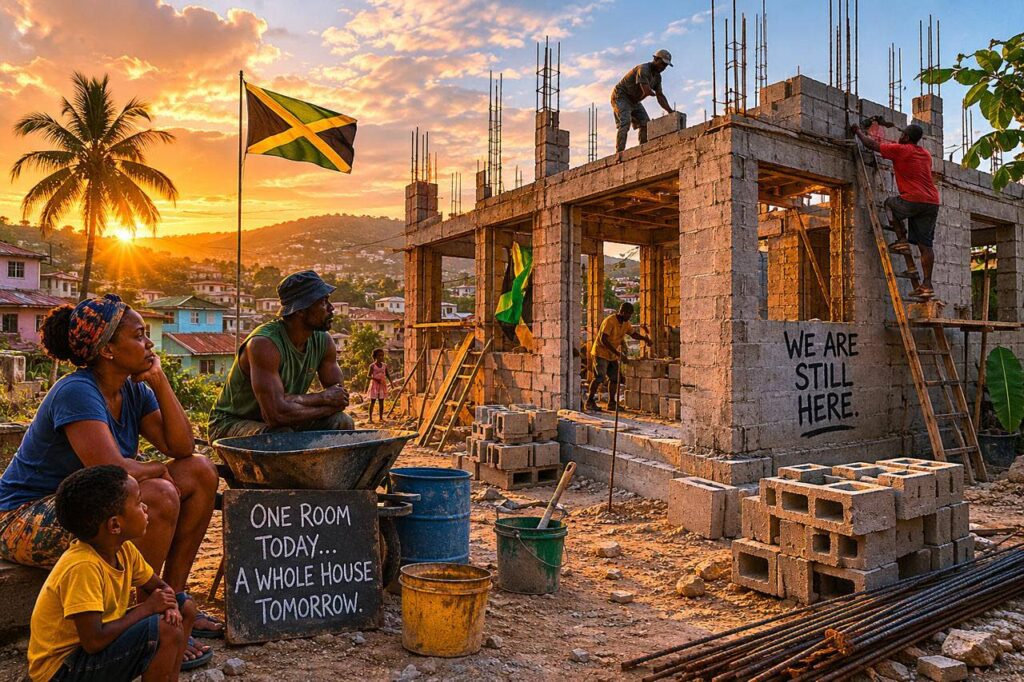
ACROSS Jamaica, a house often does not arrive whole. It rises in stages, slowly, stubbornly, sometimes beautifully. One room first, then another — a roof when money comes. Steel left pointing into the sky, waiting for the next season of work, the next draw from a partner plan, the next barrel, the next child abroad who sends home something towards the dream.
To outsiders, it can look unfinished. To Jamaicans, it often says something else entirely. It says: We are still here.
This is the real story behind Jamaica’s room-by-room building culture. It is not only about poverty, although money is central. It is not only about informality, although informality runs through it. It is not only about land, family, migration, inflation, hurricanes, interest rates, insurance, and planning approval, although every one of those things is part of the wall. It is about how Jamaicans build permanence in a country where permanence has never been cheap.
People call them unfinished houses, but many of them are actually unfinished financial stories. Every column, every block, every half-tiled room may represent a sacrifice, a remittance, a partner draw, a weekend job, or a family member overseas trying to help somebody back home stand up.
Jamaica’s housing system has long operated in two worlds. Official policy recognises a formal and informal housing market existing side by side. The Planning Institute of Jamaica has also pointed to a severe housing shortage, with policy identifying the need for thousands of additional housing units annually. That gap is where the house built room-by-room lives.
The working man, the market woman, the painter, the taxi operator, the nurse, the bank worker, the returning resident, and the small business owner are not all in the same economic position. But many share the same problem: the finished house is often priced beyond the ordinary rhythm of Jamaican life.
So the house becomes a process. A tax refund buys blocks. A Christmas bonus pays for windows. A son in England helps with the roof. A daughter in Florida sends money for tiles. A cousin who knows electrical work helps on weekends. A father who once sold porridge on the roadside eventually casts a veranda. A woman with a market stall puts down the first foundation for something her grandchildren may finish.
This is not romance, it is economics.
Traditional mortgage access has historically been difficult for many lower-income Jamaicans, and even housing reforms over the years have not fully solved affordability. For many families, incremental building became the only realistic path to ownership.
The house before the paper
In Britain, the idea of building a house room by room is usually reserved for people with unusual money, inherited land, and patience for a costly planning system. Mortgage finance, insurance, and compliance dominate the process.
Jamaica evolved differently. Here, a house can be incomplete, uninsured, partly undocumented, extended over decades and still be lived in, inherited, valued, rented, and sold. That is the contradiction at the heart of the market. The property may not meet every formal expectation, but it still carries value because land, location, and usefulness matter.
This is Jamaica’s practical legality. If the title is clear enough, if people live there, if utilities are connected, if the buyer sees potential, the market often adapts. But that adaptation carries risk.
Many incrementally built homes are difficult to properly insure. Insurers want certainty: approved plans, proper roofing, electrical safety, engineering standards, and preferably completed construction. A house built gradually over 20 years using different tradesmen and different stages of work creates uncertainty, and Jamaica is a hurricane-exposed island.
Brick-by-brick building gave many families a way into ownership. But the uncomfortable truth is that it also left many families outside the systems that protect ownership. If the house is not properly documented, properly valued, properly built and properly insured, then the family asset can become a family risk.
This is where sentiment must meet steel.
Exposed reinforcement bars left for years in salt air and rain are not just symbols of ambition. They can become structural vulnerabilities. Informal electrical work can become a fire risk. Poor drainage can become a flood or landslide issue. A house built slowly is not automatically unsafe, but without monitoring and quality control, the risks become harder to ignore.
And yet many Jamaicans continue building because the alternative is often no ownership at all.
The gated dream
At the same time, Jamaica is moving towards another housing identity: gated communities, standardised developments, private security, paved roads, shared amenities, and mortgage-ready units.
For many younger professionals and working-class families moving upward, the gated community has become more than a home. It is an emotional product. It offers order, safety, water storage, predictability, and escape from the rough edges of uncertainty.
That does not mean the room-by-room house is disappearing. It means Jamaica now has two housing cultures running at once. One is formal, financed, planned, and increasingly global. The other is adaptive, family-backed, cash-based, and built through survival.
The danger is that the gap between them widens. If planning, insurance, and compliance become too expensive, informality will not disappear. It will simply go deeper.
The future is not finished
Technology will change this story, but not overnight. Jamaica remains partly paper-based, slow in places, and uneven in digital enforcement. Artificial intelligence (AI) is not yet walking and building sites in St Mary or Clarendon, checking steel spacing and roof straps. But digital change is already creeping in.
A small contractor can watch construction methods on YouTube. A homeowner can compare floor plans online. A young Jamaican can use AI to estimate materials or draft a basic layout before speaking to a professional. Digital banking, online land searches, and cheaper design tools may slowly reshape how people build.
The future may be semi-formal incremental housing: starter homes designed for expansion, serviced lots with approved plans, phased construction with inspections at key stages, and AI-assisted design that lowers professional costs without removing oversight entirely. That may become Jamaica’s middle road because the old model cannot continue untouched forever.
Climate change, hurricanes, rising material costs, and insurance pressures will force tougher conversations about resilience and building quality. But Jamaica cannot simply copy Britain, Canada, or America either. A housing system that ignores partner plans, remittances, family land, and phased building will fail many ordinary Jamaicans.
We should not shame the room-by-room builder. We should understand him. Then we should help him build safer, smarter, and legally stronger. The goal should not be to kill the Jamaican way of building. The goal should be to protect it from becoming a disaster waiting on the next storm. That is the heart of it.
The house with steel in the sky is not just architecture; it is biography. It tells of migration, sacrifice, mistrust of debt, pride, shortage, ambition, and survival. It tells of a country where people often build first and regularise later, because waiting for everything to be perfect would mean never building at all.
Jamaica’s future housing challenge is not whether people will continue building room by room. They will. The question is whether those rooms will be safer, insurable, compliant, and resilient enough to carry the next generation.
Because the island is still building; block by block, room by room, hope by hope. As the saying goes, Jamaica is little, but tallawah. But even tallawah dreams need strong foundations.
Dean Jones is founder of Jamaica-Homes.com and a realtor associate. With master’s degrees in building surveying and communication design, as well as a strong foundation in real estate law and construction, he provides expert guidance on residential, luxury, commercial, and investment properties. He may be contacted at [email protected].
For many Jamaicans, homeownership is not a straight line. It is a long road between aspiration, affordability, and the dream of stability for the next generation. Source: Jamaica-Homes.com
.
Syndicated from Jamaica Observer · originally published .
Legal context · powered by Jurifi
Get the legal angle on this story. Pick a prompt and Jurifi's AI will explain it using Jamaican law.
AI replies are based on Jamaican law via Jurifi. Not legal advice.
Other coverage

Christopher Burgess | Bureaucracy in housing
Jamaica Gleaner
Deported Jamaicans Charged with Murder | St. Mary Arson | Man Drowns in Ocho Rios/JBNN
JBN Network (Video)Watch
Prime Minister Holness’ National Labour Day Message 2026
Office of the Prime Minister
Janiel McEwan | Sending Home [Part I]: The Lifeline
Jamaica Gleaner
Sitting of the House of Representatives || June 2, 2026
PBC Jamaica (Video)Watch