

UTech and KSAMC champion “Bouncing Forward” resilience agenda at Caribbean Urban Forum 2026
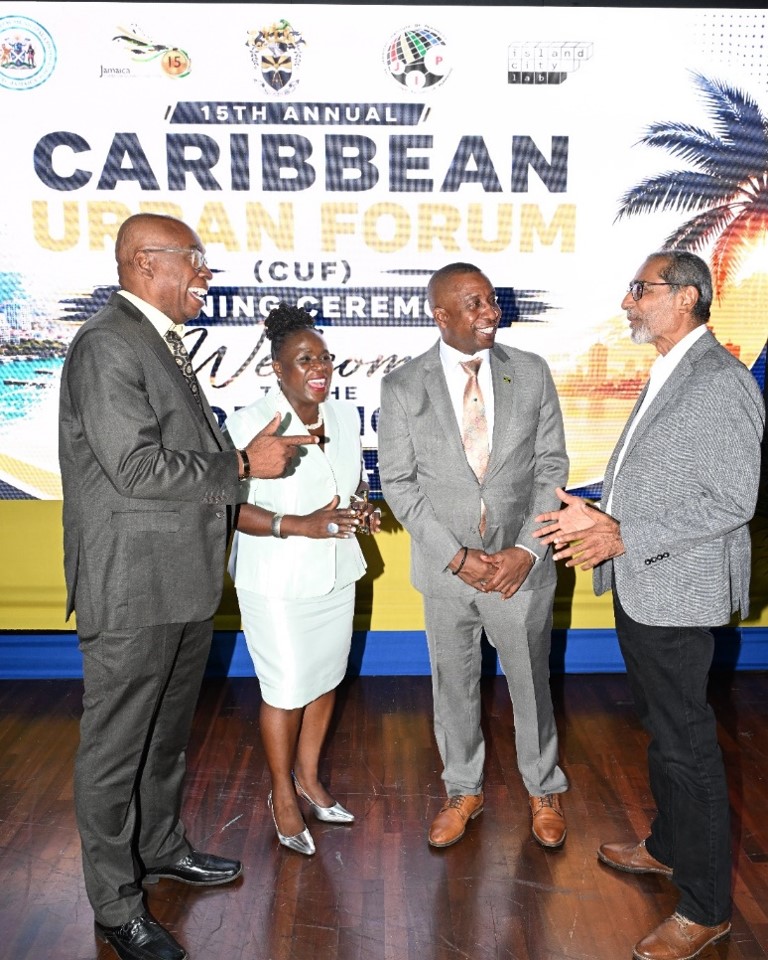
The University of Technology, Jamaica (UTech, Jamaica) and the Kingston and St. Andrew Municipal Corporation (KSAMC), in their joint staging of the 15th Caribbean Urban Forum (CUF2026), reinforced the urgent need for Caribbean countries to move beyond rebuilding “vulnerability” and towards sustainable, climate-responsive transformation. The event was held from June 17-19 in Kingston under the theme, “On the Front Lines: Rethinking Resilience and Recovery in the Caribbean.”
Hosted for the first time in Jamaica, CUF also saw Island City Lab, the Jamaica Institute of Planners and the Caribbean Network for Urban and Land Management collaborating with UTech, Jamaica and the KSAMC for the event. The conference brought together policymakers, academics, global development partners and regional municipal leaders to advance plans for proactive equity-driven approaches to urban development and disaster resilience in the Caribbean. Conference activities spanned the opening ceremony at the Courtleigh Auditorium and technical sessions at The Jamaica Pegasus Hotel.
In her address at the opening ceremony, Dr Anetheo Jackson, Conference Co-Chair and Acting Head, School of Building and Land Management at UTech, Jamaica, noted that in the wake of Hurricane Melissa, CUF2026 has revived questions surrounding reconstruction and resilience. She stressed that the forum, through its multidisciplinary programme of research presentations, technical sessions, workshops, debates and field engagement, plays a leading role in channelling ideas towards building a future-ready Caribbean.
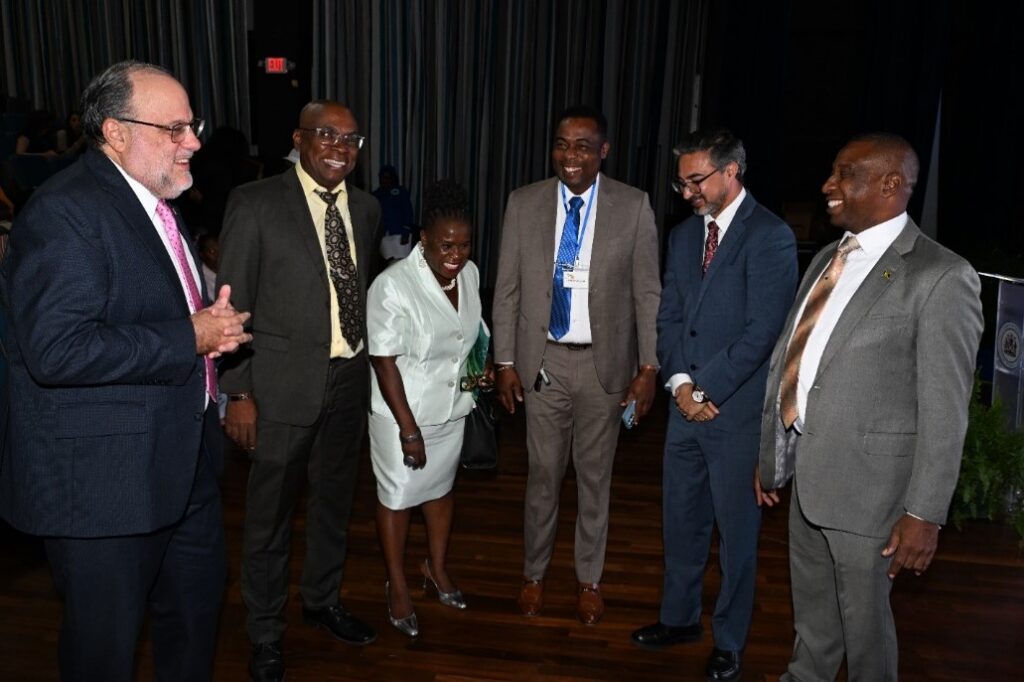
In a stark assessment of the Caribbean’s development trajectory, Dr. Laurence Neufville, Dean, Faculty of the Built Environment at the University of Technology, Jamaica, warned that traditional approaches to post-disaster recovery are no longer sufficient due to escalating climate risks.
“For decades, our region has been caught in an exhausting cycle: We build, a disaster strikes, we recover, and we repeat,” Dr Neufville said. “But as climate change accelerates and urban populations swell, recovering back to the status quo is no longer a viable strategy. It is a vulnerability,” he cautioned.
Dr Neufville further stressed that more frequent and severe climatic events continue to compress recovery windows across the region. As such, he argued that when “we rebuild damaged roads in flood-prone areas without addressing drainage deficiencies, reconstruct homes in high-risk coastal zones without stronger protection, or replace critical infrastructure without incorporating future climate projections, we are effectively recreating yesterday’s risk for tomorrow’s disaster.” He lamented that such practices trap communities in cycles of repeated losses, mounting debt, economic disruptions, and social inequalities.
“Resilience is not about bouncing back. It’s about bouncing forward…true resilience, therefore, requires a shift from rebuilding what was lost to transforming what exists,” Dr Neufville urged. He called on urban planning stakeholders to incorporate “climate-smart infrastructure, risk-informed urban planning, nature-based solutions, and governance systems that anticipate future threats rather than react to past ones.”
He concluded by underscoring the role of education in shaping future resilience capacity, noting that the Faculty of The Built Environment at UTech, Jamaica, serves to bridge the gap between cutting-edge research and grassroots reality through its architecture, land management and various postgraduate research programmes.
Professor Garfield Young, Vice President and Chief Operations and Projects Officer at UTech, Jamaica and Architect Andre Baugh, Acting Head of School at the institution’s Caribbean School of Architecture, shared details of the university’s campus master plan with attendees. Their presentation, themed “Reimagining the University of Technology, Jamaica’s Masterplan for Technology-Focused, Sustainable Physical Development,” outlines the University’s vision for transforming its facilities to support the institution’s long-term academic and strategic goals.
“The current refresh is centred on four key principles: STEM-focused, student-centric, multi-campus, and accessibility” Professor Young explained. He noted that the masterplan is being implemented through an agile approach, with several projects already underway while the plan continues to be refined. These include a Water Efficiency Project, Solar Energy Project, and Student and Staff Housing Project.
Architect Baugh noted that the key features of the design include a strong campus edge, a main one-way traffic circuit, extensive landscaping and greening, pedestrian-friendly spaces with reduced interaction between people and vehicles and four green parking structures. He also stated that all developments will meet international standards for structural integrity, durability, and sustainability.
His Worship Councillor Andrew Swaby, Mayor of Kingston and St. Andrew, highlighted key initiatives of the Kingston and St. Andrew Municipal Corporation (KSAMC) aimed at creating cooler, healthier and more resilient communities.
“Guided by the Diaspora Risk Management 2015, we are ensuring that disaster risk reduction remains integral to local governance and urban planning,” he noted. He added that the KSAMC is pursuing initiatives aimed at “improving environmental stewardship, promoting green infrastructure, enhancing watershed management, and increasing urban green cover.”
The Mayor explained that these efforts are necessary as intense rainfall continues to place pressure on drainage systems and waterways within the municipality. He added that rising temperatures have also reinforced the urgency for climate adaptation in the Caribbean.
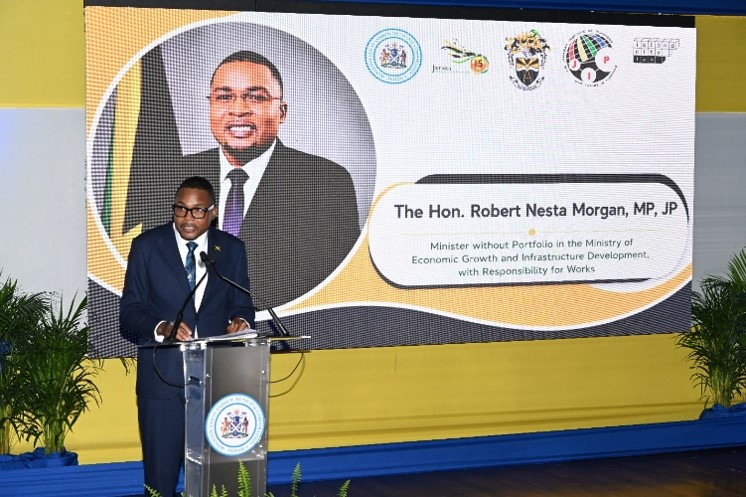
Delivering the keynote address on behalf of The Most Honourable Dr. Andrew Holness, Prime Minister of Jamaica, the Honourable Robert Morgan, Minister without Portfolio in the Ministry of Economic Growth and Infrastructure Development, stated that Caribbean cities are “centres of opportunity” and “centres of risk”, where growth and vulnerability coexist. Against this backdrop, Minister Morgan argued that resilience must be embedded in everyday systems instead of being treated as an emergency response.
“The resilient city is not only the city that recovers after the disaster. It is the city whose systems functioned before the disaster,” Morgan stated. He shared that while disasters do not create all the existing vulnerabilities within the region, they often reveal flaws related to weak planning, fragmented development and inadequate infrastructure.
Minister Morgan also stressed that issues of urban inequality must be addressed as the Caribbean seeks to build more resilient cities. He attributed the rise of informal settlements in environmentally hazardous areas to historical planning gaps and exclusion. “If we are serious about resilient cities, this must change,” he said, stressing that infrastructure must serve as a mechanism for social inclusion.
Mr Elkin Velasquez Monsalve, UN-Habitat Regional Director for Latin America and the Caribbean, stated that the 2026 staging of the Caribbean Urban Forum demonstrated “multi-level governance” in action as he lauded Jamaica’s approach to hosting the strategic event. He noted that collaboration among government, opposition, municipalities, academia and development partners is essential to advancing the goals of the forum. He urged the participants to preserve the “regional public good” of the initiative and to work collectively to expand it in ways that help shape global urban and climate agendas.
Reiterating Mr. Velasquez’s sentiments, Dr Carla Barnett, Secretary-General of CARICOM, called for deeper coordination among built environment professionals, including planners, engineers, architects and surveyors, to translate policy into practical resilience outcomes.
CUF2026 culminated with attendees embarking on a field trip to Bluefields in Westmoreland on Saturday, June 20 to view the impacts of Hurricane Melissa on the parish. Before that site visit, participants also took part in a heritage tour of Port Royal, a visit to the Abilities Foundation “Living Lab”, and Kingston’s Art Walk.
Syndicated from Our Today · originally published .
Legal context · powered by Jurifi
Get the legal angle on this story. Pick a prompt and Jurifi's AI will explain it using Jamaican law.
AI replies are based on Jamaican law via Jurifi. Not legal advice.
Other coverage

Minister Montague Urges Development Stakeholders to Prioritise Resilience
Jamaica Information Service
UTech, Jamaica Pays Tribute to Professor the Honourable Oswald Harding, KC, OJ
University of Technology, Jamaica
Jamaica Empowers Youth Voices to Shape Sustainable Development Agenda at the United Nations
Planning Institute of JamaicaUTech, Jamaica and Miya Water Jamaica Limited Partner to Establish Campus Water Efficiency Project
University of Technology, Jamaica
UTech, Jamaica in partnership with MIIC & Barita Foundation host “Know Your Numbers” Pitch to strengthen financial literacy among MSMES
University of Technology, Jamaica