

Initiative to Advance New Research Into Transatlantic Slavery Launched
Jamaican institutions and scholars will receive a significant share of £450,000 (approximately J$91 million) in programme funding, under the PASSAGE (Partnership for Atlantic Slavery Scholarship, Archiving and Global Exchange) initiative.
The scholarship falls under the PASSAGE International Research Mobility Programme, which was launched on Wednesday (May 27), at the British High Commission in Kingston.
It is supported by a £1-million grant from UK-based Lloyd’s Register Foundation to advance research into the history of transatlantic slavery.
The programme supports greater access to records documenting enslavement, strengthens archival partnerships, and promotes local interpretation of histories that continue to shape the Caribbean and wider world.
Speaking at the launch, British High Commissioner to Jamaica, Her Excellency Alicia Herbert, said approximately £450,000 of the funding will be allocated to projects in the Caribbean and West Africa.
“The programme supports new research into the history of transatlantic slavery through UK-based archival work and an international research mobility scheme for scholars and archivists in West Africa and the Caribbean,” she said.
“It places a strong emphasis on partnership and knowledge exchange, ensuring that researchers in regions most impacted by the legacies of slavery play a leading role in interpreting and sharing those histories,” the High Commissioner continued.
She noted that Jamaica’s involvement in the initiative reflects the country’s long-standing contribution to archival research and scholarship across the Caribbean.
“I’m especially pleased that Jamaica will play such a central role in this programme, including support for Jamaican researchers and institutions. That reflects both the strength of expertise here and Jamaica’s important contribution to scholarship across the Caribbean and beyond,” the High Commissioner said.
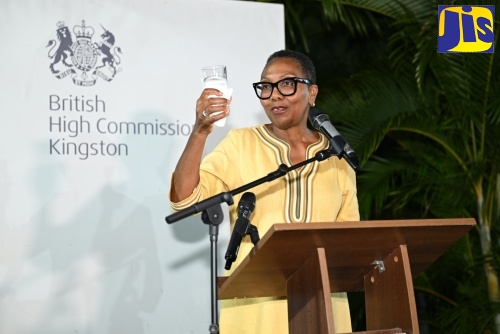
She also underscored the importance of archives in preserving and interpreting history.
“Archives are not simply about preserving old documents as people tend to think. They are about memory, about identity, about accountability and understanding,” she said.
Project Lead for PASSAGE at The National Archives (UK), Philippa Hellawell, said the initiative seeks “to increase, support and promote research into transatlantic slavery through academic research, archival access and international collaboration”.
She explained that the programme advances research through “cataloguing key records of enslavement at the National Archives, researching the maritime history of the trafficking of enslaved Africans and through the International Research Mobility Programme, which seeks to centre and support the work of archivists and researchers in West Africa and the Caribbean”.
Ms. Hellawell said the programme will fund 15 projects across Ghana, Cameroon, Jamaica, Barbados, and Trinidad and Tobago.
“In Jamaica, the programme supports national institutions, including the National Library of Jamaica and the Jamaica Archives and Records Department, who will both be undertaking large-scale digitisation of historical records related to transatlantic slavery,” she informed.
She added that the programme will also support students and faculty at the University of the West Indies, Mona, “through fellowships, scholarships, and bursaries.”
Meanwhile, Head of Research, Interpretation, and Engagement at Lloyd’s Register Foundation, Louise Sanger, said the organisation commissioned independent academic research in 2022 to better understand its historical links to transatlantic slavery.
“Our purpose wasn’t to retell the story of transatlantic slavery but to better understand our role in it,” she said.
She added that the Foundation’s support for PASSAGE forms part of a wider commitment to transparency, research, and access to historical records.
“The initiatives that we’ve undertaken… they’re not intended as reputational or repair exercises, and they’re not attempts to settle history. They’re a commitment to transparency, to making difficult histories visible,” Ms. Sanger said.
Also addressing the launch was Senior Archivist, Jamaica Archives and Records Department and PASSAGE International Research Mobility Programme award holder, Racquel Stratchan-Innerarity, who outlined a digitisation and cataloguing project involving historical Vice Admiralty records held by the Department.

She said the collections include records relating to maritime legal proceedings in Jamaica during the 18th and 19th centuries and contain significant information on slave ships, maritime insurance, trade and colonial governance.
“As such, these records hold exceptional value for scholarship on Atlantic slavery, colonial governance, maritime history and Caribbean legal traditions,” Ms. Stratchan-Innerarity said.
She noted that approximately 320 archival boxes and 145 bound and unbound items currently remain inaccessible to researchers because of limited cataloguing and the absence of digital copies.
“This project seeks to change that… . The result will be enhanced discoverability, stronger preservation, reduced handling of fragile originals, and significantly improved access for researchers both locally and internationally,” Ms. Stratchan-Innerarity added.
Syndicated from Jamaica Information Service · originally published .
Other coverage
JIS News-02.06.2026
Jamaica Information Service (Video)Watch
UTech, Jamaica hosts Research, Technology and Innovation Day… highlighting impactful STEM research by Faculty and Students
University of Technology, Jamaica
NIRA learning centre open for training, says Marks
Jamaica Observer
Fresh EU funds aim to speed digital reforms
Jamaica Gleaner
Jamaica Targets Growing US$124B Destination Wedding Market | Business Day
Television Jamaica (Video)Watch